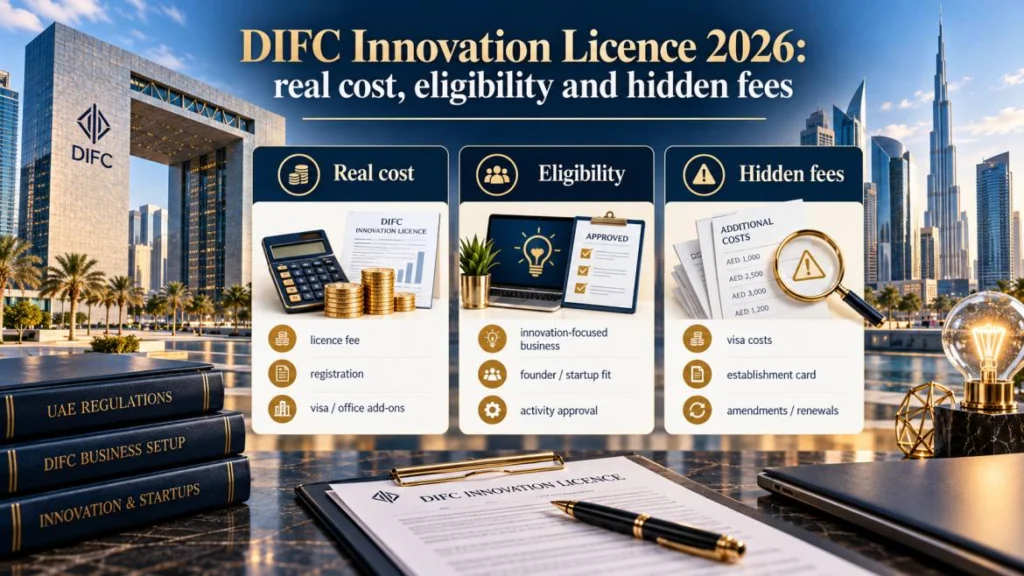
The USD 1,500 headline on the DIFC Innovation Licence is real. It is also the smallest line in your first-year budget, and the part that changes in year three is the part almost nobody publishes.
Quick Answer
- Licence fee: the DIFC Innovation Licence is listed at USD 1,500 a year, subsidised. That covers the licence only, not the desk, visas, registration or data protection.
- Realistic year one: for one founder with one visa, the published figures add up to roughly USD 6,100 to USD 9,400 (about AED 22,400 to AED 34,400), before VAT, medicals, banking and adviser fees.
- Subsidy length is disputed: DIFC says two to five years, its own offer page says two, and advisers publish four. Get your period in writing before you pay.
- Eligibility: technology and innovation firms only. Financial services, crypto exchanges and trading physical goods are excluded, and a desk in DIFC is mandatory.
- Tax: a DIFC licence is not a tax exemption. Software and IT services are not on the list of qualifying free zone activities, so check your rate before you assume 0%.
Table of Contents
What the DIFC Innovation Licence Is, and What It Is Not
The DIFC Innovation Licence is a subsidised commercial licence issued by the Dubai International Financial Centre for technology and innovation companies. It gives you a company in an English common law jurisdiction, 100% foreign ownership, access to the DIFC Innovation Hub and discounted visas. DIFC lists it at USD 1,500 per annum.
Three things it is not, because founders mix them up constantly:
- It is not a financial services licence. It does not authorise regulated activity. Anything that needs the Dubai Financial Services Authority goes through a separate application, which I covered for founders in how to start a fintech business in the UAE.
- It is not a virtual office licence. You must lease at least a flexi desk in DIFC, so there is a recurring cost on top of the licence.
- It is not a tax exemption. DIFC is a free zone, and your corporate tax rate depends on the type of income you earn. I cover that in its own section below.
If you are still weighing DIFC against other structures, start with the mainland vs free zone vs offshore comparison. For why institutions are choosing the centre at all, see what Blackstone’s move tells us about the DIFC.
DIFC Innovation Licence Cost: What Year One Actually Adds Up To
Most pages quote the licence fee and stop. The table below adds the other items that DIFC and the advisers who publish fee schedules list for a first year. I have used one founder and one visa as the example, and I show a low and a high figure because the sources disagree on three lines.
| Item | Low (USD) | High (USD) | What it covers and where the figure comes from |
|---|---|---|---|
| Innovation Licence fee | 1,500 | 1,500 | Annual licence only. DIFC lists it as subsidised. |
| Registration fee | 100 | 100 | One time. Shown on DIFC’s offer page and by advisers. |
| Data protection fee | 0 | 250 | DIFC’s offer page shows no charge; two adviser schedules show 250 in year one, then 200 a year. |
| Flexi desk in the Innovation Hub | 3,000 | 6,000 | DIFC’s offer page shows 250 a month billed annually; law firm and adviser sources show 500 a month, plus VAT. |
| Establishment card | 517 | 517 | AED 1,900, needed before any visa application. Two adviser schedules agree. |
| One employment visa (two years) | 716 | 716 | From AED 2,630 per an adviser schedule. DIFC offers up to 50% off visa fees. |
| Personnel sponsorship deposit | 275 | 275 | Per visa, per an adviser schedule. Confirm if it is refundable. |
| Year-one total | about 6,100 | about 9,400 | About AED 22,400 to AED 34,400 at 3.6725 |
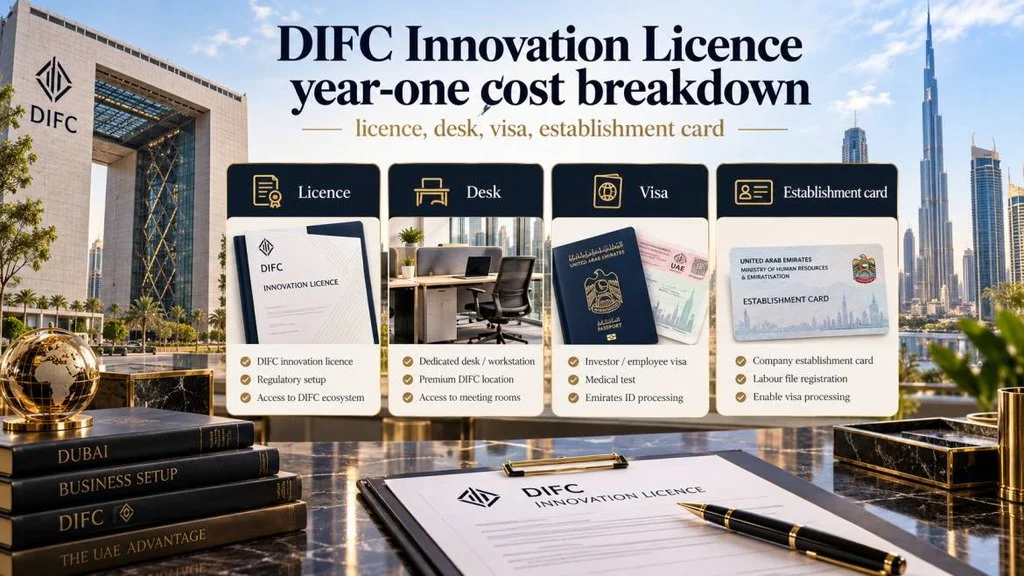
This is my own arithmetic from published figures, not a quote. It leaves out VAT on the desk, medicals and Emirates ID, a corporate bank account, accounting, and any adviser fee. A cost that looks like USD 1,500 on the website is closer to USD 6,000 to USD 9,500 in practice, and that is the number to compare against other free zones. For the same exercise in another zone, see SPARK free zone cost 2026 and the real price of the cheapest free zones.
The Subsidy Question: Two Years, Four Years or Five?
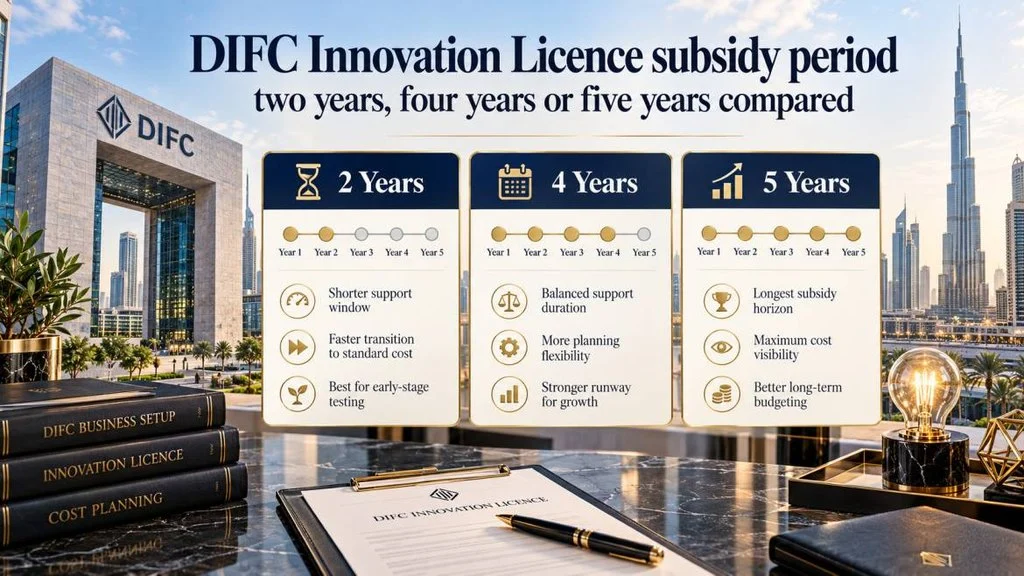
This is the part of the DIFC Innovation Licence that decides your three-year cost, and the published sources do not agree.
| Source | How long is the USD 1,500 rate? |
|---|---|
| DIFC Innovation Licence page | Two to five years, with a footnote the page does not display |
| DIFC offer page | Two years |
| Al Tamimi (November 2025) | First two years |
| A 2020 law firm note and one adviser | First four years |
| One adviser schedule | Years one to five at USD 1,500, then USD 4,000 in year six and USD 8,000 in year seven |
Some of these are older policy, some are adviser interpretations, and I cannot tell you which one applies to your application date. What I can tell you is what comes after. DIFC’s offer page says that from year three the fee depends on headcount, and a company with more than 10 full-time employees pays USD 12,000 a year. None of the pages I checked state the fee for a company with 10 or fewer employees after the subsidy ends.
So ask three questions in writing before you pay: how many years is my subsidy, what is the fee in the first unsubsidised year at my expected headcount, and does the subsidy survive a change of desk or shareholder. If an adviser will not put the answers in an email, treat the USD 1,500 as a two-year price.
Hidden Fees and Recurring Costs Most Guides Leave Out
Nothing here is hidden by DIFC. These are simply the costs that sit outside the headline figure, so they surprise people who only read the licence page.
- The desk is the biggest recurring cost. It costs more than the licence itself in most cases, and it is mandatory because the licence is not issued without a DIFC lease.
- VAT on the desk. The law firm schedule quotes the desk plus VAT, so the real figure is higher than the table above.
- Data protection, every year. Advisers list a filing in year one and a reduced annual fee after, plus an annual confirmation statement from year two (one schedule shows about USD 300).
- Visa renewals. A visa runs for two years, so the establishment card and visa costs recur, and the deposit applies for each visa.
- The year-three step. Past the subsidy, the fee can rise sharply if you grow past 10 full-time employees. A good year for hiring can be an expensive year for licensing.
- Accounting and tax. A DIFC company still registers for corporate tax, keeps records and files returns. See UAE audit requirements for when an audit applies.
- Company secretarial work. A private DIFC company does not need a secretary, but registers and filings still exist. I explain the rules in company secretary UAE: mainland, DIFC, ADGM and free zones.
This is the same pattern I warn about in why the cheapest UAE licence may not be the right setup. A low licence fee is a fact. A low total cost has to be shown.
Eligibility: Who Qualifies for the DIFC Innovation Licence
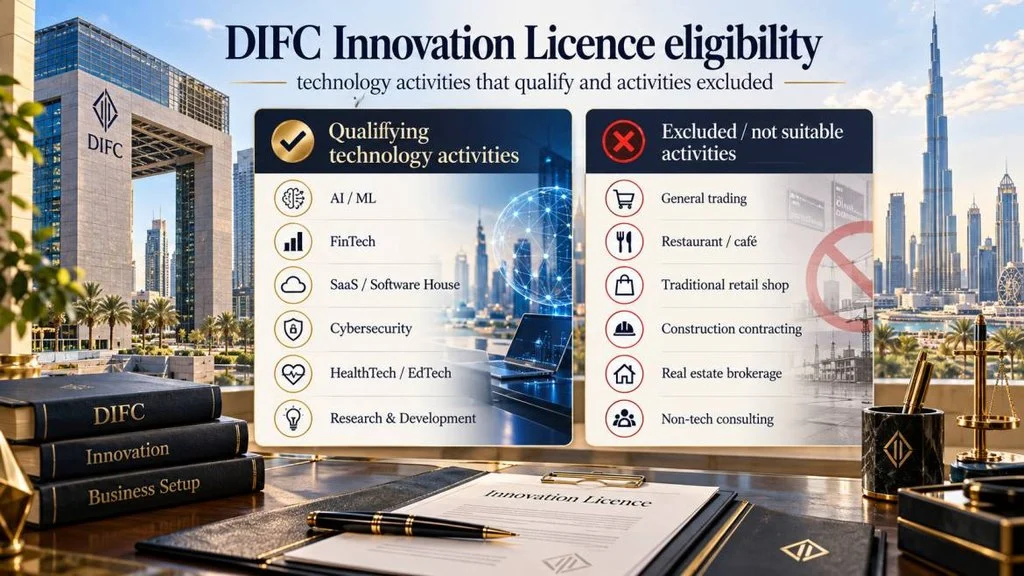
DIFC says the licence is open to technology and innovation firms at any stage. The sectors it names include AI and machine learning, AR and VR, gaming, fintech, insurtech, proptech, regtech, healthtech, edtech, greentech, climate tech, martech and e-commerce technology. The offer page also states that it is for new registrants, so an existing DIFC company cannot simply switch.
| Qualifies | Does not qualify |
|---|---|
| Software houses and SaaS products | Financial advisory, payment services and brokerage |
| Technology research and development | Crypto or NFT exchanges (creating an NFT is allowed, selling it is not, per one adviser) |
| IT infrastructure, IT consultancy, cybersecurity | Trading or selling physical products |
| Web design, portals, internet content | Any activity that needs DFSA authorisation |
| AI and data analytics companies | Companies that will not take a physical desk in DIFC |
Two conditions catch people. First, the business must be technology-led, so a trading or consulting company with a website does not qualify. Second, regulated technology such as money services or crowdfunding is routed to the DFSA’s separate Innovation Testing Licence, not this one. Crypto founders should read my guide for forex and crypto traders choosing a structure before applying, because the exclusion is firm.
How to Apply: Documents, Steps and Realistic Timing
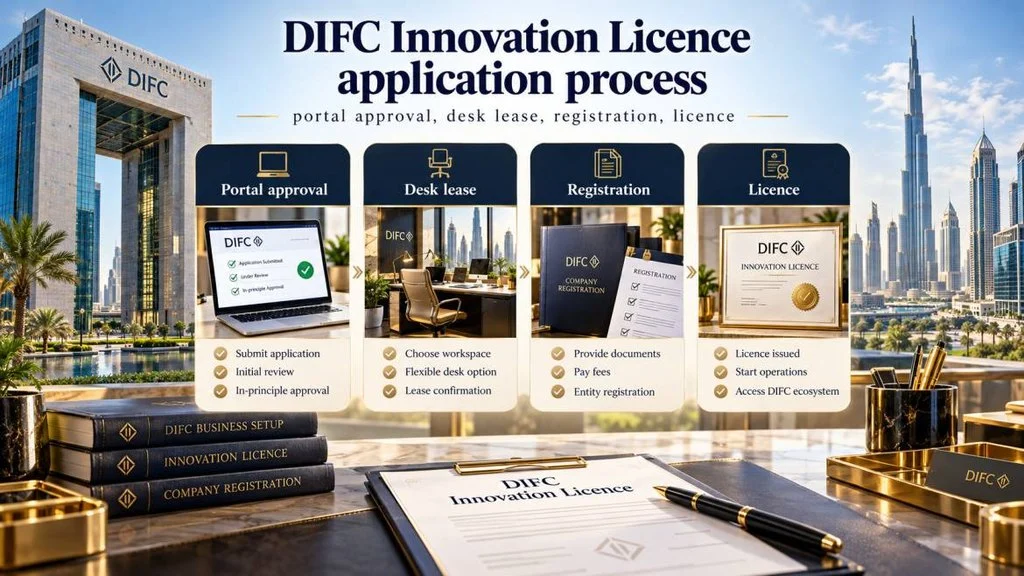
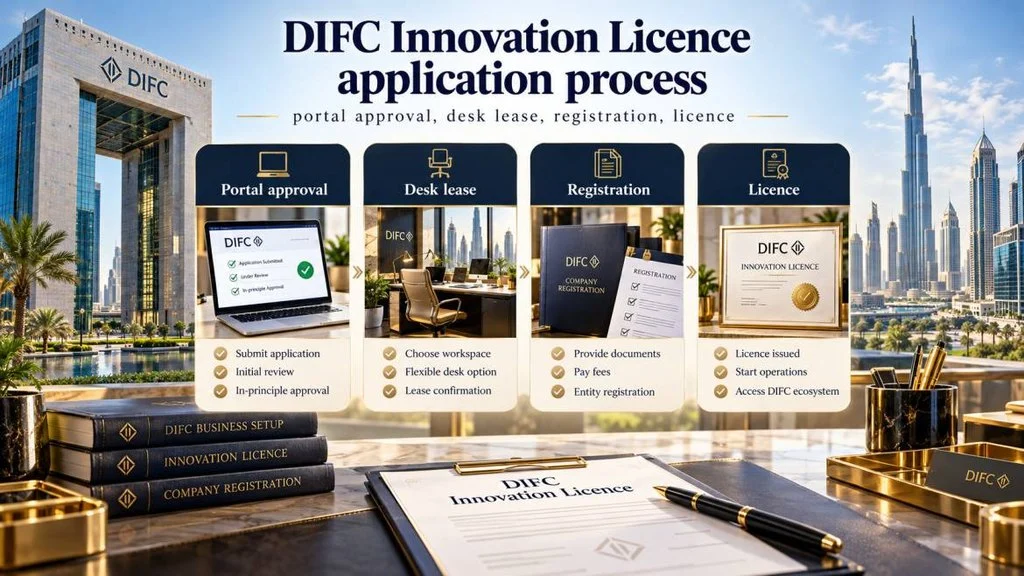
DIFC describes a three-step process: discuss the proposed company with the DIFC team, apply through the DIFC portal for in-principle approval, then register the entity, which includes taking space in DIFC. Onboarding is digital, so you can start from abroad.
- Business plan and KYC: ownership, activities, target market and source of funds.
- Passport copies for shareholders, directors and ultimate beneficial owners.
- Funding evidence: bank statements for an individual funder, or audited financials and a certificate of incorporation for a corporate parent (per an adviser schedule).
- A short description of the technology, such as a deck or workflow chart.
Timing is where sources split. DIFC’s offer page puts in-principle approval at around five to seven working days. After that, advisers report anything from about two weeks to eight weeks for the licence, and the lease is usually the slow step, so the desk should be agreed before approval arrives. I would plan for a month, not a week.
Corporate Tax: Why the DIFC Innovation Licence Is Not a 0% Licence
A company in DIFC is a free zone company, so the Qualifying Free Zone Person rules decide its rate. Under Federal Decree-Law No. 47 of 2022 and Cabinet Decision No. 100 of 2023, a qualifying company pays 0% on qualifying income and 9% on other taxable income above AED 375,000.
The catch for this licence is the list of qualifying activities in Ministerial Decision No. 265 of 2023. It covers manufacturing, trading in listed commodities, holding shares, fund and wealth management, headquarter and treasury services, logistics, and a few others. Software development and IT services are not on it. Income from services to mainland customers is generally non-qualifying, and non-qualifying revenue must stay within the lower of 5% of revenue or AED 5 million. Exceed it and the company loses qualifying status for that year and the next four, with the 9% rate applying to all taxable income.
This does not make DIFC a bad choice for a software company. It means the 0% assumption is wrong, and the decision should rest on the court system, investor access and credibility, not a tax rate. Check your own position with the Federal Tax Authority guidance and a tax adviser. If your revenue is small, UAE small business relief may be relevant. My tax registration and filing service covers the registration step.
DIFC Innovation Licence vs Dubai AI Licence vs Other DIFC Licences
| Licence | Annual fee | Best for | Main limit |
|---|---|---|---|
| Innovation Licence | USD 1,500, subsidised | Technology and innovation startups | No financial services or physical trading; desk required |
| Dubai AI Licence | USD 1,500, subsidised | AI developers who want Dubai AI Campus membership | Same non-regulated scope; DLT limited to database management |
| Standard non-retail commercial licence | USD 12,000 | Non-tech services and holding structures | Highest cost of the non-regulated options |
| DFSA authorised firm | Varies by category | Regulated financial services | Base capital from USD 50,000 for categories 1 to 4 |
| DFSA Innovation Testing Licence | Set by the DFSA | Regulated fintech testing in a sandbox | For regulated technology, with its own conditions |
The DIFC AI Licence is the same subsidised structure with membership of the Dubai AI Campus, a free Ignyte subscription, and two added activities: AI research and consultancy, and distributed ledger technology services. If you are building an AI product, read the best free zones in the UAE for AI and technology companies and how to start an AI agent business in Dubai before choosing between the two. Holding structures sit in a different part of the centre, which I compare in DIFC, ADGM and RAK holding companies and foundations.
Who Should Choose the DIFC Innovation Licence, and Who Should Not
It fits you if
- You are building a software, AI or data product and expect to raise venture funding. Investors know DIFC’s legal framework, which I discuss in the best Dubai free zones for tech startups chasing VC funding.
- You will stay at or under 10 full-time employees for the first few years.
- You want a DIFC address and common law structure and will take a desk there.
- Your revenue comes mostly from outside the UAE or from product income you have already tested against the tax rules.
Look elsewhere if
- You sell physical goods, trade commodities or run a pure consultancy. The licence excludes trading, and a consultancy is not a technology business.
- You need a regulated financial licence. Start with the DFSA, not the Innovation Licence.
- You are cost-led. Compare the all-in year-one figure, not the licence line. Sharjah’s SPARK free zone, run by the Sharjah Research, Technology and Innovation Park, is the route I compare most often for technology founders, and who should not choose SPARK is the honest counterpart to this section.
- You plan to hire past 10 people early. The year-three fee changes the maths.
For software and IT founders weighing Sharjah, start with SPARK for digital and IT companies and the SPARK free zone business activities guide. The route in is covered in the setup process and the visa guide, and the accelerator side in the SRTIP SPARK accelerator, the SAIA accelerator and SoiLAB. Sector fits are in healthcare and insurtech, mobility and logistics, sustainability, research and innovation, advanced manufacturing, consultancy and e-commerce technology. To see where SPARK sits among its neighbours, read the five Sharjah free zones compared and my SPARK free zone guide.
Five Mistakes I See With the DIFC Innovation Licence
- Budgeting the licence fee as the total. The desk alone can cost twice as much.
- Assuming the subsidy lasts five years. DIFC says two to five, and its own offer page says two.
- Choosing it for the tax rate. Software and IT services are not qualifying activities, so 0% is not the default.
- Applying with a trading or fintech plan. Both are excluded, and a rejected application costs weeks.
- Forgetting the bank account. Account opening takes its own time and has its own tests, which I explain in opening a UAE business bank account in 2026.
Most of these are visible before you pay anything. They are far cheaper to catch in a first conversation than in the second year, and I list more in 12 mistakes a good business setup advisor should help you avoid.
My Approach: Test the Total Cost Before You Choose the Licence
Most business setup consultants help you register a company. I help you make informed business decisions before you invest.
For the DIFC Innovation Licence, that means I do not start with the USD 1,500. I start with your product, your customers, how many people you will hire and where your revenue will come from. Then I price year one, year three and the first unsubsidised year, test your income against the qualifying activities list, and tell you plainly if SPARK or another zone costs less for the same result.
My advisory process focuses on helping you reduce uncertainty and make confident decisions, not just complete documentation.
What you can expect when you work with me:
- Business idea validation before you commit to a jurisdiction
- Market research on your customers and where they are based
- Competitor analysis to see which zones similar companies use
- A written year-one and year-three cost comparison across DIFC and other zones
- A check that your activity fits the licence scope and exclusions
- Corporate tax planning, including qualifying income and the 5% test
- Business plan and KYC document preparation for the DIFC portal
- Financial feasibility and startup cost estimation
- Business bank account strategy and readiness
- Investor and employment visa planning for you and your team
- Risk assessment on growth, headcount and the subsidy end date
- Expansion planning if you outgrow the first structure
The objective is simple: help you start your business with clarity, confidence and a long-term strategy. If your plan involves a technology company, see startup and pre-launch consulting and free zone company formation, or book a free consultation and send me your activity and headcount plan.
Frequently Asked Questions
How much does the DIFC Innovation Licence cost?
DIFC lists the licence at USD 1,500 a year, subsidised. That covers the licence only. For one founder with one visa, published fees for the desk, registration, data protection, establishment card and visa bring year one to roughly USD 6,100 to USD 9,400, before VAT, banking and adviser fees.
How long does the USD 1,500 subsidy last?
DIFC’s licence page says two to five years, its offer page says two years, and some advisers publish four. Ask for your period in writing. From year three, a company with more than 10 full-time employees pays USD 12,000 a year, per DIFC’s offer page.
Who is eligible for the DIFC Innovation Licence?
Technology and innovation firms at any stage that are new DIFC registrants, including AI, software, edtech, healthtech, greentech and e-commerce technology companies. Financial services, crypto exchanges and trading physical goods are excluded.
Do I need a physical office for a DIFC Innovation Licence?
Yes. You must lease at least a flexi desk in DIFC, and the licence is not issued until the lease is in place. A virtual office does not meet the requirement.
How many visas does the DIFC Innovation Licence include?
DIFC’s offer page states up to four visas on the first desk, with up to 50% off visa fees. You still pay for the establishment card, the visa itself and the sponsorship deposit, and the number can depend on the space you lease.
Can I offer financial services with a DIFC Innovation Licence?
No. Financial advisory, payment services and crypto or NFT exchanges are excluded. Regulated activity needs DFSA authorisation, and regulated technology can be tested under the DFSA’s Innovation Testing Licence.
Does the DIFC Innovation Licence mean 0% corporate tax?
No. A DIFC company pays 0% only on qualifying income as a Qualifying Free Zone Person, and software and IT services are not on the qualifying activities list. Non-qualifying revenue above the lower of 5% of revenue or AED 5 million can cost you qualifying status for five years.
How long does it take to get a DIFC Innovation Licence?
DIFC’s offer page puts in-principle approval at around five to seven working days. Advisers report roughly two to eight weeks for the licence itself, and the desk lease is usually the slowest step. Plan for about a month.
Sources and How This Was Checked
I checked these pages and adviser publications on 12 October 2026. Where DIFC’s pages and advisers disagree, I say so rather than pick one. Fees change, so confirm them with DIFC before you pay.
- DIFC – Innovation Licence
- DIFC – AI Licence
- DIFC – Innovation Licence offer page
- DIFC – Innovation Hub
- Al Tamimi & Company – DIFC Innovation and AI Licence
- BSA – DIFC AI and Innovation Licences: what founders need to know
- 10 Leaves – DIFC Innovation Licence fee schedule (adviser figures)
- Arnifi – DIFC Innovation Licence cost table (adviser figures)
- UAE Federal Tax Authority
Related Reading
- What Blackstone’s Return Tells Us About the DIFC
- Best Dubai Free Zones for Tech Startups Chasing VC Funding
- Best Free Zones in UAE for AI and Technology Companies
- SPARK Free Zone Cost 2026
- SPARK Free Zone Business Activities 2026
- SRTIP SPARK Accelerator: What It Offers Founders
- Company Secretary UAE: Mainland vs DIFC vs ADGM vs Free Zones
- Mainland vs Free Zone vs Offshore in 2026