Quick Answer: SPARK for software and IT companies covers one shared category. SPARK, the Sharjah free zone formerly known as SRTIP, licenses software development, SaaS, AI, ERP/CRM implementation, cloud services, IT support and automation businesses under a shared digital and IT category. But “IT company” is not one licensing decision. A software developer billing per project, a SaaS founder building recurring revenue, and an AI implementation consultancy selling services each need a different activity structure, and the SaaS founder specifically needs to understand how UAE Corporate Tax treats owned software differently from billed services. Choose the licence to match how the business actually earns, not what the technology is called.
In this guide
SPARK for Software and IT Companies: What Actually Fits
A software developer, an AI implementation consultancy, a SaaS startup and an ERP implementation company can all describe themselves as “technology businesses.” They do not need the same UAE company structure.
SPARK, the Sharjah Research, Technology and Innovation Park’s current brand, was built around research, innovation and commercialization, and its published activity guidance covers software development, website and application design, UI/UX, IT support, cloud services, ERP/CRM implementation, artificial intelligence, data analytics and business-process automation. Officially, this sits alongside SPARK’s other five research sectors. In practice, digitalization already accounts for roughly half of everything registered inside the zone, which I cover in full, with the current sector numbers and 2026 pricing, in what actually changed at SPARK in 2026.
That is the short version of SPARK for software and IT companies. It establishes eligibility. It does not answer the harder question: does SPARK match how your specific technology business actually makes money, serves customers and grows? That is where activity selection, not licence eligibility, becomes the real decision.
| Business model | Typical activity |
|---|---|
| Software company | Web, mobile or custom software development |
| SaaS startup | Development and commercialization of a software platform |
| Web agency | Website development and digital solutions |
| UI/UX studio | Interface and product design |
| Managed IT company | IT support, systems administration, technical services |
| Cloud consultancy | Cloud migration, architecture, implementation |
| ERP or CRM consultancy | Implementation, customization, system integration |
| AI consultancy | AI implementation and business-use-case development |
| Automation agency | Workflow automation, integrations, AI agents |
| Data analytics company | BI dashboards, analytics, decision-support tools |
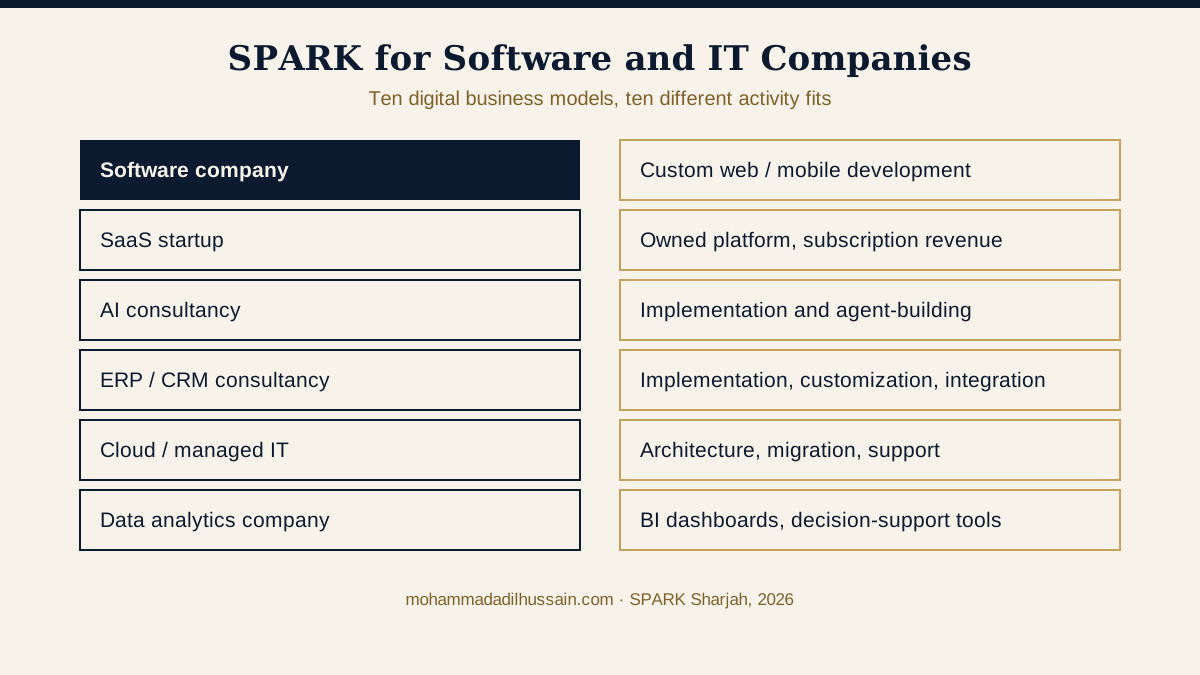
A business often starts in one row and moves into another. A software developer adds AI implementation. An ERP consultancy builds its own SaaS product. SPARK’s Growth-tier package currently allows up to five activities under one licence, which matters more for a technology company than for most other business types, because technology business models tend to shift faster than the activity list a founder chose on day one.
Software Development: The Straightforward Case, With One Catch
A conventional software-development company is the easiest of these models to understand. You build websites, applications or custom systems and invoice for the work. SPARK’s activity guidance specifically includes web and mobile software development.
This is the first place SPARK for software and IT companies gets more complicated than it looks. The catch shows up at the revenue-model level, not the licensing level. Compare two companies. Company A builds custom applications for UAE clients and bills AED 50,000 to 200,000 per project. Company B owns a platform and charges 1,000 customers a monthly subscription. Both call themselves software companies. For corporate tax purposes, they are not the same business, and that distinction is worth resolving before incorporation, not after the first tax filing.
SaaS Companies: The Question That Actually Decides Your Tax Position
This is the single most consequential decision inside SPARK for software and IT companies, if your business is SaaS. The real strategic question is whether you are building a service business with software attached, or a software product generating recurring licence or subscription income. That distinction affects valuation and scaling, and it affects UAE Corporate Tax treatment specifically.
The UAE free zone tax regime is not a blanket 0% system. Ministerial Decision No. 229 of 2025 sets out the current Qualifying Activities framework, and ordinary software-development or IT-consultancy services are not among the activities it lists. Copyrighted software, however, can fall within the UAE’s definition of Qualifying Intellectual Property under Cabinet Decision No. 100 of 2023, with qualifying income determined against the applicable nexus and other requirements.
That means a SaaS founder should not structure around the assumption “I am in a free zone, so my company pays 0% corporate tax.” The real question is what generates the company’s income, and whether that specific income satisfies the applicable free zone rules. I go through the full Qualifying Free Zone Person mechanics, and how SPARK specifically applies it, in what changed at SPARK in 2026, and the registration side is covered in UAE Corporate Tax Registration & VAT Filing.
AI Companies: SPARK Goes Beyond Just Permitting an AI Activity
AI is where SPARK for software and IT companies gets more interesting, because SPARK has built an actual ecosystem around it, not just an activity code. But “AI company” describes at least four different businesses with different requirements.
An AI implementation consultancy earns mostly professional-service revenue, building agents or automations for individual clients. An AI SaaS company owns software and sells recurring access. An AI research startup may need academic collaboration, specialist talent or lab access. A robotics or AI hardware company may need prototyping facilities rather than a flexi-desk.
SPARK’s advantage gets more visible as a business moves from ordinary IT services toward research, prototyping or genuine technology commercialization. The park promotes lab access, research partnerships and proximity to Sharjah’s University City ecosystem. A two-person website agency will likely never touch those advantages. A robotics or applied-AI startup might build the business around them. That difference should shape the free zone decision, not just the activity list.
ERP and CRM Implementation: An Underused Fit
ERP and CRM implementation sits between technology consulting and software, and it is a genuinely underused category within SPARK for software and IT companies. A typical business here provides implementation, deployment, customization, API integrations, data migration, training and ongoing maintenance, and SPARK’s activity guidance specifically references ERP/CRM implementation support.
The opportunity grows when ERP consulting extends into automation and AI implementation, integrating CRM, ERP, accounting, WhatsApp, e-commerce and AI systems into one operational workflow instead of installing software in isolation. That broader technology-services model is exactly the case where getting the activity combination right at incorporation, rather than correcting it later, matters most.
Cloud Services and Managed IT: Match the Licence to Actual Scope
Cloud consultants and managed IT companies commonly make one mistake at the licence-selection stage: choosing a single broad “IT consultancy” activity because it appears to cover everything. A growing IT company may eventually offer cloud architecture, cybersecurity support, infrastructure management, software integration and automation, several of which generate material, separately trackable revenue.
The licence should reflect the actual commercial scope, mapped before applying, not corrected after client contracts and banking relationships are already in place. SPARK currently allows compatible activities to be combined, which gives founders room to license for realistic growth rather than one narrow service.
Data Analytics and Automation: Where IT Consulting Is Already Heading
Traditional IT consulting is moving into two higher-value areas: data intelligence and business automation. Businesses increasingly want dashboards, automated reporting, CRM workflows, AI agents and systems that remove repetitive work, and SPARK’s published guidance explicitly includes AI solutions, data analytics, business intelligence and process automation among its technology categories.
The distinction worth holding onto here is between what technology you use internally and what customers actually pay you for. A company using AI internally does not automatically need an AI-focused activity. A company selling AI implementation as a core service probably does. Licence selection should follow the revenue model, not the tools.
Banking: Make the Technology Story Coherent
Inside SPARK for software and IT companies, the bank-account application should tell one coherent commercial story. If your licence says software development, your website says AI automation, your invoices say consulting and your business plan describes a SaaS platform, those pieces need to line up.
Before formation, I map the activity, the actual product or service, target customers, expected countries of operation, projected transaction size and source of initial capital. That groundwork supports incorporation, and it produces a cleaner banking profile, which matters more for technology companies than for most other business types because their revenue models are less immediately legible to a compliance officer than “we sell physical goods.” More on the banking side in Banking & Financial Services.
When SPARK Makes Strong Strategic Sense, and When It Doesn’t
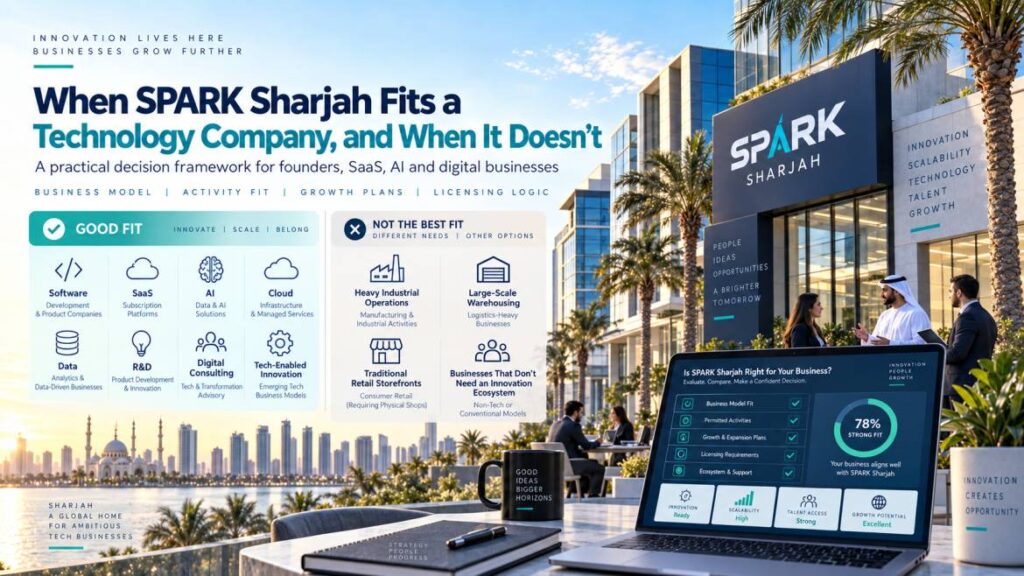
SPARK for software and IT companies is compelling when a founder wants a cost-conscious Sharjah base combined with a genuine technology and innovation ecosystem, and stronger still when the business touches software, AI, automation, R&D or technology commercialization specifically, since those are the activities positioned to actually use the lab access, research partnerships and accelerator exposure.
It is a weaker fit when a founder wants the cheapest possible licence with no interest in the ecosystem, when a Dubai address is commercially necessary, or when the investor structure needs a different legal framework entirely. For a broader Sharjah comparison, see Business Setup in Sharjah 2026: Free Zone Comparison, and for how SPARK stacks against Dubai and Abu Dhabi options specifically for AI and tech, see Best Free Zones in UAE for AI and Technology Companies in 2026. If venture capital is part of the plan, Best Dubai Free Zones for Tech Startups Chasing VC Funding covers the investor-structure side directly.
My Approach: Beyond Company Formation
Most business setup consultants help you register a company. I help you make informed business decisions before you invest.
For an IT or technology founder, I do not start with “how many visas do you need.” I start with what exactly you are selling: development work, monthly SaaS subscriptions, AI implementation, ERP projects, cloud consulting, data analytics, automation, or proprietary technology you plan to commercialize. Only once that model is clear does it make sense to decide whether SPARK is the right free zone and which activities belong on the licence.
As an AI Business Consultant and UAE Business Setup Advisor, my pre-formation work covers business idea validation, market research, competitor analysis, business plan development, startup cost estimation, financial feasibility, structure recommendation, licence and activity selection, visa planning, banking strategy, risk assessment and expansion planning. The goal is straightforward: start with clarity and a strategy, not a licence chosen first and its consequences discovered later.
If you are weighing SPARK for a software, AI, cloud, ERP/CRM or data business, get in touch and I will work through the activity structure and tax position with you before you commit capital. For the formation mechanics themselves, see Free Zone Company Formation UAE.
Frequently Asked Questions
Is SRTIP the same as SPARK?
SPARK is the current brand for what was previously called SRTIP, the Sharjah Research, Technology and Innovation Park, following an October 2025 rebrand. Both names are still in common use, which is why they turn up together in most searches on this free zone.
Can I start a software-development company in SRTIP?
Yes. SPARK’s published activity guidance includes web and mobile software development among its technology-related activities. Confirm the exact activity wording and any combination with other activities before you apply.
Can I start an AI company in SPARK?
Yes. SPARK has built a specific AI-focused ecosystem, including AI development, AI training, robotics, consultancy and R&D activities, and digitalization is already the zone’s largest sector by registered company count.
Can an SRTIP company provide ERP or CRM implementation?
Yes, SPARK’s guidance specifically includes ERP/CRM implementation support. Your activity combination should reflect whether you provide consulting, implementation, customization, development or a mix of these.
Can I combine software, AI and consultancy activities under one licence?
Yes, within limits, which is exactly the flexibility that makes SPARK for software and IT companies work for founders whose business model changes fast. SPARK currently allows compatible activities to be combined, and its Growth-tier package supports up to five activities. The exact combination remains subject to activity compatibility and SPARK’s approval.
Is an SRTIP software company automatically eligible for 0% UAE Corporate Tax?
No. A Qualifying Free Zone Person receives 0% only on Qualifying Income, subject to conditions. Ordinary software-development and IT-consultancy services are not among the activities listed in Ministerial Decision No. 229 of 2025, so software and IT founders should review their actual revenue categories rather than assume the licence itself creates a tax exemption.
Does copyrighted software receive different tax treatment?
Potentially. UAE rules include copyrighted software within the definition of Qualifying Intellectual Property under Cabinet Decision No. 100 of 2023, but the treatment depends on the applicable nexus, expenditure and other Qualifying Free Zone Person requirements.