
There is no such thing as a UAE fintech licence. That sentence contradicts most of what is written about this subject, including several pages currently ranking for it, and it is the most useful thing to understand before you spend money. What exists are five financial regulators, each with its own licence categories, capital requirements and timelines, plus a set of commercial licences that look like fintech licences and legally are not. Starting a fintech business in the UAE begins with working out which of those five applies to you, because that answer sets your capital, your timeline and your cost by a factor of roughly a hundred.
Quick Navigation
Quick Answer
- The UAE has five financial regulators: the Central Bank (CBUAE), the Capital Market Authority (CMA), Dubai’s Virtual Assets Regulatory Authority (VARA), the DFSA in DIFC and the FSRA in ADGM.
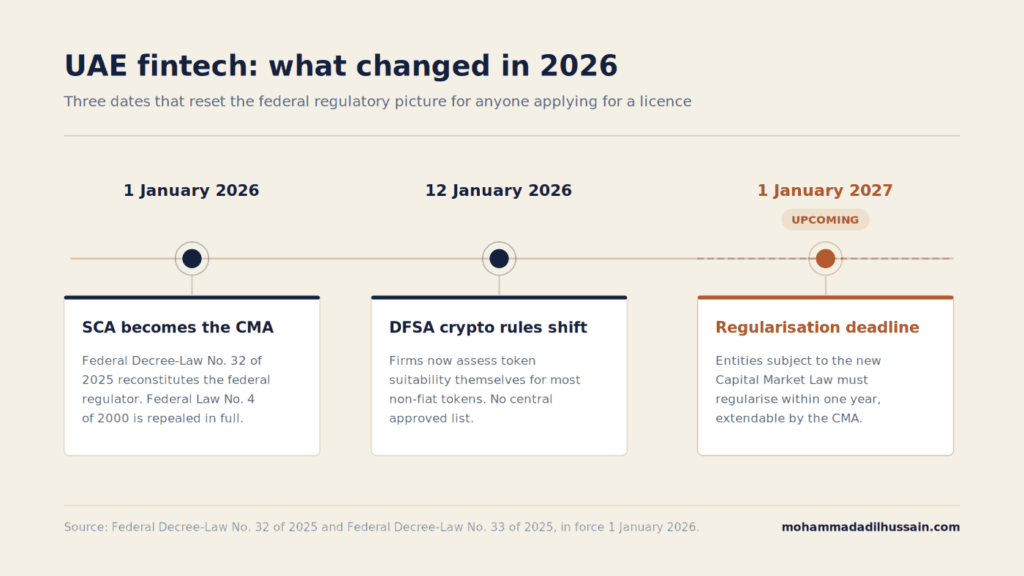
- The Securities and Commodities Authority was reconstituted as the Capital Market Authority on 1 January 2026 under Federal Decree-Law No. 32 of 2025. Entities caught by the new Capital Market Law have until 1 January 2027 to regularise.
- A DIFC Innovation Licence or a free zone trade licence is a commercial licence. It does not authorise regulated financial activity, and using one as if it did is the most common and most expensive mistake in this sector.
- CBUAE retail payment licences require initial capital of AED 100,000, AED 1.5 million or AED 3 million depending on category and transaction volume.
- A DIFC or ADGM licence does not permit you to serve mainland UAE customers. Directing retail payment services at the mainland can trigger CBUAE licensing regardless of where you are incorporated.
There Is No Fintech Licence
Search for a fintech licence in Dubai and you will find consultancies quoting AED 15,000 to AED 30,000. What they are quoting is a commercial trade licence with an activity such as software development, IT consultancy or financial consultancy attached.
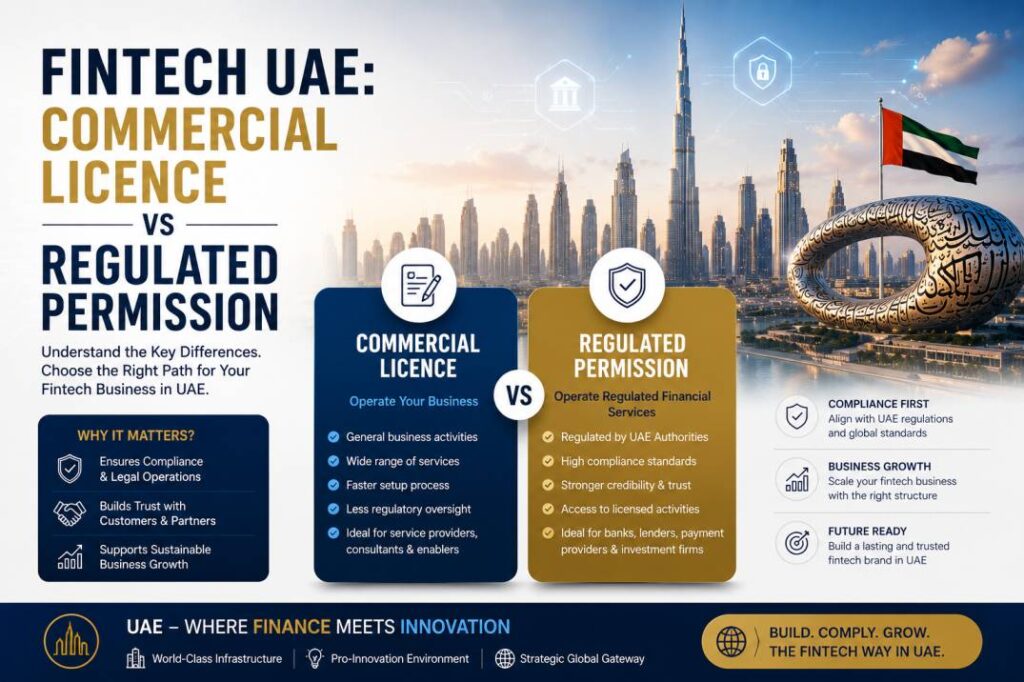
That licence is real, and for some fintech companies it is genuinely all you need. If you build software that banks buy, and you never at any point hold client money, hold client assets, execute transactions, or advise on financial products, you are a technology vendor selling to financial institutions. A commercial licence covers that.
The moment you touch money or assets, you need a second thing: authorisation from a financial regulator. Those are separate applications, separate timelines, separate costs, and they are not interchangeable.
The DIFC Innovation Licence makes this concrete. It is a low-cost commercial licence issued by the DIFC Authority, roughly USD 1,500 to USD 3,000, with more than 700 firms holding one. It is genuinely good value for a technology company. It is not a DFSA licence, and it cannot be used to conduct regulated financial services. A firm whose model crosses into regulated territory has to apply to the DFSA separately.
So the first question is not which free zone. It is this: does your product touch client money, client assets, or regulated advice? If the answer is no, your setup is straightforward and cheap. If the answer is yes, everything below applies.
The Five Regulators, and Which One Is Yours
The UAE is a federal state with two common law financial free zones that operate as separate legal jurisdictions. That produces five regulators rather than one, and every fintech business in the UAE answers to at least one of them.
CBUAE (Central Bank of the UAE). The federal regulator for money, payments and payment tokens onshore. If you are building a payment gateway, a wallet, a remittance service, a merchant acquirer or an AED-referenced stablecoin, this is almost certainly your regulator. The Retail Payment Services and Card Schemes Regulation, issued under CBUAE Circular No. 15/2021, defines nine regulated retail payment services and four licence categories.
CMA (Capital Market Authority). The federal securities and capital markets regulator onshore, and the successor to the SCA since 1 January 2026. Relevant if you are running an investment platform, a robo-adviser, a crowdfunding platform or a virtual asset business outside DIFC, ADGM and Dubai.
VARA (Virtual Assets Regulatory Authority). Dubai’s dedicated virtual assets regulator, covering the Emirate of Dubai including its free zones but excluding DIFC. Seven regulated activities: exchange, brokerage, advisory, asset management, lending, staking and custody. VARA requires two Responsible Individuals, each a full-time employee and UAE resident, individually approved before the licence issues.
DFSA (Dubai Financial Services Authority). Regulates financial services inside DIFC, under English common law with its own courts. Category-based licensing from Category 1 down to Category 5, with capital scaling accordingly.
FSRA (Financial Services Regulatory Authority). Regulates financial services inside ADGM. Activities-based: you apply for a Financial Services Permission covering only what you intend to do. Capital is expense-driven, typically around six months of operating expenses for intermediary activities and twelve months for operating a multilateral trading facility.
Choosing wrongly is not a small error. It can mean re-papering an entire application months in. For the deeper picture on why institutional money keeps concentrating in DIFC specifically, see what Blackstone’s return tells us about the future of the DIFC.
The Perimeter Trap: Free Zone Licence, Mainland Customers
This is the section I would read twice, because it is where a fintech business in the UAE most often discovers it needs a second licence.
DIFC and ADGM sit outside the CBUAE regulatory perimeter. Firms regulated exclusively by the DFSA or the FSRA are not caught by the Retail Payment Services regulation. That is true, and it is where most articles stop.
Here is what they leave out. The RPSCS Regulation prohibits any person from providing or promoting retail payment services in the UAE without a CBUAE licence. If your DIFC-licensed payment product is marketed to, or serves, customers in mainland UAE, that activity can fall inside the CBUAE perimeter regardless of where you are incorporated.
The practical consequence is uncomfortable and worth stating plainly. A founder can complete a DIFC authorisation, celebrate, launch, sign mainland merchants, and only then discover that the mainland customer base requires a separate CBUAE licence with its own capital requirement and its own six-to-twelve-month timeline.
Free zone incorporation is a corporate structure decision. Regulatory perimeter is a customer location decision. They are not the same question, and answering the first does not answer the second. If you want the underlying structural comparison, it is set out in the difference between mainland and free zone companies in the UAE.
What Changed on 1 January 2026
If you are researching a fintech business in the UAE using guidance written before this year, some of it is now wrong.
On 1 January 2026, Federal Decree-Law No. 32 of 2025 and Federal Decree-Law No. 33 of 2025 came into force. Together they repealed Federal Law No. 4 of 2000 in its entirety and reconstituted the Securities and Commodities Authority as the Capital Market Authority. The CMA is the SCA legal successor and inherited all its rights, obligations and contracts. Existing SCA licences and approvals transferred automatically, with no re-application.
Three things follow that matter commercially.
The mandate expanded. The new Capital Market Law codifies the licensing regime for financial activities, the rules on offerings of securities, and market conduct in a single statute, and expands the definition of financial products to include virtual assets.
There is a deadline. All entities and persons subject to the Capital Market Law must regularise their status within one year of 1 January 2026, extendable at the CMA discretion. That puts the working date at 1 January 2027.
Enforcement got sharper. The CMA has broader investigative powers and a wider range of administrative sanctions than the SCA held.
Separately, the DFSA implemented significant changes to its crypto token regime effective 12 January 2026, shifting responsibility onto firms to assess the suitability of most non-fiat tokens rather than relying on a central approved list. If your model depends on token listings, that change alters your compliance burden materially. The broader digital asset context is covered in how the tokenization revolution is reshaping global finance.
The Sandboxes: DFSA Innovation Testing Licence and ADGM RegLab
Both financial free zones run a supervised testing route, and they are genuinely useful if your product is real but unproven.
DFSA Innovation Testing Licence (ITL). A restricted financial services licence operating since 2017. More than 200 firms have applied and more than 80 have been accepted. It lets you test a regulated product with a restricted client base and transaction caps, as a defined pathway toward full DFSA authorisation.
ADGM RegLab. Participants hold a Financial Services Permission restricted to developing fintech services inside the lab, running for two years under caps on transaction volume and client numbers set individually by the FSRA. At the end you either apply for full authorisation or exit. Details of both sit on the UAE Government page on regulatory sandboxes.
Two practical notes. The name Innovation Testing Licence belongs to the DFSA, not to ADGM, and founders routinely search for it in the wrong jurisdiction. And a sandbox place is not a shortcut past authorisation. It is a supervised runway toward it, with a defined exit, and the regulator expects a product that is ready to test rather than an idea.
The honest counterweight: a sandbox adds a year or more to your path to full commercial operation. For a team with a validated product and funding in place, applying directly may be faster even though it is harder.
What a Fintech Business in the UAE Actually Costs
Two numbers get quoted for this sector and they are roughly two orders of magnitude apart. Both are real. They describe different things.
The commercial licence route. A DIFC Innovation Licence runs USD 1,500 to USD 3,000 for the licence itself, with total first-year cost including government fees and professional support commonly landing in the USD 10,000 to USD 20,000 range. This is the number consultancies advertise. It is accurate for a technology vendor and misleading for anyone else.
The regulated route. Here the binding constraint is regulatory capital, not licence fees. Under the CBUAE retail payment framework, initial capital requirements are set by category and transaction volume: AED 100,000 for payment initiation and payment account information services regardless of volume, AED 1.5 million where monthly average payment transaction value sits below AED 10 million, and AED 3 million where it reaches AED 10 million or above. Crossing AED 10 million in monthly average value for three consecutive months automatically moves you into the higher band, and the CBUAE reserves the right to impose more.
Published consultancy estimates for a full ADGM or DIFC authorisation put realistic first-year totals in the high hundreds of thousands to low millions of dirhams once capital, office, application fees and legal work are included. Treat those as indicative and get a written itemised quote, because the range is wide and depends heavily on the permission set.
Then there are the costs no table includes. Two VARA Responsible Individuals must be full-time employees and UAE residents, individually approved before your licence issues, which is a payroll line that starts before revenue does. Compliance and money laundering reporting functions are ongoing salaries, not a one-off. And regulator question rounds consume months of founder time.
The honest summary: if the capital requirement alone is a stretch, the licence fee was never the relevant number.
Corporate Tax Splits the Sector in Two
A detail that surprises founders who assumed a free zone means 0% for any fintech business in the UAE.
Free zone companies pay 0% corporate tax only on Qualifying Income. Ministerial Decision No. 229 of 2025 lists 13 Qualifying Activities. Two of them matter here: fund management services and wealth and investment management services, both subject to regulatory oversight.
Payment processing is not on the list. Neither is software development, IT consultancy or lending. So a DIFC-based fund manager and a DIFC-based payments company can sit in the same building on the same licence tier and face different effective tax rates.
There is a second trap. Any transaction with a natural person is an Excluded Activity, with narrow exceptions that include fund management and wealth management. A consumer-facing fintech serving individuals is generating non-qualifying revenue on those transactions by default.
The full mechanics, including the substance requirements and the five-year lockout that follows a failed condition, are in best free zones in UAE for AI and technology companies, and the registration process is covered on my corporate tax registration and filing page.
Where the Opportunities Actually Are
Four areas where the regulatory groundwork has been laid and the commercial gap is still open for a new fintech business in the UAE.
Payment infrastructure riding the national rails. Under the CBUAE Financial Infrastructure Transformation programme, the Aani instant payments platform and the Jaywan domestic card scheme are live, with the Digital Dirham on a phased rollout. New rails create a window for products built on top of them before incumbents adapt.
Compliance and regulatory technology. Five regulators, a new Capital Market Law, a regularisation deadline in January 2027 and sharper enforcement across VARA, the DFSA and the FSRA. Firms need tooling. Selling software to regulated institutions also keeps you outside the regulatory perimeter, which is a structural advantage rather than a limitation.
SME lending and working capital. Underserved relative to the size of the trading economy here, though this route requires a lending permission and real capital.
Cross-border remittance and treasury. The UAE expatriate population and trade corridors make this permanently large. It is also crowded and heavily regulated, so the opening is in specific corridors and specific customer segments rather than in general.
The pattern worth noticing: the two easiest to enter are the two that avoid touching client money.
My Approach: The Perimeter Question Comes First
Most business setup consultants help you register a company. I help you make informed business decisions before you invest.
For a fintech business in the UAE, the conversation that matters is not which free zone is cheapest. It is a perimeter question asked before anything else: does your product touch client money, client assets or regulated advice, and where do your customers physically sit? Those two answers together determine your regulator, your capital requirement, your timeline and whether your first-year cost is USD 15,000 or AED 3 million. Every consultancy that quotes you a licence price before asking those two questions is quoting you a number for a different business.
My advisory process focuses on helping you reduce uncertainty and make confident decisions, not just complete documentation. Here is what that looks like in practice.
- Regulatory perimeter assessment, establishing whether you need authorisation at all before anyone discusses jurisdictions.
- Regulator mapping across CBUAE, the CMA, VARA, the DFSA and the FSRA, matched to your specific activity set.
- Market research on which segments here are underserved rather than merely large.
- Competitor analysis across licensed firms already holding the permission you are seeking.
- Capital planning covering regulatory capital, not just setup fees, modelled against your projected transaction volumes.
- Startup cost estimation including compliance salaries, Responsible Individual requirements and audit, disclosed together.
- Financial feasibility modelling across the full authorisation timeline, since revenue typically starts well after costs do.
- A structure recommendation matched to your regulator, because the regulator constrains the structure rather than the reverse.
- Sandbox assessment, meaning whether the DFSA Innovation Testing Licence or ADGM RegLab genuinely shortens your path or simply delays it.
- Corporate tax registration and filing planning, including whether your activity is a Qualifying Activity.
- Banking strategy, which for fintech is materially harder than for a standard business.
- Investor and employment visa planning for the compliance and technical hires your licence requires you to have.
The objective is simple: help you start your business with clarity, confidence and a long-term strategy.
Is This the Right Move for Your Business?
The UAE is a strong base for fintech when you have capital proportionate to your permission, a product validated somewhere before you arrive, and patience for a timeline measured in quarters rather than weeks.
It is a poor fit when the plan depends on launching a regulated product cheaply and fast. That combination does not exist here, and consultancies that suggest otherwise are quoting you for a commercial licence while you are hearing a financial one.
There is a third path worth taking seriously. Many of the best fintech businesses here never get regulated at all, because they sell software to institutions that are. That route is faster, cheaper and structurally more defensible than founders expect.
If you want your perimeter position assessed before you commit capital, review business setup services or get in touch.
Frequently Asked Questions
Is there a fintech licence in the UAE?
No. There is no single fintech licence. You need a commercial trade licence to incorporate, and separately, if your product touches client money, client assets or regulated advice, authorisation from one of five financial regulators: CBUAE, the Capital Market Authority, VARA, the DFSA or the FSRA.
Which regulator applies to my fintech?
It depends on your activity and where your customers are. CBUAE covers payments, e-money and payment tokens onshore. The CMA covers securities and virtual assets outside the financial free zones and Dubai. VARA covers virtual assets across Dubai excluding DIFC. The DFSA covers financial services inside DIFC and the FSRA inside ADGM.
Is the SCA still the UAE securities regulator?
No. The Securities and Commodities Authority was reconstituted as the Capital Market Authority on 1 January 2026 under Federal Decree-Law No. 32 of 2025. Federal Law No. 4 of 2000 was repealed. Existing licences transferred automatically, and entities subject to the new Capital Market Law have until 1 January 2027 to regularise.
Can a DIFC company serve mainland UAE customers?
Not automatically. DIFC and ADGM firms sit outside the CBUAE perimeter, but the Retail Payment Services regulation prohibits providing or promoting retail payment services in the UAE without a CBUAE licence. Serving or marketing to mainland customers can trigger a separate licensing obligation regardless of where you are incorporated.
What capital do I need for a UAE payments licence?
Under the CBUAE retail payment framework, initial capital is AED 100,000 for payment initiation and payment account information services, AED 1.5 million where monthly average transaction value is below AED 10 million, and AED 3 million where it reaches AED 10 million or above. The CBUAE can require more.
Does the DIFC Innovation Licence let me run a fintech?
Only if your product is unregulated. It is a commercial licence from the DIFC Authority, not a DFSA authorisation, and it cannot be used to conduct regulated financial services. A firm whose model crosses into regulated territory must apply to the DFSA for full authorisation or an Innovation Testing Licence.
Do fintech companies pay 0% corporate tax in a UAE free zone?
It depends on the activity. Fund management and wealth and investment management are Qualifying Activities under Ministerial Decision No. 229 of 2025. Payment processing, lending and fintech software are not, so income from those is taxed at 9%.
Sources & References
- CBUAE Rulebook – Retail Payment Services and Card Schemes Regulation
- UAE Government – Regulatory Sandboxes in the UAE
- Ministry of Finance – Ministerial Decision No. 229 of 2025 on Qualifying and Excluded Activities
- Capital Market Authority (UAE)
- Virtual Assets Regulatory Authority (VARA)
- Dubai Financial Services Authority