Quick Answer
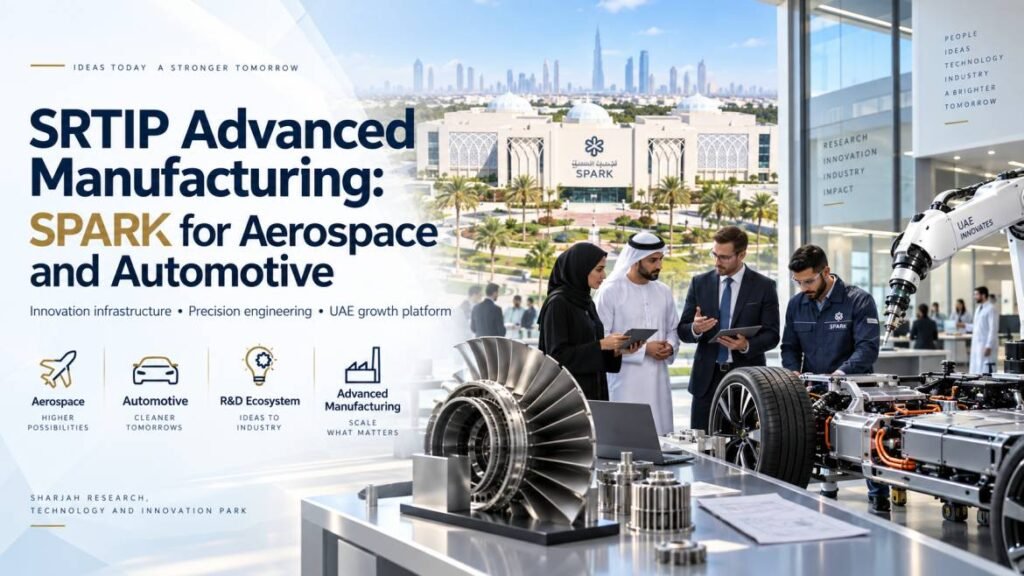
SRTIP advanced manufacturing is a real, officially stated sector, not a stretch. If you’re building a precision manufacturing, aerospace component, automotive engineering, or advanced design business, SRTIP’s SPARK programme isn’t only for AI and software founders. Advanced Manufacturing is one of SRTIP’s four officially stated focus sectors, described on SRTIP’s own site as “driving precision manufacturing in aerospace and automotive sectors with cutting-edge engineering and design innovations.” That’s a real, stated mandate, not a stretch.
The fit is specifically for R&D-adjacent, engineering-and-design-stage manufacturing, not large-scale assembly or aviation MRO, which is better served by a dedicated hub like Dubai South.
Table of Contents
SRTIP Advanced Manufacturing: SPARK’s Sector Focus, in Its Own Words
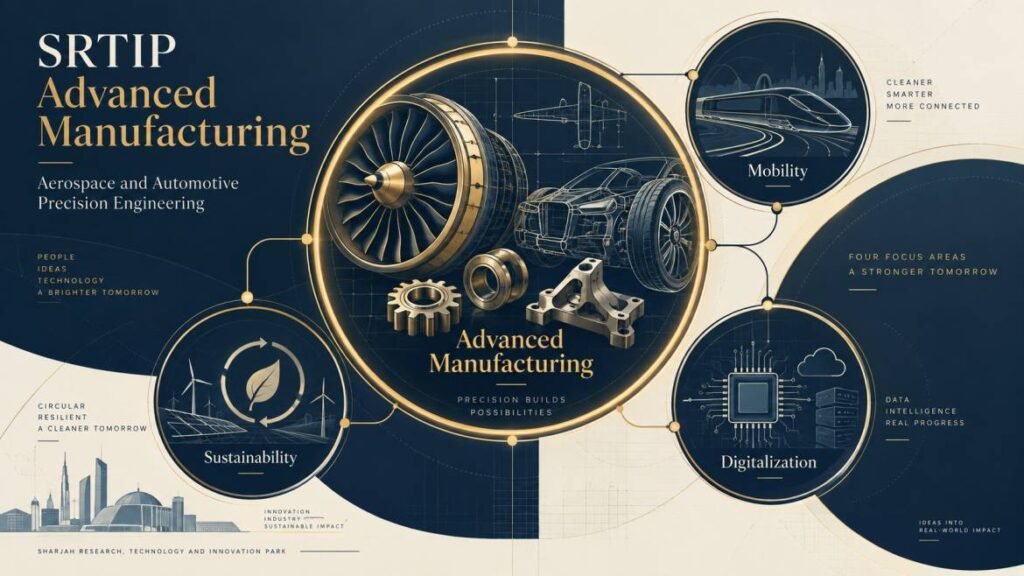
SRTIP doesn’t just tolerate manufacturing activity as an afterthought to its tech and AI positioning. Advanced Manufacturing is explicitly listed as one of SRTIP’s four core innovation ecosystem focus areas, alongside healthcare, sustainability and environmental technology, and mobility and logistics digitalization. SRTIP’s own description of this sector is specific: precision manufacturing in aerospace and automotive, built around engineering and design innovation rather than volume production, stated directly on SRTIP’s own Innovation Ecosystem page.
That distinction matters. This isn’t a general manufacturing licence category, it’s positioned around the design and engineering-intensive end of aerospace and automotive work: component design, precision fabrication, advanced materials, and the R&D work that sits upstream of large-scale production.
What “Advanced Manufacturing” Actually Means Here
For aerospace, this typically covers activity like precision-machined components, engineering design and simulation work, advanced materials research, and specialized parts fabrication, the kind of work that happens before or alongside full-scale assembly, not the assembly line itself.
For automotive, the same logic applies: engineering design, precision component manufacturing, advanced materials and prototyping, work that fits an R&D-adjacent business far better than a high-volume production facility.
If your business is design and engineering-led, developing and refining precision components, running simulation and prototyping work, or building specialized manufacturing IP, this sector description fits what you’re actually doing. If your business is large-scale assembly, high-volume production lines, or full aviation MRO, the fit is weaker, and that’s worth being upfront about rather than stretching the sector description to cover every kind of manufacturing.
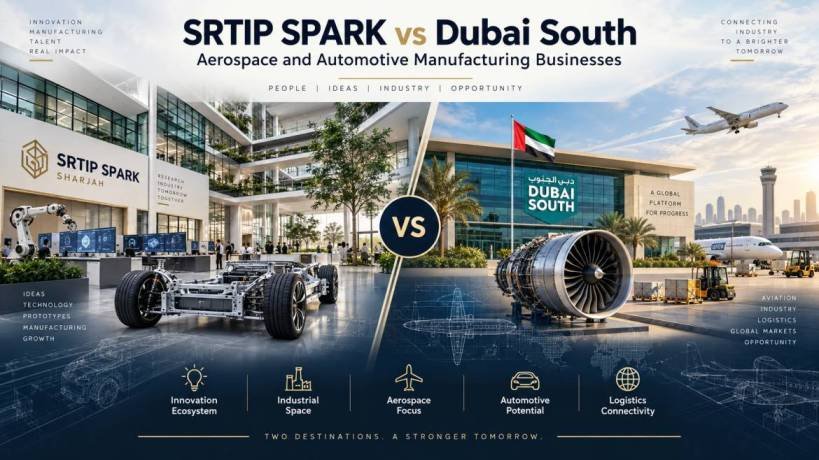
SRTIP vs. Dubai South: Two Different Kinds of Aerospace Business
It’s worth being precise here, because “aerospace free zone in the UAE” often gets treated as a single category when it isn’t.
| Factor | SRTIP (SPARK) | Dubai South (MBRAH) |
|---|---|---|
| Best for | Precision engineering, component design, R&D-adjacent manufacturing | Large-scale MRO, aviation services, flight training, business aviation |
| Scale | Design and engineering-stage, smaller-footprint operations | Dedicated 7 kmxc2xb2 aerospace hub built for scale |
| Ecosystem | Research, innovation, university-adjacent, Sharjah’s University City | Aviation industry cluster, logistics corridor, major carriers nearby |
| Activity type | Engineering, design, precision fabrication | Maintenance, repair, overhaul, aviation services, assembly-scale work |
Neither is universally better. A component-design or precision-engineering startup genuinely fits SRTIP’s research-driven environment. A business that needs to be inside an active aviation MRO ecosystem, or that’s planning large-scale production, is better served by Dubai South’s dedicated aerospace infrastructure. I’ve covered Dubai South’s logistics and aerospace corridor in detail here if that’s a closer fit for your scale.
How This Fits Alongside SPARK’s Broader Tech Positioning
If you’ve read my breakdown of SPARK’s transformation into an AI and digitalization hub, you’ll know digitalization is SPARK’s largest sector by registered company count, 52 of 105 companies, well ahead of advanced manufacturing and the other research sectors combined. That’s worth knowing going in: advanced manufacturing businesses at SPARK are a smaller, more specialized cluster, not the dominant peer group.
For some founders that’s an advantage, less noise, closer access to the specific research and lab infrastructure. For others weighing pure ecosystem scale, it’s a genuine trade-off to factor in, not a reason to avoid SPARK, but a reason to set expectations correctly.
Licensing and Activity Scope
SPARK supports over 1,500 approved business activities across its research sectors and general commercial categories, and SRTIP advanced manufacturing activities are licensed alongside the platform’s tech and AI licensing, not as a separate, lesser track. Multi-activity licensing applies here too, letting an engineering-focused business combine design, consultancy, and fabrication-adjacent activities under one licence where that reflects the actual business.
As with any free zone activity, the specific activity codes and any additional approvals should be confirmed directly with SRTIP before committing, since activity classifications and approval requirements are specific to what you’re actually doing.
What Regulatory Review Typically Looks Like for Aerospace-Adjacent Work
Aerospace-adjacent manufacturing and engineering activities in the UAE can carry additional layers of review beyond a standard free zone licence application, and it’s worth setting that expectation early rather than discovering it mid-process. Depending on what you’re designing, fabricating, or testing, your activity may fall under additional civil aviation, export control, or dual-use technology considerations administered outside the free zone authority itself, particularly if any component, material, or design work has both civilian and defense-adjacent applications. This is not unique to SRTIP, it applies to aerospace and precision engineering activity in any UAE jurisdiction, but founders sometimes assume a free zone licence alone covers every regulatory angle when it doesn’t.
The practical approach: have a clear, written description of exactly what you’re designing or fabricating, and where the end product or service is headed, before you apply. That clarity is what determines whether your activity needs additional review, and it’s far easier to work through at the planning stage than after a licence is already issued and you discover an additional approval was needed. If your work sits purely in commercial automotive or general precision engineering with no aerospace or dual-use dimension, this consideration typically doesn’t apply, but it’s worth ruling in or out explicitly rather than assuming either way.
The Tax and Compliance Point, Applied Here
The same corporate tax mechanics that apply across UAE free zones apply to advanced manufacturing businesses at SPARK: 9% corporate tax on profits above AED 375,000, with 0% available only on qualifying income for entities meeting Qualifying Free Zone Person conditions, adequate substance, qualifying activity, and compliance requirements, not a blanket exemption, conditions detailed directly on the Federal Tax Authority’s website. Manufacturing and engineering businesses should pay particular attention to how their income is classified, since qualifying versus non-qualifying income treatment can differ depending on whether revenue comes from design services, licensing IP, or physical goods production.
Setup Process and Timeline for an Advanced Manufacturing Licence at SPARK
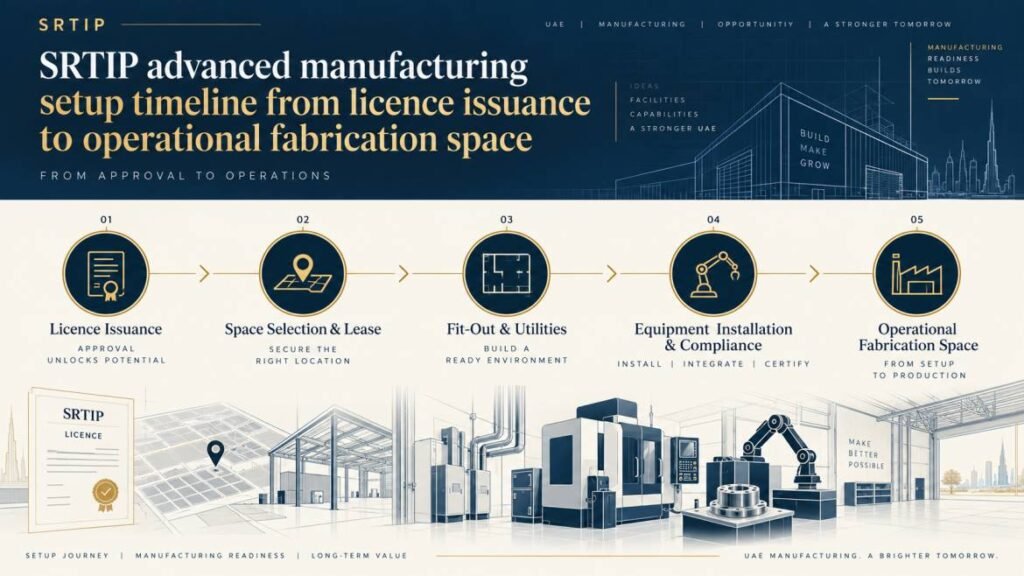
The general SPARK licensing process applies here, activity confirmation, document submission, and licence issuance typically moving in days once your activity description and paperwork are in order, the same baseline timeline that applies across SPARK’s licensing categories. What extends the real timeline for an advanced manufacturing business specifically is everything beyond the licence itself: securing appropriate lab, workshop, or fabrication space that matches what you’re actually building, working through any additional regulatory review your specific aerospace or automotive activity triggers, and setting up supplier or materials relationships if your work involves physical fabrication rather than pure design and engineering services.
Founders coming from a pure software or services background sometimes underestimate this gap, a design-only consultancy can be operational almost as soon as the licence issues, while a business that needs physical fabrication space or specialized equipment access has a longer runway before it’s genuinely producing anything. Budgeting realistically for that difference, rather than assuming manufacturing and software licensing move at the same pace, avoids a common and avoidable planning mistake.
It’s also worth confirming early whether your specific work needs dedicated lab or fabrication space through SRTIP’s own facilities, or whether a flexi-desk arrangement is sufficient because your activity is design and engineering work rather than physical production. That single decision affects both your cost structure and your realistic operational timeline more than almost any other setup choice.
Common Mistakes When Positioning an Advanced Manufacturing Business at SPARK
- Overstating the manufacturing scale in your activity description. Describing a design-and-engineering business as full production manufacturing can create a mismatch between what your licence says and what you’re actually doing, which causes friction later with banks, regulators, or facility access.
- Assuming SRTIP and Dubai South are interchangeable. They serve genuinely different stages of aerospace and automotive work. Choosing based on cost or convenience alone, without matching the ecosystem to your actual activity, is a structural mistake that’s expensive to unwind later.
- Skipping the regulatory review question until after licensing. If any part of your work has an aerospace or dual-use dimension, it’s worth clarifying additional approval requirements before you apply, not after a licence is already issued.
- Treating the tax rate as fixed regardless of activity. Whether income comes from design services, IP licensing, or physical goods production can affect qualifying income treatment differently. This isn’t a detail to leave until tax filing season.
- Underestimating facility lead time. Physical fabrication space takes longer to secure and set up than a flexi-desk licence. Plan your operational launch date around when you can actually produce, not around when the licence itself is issued.
How This Compares to Generic “Manufacturing Free Zone” Advice
Most generic UAE free zone content treats manufacturing as a single undifferentiated category, list the free zones that allow industrial licensing, done. That approach misses the more useful question for aerospace and automotive founders specifically: which UAE jurisdiction actually matches the stage of your business, R&D and design-stage work, or scaled production and assembly. SRTIP’s own stated sector language answers that question directly for SPARK, and Dubai South’s dedicated aerospace hub answers it for the production and MRO end of the spectrum. Neither a generic “best free zones for manufacturing” list nor older SRTIP content built purely around its AI and tech rebrand actually walks through this distinction, which is the gap this article is built to close.
My Approach: Beyond Company Formation
Most business setup consultants help you register a company. I help you make informed business decisions before you invest.
Choosing between SRTIP and Dubai South, or between a research-driven engineering base and a scale-built aviation hub, isn’t a decision a sector description alone should make for you. It depends on where your business actually sits, design and engineering-stage work, or production-scale operations, and what ecosystem genuinely serves that stage. My approach combines AI-enabled research and market intelligence with practical UAE advisory experience to help you get that fit right before you commit capital to a jurisdiction.
If you’re evaluating your broader business setup options or thinking about how an advanced manufacturing base fits into a market expansion strategy, that’s exactly the groundwork worth doing first.
Who Should Actually Consider SRTIP Advanced Manufacturing
SPARK is a strong fit if:
- Your business is design, engineering, or R&D-stage rather than high-volume production
- You’re building precision components, advanced materials, or engineering IP for aerospace or automotive
- You value proximity to a research and university-adjacent ecosystem
- Your operation’s footprint is smaller and specialized rather than large-scale
Dubai South or another aerospace-specific hub is worth comparing if:
- You need to be inside an active aviation MRO and services ecosystem
- Your business is production-scale assembly, not design-and-engineering-stage
- Proximity to major carriers and an established aviation cluster matters operationally
Frequently Asked Questions
Does SRTIP actually target aerospace and automotive manufacturing, or is this a stretch?
No, it’s stated directly on SRTIP’s own site. Advanced Manufacturing is one of four official focus sectors, described specifically as precision manufacturing for aerospace and automotive with engineering and design innovation.
Is SRTIP a good fit for large-scale aerospace assembly or MRO work?
Not typically. SRTIP’s advanced manufacturing focus is R&D-adjacent, design and engineering-stage work. Large-scale assembly or aviation MRO is better served by a dedicated hub like Dubai South’s MBRAH.
What kind of automotive business fits SPARK specifically?
Engineering design, precision component manufacturing, advanced materials research, and prototyping work fit well. High-volume vehicle production doesn’t fit SPARK’s actual positioning.
How does advanced manufacturing licensing work alongside SPARK’s tech and AI focus?
They’re licensed on the same platform, not separately. SPARK supports over 1,500 approved activities across its research sectors, including advanced manufacturing, alongside its larger digitalization and AI-focused base.
Do advanced manufacturing businesses get 0% corporate tax at SPARK?
Only on qualifying income, and only if Qualifying Free Zone Person conditions are met. Manufacturing businesses should pay particular attention to how design, IP licensing, and physical production income are each classified.
Does aerospace-adjacent work need any approval beyond the free zone licence itself?
Sometimes. Depending on what’s being designed or fabricated, additional civil aviation, export control, or dual-use technology review can apply outside the free zone authority. This isn’t SRTIP-specific, it applies UAE-wide to aerospace and dual-use activity, and it’s worth clarifying your exact activity description before you apply.
Should I compare SRTIP against Dubai South before choosing?
Yes, if your business involves aerospace at any scale. They serve genuinely different stages: SRTIP for research-driven, engineering-stage work, Dubai South for scale, MRO, and active aviation industry proximity.
SRTIP advanced manufacturing is a genuinely distinct pathway from the AI-focused side of the free zone, and founders in aerospace, automotive or precision engineering should evaluate it on its own terms. The SRTIP advanced manufacturing offering keeps expanding as the zone matures.
The practical next step for a manufacturing founder evaluating SRTIP is the same as for any free zone decision: get the licence activity list, the facility specifications and the actual cost breakdown in front of you before comparing it against alternatives like KIZAD or Dubai Industrial City, rather than deciding on reputation alone.