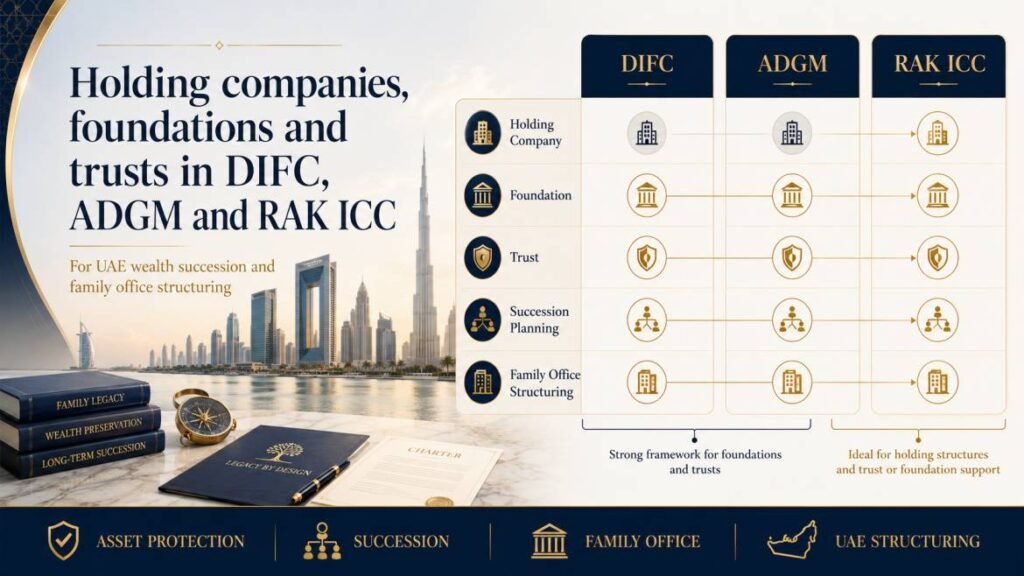
Search for holding companies, foundations and trusts for UAE wealth succession and nearly every guide walks through the same three-jurisdiction comparison: DIFC, ADGM, RAK ICC. Almost none of them state the one distinction that actually determines whether a structure works the way a family expects it to. A “Family Foundation” is not a fourth type of legal entity sitting alongside these three jurisdictions. It is a tax election under Article 17 of the UAE Corporate Tax Law, available to a foundation or certain trusts if specific conditions are met, and conflating the entity with the election is the single most common and most costly misunderstanding in this entire topic. Here is the full picture: what each vehicle actually is, what the tax status genuinely requires, and how the pieces are meant to fit together.
Quick Navigation
Quick Answer
- DIFC and ADGM foundations are the leading UAE private wealth vehicles, offering legal personality, no shareholders, and succession continuity that survives the founder’s death. RAK ICC foundations offer a more cost-effective alternative for families who do not need DIFC or ADGM’s institutional layer.
- A “Family Foundation” is not a separate legal entity anywhere in UAE law. It is a fiscal transparency election under Article 17 of Federal Decree-Law No. 47 of 2022, available to a qualifying foundation, trust, or similar arrangement that meets specific conditions.
- A foundation is not automatically tax-free. Standard corporate tax at 9% above AED 375,000 applies unless the Family Foundation election is made and the qualifying conditions are met, and even then tax exposure can shift to beneficiaries rather than disappear.
- The correct architecture typically places a foundation or trust at the top, holding companies and SPVs beneath it for liability separation and banking clarity, and operating businesses, property or investments at the base, rather than one vehicle holding everything directly.
- DIFC’s family office entry threshold sits meaningfully higher than ADGM’s, which is the practical reason many families choose ADGM rather than a prestige preference.
Holding Companies, Foundations and Trusts in UAE Wealth Succession: The Distinction Almost Every Guide Gets Backwards
Start here, because everything else in DIFC ADGM RAK wealth succession planning is easier to understand once this is settled.
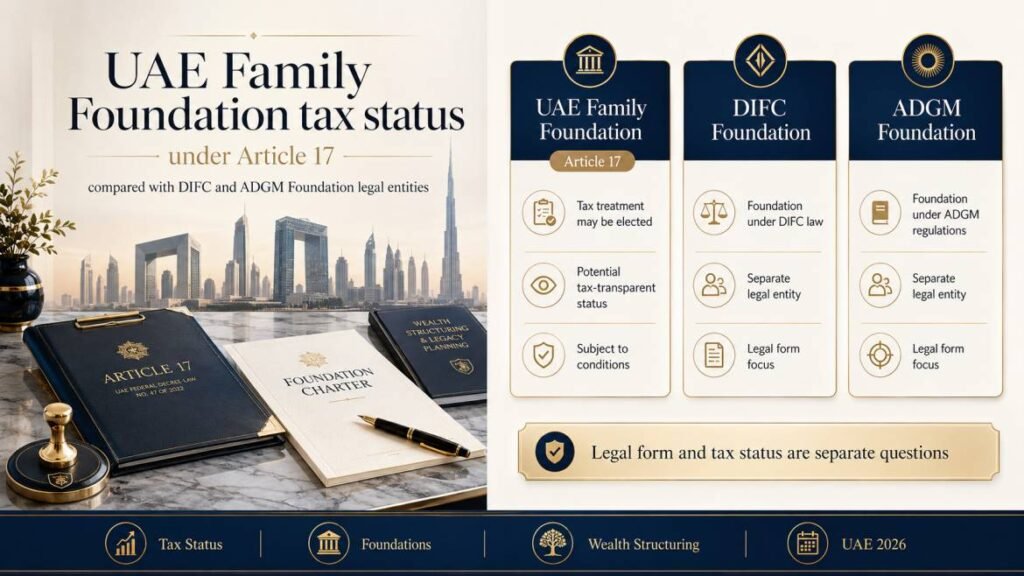
A “Family Foundation” is not a type of legal entity you register. It does not sit alongside DIFC Foundations, ADGM Foundations and RAK ICC Foundations as a fourth option on a comparison table. It is a tax status, specifically a fiscal transparency election under Article 17 of Federal Decree-Law No. 47 of 2022, the UAE’s Corporate Tax Law.
What that means practically: you first establish a real legal vehicle, most commonly a DIFC Foundation, an ADGM Foundation, a RAK ICC Foundation, or a qualifying trust. That vehicle then has the option, if it meets specific conditions, to elect Family Foundation treatment with the Federal Tax Authority. Once elected and approved, the vehicle is treated as fiscally transparent, meaning income is generally attributed to the underlying beneficiaries for tax purposes rather than taxed at the entity level.
The FTA published dedicated guidance on this treatment in May 2025, and has continued refining it since, including clarification that certain trusts and similar contractual arrangements, not only formally established foundations, may also qualify for transparent treatment where the relevant Article 17 conditions are met.
Why this distinction matters in practice: a family that sets up a DIFC Foundation assuming it is automatically a “Family Foundation” for tax purposes has not actually secured that treatment. The foundation is a real, valid legal structure regardless. The tax status is a separate, additional step that has to be actively elected and qualified for. Skipping this step does not make the foundation invalid. It does mean the foundation is taxed under the ordinary corporate tax rules rather than the transparent treatment many families assume they already have.
DIFC ADGM RAK Wealth Succession: What a Foundation Actually Is
With that distinction clear, here is what the underlying legal vehicle in DIFC ADGM RAK wealth succession structures itself provides.
A DIFC or ADGM Foundation is a distinct legal entity with its own legal personality, similar in that sense to a company, but structurally different in an important way: it has no shareholders. Instead, it is governed by a Council, overseen by a Guardian whose role is to ensure the foundation is administered in line with its charter and the founder’s wishes, and it holds assets in its own name for the benefit of designated beneficiaries according to a founding charter and by-laws.
The practical advantage over personal ownership: because the foundation itself holds the assets and has no shareholders whose shares would need to pass through inheritance or probate, the structure can continue operating exactly as designed after the founder’s death, without the succession disruption that personal share ownership in a holding company can create. A Foundation can sit above operating companies, property vehicles and investment accounts, providing a single point of continuity even as the assets beneath it change over time.
Both DIFC and ADGM operate under common law frameworks, and both are well established as private wealth jurisdictions, with genuine differences in cost, threshold requirements and institutional ecosystem covered later in this guide.
Trusts: The Older Tool, and Where They Still Fit
A trust works on a fundamentally different legal logic than a foundation, and the difference matters for which tool fits a given family’s situation.
A trust has no separate legal personality. Instead, it relies on a trustee holding legal title to assets on behalf of beneficiaries, under the terms of a trust deed. The DIFC and ADGM both operate established trust law frameworks, and cross-border UAE estate planning for high-net-worth individuals commonly relies on a combination of DIFC and ADGM trusts and foundations alongside RAK ICC vehicles.
The practical distinction from a foundation: a trust depends on the ongoing relationship between trustee and beneficiary, which some families and advisers prefer for its flexibility and long common law history, particularly where the family already has trust structures in other jurisdictions they want to mirror or connect to. A foundation, with its own legal personality and no reliance on a trustee relationship in the same sense, is often preferred where a family wants a structure that behaves more like an institution than a contractual relationship.
As covered above, certain trusts can also potentially qualify for Family Foundation tax transparency treatment under Article 17, provided the specific conditions are met, which narrows the practical tax gap between choosing a trust or a foundation for many families.
RAK ICC: The Cost-Effective Third Option
Ras Al Khaimah International Corporate Centre, the RAK option here, offers its own foundations regime, alongside company and SPV structures, and is consistently described as the more cost-effective alternative to DIFC and ADGM for families who do not specifically need the institutional layer those two jurisdictions provide.
RAK ICC is commonly used for the SPV and holding company layer beneath a DIFC or ADGM foundation, as well as for standalone foundation structures where a family’s asset base and governance needs do not require DIFC or ADGM’s more built-out private wealth ecosystem, banking relationships and regulatory density. For an offshore company or SPV specifically, the mechanics of that structure are covered in offshore company formation.
The trade-off here is straightforward: lower cost and administrative burden, against a lighter institutional and banking ecosystem than DIFC or ADGM offer. For many families, particularly those using RAK ICC as a supporting layer beneath a DIFC or ADGM foundation rather than as the primary wealth vehicle, this trade-off is the right one.
The Layered Architecture Nobody Explains Properly
This is the most practically useful piece of structuring advice in this entire topic, and it is currently a single throwaway line across the guides I reviewed rather than a properly explained principle.
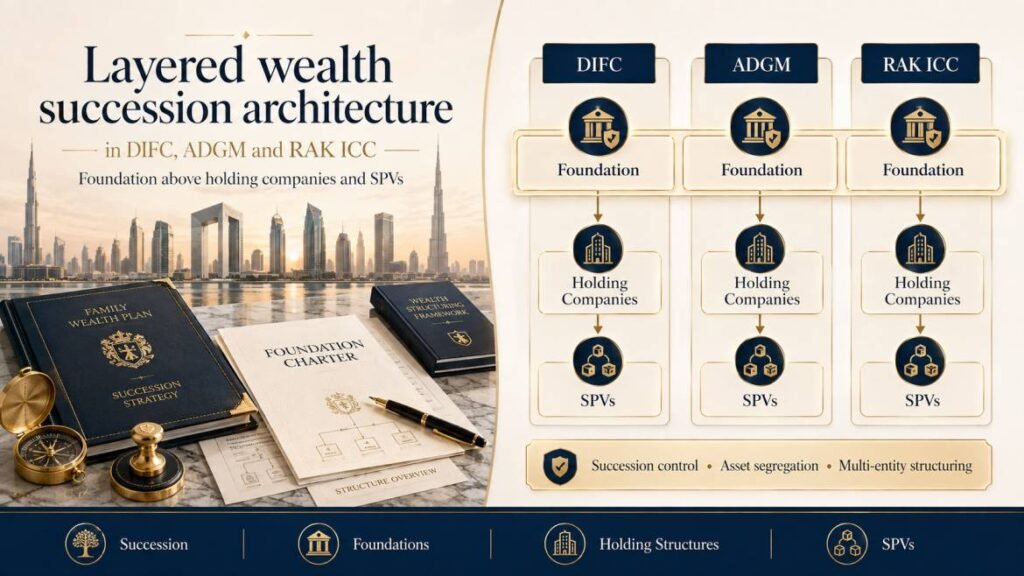
A foundation should rarely hold every business asset directly. The stronger architecture places the foundation or trust at the top of the structure, functioning purely as the control and succession layer, with separate holding companies and SPVs sitting beneath it to actually hold operating businesses, property and investment accounts.
The reasoning is practical rather than theoretical. Separating liabilities across distinct holding companies and SPVs means a problem in one operating business or investment does not directly expose the foundation, or the family’s other assets, to the same risk. It also makes individual assets easier to sell, refinance or restructure independently, since a buyer or bank is dealing with a specific holding company rather than negotiating around the foundation’s full asset base. And it tends to make banking relationships clearer, since banks generally find it easier to assess and service a specific operating or holding entity than a broad, multi-asset foundation directly.
Under this architecture, the foundation continues to provide what it does best, succession continuity and governance control at the top, while the holding companies and SPVs beneath it handle the practical, asset-specific work of ownership, financing and risk separation. This structure is a deliberate design choice, not a default outcome of simply forming a foundation.
DIFC or ADGM: A Threshold Question, Not a Prestige Question
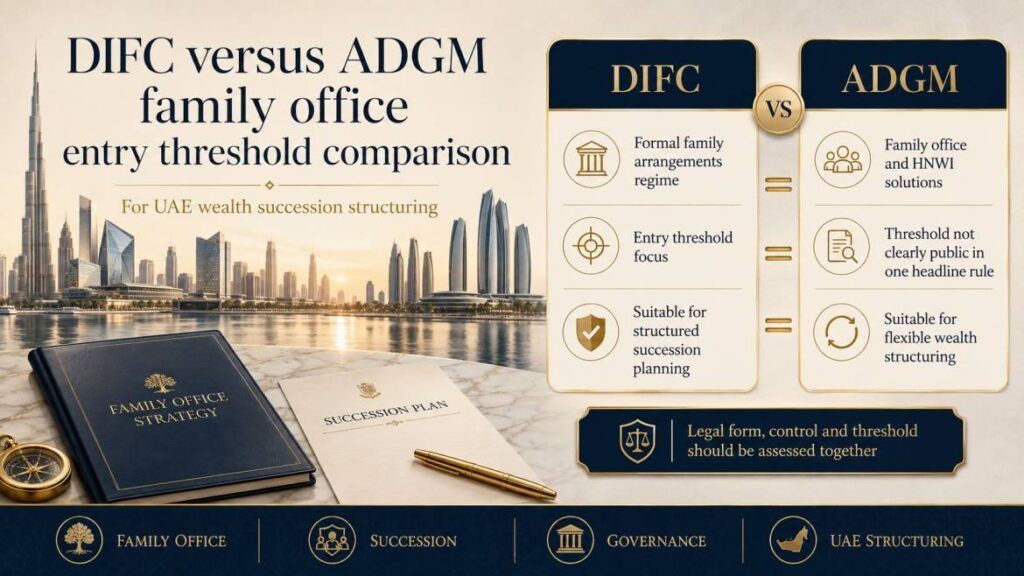
Most comparisons frame DIFC versus ADGM as a matter of preference, Dubai’s institutional density against Abu Dhabi’s lower operational hurdles. That framing is not wrong, and it skips the filter that actually decides the choice for many families before preference even enters the conversation.
DIFC’s entry requirements for a Single Family Office sit meaningfully higher than ADGM’s. Families who do not clear DIFC’s threshold are not simply choosing ADGM for cost or convenience. ADGM has deliberately positioned itself as the more accessible route specifically for families in this position, with its Single Family Office structure not requiring a full financial services permission for core family management activities, while a Multi-Family Office serving several families does require an FSRA Category 4 licence.
For families who comfortably clear DIFC’s threshold, the institutional density, banking relationships and ecosystem maturity in Dubai remain genuine reasons to choose it. For families below that threshold, or whose asset base sits predominantly in Abu Dhabi, ADGM is very often not a compromise choice but the more appropriate one on the merits. For DIFC ADGM RAK wealth succession planning, confirm current threshold figures directly with DIFC or ADGM, or with a qualified adviser, since these requirements are reviewed periodically and a guide stating an exact figure risks quoting a superseded number.
What Changed in 2025 and 2026
Two developments worth knowing specifically because they are recent enough that a meaningful share of published content has not caught up.
The FTA’s family foundation guidance has been actively refined, not static. Beyond the original May 2025 dedicated guidance, further clarification has followed on how trusts and similar contractual arrangements can qualify for transparent treatment under Article 17, not only formally constituted foundations. Anyone relying on guidance from immediately after the 2023 Corporate Tax Law introduction, without checking for these later refinements, is working from an incomplete picture.
ADGM tightened beneficial ownership, trust and foundation disclosure requirements in 2026. For families or advisers who still assume these structures carry minimal ongoing disclosure obligations, this is a material, dated change. The administrative simplicity these vehicles are known for now comes alongside a continuing compliance and substance requirement that did not exist in the same form previously.
My Approach to DIFC ADGM RAK Wealth Succession: The Structure Follows the Family
Most business setup consultants help you register a company. I help you make informed business decisions before you invest, and here that means understanding the structure before the jurisdiction.
The families who end up with a structure that does not actually serve them are rarely the ones who chose the wrong jurisdiction outright. They are the ones who assumed a foundation was automatically tax-efficient without checking the Article 17 election, or who placed every asset directly inside a single foundation without the holding-company layer that would have kept problems in one business from touching the rest of the family’s wealth. Getting the architecture right at the outset, not correcting it years later, is what actually protects a family’s succession plan.
My advisory process focuses on helping you reduce uncertainty and make confident decisions, not just complete documentation. In practice:
- Structure assessment across DIFC, ADGM and RAK ICC based on your actual asset location, threshold position and governance needs, not jurisdiction preference alone.
- Family Foundation tax election guidance, since qualifying for Article 17 treatment is a distinct, additional step from simply forming a foundation.
- Layered architecture design, separating a foundation or trust’s control function from the holding companies and SPVs that actually hold operating assets.
- Corporate tax registration and filing planning that accounts for the specific tax position of each layer in the structure.
- Banking setup coordinated across the foundation, holding company and operating entity layers, since each carries different banking requirements.
- Coordination with the property and asset-holding decisions covered in holding company vs personal property ownership, where relevant to the family’s broader asset base.
The objective is simple: help you build a wealth succession structure with clarity, confidence and a long-term strategy, understood correctly from the first conversation rather than corrected after a costly assumption.
If you are weighing DIFC ADGM RAK wealth succession options and want the architecture and tax position confirmed properly before you commit, get in touch.
Frequently Asked Questions
Is a Family Foundation a different legal structure from a DIFC Foundation?
No. A “Family Foundation” is not a separate legal entity anywhere in UAE law. It is a tax status, a fiscal transparency election under Article 17 of Federal Decree-Law No. 47 of 2022, that a DIFC Foundation, ADGM Foundation, RAK ICC Foundation, or certain trusts can potentially hold if specific conditions are met. The foundation is the legal vehicle. The Family Foundation status is a separate election.
Is a DIFC or ADGM foundation automatically tax-free?
No. Standard UAE corporate tax at 9% above AED 375,000 applies to a foundation unless it specifically elects Family Foundation transparency treatment under Article 17 and meets the qualifying conditions. Even with the election, tax exposure can shift to the beneficiaries rather than disappear entirely, depending on their own tax position.
What is the difference between a trust and a foundation for UAE wealth succession?
A trust has no separate legal personality and relies on a trustee holding legal title to assets on behalf of beneficiaries. A foundation is a distinct legal entity in its own right, with no shareholders, governed by a Council and overseen by a Guardian. Both are used for succession planning in DIFC and ADGM, and certain trusts can also potentially qualify for Family Foundation tax treatment.
Should a foundation hold all of a family’s assets directly?
Generally not. The stronger architecture places the foundation or trust at the top as the control and succession layer, with separate holding companies and SPVs beneath it actually holding operating businesses, property and investments. This separates liabilities, simplifies banking relationships, and makes individual assets easier to sell or restructure independently.
Should I choose DIFC or ADGM for a family office?
It depends substantially on whether your family clears DIFC’s Single Family Office entry threshold, which sits meaningfully higher than ADGM’s. Families below that threshold, or with assets predominantly located in Abu Dhabi, often find ADGM the more appropriate choice on the merits rather than as a fallback option.
Is RAK ICC a good alternative to DIFC or ADGM for a foundation?
RAK ICC offers a more cost-effective foundation and SPV regime, well suited to families who do not need DIFC or ADGM’s institutional and banking ecosystem, or as a supporting holding layer beneath a DIFC or ADGM foundation. It generally involves a lighter institutional environment than DIFC or ADGM in exchange for lower cost and complexity.
What changed recently for these structures?
The FTA has continued refining its Family Foundation tax guidance since the original May 2025 publication, including clarifying that certain trusts can also qualify for transparent treatment. Separately, ADGM tightened beneficial ownership, trust and foundation disclosure requirements in 2026, meaning these structures now carry more active compliance obligations than in earlier years.