
Most guides to starting an AI business in Dubai are written for a company that ships software. An AI agent business is different in one specific way: your product does not advise your client, it acts on their behalf. It sends the email, updates the record, books the appointment, answers the customer. That single difference changes which licence you need, what your contract has to say, and which regulator can reach you. This is what starting an AI agent business in Dubai actually involves in 2026, including the EU disclosure rule that came into force in August 2026 and applies to you even if you never set foot in Europe.
Quick Navigation
Quick Answer
- There is no “AI agent” business activity in the UAE. You license under existing IT, software or consultancy activities, and what your agent does for clients determines whether you also touch a regulated activity.
- EU AI Act Article 50 transparency obligations took effect on 2 August 2026 and were not postponed. If your agent talks to a person in the EU, it must disclose that it is an AI.
- DIFC Regulation 10 is the only regulation in the region written specifically for autonomous and semi-autonomous systems, and it reached full enforcement on 1 January 2026.
- AI agent services are not a Qualifying Activity for free zone corporate tax purposes, so most agent businesses pay 9% on service revenue rather than 0%.
- The UAE R&D Tax Credit, worth up to 50% of eligible expenditure and capped at AED 5 million, is not available to any business that elected Small Business Relief. You get one or the other.
What an AI Agent Business Actually Is
The term gets used loosely, so it is worth being precise before spending money on a licence.
An AI tool produces an output a human then uses. A dashboard, a summary, a draft. An AI agent completes a task end to end: it reads the inbox, decides which enquiries are qualified, writes the reply, sends it, and updates the CRM without a human approving each step.
The commercial difference is that clients buy agents to remove work, not to assist with it. The legal difference is that when an agent acts, someone is accountable for the action. Regulators have started to treat that distinction seriously, which is why an AI agent business in Dubai runs into rules that a dashboard company never encounters.
The Four Models That Are Actually Selling Here
Four shapes, with different economics and different risk profiles.
Agency and implementation. You build and deploy agents inside a client’s systems for a project fee plus a retainer. Fastest to revenue, lowest capital requirement, hardest to scale. Most new entrants start here.
Vertical agent product. One agent, one industry, sold as a subscription. In Dubai the demand is concentrated where document volume is high and margins justify it: real estate lead qualification and listing management, logistics documentation, clinic and salon booking, recruitment screening, and government paperwork workflows.
Agent-as-a-service on outcomes. You charge per resolved ticket, per qualified lead, per processed document. Attractive to clients, and the model that most exposes you to liability, because you are now accountable for a result rather than for a tool.
Internal enablement for enterprises. Building agent capability inside large organisations. Long sales cycles, and the model where the Dubai AI Seal covered below stops being optional.
Where the demand actually sits is a separate question from where the technology is interesting. For the sector-level picture behind that demand, see how AI, Web3 and renewable energy are reshaping Dubai’s economy, and for the infrastructure argument behind why this is happening in the UAE at all, see what it actually takes to build an AI company in the UAE.
There Is No AI Agent Licence, So What Do You Apply For?
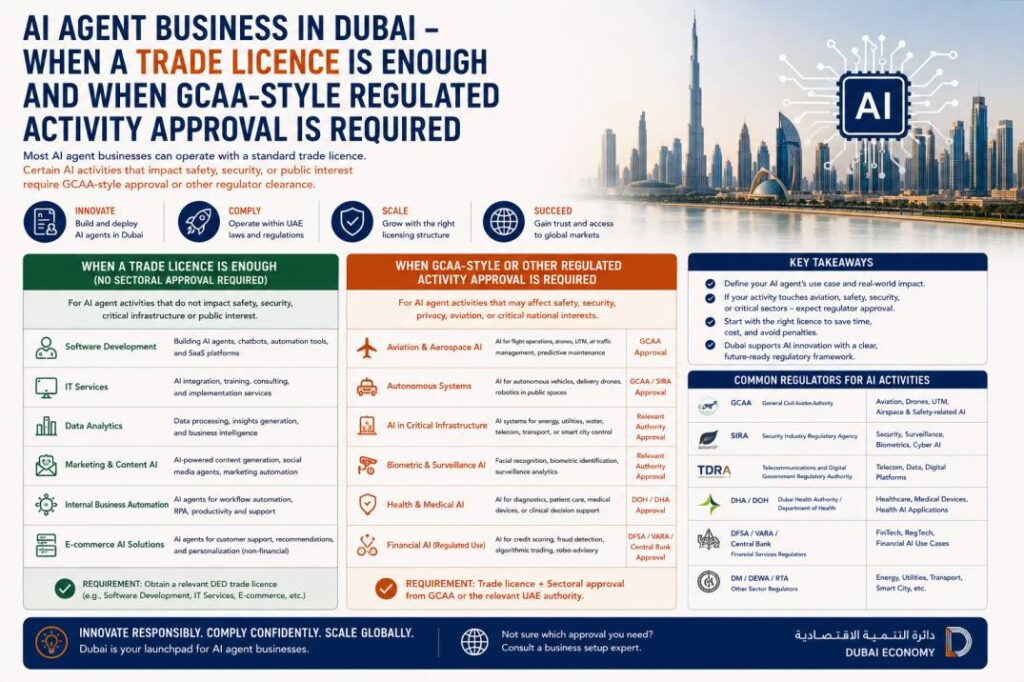
Every setup guide tells you to choose your business activity. None of them mention that no UAE authority publishes an activity called AI agent services.
What exists are established activity categories: software development and design, IT consultancy, computer systems and software design, management consultancy, and various artificial intelligence and data services activities depending on the authority. An AI agent business in Dubai gets licensed under one or more of those.
Two things matter far more than which label you pick.
Your licence has to match what you actually do. If your licence says consultancy and your website sells a subscription product, that mismatch surfaces at the bank, not at the licensing authority. It is a common reason agent businesses stall at account opening.
What your agent does can pull you into a regulated activity. An agent that books appointments is unregulated. An agent that gives investment recommendations, handles client funds, provides medical triage, or makes lending decisions is not, regardless of what your trade licence says. The activity is judged by the function performed, not by the technology performing it. This is the single most expensive thing to get wrong, because discovering it after launch means either restructuring or shutting down a live product line.
Before you file anything, write down in one sentence what your agent will be permitted to do without a human approving it. That sentence, not the activity list, is what determines your licensing path.
Mainland or Free Zone for an Agent Business
The short version, because the full comparison sits in a separate piece.
Mainland makes sense when your customers are UAE companies. You can contract with mainland businesses and government entities directly, and there is no restriction on where in the UAE you serve clients.
Free zone makes sense when your customers are mostly outside the UAE, or in other free zones, and when you want lower fixed cost in year one.
For an AI agent business in Dubai specifically, one factor tips the decision more than cost. If a meaningful share of your pipeline is Dubai government or semi-government work, mainland plus Dubai AI Seal certification is the path that actually opens those doors.
The full comparison, including the corporate tax consequences of each, is in the difference between mainland and free zone companies in the UAE, and the zone-by-zone breakdown for technology companies is in best free zones in UAE for AI and technology companies.
The Rules That Actually Apply to Agents
This is where an AI agent business in Dubai diverges hardest from a generic technology setup, and where most published guidance is either silent or out of date.
EU AI Act Article 50: already in force, and it reaches you
If your agent interacts with a person in the EU, or its output is used in the EU, the EU AI Act applies to you regardless of where your company is registered.
Here is the part most published guidance now gets wrong. Regulation (EU) 2026/1744, the Digital Omnibus on AI, was published in the Official Journal on 24 July 2026 and entered into force on 27 July 2026. It moved the high-risk obligations for Annex III systems from 2 August 2026 to 2 December 2027, and Annex I product-embedded systems to 2 August 2028.
It did not move Article 50. The transparency obligations, which require that a person be told when they are interacting with an AI system and that AI-generated content be labelled, applied from 2 August 2026 as originally scheduled. For systems already on the market at that date, the specific watermarking requirement under Article 50(2) was given until 2 December 2026.
For an agent business, Article 50 is the operative rule, not the high-risk regime. A customer service agent handling EU enquiries has a disclosure duty today. A guide telling you that you have until 2027 is reading the wrong provision.
DIFC Regulation 10
DIFC has the only regulation in the region written specifically for autonomous and semi-autonomous systems. Regulation 10 of the DIFC Data Protection Regulations has been in force since 1 September 2023 and reached full enforcement on 1 January 2026. It imposes documented impact assessment, transparency and record-keeping duties, and requires certification plus the appointment of an Autonomous Systems Officer before high-risk processing.
If you are registered in DIFC, this applies to you directly. If you are not, it still matters commercially, because DIFC-based clients will push those obligations down to you through their vendor contracts.
UAE data protection
Federal Decree-Law No. 45 of 2021 on Personal Data Protection governs processing of UAE residents’ personal data. The practical issue for agent businesses is routine and easy to miss. If your agent calls a model API hosted outside the UAE, you are transferring personal data across a border every time it runs. That needs a lawful basis and contractual safeguards, and it needs to be documented before a client’s compliance team asks, not after.
Corporate Tax: Services Versus Owned Software
A short section, because the full analysis sits in another post.
Free zone companies pay 0% corporate tax only on Qualifying Income. Ministerial Decision No. 229 of 2025 lists 13 Qualifying Activities, and software development, AI services and IT consultancy are not among them. An agency-model AI agent business selling implementation services is earning non-qualifying income and pays 9%.
Owned software is treated differently. Cabinet Decision No. 100 of 2023 defines copyrighted software as Qualifying Intellectual Property, which means a product-model agent business that owns its code has a route to 0% on a nexus-adjusted portion that a services business does not.
That is a genuine argument for building a product rather than selling hours, and it is a tax argument, not a strategy platitude. The mechanics, including the substance requirements and the five-year lockout for a failed condition, are set out in best free zones in UAE for AI and technology companies.
R&D Tax Credit or Small Business Relief, Not Both
On 18 March 2026 the UAE launched Phase 1 of its R&D Tax Incentives Programme through Ministerial Decision No. 24 of 2026, implementing Cabinet Decision No. 215 of 2025. It applies to tax periods beginning on or after 1 January 2026 and offers a non-refundable credit of up to 50% of eligible R&D expenditure, capped at AED 5 million.
Two conditions decide whether it is relevant to you, and both cut against the typical agent business.
The work has to be genuine research and development. Under Ministerial Decision No. 24 of 2026, a qualifying activity must be novel, creative, uncertain in outcome, systematic, and transferable or reproducible. Wiring together existing model APIs to automate a client workflow is competent engineering. It is not novel or uncertain in the sense the decision means. Building your own orchestration layer, evaluation framework or fine-tuned models may be.
You cannot combine it with Small Business Relief. Entities that elected Small Business Relief are excluded from the R&D Tax Credit. Since Small Business Relief runs to 2029 and gives an effective 0% position under AED 3 million of revenue, most early-stage agent businesses will be better off with the relief. But if you are running a real research programme with meaningful UAE staff costs, that default deserves to be modelled rather than assumed.
Neither of these is a reason to pick one today. It is a reason to know which one you are aiming at before your first tax return, because the election happens there.
The Dubai AI Seal, and Why It Matters More Than a Licence Upgrade
The Dubai Centre for Artificial Intelligence, under the Dubai Future Foundation, runs a certification called the Dubai AI Seal. Companies are assessed on activities and services, number of AI-specialist employees, current and future projects, and public and private sector partnerships, then classified across six tiers from E up to S.
Three facts make this worth your attention early. It is a prerequisite for participation in Dubai government AI projects. Applications are free. And by the time of the last published figure, 325 companies operating in Dubai had applied, with e& and IBM among the first awarded Tier S.
For a new entrant, Tier E is realistic and Tier S is not. That is fine. The value is being inside the certified network at all, because it converts a claim about doing AI into a verifiable one during procurement, which is exactly what a young company selling autonomous systems to a cautious buyer needs.
What an AI Agent Business in Dubai Actually Costs
Published figures for AI company setup in Dubai range from roughly AED 12,000 to AED 50,000 depending on jurisdiction, visa count and office type. That range is so wide it is close to useless as a planning number, so here is how to make it useful.
Ask for a quote itemised across five lines, not one: the licence fee, the visa cost per person including medical and Emirates ID, the office or flexi-desk requirement, the renewal cost in year two, and the annual audit fee if you are pursuing Qualifying Free Zone Person status.
For an agent business specifically, budget for three costs that a standard setup quote will not include. Professional indemnity insurance, which enterprise clients increasingly require in the contract. Model API and compute spend, which is a cost of goods sold rather than an overhead and scales directly with usage. And legal review of your client contract template, which for this business model is not optional.
The honest counterweight: the licence is the cheapest part. A founder who budgets AED 20,000 for setup and nothing for insurance, compute or contracts has not budgeted for the business.
Liability: The Question Founders Ask Too Late
When an agent you built sends a wrong quote to a client’s customer, cancels the wrong booking, or emails the wrong list, who pays?
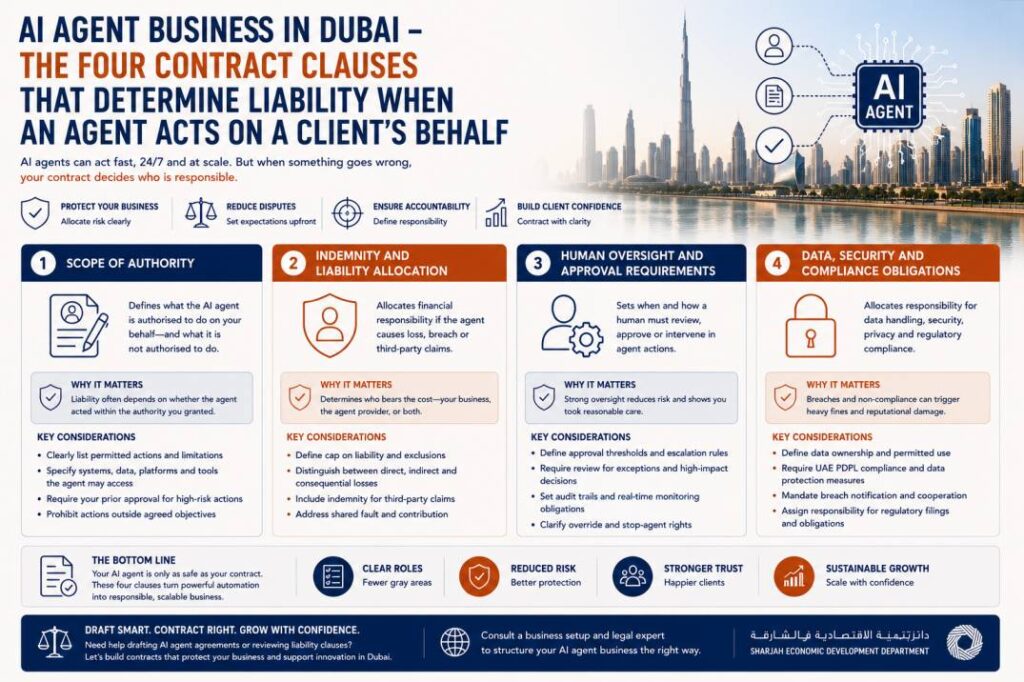
For an AI agent business in Dubai, that question has no default answer in UAE law specific to autonomous systems. It is answered by your contract, which makes the contract a core product decision rather than paperwork.
Four clauses do most of the work. A scope definition stating exactly which actions the agent may take without human approval. A human-in-the-loop requirement for the categories where an error is expensive, meaning financial commitments, legal notices, and anything irreversible. A liability cap tied to fees paid rather than to client losses. And a logging and audit provision, which protects you as much as the client, because a complete action log is what lets you prove what the agent actually did.
Outcome-based pricing raises this exposure sharply. If you charge per resolved ticket, you have contracted for a result, and the argument that you merely supplied a tool becomes much harder to make. That is not a reason to avoid the model. It is a reason to price the risk into it.
My Approach: Pricing the Risk Before the Licence
Most business setup consultants help you register a company. I help you make informed business decisions before you invest.
For an AI agent business in Dubai, the setup conversation that matters is not which free zone is cheapest. It is one question asked first: what will your agent be allowed to do without a human approving it? The answer determines your activity selection, whether you touch a regulated function, whether Article 50 disclosure applies to you, what your contract has to cap, and whether you are a services business paying 9% or a product business with a route to 0%. Get that sentence right and the licence decision takes twenty minutes. Get it wrong and you find out from a bank, a client’s legal team, or a regulator.
My advisory process focuses on helping you reduce uncertainty and make confident decisions, not just complete documentation. Here is what that looks like in practice.
- Idea validation against what your agent will actually be permitted to do, and whether that function is regulated.
- Market research on which Dubai sectors are buying agent deployments today rather than piloting them.
- Competitor analysis across the agencies and vertical products already selling into your target sector here.
- Business model assessment, specifically whether agency, product or outcome-based pricing fits your risk tolerance.
- Startup cost estimation covering licence, visas, compute, insurance and contract review together, not one number at a time.
- Financial feasibility modelling including compute as a cost of goods sold, which most AI business plans understate.
- A structure recommendation matched to where your customers actually are.
- Licence and activity selection that matches what your agent does, not just what you call it.
- Corporate tax registration and filing planning, including the R&D Tax Credit versus Small Business Relief decision before your first return.
- Investor and employment visa planning for the engineering talent you need to bring in.
- Banking strategy, since AI businesses now face specific questions about data sources and storage during account opening.
- Risk assessment covering data residency, cross-border model calls, client liability and audit logging.
The objective is simple: help you start your business with clarity, confidence and a long-term strategy.
Is This the Right Business for Your Situation?
An AI agent business in Dubai is a good fit when you have a specific industry you understand well, a workflow inside it you can describe end to end, and a first client willing to pay before you build. The technical part is the commodity now. The domain knowledge and the client relationship are not.
It is a poor fit when the plan is to build a general-purpose agent and find the buyers afterwards, when you have no route to a first customer, or when the appeal is mainly that the category is fashionable. Dubai is a good place to build this business. It is not a place where the category alone sells.
If you want to test the specific idea before you pay a registration fee, review business setup services or get in touch, and we will start with what your agent is allowed to do.
Frequently Asked Questions
What licence do I need for an AI agent business in Dubai?
There is no dedicated AI agent activity. You license under existing categories such as software development, IT consultancy or artificial intelligence services, depending on the authority. What matters more is whether the function your agent performs falls into a regulated area such as financial advice, lending, healthcare or legal services, which requires separate authorisation regardless of your trade licence.
Does the EU AI Act apply to a Dubai company?
Yes, if your agent is placed on the EU market or its output is used in the EU. The Act is extraterritorial. Article 50 transparency obligations, which require disclosing that a person is interacting with an AI system, took effect on 2 August 2026 and were not postponed by the Digital Omnibus.
Was the EU AI Act deadline delayed to 2027?
Partly. Regulation (EU) 2026/1744 entered into force on 27 July 2026 and moved Annex III high-risk obligations to 2 December 2027 and Annex I obligations to 2 August 2028. Article 50 transparency duties, the prohibited practices regime and the general-purpose AI obligations were not delayed.
Do AI agent businesses pay 0% corporate tax in a UAE free zone?
Usually not on service revenue. AI and software services are not among the 13 Qualifying Activities in Ministerial Decision No. 229 of 2025, so an agency-model agent business generally pays 9%. A product business earning income from its own copyrighted software has a route to 0% on a nexus-adjusted portion.
Can I claim the UAE R&D Tax Credit for building AI agents?
Only if the work meets the qualifying criteria in Ministerial Decision No. 24 of 2026: novel, creative, uncertain, systematic and reproducible. Integrating existing model APIs into client workflows generally does not qualify. Building original orchestration, evaluation or model work may. Businesses that elected Small Business Relief are excluded from the credit entirely.
Is the Dubai AI Seal mandatory?
Not for operating. It is a prerequisite for participation in Dubai government AI projects, and applications are free, so for any company targeting public sector work it is effectively required. Companies are classified across six tiers from E to S.
Who is liable if my AI agent makes a mistake for a client?
There is no UAE law assigning liability specifically for autonomous systems, so it is determined by your contract. A scope definition, a human-in-the-loop requirement for irreversible actions, a liability cap tied to fees paid, and complete action logging are the four provisions that decide the answer in practice.
Sources & References
- UAE Government – Tax Incentives for Innovation-Driven Businesses
- Ministry of Finance – Ministerial Decision No. 24 of 2026 on R&D Tax Credit
- Ministry of Finance – Cabinet Decision No. 215 of 2025 on R&D Tax Credit
- Ministry of Finance – Ministerial Decision No. 229 of 2025 on Qualifying and Excluded Activities
- DIFC – Regulation 10 on Personal Data Processed Through Autonomous and Semi-Autonomous Systems
- Dubai Future Foundation – Dubai AI Seal