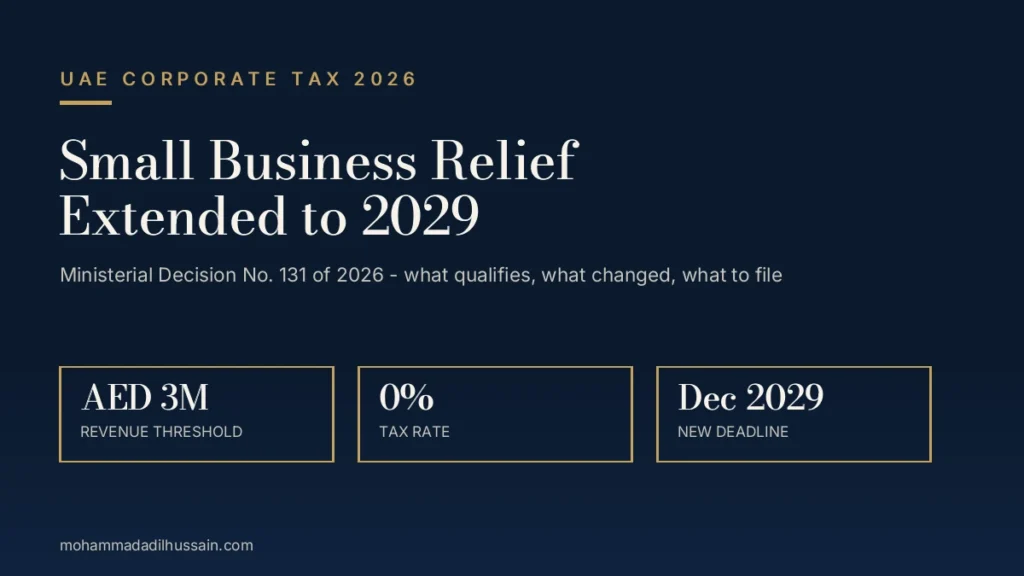
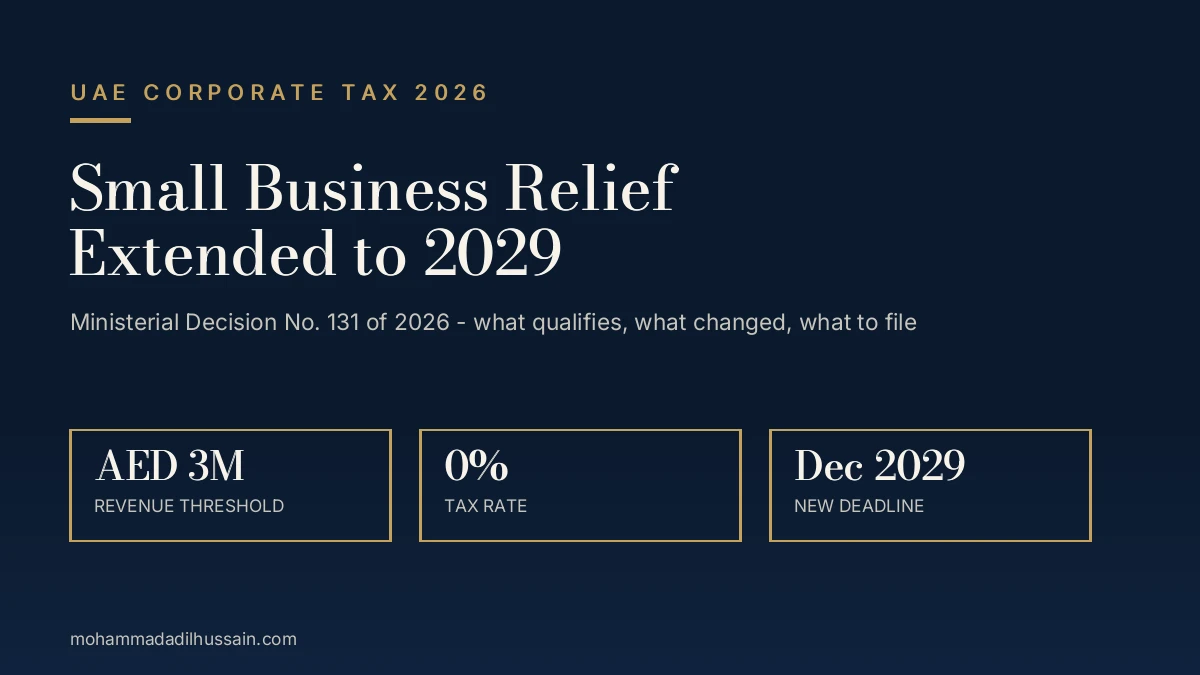
UAE Small Business Relief 2029 is now official: Ministerial Decision No. 131 of 2026 gives businesses under AED 3 million in revenue three more years of 0% corporate tax – but only if they handle the paperwork correctly.
Quick Answer
- The extension is official via Ministerial Decision No. 131 of 2026: businesses under AED 3 million in revenue get three more years of 0% corporate tax, through 2029.
- Relief is elective, not automatic. You must actively claim it when filing, and missing the deadline forfeits it for that period.
- A lookback trap exists: prior-period revenue can disqualify a business even if current-period revenue sits under the threshold.
- Free zone businesses usually skip this relief, since Qualifying Free Zone Person tax treatment is generally more valuable when both are available.
- Missing your filing deadline has real consequences beyond losing the relief itself.
In this guide
On 7 August 2026, the UAE Ministry of Finance issued Ministerial Decision No. 131 of 2026, and it quietly solved a problem that had been sitting on the calendar of every small business owner in the country: Small Business Relief, the mechanism that lets qualifying businesses pay 0% corporate tax, was due to expire on 31 December 2026. It now runs through tax periods ending on or before 31 December 2029.
That is genuinely good news. It is also the kind of announcement that gets summarised in a two-line WhatsApp forward and then misunderstood by the people it is meant to help. The relief itself has not changed. The threshold has not changed. What changed is how long you have to use it properly – and “properly” is doing a lot of work in that sentence.
Here is what UAE Small Business Relief 2029 actually means, who qualifies, the trap that catches businesses that do not read the fine print, and what I would tell you if you sat across from me asking whether this changes your plans.
What Ministerial Decision No. 131 of 2026 Changed
UAE Small Business Relief 2029 traces back to Ministerial Decision No. 73 of 2023, which first introduced the relief, and it lets eligible resident taxable persons elect to be treated as having zero taxable income for a given tax period. In plain terms: no 9% corporate tax bill, provided you qualify and you file correctly. Filing correctly matters more than it used to, because the new UAE anti-evasion tax laws changed what happens when you do not.
It was originally scoped to tax periods commencing on or after 1 June 2023 and ending on or before 31 December 2026 – a roughly three-and-a-half-year runway meant to give startups and micro businesses room to get established before the standard tax regime kicked in. Ministerial Decision No. 131 of 2026 extends that runway by another three years, to 31 December 2029, without altering the underlying mechanics. The AED 3 million revenue threshold stays exactly where it was. The election process stays the same. What you get is more time.
The Ministry framed the move as support for “small businesses and start-ups” and an effort to “strengthen the business environment” – language that matches what advisors on the ground have been asking for since the original 2026 sunset date started showing up in client planning conversations last year.
Who Actually Qualifies for the AED 3 Million Relief
Two conditions decide whether you can elect Small Business Relief:
- Resident status. You must be a juridical or natural person resident in the UAE for Corporate Tax purposes.
- The AED 3 million threshold. Gross revenue for the current tax period, and every tax period before it, must not exceed AED 3,000,000 (roughly USD 816,880).
Two categories are excluded regardless of revenue. Qualifying Free Zone Persons cannot elect Small Business Relief – more on why below – and neither can members of a Multinational Enterprise Group whose consolidated group revenue exceeds AED 3.15 billion, even if the specific UAE entity’s own revenue is small. Revenue, for this test, means gross revenue: everything you invoiced or received before deducting costs, salaries, rent, or anything else. It is not net profit and it is not taxable income.
The Lookback Trap Nobody Explains Clearly
This is the part that catches people. The AED 3 million threshold is not tested year by year in isolation – it is tested cumulatively, against every tax period since the relief window opened. Once your revenue exceeds AED 3 million in any single tax period, Small Business Relief becomes permanently unavailable for the rest of the relief window. Not just for that year. For every year after it too, even if revenue drops straight back down.
Picture a small trading business doing AED 2.2 million in 2026, AED 2.6 million in 2027, then a strong year at AED 3.2 million in 2028 – a single busy quarter tips them over. Even if 2029 comes in at AED 1.5 million, they are out. There is no reset button, and there is no partial-year proration that saves you. If growth is part of your plan for the next few years, it is worth modelling out where AED 3 million actually sits relative to your trajectory, rather than assuming this year’s number is the only one that matters.
Relief Is Elective, Not Automatic
The most common misconception I hear from business owners under the AED 3 million mark is that being small means they can more or less ignore the Federal Tax Authority. On 3 August 2026, the FTA issued a reminder that says the opposite, plainly: eligibility for the relief does not remove the obligation to file.
Small Business Relief is an election you make, not a status you are automatically granted. To actually get the 0% outcome, you need to:
- Register for Corporate Tax and hold a valid Tax Registration Number, regardless of how small your revenue is.
- Keep clean financial records that can demonstrate your revenue stayed under the threshold if the FTA ever asks.
- File a simplified Corporate Tax return within nine months of your tax period ending, and actively elect Small Business Relief within that return.
The FTA’s own example is a useful gut-check on timing: registrants with a financial year ending 31 December 2025 need to file by 30 September 2026. If UAE Small Business Relief 2029 applies to your business, this is not a someday task – depending on when you are reading this, it may already be a matter of weeks.
What Happens If You Miss the Deadline
Under Cabinet Decision No. 129 of 2025, the FTA’s administrative penalty framework got simpler and, in some ways, tougher. Missing your Corporate Tax registration deadline can trigger an AED 10,000 penalty. The FTA has, at points, run time-limited waiver or credit initiatives for businesses that register within a grace window, so it is not universally unavoidable – but you should not plan around a waiver existing when yours comes due, because it applies in full once that window closes.
Late tax payments now accrue a flat 14% annualised interest rate, calculated monthly on the outstanding balance – simpler than the old structure of 2% on the due date plus 4% per month, but no gentler on your cash flow if a filing slips. And critically: filing late does not just cost you a penalty. It can forfeit your Small Business Relief election for that period entirely, even if your revenue would otherwise have qualified you for 0% tax.
Why Free Zone Businesses Usually Skip This Relief
If you are operating in a UAE free zone and qualify as a Qualifying Free Zone Person, you cannot elect Small Business Relief at all – the two regimes are mutually exclusive. In most cases that is fine, because the QFZP route already offers 0% tax on qualifying income, with no AED 3 million ceiling attached to it. But QFZP status is not automatic either. It requires demonstrable commercial substance: real operations, decision-making, and adequate expenditure inside the zone, not a licence and a mailbox. The FTA has been explicit that paperwork alone does not satisfy this test.
The practical decision, then, is not “which regime sounds better” – it is which one your actual business, revenue mix, and customer base genuinely qualify for, and that is a structuring question, not a marketing one.
My Approach to Small Business Relief Planning
Most business setup consultants help you register a company. I help you make informed business decisions before you invest.
Small Business Relief is a good example of why that distinction matters. On the surface it looks like a simple revenue test – stay under AED 3 million, tick a box, done. In practice, it intersects with your structure decision (mainland vs free zone), your growth plan (the lookback trap), your banking setup, and your filing discipline, all at once. I would rather walk through those together before you commit to a structure than have you discover the interaction six months into a tax period you cannot undo.
My approach is to start with strategy, not paperwork: understand what you are actually building, model your realistic revenue path against the AED 3 million line, and only then decide whether Small Business Relief, the standard 9% regime, or a Qualifying Free Zone Person structure fits your business. Successful businesses are not built by chance – they are built on decisions made with the full picture in front of you, and getting your UAE corporate tax registration and filing right from day one is part of that picture, not an afterthought bolted on once you are already operating. If your current setup has left compliance as a Year 2 problem, that is usually the first thing worth revisiting through ongoing corporate compliance support.
What This Means If You Are Setting Up in the UAE in 2026
If you have been holding off on a UAE market entry because the original 2026 sunset date made the numbers feel tight, this extension changes the calculus. Three more years of a 0% tax runway is a meaningful head start for a business trying to reach profitability before the standard rate applies.
But the relief itself should never be the reason you choose a structure. Whether you land on a mainland company, a free zone entity, or an offshore holding structure depends on where your customers are, whether you need to trade directly with the UAE mainland, and what your banking and visa needs look like – questions I walk through in detail in mainland vs free zone vs offshore. Small Business Relief and the standard AED 375,000 zero-rate band both apply across mainland and free zone structures alike, so it should be the last variable in your decision, not the first.
Once the structure is settled, the sequencing that actually protects your tax-free years is straightforward: get your UAE corporate bank account open early, register for Corporate Tax immediately rather than waiting for your first invoice, and build your bookkeeping so revenue-tracking against the AED 3 million line is a five-minute check, not a year-end scramble. If you want a second opinion on where you stand, start with a strategy conversation rather than a licence quote.
Frequently Asked Questions
What is UAE Small Business Relief 2029 and how long has it been extended?
Small Business Relief lets eligible UAE resident businesses with annual revenue up to AED 3 million elect to be treated as having zero taxable income for corporate tax purposes. Ministerial Decision No. 131 of 2026, issued on 7 August 2026, extends the relief from its original 31 December 2026 sunset date to tax periods ending on or before 31 December 2029.
Do I automatically get Small Business Relief if my revenue is under AED 3 million?
No. Small Business Relief is elective, not automatic. You must register for Corporate Tax, keep records proving your revenue, and actively elect the relief when you file your simplified Corporate Tax return – the FTA confirmed this again on 3 August 2026.
What is the lookback rule for Small Business Relief?
The AED 3 million threshold is tested against the current tax period and every prior tax period. If your revenue exceeds AED 3 million in any single period, you lose eligibility permanently for the rest of the relief window, even if revenue later drops back below the threshold.
Can free zone companies claim Small Business Relief?
Only if they are not applying the 0% Qualifying Free Zone Person rate on qualifying income, since the two regimes are mutually exclusive. Most free zone businesses that meet the QFZP commercial substance test use that route instead, since it has no AED 3 million ceiling.
What happens if I miss my Corporate Tax filing deadline?
You risk an AED 10,000 late-registration penalty and a flat 14% annualised interest charge on any outstanding tax, calculated monthly under Cabinet Decision No. 129 of 2025 – and you can forfeit Small Business Relief for that period even if your revenue qualified.
Related reading: the UAE e-commerce tax trap most free zone plans miss.
Related reading: mainland vs free zone: what actually matters in 2026.
Related reading: why UAE non-oil growth matters for your market entry timing.