Quick Answer: Most UAE business setup mistakes aren’t about picking the wrong provider, they’re decisions founders make alone, before or during formation, that a good advisor would have flagged. Wrong activity codes, a free zone that can’t reach mainland clients, corporate tax exposure discovered at filing time, visa costs left out of the budget. None of these require bad intentions from anyone, just a structure decided before the business was fully understood. Below are 12 of the most common ones, and what avoiding each actually looks like.
In this guide
Why These UAE Business Setup Mistakes Happen to Careful Founders Too
None of the mistakes below come from carelessness. They come from sequencing: forming the company before fully mapping the business, or trusting a headline price or a fast timeline over a slower, more thorough structure conversation. A good advisor’s job is to catch these before formation, not after. This list isn’t about vetting a provider, I’ve written that one already, it’s 10 signs of a licence seller, not a business advisor. This is about the decisions themselves, the ones worth getting right regardless of who you’re working with.
12 Mistakes a Good Business Setup Advisor Should Help You Avoid
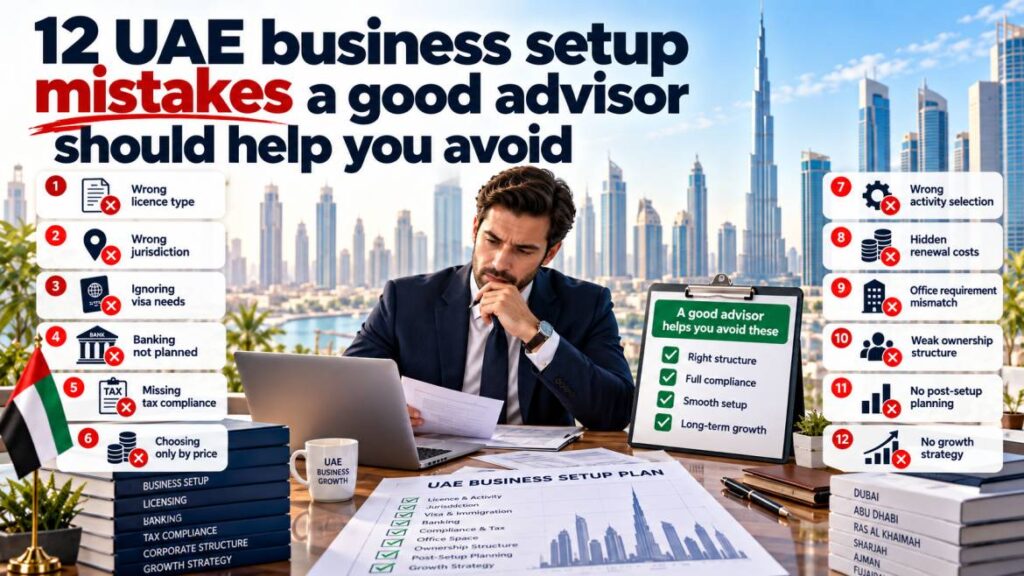
1. Choosing a free zone before confirming you need mainland trading access
Some free zone structures restrict direct trade with the UAE mainland market without an additional distributor arrangement. This is one of the most common UAE business setup mistakes because it’s invisible at signing, it only surfaces the first time a mainland client wants to contract directly. Covered in more depth in Mainland vs Free Zone vs Offshore in the UAE.
2. Picking activity codes too narrowly for what the business actually does
This is one of the quieter UAE business setup mistakes because it looks cheaper upfront. A licence built around one or two generic activities gets expensive the moment the business needs a third. Amendment fees to add an activity later frequently cost more than choosing the full, correct list would have cost at formation.
3. Ignoring corporate tax exposure until filing time
A free zone company doesn’t automatically pay 0% corporate tax, only a Qualifying Free Zone Person receives 0% on Qualifying Income, covered in UAE Corporate Tax Registration & VAT Filing. Founders who assume “free zone means tax-free” often discover the real position only when the first return is due, well after the choices that determined it were made.
4. Budgeting the licence fee without the visa cost
Headline licence prices are almost always zero-visa figures. Adding the one residency visa most founders actually need can more than double the real first-year cost, a pattern covered in why the cheapest UAE business licence may not be the right setup.
5. Not checking which specific free zone authority a “cheap zone” name actually refers to
Several emirates have more than one free zone authority, sometimes with meaningfully different rules under a similar-sounding name. Confirming the exact authority, not just the emirate, before comparing prices avoids comparing two different products as if they were one.
6. Delaying the bank account conversation until after formation
No provider can guarantee bank account approval, that decision sits with the bank’s own compliance process, but a founder who starts the conversation only after the licence is issued has usually lost weeks that could have been used preparing a stronger application, covered further in Banking & Financial Services.
7. Underestimating office or Ejari requirements for the licence type chosen
Some licence categories require a physical office or specific tenancy documentation beyond a flexi-desk, particularly for certain mainland activities. Discovering this after formation means an unplanned second cost and a delay before the company can operate as intended.
8. Not tracking the VAT registration threshold from day one
VAT registration becomes mandatory once taxable turnover crosses the federal threshold set by the UAE Federal Tax Authority, and voluntary registration is available earlier. Missing this is one of the UAE business setup mistakes that compounds quietly, since penalties accrue from the date registration should have happened, not the date it is caught. Founders who don’t track this from the first invoice sometimes cross the threshold without noticing, creating a compliance gap that’s more expensive to fix retroactively than to have registered on time.
9. Treating bookkeeping as a year-two problem
Corporate tax filing, audit requirements in some structures, and VAT records all depend on financial records that should have started on day one. Reconstructing a year of transactions from bank statements right before a filing deadline is avoidable, and expensive when it isn’t avoided.
10. Choosing a structure that doesn’t accommodate future investors or co-founders
Among UAE business setup mistakes, this one is the hardest to see coming. A structure that works cleanly for a solo founder can create friction the moment a second shareholder, an investor, or an ESOP pool needs to be added. Confirming the likely ownership path in the next two to three years before choosing a structure avoids a costly restructuring later.
11. Not confirming the trade name is available before committing to a package
Trade name conflicts and naming rule violations (certain words are restricted or require additional approval) are simple to check early and disruptive to discover after a deposit is paid and paperwork is underway.
12. Signing before asking what happens after the licence is issued
Formation is the fast part. Tax registration, renewals, and ongoing compliance are where founders most often need support, and it’s worth knowing before you sign whether that support continues or ends at the point of formation. The full 12-question script for that conversation is in how to choose a business setup partner in Dubai.
The Pattern Behind Most of These
Almost every one of these UAE business setup mistakes traces back to the same root cause: the structure got decided before the business model was fully mapped. Fixing that sequencing problem, business model first, then structure, then price, prevents most of the list at once. That’s the same principle covered from a different angle in business setup consultant vs advisor in the UAE.
My Approach: Catching These Before Formation, Not After
Most of this list gets caught in the first real conversation, before any structure is chosen. What are you selling, to whom, what does growth look like in two years, and what does the full first-year cost actually include. Structure and provider comparison come after that, not before it.
I’d rather spend an extra thirty minutes on this upfront than have a founder discover an avoidable mistake at tax filing time. The fuller case for this approach is in why founders choose to work with me.
If you’ve already formed your company and want a second opinion on whether any of these apply to you, get in touch and I’ll take a straight look.
Frequently Asked Questions
What’s the single most common UAE business setup mistake?
Choosing a free zone or structure before confirming whether the business needs mainland trading access. It’s invisible at signing and only surfaces once a mainland client wants to contract directly.
Can these mistakes be fixed after formation?
Most can, but almost always at a higher cost than getting them right the first time, whether that’s an activity amendment, a jurisdiction change, or a retroactive VAT registration.
Do I need a lawyer to catch these, or is a business setup advisor enough?
A genuine business setup advisor should catch most of these during the initial structure conversation. A lawyer becomes necessary for specific contractual or dispute matters, not for standard formation planning.
Is it too late to check for these mistakes if my company is already formed?
No. Most can still be reviewed and corrected, some more easily than others. The cost of fixing them tends to rise the longer they go unaddressed, so a review sooner rather than later is worth it.
Which of these mistakes is the most expensive to fix later?
Choosing the wrong jurisdiction for mainland trading access and missing VAT registration deadlines tend to be the costliest, since both carry compounding costs the longer they go uncorrected.
How do I know if my current structure has one of these problems?
Compare your current setup against this list directly, mainland access, activity scope, tax position, VAT status, and bookkeeping. Anywhere you’re unsure is worth a second opinion.
Does this apply to mainland companies too, or only free zone ones?
Most of these apply to both. Tax exposure, VAT thresholds, bookkeeping, activity codes, and trade name checks matter regardless of whether the company is mainland or free zone.