Quick Answer
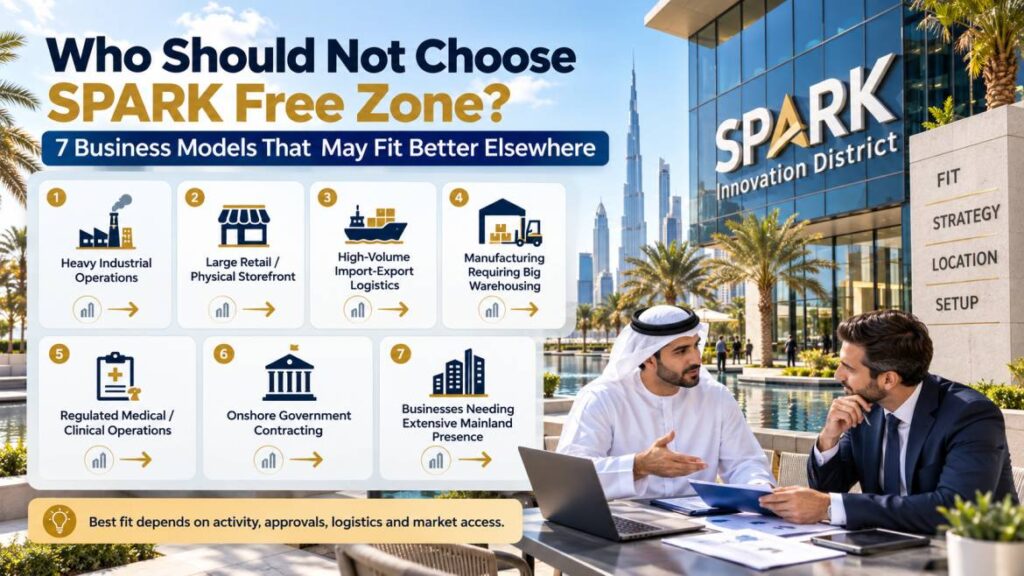
Choosing SPARK free zone, still widely searched for under its former name, SRTIP free zone, only makes sense for research, technology and innovation-classified activity, and that focus is exactly why it’s the wrong fit for seven common business models: retail storefronts, restaurants and F&B outlets, general trading needing bonded warehousing at scale, real estate brokerage, direct-patient-care clinics, media production, and high-volume industrial manufacturing. None of these are lesser businesses, they simply need infrastructure, licensing authority or customer-facing access that a research and innovation park isn’t built to provide. Here’s each one, and where it actually fits instead of choosing SPARK (SRTIP) free zone by default.
Table of Contents
1. Retail Storefronts and Walk-In Shops
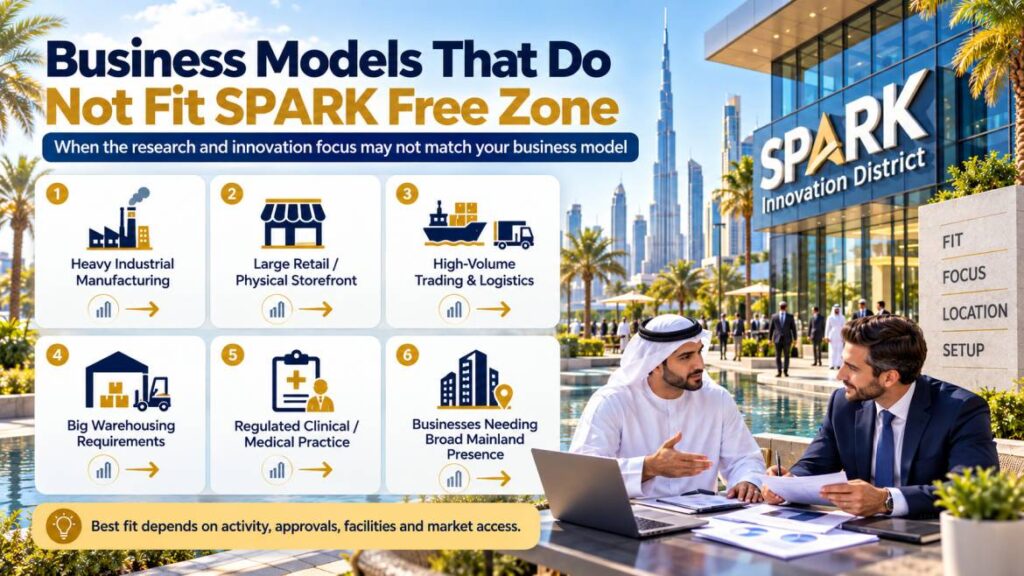
A business that depends on street-level or mall footfall needs retail-zoned premises, something a research and innovation park isn’t set up to lease. SPARK free zone physical presence options run from flexi-desks to lab and prototyping space, covered in what SoiLAB SRTIP actually offers, neither of which substitutes for a shopfront. A retail concept generally fits SAIF Zone or a mainland retail licence with proper storefront zoning far better.
2. Restaurants and F&B Outlets
Food and beverage businesses need commercial kitchen infrastructure and municipal food safety licensing tied to a specific physical premises, neither of which a research park’s standard office or lab space is built around. This isn’t a licence-category problem so much as an infrastructure one, no formation structure changes the fact that the physical space itself needs a commercial kitchen fit-out and health authority sign-off.
3. General Trading at Import-Export Scale
A trading business moving physical goods at volume needs customs-bonded warehousing and proximity to port or airport logistics infrastructure. SPARK free zone is built around R&D and technology-classified activity, not bulk goods movement, covered from the full Sharjah comparison angle in five Sharjah free zones, one confusing choice, where SAIF Zone is the clearer fit for trading, logistics and e-commerce fulfilment with real infrastructure behind it. The UAE government’s own free zones guidance is a useful independent check on which zones are actually licensed for bonded trading activity before assuming SPARK free zone covers it.
4. Real Estate Brokerage
Real estate brokerage activity is generally regulated by a specific real estate regulatory authority tied to the emirate and often the mainland, not issued as a standard free zone activity in the way a consultancy or research licence is. A SPARK free zone company formed around this activity typically can’t practise brokerage the way the business model actually needs to, which makes this one of the clearer mismatches on this list.
5. Direct-Patient-Care Clinics
This is a genuine nuance, not a blanket rule. Medical devices, AI-driven healthcare solutions, hospital technology and insurtech businesses fit SPARK free zone well, covered in full in SRTIP for healthcare, medtech and insurtech. A clinic providing direct patient care is a different business entirely, it needs facility-level licensing from the relevant health authority tied to the specific physical premises where patients are treated, a regulatory layer a free zone company formation doesn’t confer on its own regardless of sector fit.
6. Media Production and Broadcast Businesses
Media production, broadcast and content licensing has its own dedicated Sharjah free zone built specifically around it. SHAMS offers media, consultancy and freelance activities at a lower realistic entry cost than SPARK free zone, and its licensing framework is purpose-built for media businesses in a way SPARK’s research and technology focus isn’t, again covered in the full Sharjah free zone comparison.
7. High-Volume Industrial Manufacturing
Here too, the distinction is about scale, not sector. Design and engineering-led advanced manufacturing, aerospace and automotive work, precision components, simulation, prototyping, genuinely fits SPARK free zone, covered in SRTIP for advanced manufacturing, aerospace and automotive. A business that needs a full production-line factory floor at industrial volume needs the larger dedicated industrial infrastructure a zone like Hamriyah is built around, not a research park’s prototyping and lab facilities.
What Actually Does Fit SPARK Free Zone
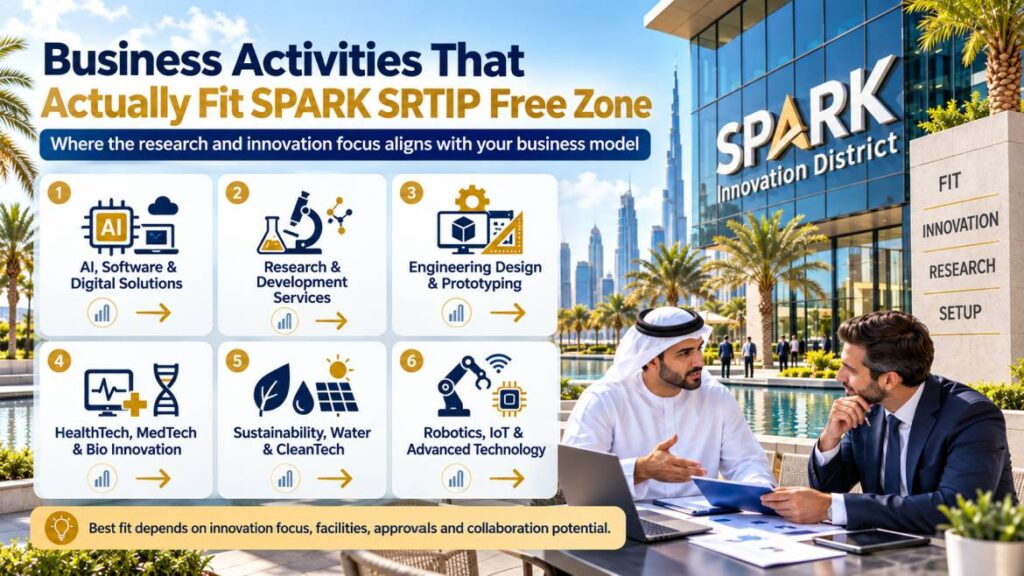
None of this makes SPARK free zone a narrow or weak option, it means its strength is specific: R&D, technology, consultancy and research-classified activity across sectors from AI and software to healthcare technology, sustainability, mobility and advanced manufacturing engineering work. I’ve written the sector-specific fit for each of these in detail, and the pattern across all of them is the same: choosing SPARK free zone works for businesses producing ideas, software, research or engineering-led technology, not businesses that need physical customer footfall, bulk goods infrastructure, or facility-level regulatory licensing tied to a specific premises.
My Approach: When SPARK Free Zone Is the Wrong Fit
Most business setup content is written to make every free zone sound like the right answer for every business. I’d rather tell a founder SPARK free zone isn’t the fit and point them to SAIF Zone, SHAMS, Hamriyah or a mainland licence, covered in the full comparison, than form a company that can’t actually operate the way the business needs to. The fuller case for working this way is in why founders choose to work with me, and the honest cost-versus-fit trade-off behind this is covered in the cheapest UAE business licence may not be the right setup.
If you’re not sure whether SPARK free zone genuinely fits what you’re building, or you suspect it might not, get in touch.
Frequently Asked Questions
Is SPARK a bad free zone for these seven business models?
No, SPARK free zone is strong for its intended focus, research, technology and innovation-classified activity. These seven models simply need infrastructure or licensing that a research park isn’t built to provide.
Can a healthcare business ever fit SPARK?
Yes, medical devices, healthcare technology and insurtech businesses fit well. The distinction is direct patient care, which needs facility-level health authority licensing a free zone company formation doesn’t confer.
Can a manufacturing business ever fit SPARK?
Yes, design and engineering-led manufacturing, aerospace and automotive work fits well. High-volume production-line manufacturing needs larger dedicated industrial infrastructure instead.
Where should a retail or F&B business go instead of SPARK?
Generally SAIF Zone for retail and trading infrastructure, or a mainland licence with proper storefront and commercial kitchen zoning for F&B specifically.
Which Sharjah free zone fits media and freelance businesses better than SPARK?
SHAMS, which is purpose-built for media, consultancy and freelance activities at a lower realistic entry cost.
Does real estate brokerage ever fit any UAE free zone?
Real estate brokerage activity is generally tied to a specific regulatory authority rather than a standard free zone activity, so this needs checking against the relevant authority directly rather than assumed into any free zone licence.
How do I know if my business genuinely fits SPARK before committing?
Match the actual activity, not the sector label, against what SPARK free zone licence categories and infrastructure are built for, and get a second opinion before forming the company if there’s any doubt.