Quick Answer
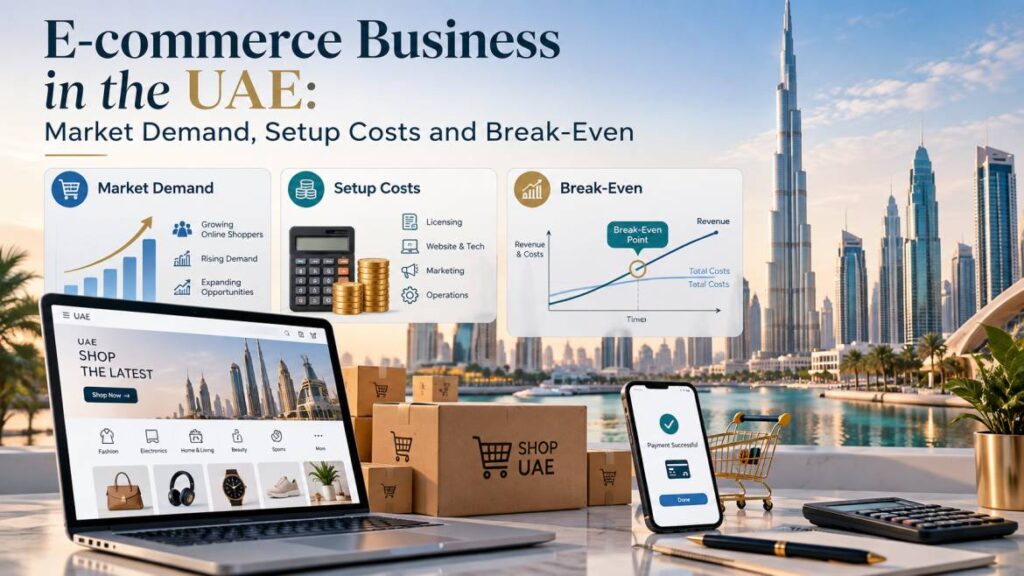
Yes, an e-commerce business in the UAE is still worth starting, but only if the product economics work before you choose a licence. The market is large, at roughly US$11 to 12 billion in 2025, and is forecast to grow 9.9% a year to 2030, yet that growth now rewards execution, not early entry. The UAE also works as a base for cross-border selling, although every destination market needs its own landed-cost model.
In the base case I use in this guide, a lean UAE e-commerce business loses about AED 230,000 in Year 1 and reaches EBITDA break-even around the start of Year 3. That points to AED 0.6 to 1.0 million of starting liquidity. Mainland suits UAE-first selling, a free zone suits export and logistics-led models, and an offshore company is not an operating vehicle. This covers demand, competition, setup costs, break-even and licensing in that order.
Table of Contents
Is the UAE Still a Good Market for an E-commerce Business?
The 2026 EZDubai and Euromonitor study puts the UAE e-commerce market at roughly US$11 to 12 billion in 2025. It forecasts 9.9% annual growth for 2026 to 2030, which implies about US$18 billion by the end of the period. The same study has the wider MENASA region at US$141.4 billion, with the UAE at about 8% of that and Saudi Arabia at 11%.

The more useful number is the change in pace. Growth is slowing from 19.0% a year over 2020 to 2025 to 9.9% over 2026 to 2030. That is a mature market, where new shoppers matter less and share capture, delivery experience, payments and basket size matter more. Anyone planning a new e-commerce business should read that as a warning and an opening at the same time.
One caution before you quote any market-size figure in a business plan. Research houses define e-commerce differently, so their numbers can differ by a wide margin, and I explained why in the honest numbers on UAE e-commerce licence, tax and delivery costs. Always record the source, the year and the definition next to the figure.
What Sells Online in the UAE, and What Is Hard to Make Money On
Category choice decides more of your result than the free zone you pick. A large category can still be a poor business if returns, freight or price competition eat the margin. The table shows the demand signal and the main problem in each category.
| Category | Demand signal | Main challenge |
|---|---|---|
| Apparel and footwear | Largest measured category, US$3.1 billion in 2025 | Size-driven returns and high fashion acquisition cost |
| Consumer electronics | US$2.7 billion in 2025 | Thin margins and heavy marketplace price competition |
| Home care | US$2.0 billion in 2025, 10.4% forecast growth | Bulky items make delivery costs hard to recover |
| Consumer appliances | Fastest selected category, 18.5% forecast growth | Inventory capital, warranty and reverse logistics |
| Beauty and personal care | 13.5% forecast growth | Product registration, authenticity and claims rules |
For a founder without a fixed product, I would investigate beauty, differentiated home products, specialised accessories and repeat-purchase consumables first. They combine repeat demand with room for a brand. Commodity electronics have the biggest absolute demand, but I steer under-capitalised entrants away from them unless they have exclusive sourcing or a defensible niche.
Competition and Channels: Do Not Try to Outspend Amazon or Noon
A new e-commerce business will not win by outspending Amazon.ae or Noon on generic traffic. The edge has to come from a product nobody else has, better content, category expertise, faster service or a stronger community. EZDubai also notes that low-cost platforms such as Temu and SHEIN are intensifying price pressure, so undifferentiated products get squeezed from both sides.
The better question is not marketplace or own website, but how to use each one. A marketplace buys you high-intent discovery and fulfilment scale. Your own site buys you first-party customer data, bundles and repeat purchases.
| Channel | What it does for you | What it costs you |
|---|---|---|
| Amazon.ae | Strongest validation channel for search-led products | Most referral fees sit between 4.5% and 15%, plus fulfilment and advertising |
| Noon | Regional marketplace for UAE and Saudi mass-market products | Terms depend on category and contract, so confirm at onboarding |
| Own D2C website | Repeat purchases, bundles and customer data | No commission, but you pay gateway fees and the full acquisition cost |
| Cross-border shipping | Low-volume testing of a wide catalogue | Longer lead times, customs friction and more returns complexity |
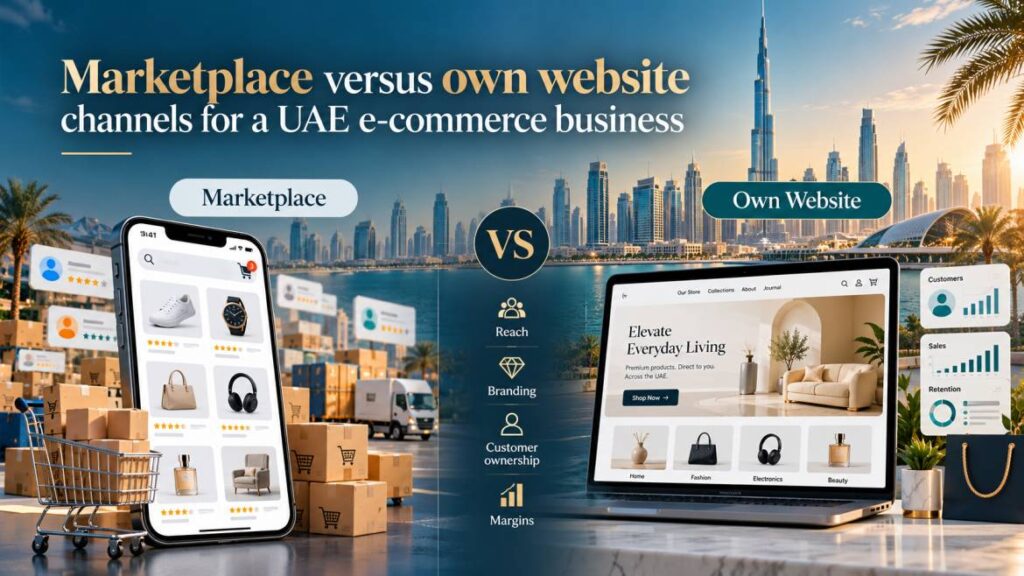
My default launch is one primary marketplace plus your own site, and then a second marketplace once operations are stable. Amazon publishes its fee structure on its UAE seller pricing page, which makes it easier to model than most alternatives. If logistics is central to your model, my notes on the Dubai South logistics corridor and the UAE as a re-export hub cover the fulfilment side.
Customer Acquisition: Work Out Your Maximum CAC First
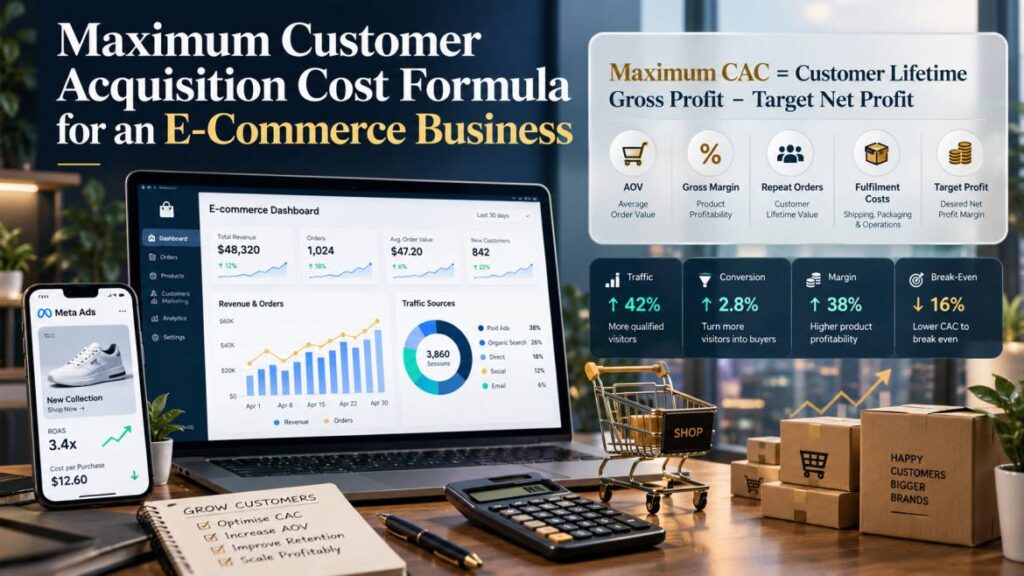
There is no reliable, universal UAE acquisition cost benchmark that applies to every category, so do not copy one. Work it out from your own margins. The maximum you can afford to pay for a first order is the average order value multiplied by your gross margin, minus other variable costs, minus the contribution you need from that first order.
Take an illustrative order of AED 250, a 45% gross margin, 14% for payment, fulfilment, packaging and returns, and a required 10% contribution. The maximum first-order acquisition cost is AED 250 x (45% – 14% – 10%), which is AED 52.50. A campaign that delivers customers at AED 80 each fails on first-order economics unless repeat purchases prove otherwise.
Discovery also works differently from what most founders assume. In the 2025 UAE consumer survey, 70% of respondents used YouTube to research products and brands, and more than half of shopping activity in every measured category happened on a mobile phone. Free delivery was the most wanted delivery feature at 51%, and free returns followed at 45%. Those are the features that cause the most margin leakage, so price them into your basket thresholds and do not treat them as free.
E-commerce Business Setup Costs: The Licence Is the Smallest Number
Founders budget for the licence and forget the launch. A planning range for a mainland licence is AED 40,000 to 80,000 or more in the first year once office, visa and activity costs are added, while a lean free zone package is often planned at AED 12,000 to 30,000. Those are adviser planning ranges, not government tariffs, and the real quote depends on your activity and visa count.
The table below shows the wider first-year cash picture for a generic physical-goods business. The figures are illustrative planning assumptions and will move a lot by category. An appliance business needs many times the inventory budget of a made-to-order accessories brand.
| First-year item | Planning range (AED) |
|---|---|
| Licence, entity, visas and admin | 15,000 to 80,000+ |
| Website, storefront and integrations | 15,000 to 60,000 |
| Accounting, ERP and e-invoicing readiness | 5,000 to 30,000 |
| 3PL onboarding, deposits and racking | 5,000 to 30,000 |
| Product photography and content | 10,000 to 40,000 |
| Initial performance and creator marketing | 100,000 to 300,000 |
| Initial inventory | 150,000 to 500,000+ |
Add a working-capital reserve on top, sized to several months of fixed costs plus one full replenishment cycle. A business that budgets AED 15,000 for the licence and nothing for returns, gateway integration and acquisition is not properly capitalised. I start with a 3PL and avoid an owned warehouse until order density justifies the fixed cost.
Break-Even Potential: Three Scenarios for a UAE E-commerce Business
This model is driver-based and illustrative. It represents a UAE marketplace plus D2C business selling physical goods, with figures in AED thousands excluding VAT. EBITDA here excludes inventory funding, financing costs, depreciation and corporate tax, so treat it as a decision model and rebuild it once your real margin, order value, returns and fulfilment rates are known.
| Scenario | Metric | Year 1 | Year 2 | Year 3 |
|---|---|---|---|---|
| Conservative | Revenue | 900 | 1,200 | 1,500 |
| Conservative | EBITDA | -429 | -426 | -405 |
| Base | Revenue | 2,000 | 3,800 | 6,500 |
| Base | EBITDA | -230 | -80 | 303 |
| Aggressive | Revenue | 3,000 | 6,500 | 11,500 |
| Aggressive | EBITDA | -230 | 153 | 845 |
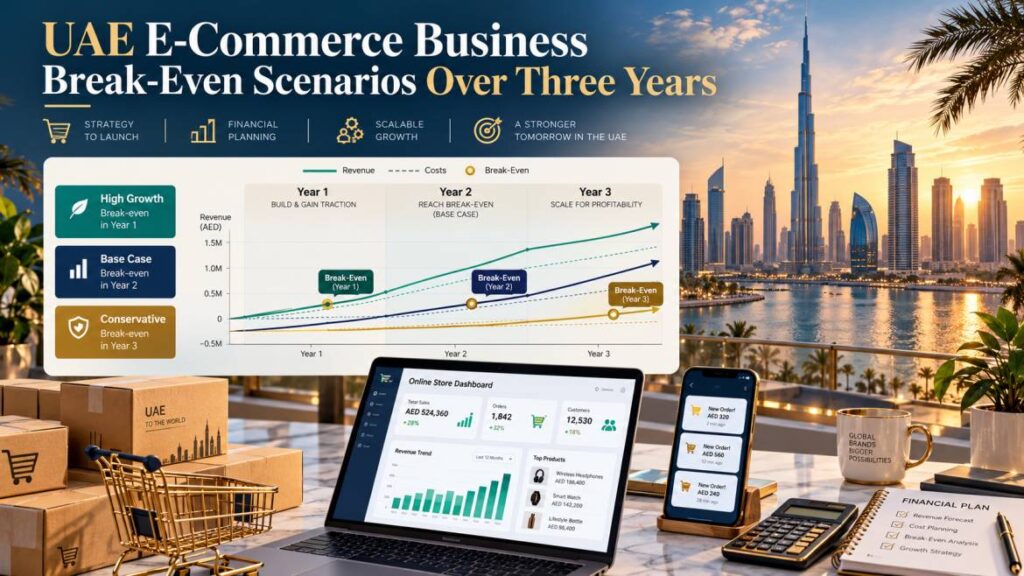
Three conclusions matter. First, revenue growth alone does not fix a weak business, because the conservative case stays deeply loss-making even as sales rise. A gross margin of 38 to 40% cannot carry marketing and fixed costs.
Second, the base case reaches EBITDA break-even only around the move into Year 3, so the business cannot be expected to fund itself from the first month of orders. Third, the aggressive case turns positive in Year 2 only because revenue, purchasing margin and marketing efficiency all improve together.
At AED 6.5 million of Year 3 base revenue, each percentage point of gross margin, marketing efficiency or variable-cost leakage moves EBITDA by about AED 65,000. Combine the AED 230,000 Year 1 loss with stock and launch costs and a generic product business could need roughly AED 0.6 to 1.0 million of starting liquidity. That is a planning inference from the model and not a market rule.
Licensing Strategy: Mainland, Free Zone or Offshore
There is no single e-commerce licence to buy. You need a commercial licence whose activity matches your real model, and Amazon states that UAE sellers need a valid licence from a mainland or free zone authority. Choose the jurisdiction from your customer and supply chain, and not from a zero-tax sales pitch.
| Structure | Best fit | Watch out for |
|---|---|---|
| Mainland LLC | UAE-first selling, omnichannel retail, local B2B, your own mainland warehouse | Higher setup cost and office requirements |
| Free zone company | Lean launch, cross-border trade, re-export, logistics-led models | Selling into the mainland still needs the right customs, tax and licensing treatment |
| Offshore or SPV | Holding assets, shares or intellectual property | Not a primary operating vehicle for an active UAE seller |
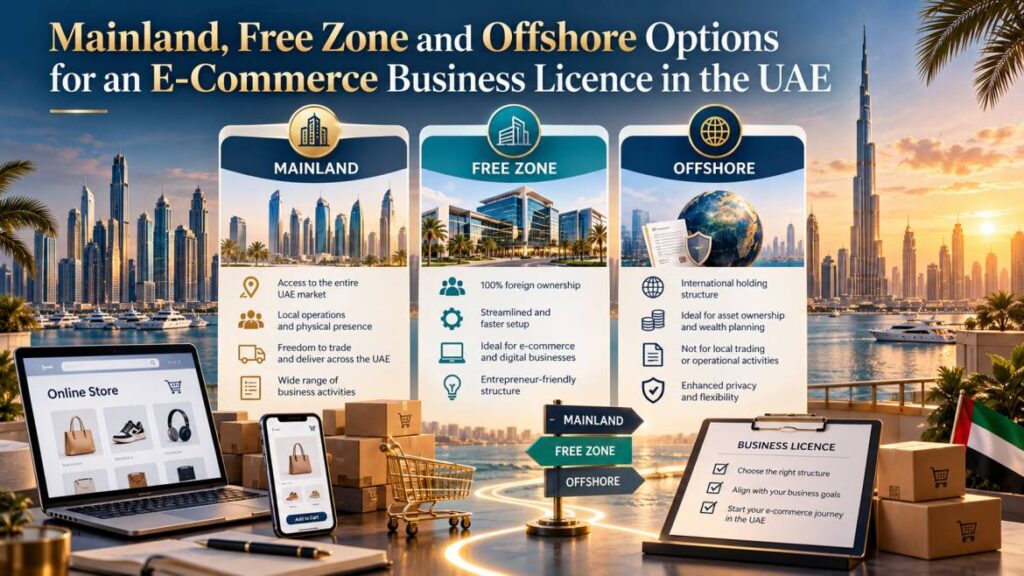
Invest in Dubai positions mainland incorporation as the route for businesses trading within the UAE. Dubai also introduced a Free Zone Mainland Operating Permit in 2025, at AED 5,000 for six months and renewable at the same fee. Eligibility and permitted activities must be checked, and it is a specific permit route, so it does not erase the difference between free zone and mainland. I compare the structures in more depth in the difference between a mainland and free zone company and mainland vs free zone vs offshore.
Tax follows the same logic. UAE VAT is 5%, mandatory registration generally applies once taxable supplies and imports pass AED 375,000, and voluntary registration starts at AED 187,500, as set out by the Federal Tax Authority. Corporate tax is 0% on taxable income up to AED 375,000 and 9% above it, and a free zone licence does not automatically make all e-commerce profit tax-free. The Qualifying Free Zone Person regime has its own income and compliance tests. My notes on VAT registration and the new penalty rules and Small Business Relief to 2029 cover the detail.
Using the UAE as a Hub for a Cross-Border E-commerce Business
The UAE is not only a place to sell to UAE shoppers. Dubai works as a regional inventory and re-export node, and Dubai South’s EZDubai is designed as a dedicated e-commerce ecosystem with fulfilment centres, last-mile infrastructure and supply hubs. The UAE government also identifies around 40 free zones, so you can choose a general-purpose zone or a logistics-focused one. I cover the logistics side in the Dubai South logistics corridor and the trading side in the UAE as a re-export hub.
A cross-border e-commerce business based in the UAE usually picks one of four fulfilment models. The right one depends on where your customers are and how fast your products move.
| Hub model | Best for | Watch out for |
|---|---|---|
| Free zone logistics hub | Regional stockholding, imports and re-export, GCC expansion | Selling into the mainland still needs the right customs, tax and licensing treatment, and a free zone is not automatically a VAT-designated zone |
| Mainland warehouse or 3PL | UAE-first sales and local B2B supply | Fixed rent, and inventory is imported into the mainland customs territory |
| Marketplace fulfilment | Fast validation of a product | Platform fees, inventory allocation limits and less control |
| Cross-border direct shipment | Low-volume testing of a wide catalogue | Longer lead times, customs friction and harder returns |
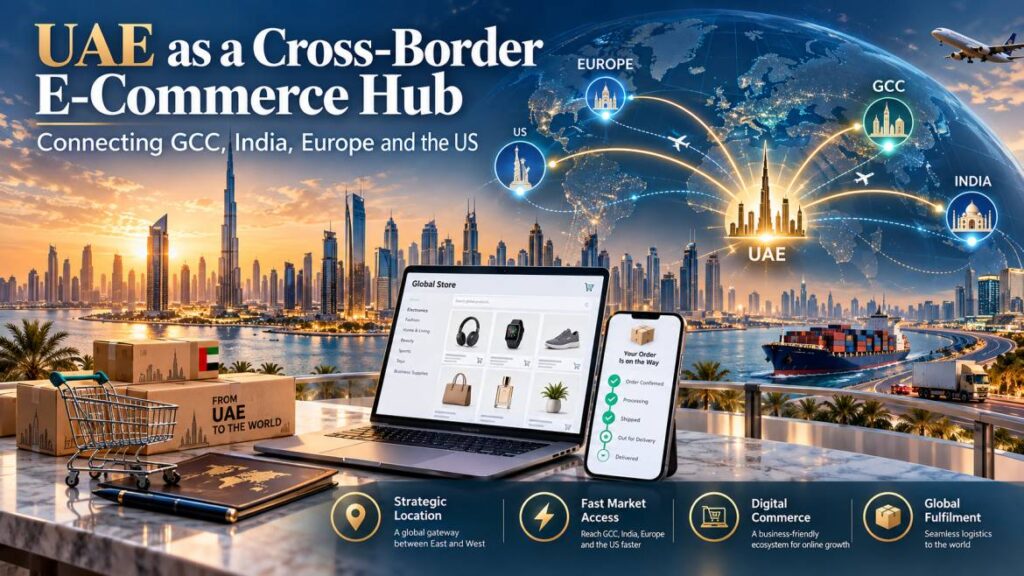
Which markets to enter first matters as much as the hub. For a UAE-headquartered seller, the UAE and Saudi Arabia together form the logical first corridor, because proximity and shared regional logistics outweigh the raw size of larger foreign markets. The table gives the scale of each market and how I read it.
| Market | Recent scale | How I read it for a UAE-based seller |
|---|---|---|
| Saudi Arabia | About US$15 to 16 billion in 2025, 8.3% forecast growth | Largest immediate expansion after the UAE, but it needs Arabic localisation, Saudi payment methods, local fulfilment and separate tax and customs planning |
| Egypt | About US$4 to 5 billion in 2025, 15%+ forecast growth | High growth, but purchasing power and logistics differ, so do not copy a UAE cost structure |
| India | About US$93 billion in 2025 on the EZDubai definition | Huge scale and intense price competition, useful as a sales market and a sourcing base |
| European Union | 78% of internet users bought online in 2025 | Model country by country, because cross-border VAT, product conformity and return rules add complexity |
| United States | US$340.2 billion of retail e-commerce in Q2 2026 alone | Attractive for differentiated brands, but advertising, returns and competition are costly |
| China | RMB 15.972 trillion of online retail in 2025 | For most UAE SMEs it is a sourcing and manufacturing base more than a sales market |
The figures come from different statistical definitions, so use them to rank markets and not to add them together. The hard part of crossing a border is landed cost. Give every product a record with its HS code, country of origin, weight and dimensions, supplier Incoterm, customs duty, import VAT treatment and approval status, and then model each destination as its own landed margin. A Saudi, EU or US price list is never just an extension of the UAE one.
On licensing, an export-heavy or re-export model usually points towards a free zone company with logistics access, while a model that also sells to UAE shoppers may need a mainland licence or the permit route I described above. An offshore company still does not work as the operating seller. For the trade-agreement angle, read my notes on the UAE’s CEPA trade network, India-UAE trade and CEPA and Bharat Mart Dubai and the RBI’s rules for Indian exporters. The GCC and ASEAN corridor is covered in the Yalla Commerce 2026 summit guide.
My rule is to prove the UAE first, then add Saudi Arabia and the GCC, and assess India, the EU, the US and China one category at a time. Each new market should earn its place through landed contribution after local taxes, customs, fulfilment and localisation.
The Compliance Stack to Finish Before You Import Stock
Compliance for an e-commerce business is a stack, not one licence. The UAE government portal identifies Federal Decree-Law No. 14 of 2023 on modern technology-based trade as the primary federal framework. Write a compliance matrix before stock arrives, covering these layers:
- Commercial licence with an activity that matches what you sell.
- Consumer protection and invoicing, including compliant invoices and clear returns terms.
- Personal data protection under Federal Decree-Law No. 45 of 2021, including processor contracts and data transfers.
- VAT, corporate tax and customs, with an HS code and duty treatment for each product.
- E-invoicing readiness, since a PDF or email attachment is not a structured electronic invoice.
- Product approvals for food, cosmetics, health products and some electronics, checked before you pay a supplier deposit.
Payments and delivery need the same discipline. Launch with cards, Apple Pay and Google Pay, add one buy-now-pay-later option where the basket size supports it, and control cash on delivery with verification and lower order limits. In the 2025 survey, 87% of respondents used cards online, 67% used cash and 52% used wallets, but those are overlapping usage figures and not shares of transaction value. A banking plan matters too, and how to open a UAE business bank account explains what to prepare.
Where SRTIP (SPARK) Fits an E-commerce Business, and Where It Does Not
Not every e-commerce business is a retailer. Some founders build the technology underneath it, such as checkout and payment tools, fulfilment and logistics software, returns management, retail analytics or AI personalisation sold to other sellers. For that kind of business, SRTIP, the Sharjah Research, Technology and Innovation Park now branded SPARK, is a serious option.
The licence itself is only part of the reason. The SRTIP SPARK accelerator is built around an ecosystem that includes research and development lab access, mentorship, coworking space and an investor network, with support that continues after the licence is issued. Pricing starts at around AED 5,500 for a zero-visa package, and I break down the real first-year figure in the SPARK free zone cost guide. Confirm every number directly with the free zone before committing, because pricing changes.
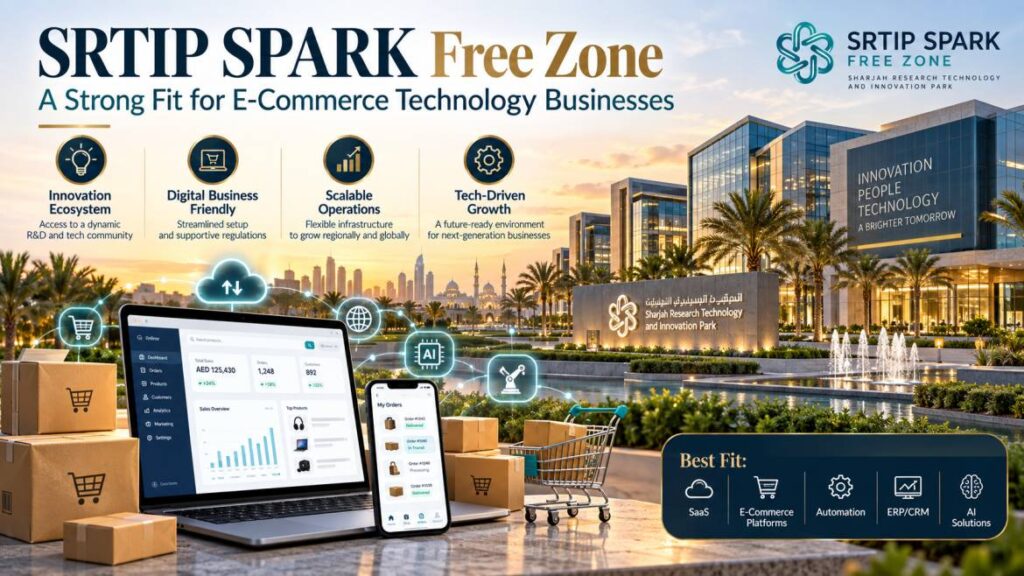
I also say where it does not fit. If you are selling physical products from a storefront, dropshipping or running a direct-to-consumer brand, SPARK is usually not the operating vehicle, and I explain the split in my take on SRTIP Accelerator for e-commerce founders and in who should not choose SPARK. Some founders separate the technology they own from the trading operation. Whether that split makes sense depends on tax and substance, so I model it before recommending it.
If you are weighing SPARK, these posts are the next reads: how SPARK became an AI free zone, what the SAIA SRTIP accelerator offers, the SPARK setup process from licence to bank account and how the five Sharjah free zones compare.
Decision Gates Before You Scale an E-commerce Business
I treat the first year as a validation business: a licensed local entity, outsourced fulfilment, one major marketplace, a D2C site, 20 to 50 priority products and tightly controlled paid acquisition. Scale only when these gates are passed:
- Product: each product earns positive contribution after realistic returns and fulfilment costs.
- Acquisition: your cost per customer is sustainable on first-order economics or proven lifetime value.
- Inventory: you can replenish winners faster than demand and clear slow movers without destructive discounting.
- Operations: delivery, tracking, refunds and support stay stable at current order volume.
- Channels: marketplace revenue is incremental and profitable after commission and advertising, and owned-channel repeat revenue is rising.
- Capital: working capital can fund inventory growth before cash from earlier orders comes back.
Only after those gates should you add a second marketplace, negotiate gateway and 3PL rates and look at Saudi Arabia. The UAE plus Saudi corridor is the logical first expansion for a UAE-based business, while India, the EU, the US and China should be assessed category by category.
My Approach: Product Economics First, Licence Second
I start with the product, not the package price. I ask for your category, expected order value, margin and supplier terms, build the contribution model, and only then decide between mainland, a free zone or a technology-focused zone. If the maths does not work, I say so before you pay for a licence.
That order is deliberate. Entity formation in the UAE is fast and relatively cheap. Sustainable contribution margin is the hard part, and it is what decides whether the business survives Year 2. The reasoning behind this way of working is in why founders choose to work with me, and the signs you are talking to a licence seller shows what to avoid. If you want your model and structure reviewed, get in touch.
Frequently Asked Questions
Is starting an e-commerce business in the UAE profitable?
It can be, but not quickly. In the illustrative base case, EBITDA is negative in Years 1 and 2 and turns positive around Year 3, and the result depends on gross margin, returns and acquisition cost more than on market size.
How much does it cost to start an e-commerce business in the UAE?
The licence is the smallest part. A generic physical-goods launch can need AED 0.6 to 1.0 million of starting liquidity once inventory, marketing, website, 3PL and the first-year loss are included, and the figure varies widely by category.
How long does an e-commerce business take to break even in the UAE?
In the base case, EBITDA break-even arrives around the start of Year 3. A stronger business with better margin and repeat buying can turn positive in Year 2, and a weak one may not break even at all.
Do I need a mainland or free zone licence for an e-commerce business?
Mainland generally suits UAE-first selling and your own warehouse. A free zone suits a lean, cross-border or logistics-led launch. Either way you need a valid commercial licence to sell on Amazon.ae.
Do I need VAT registration for an e-commerce business in the UAE?
Registration is mandatory once taxable supplies and imports exceed AED 375,000, and voluntary registration is available from AED 187,500. Check the rules for marketplace sales and non-resident businesses separately.
Should I sell on Amazon.ae, Noon or my own website?
Use one marketplace plus your own site at launch. The marketplace brings intent and fulfilment scale, while the site builds repeat purchases and customer data. Add a second marketplace after operations are stable.
Can I run an e-commerce business from an offshore company?
Not as the main operating company. An active UAE seller still needs a commercial operating licence, so an offshore company is better kept as a holding or intellectual property structure.
Can I use the UAE as a hub for a cross-border e-commerce business?
Yes. Dubai works as a regional inventory and re-export node, and free zone logistics hubs such as EZDubai at Dubai South are built for it. Model customs, tax and fulfilment separately for each destination, and start with Saudi Arabia and the GCC before larger markets.
Is SRTIP (SPARK) a good free zone for an e-commerce business?
It fits e-commerce technology businesses such as logistics, checkout and analytics platforms. For a storefront selling physical goods, it is usually not the right operating vehicle, so match the zone to what you actually do.
Related Reading
- SRTIP SPARK Accelerator: What It Offers Founders
- My Take on SRTIP Accelerator for E-Commerce Founders
- Starting an E-Commerce Business in the UAE: The Honest Numbers
- Yalla Commerce 2026: The UAE’s First Global E-Commerce Summit
- How SPARK Quietly Became an AI Free Zone
- SAIA SRTIP Accelerator: What It Actually Offers
- SPARK Free Zone Cost 2026
- Why Global Giants Are Moving to Dubai South
Further reading: Selling vehicle parts online is a different model again, and I covered whether an automotive spare parts trading business in Dubai makes sense.