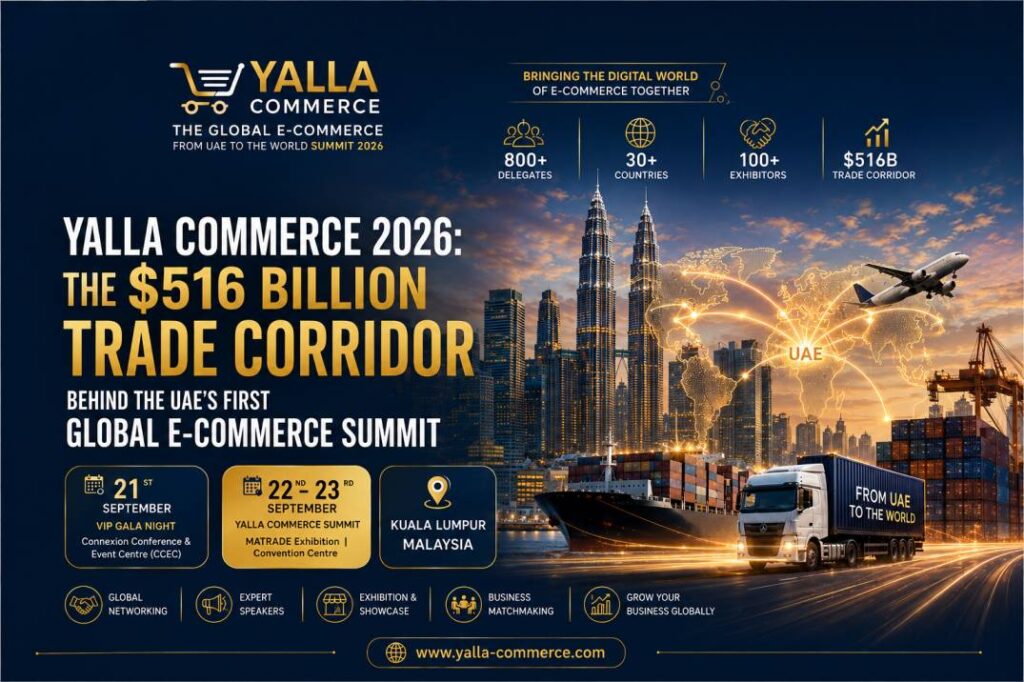
Yalla Commerce 2026 is a UAE-born global e-commerce summit making its debut in Kuala Lumpur on 22-23 September 2026 – and for e-commerce operators, logistics companies, digital service providers and fintech firms working the GCC-ASEAN corridor, it is one of the most commercially focused rooms of the year.
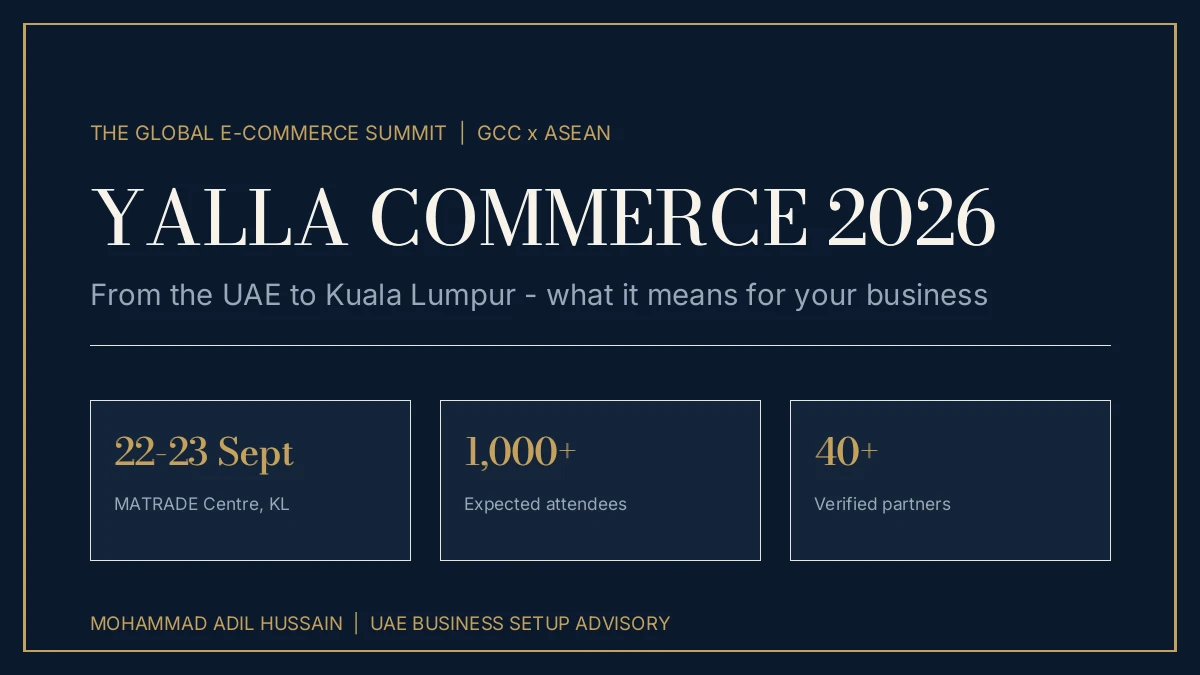
Quick Answer
- Yalla Commerce 2026 is a UAE-born global e-commerce summit debuting in Kuala Lumpur on 22-23 September 2026, connecting the GCC and ASEAN digital trade corridors.
- It is relevant to e-commerce operators, logistics and fulfilment providers, fintech and payment companies, and digital services or SaaS providers working that corridor specifically.
- The summit connects to a dedicated UAE Zone, which links attendance directly to a genuine UAE market entry path, not just networking.
In this guide
Most trade events promise networking. Very few are built, from the ground up, around a specific trade corridor – and that is what makes Yalla Commerce worth paying attention to. It is not another generic e-commerce conference; it is a deliberate attempt to put the UAE and Southeast Asian e-commerce ecosystems in one room, with government trade bodies on both sides backing it.
I advise founders and companies on UAE market entry, and the GCC-ASEAN corridor this summit is built around is exactly where I see some of the most underexploited opportunity right now. So here is a clear-eyed look at what Yalla Commerce actually is, what the numbers behind it say, and specifically what e-commerce, logistics, fintech and digital services providers stand to gain from being there.
What Is Yalla Commerce?
Yalla Commerce 2026 is a UAE-born global e-commerce summit, organised by Unbound and carrying the tagline “From UAE to the World.” Its inaugural edition takes place in Kuala Lumpur, Malaysia: an invitation-only VIP Gala Night on 21 September 2026 at the Connexion Conference & Event Centre, followed by the two-day main summit on 22-23 September 2026 at the MATRADE Exhibition & Convention Centre (MECC).
The scale for a first edition is notable: over 1,000 expected attendees, 20+ industry speakers, and 40+ verified partners across a two-day programme. The attendee mix is deliberately structured – roughly 500 public paid passes aimed at Malaysian e-commerce founders and operators, around 200 UAE ecosystem partners, some 250 Malaysian partners, and about 50 VIPs and government officials. Malaysia’s own trade and digital economy agencies – MATRADE, MDEC and PIKOM – are supporting the event, with Dubai CommerCity as diamond sponsor and partners including Pos Malaysia, PayPal and Razorpay Curlec.
Two things separate it from a standard conference format. First, structured business matchmaking: participants complete a profile, the organising team curates introductions, and confirmed meetings happen in a dedicated matchmaking area – meaning you arrive with a qualified agenda rather than hoping for corridor luck. Second, the Yalla Commerce Council, a year-round ecosystem body designed to keep the ASEAN-GCC digital trade corridor active between summits, so the event functions as an entry point into an ongoing platform rather than a one-off gathering. After Kuala Lumpur, the organisers have signalled expansion to Singapore, Saudi Arabia, Qatar and Dubai.
Why a UAE Summit Is Launching in Kuala Lumpur
The choice of Malaysia is not sentimental – it is arithmetic. The UAE e-commerce market is projected at roughly $12.3 billion in 2026, growing to about $21 billion by 2031. Malaysia’s is almost a mirror image: around $12.2 billion in 2026, heading to roughly $23.1 billion by 2031 at an even faster growth rate. Two similarly sized, fast-growing digital markets – one the gateway to the GCC, the other a gateway to ASEAN’s 600-million-plus consumers.
Add two more numbers and the corridor logic becomes obvious. Around 40% of Malaysian e-commerce transactions are already cross-border, and Gulf-Asia trade reached roughly $516 billion in 2024 – nearly double the Gulf’s trade with Western markets. The commercial connection between these two regions is already enormous; what has been missing is structured, in-person infrastructure for the e-commerce layer of it. Malaysian sellers want to enter the UAE, UAE solution providers want to enter Malaysia, and today that connection mostly happens through expensive travel or cold outreach. A summit purpose-built for that corridor is the missing bridge.
This mirrors something I have written about from the UAE side: the country has spent five years building a 37-country CEPA trade agreement network and positioning itself as a global re-export hub, and Malaysia is one of the ASEAN economies where a UAE CEPA is on the table. Events like this are the commercial layer forming on top of that trade infrastructure.
What E-Commerce Businesses Get Out of It
If you run an online brand or marketplace business, the value is concentrated in three places:
- Market entry intelligence, compressed. The programme includes a dedicated UAE Expansion Workshop covering business setup, tax, visas and market entry, plus masterclass sessions on payment strategies and marketplace entry – including how selling on Amazon.ae and Noon actually works. That is a week of research compressed into two days, delivered by people operating in the market.
- Direct access to enablers. The UAE partner contingent spans marketplace enablers, fulfilment and warehousing companies, quick commerce operators, free zone representatives and distributors – the exact supply chain a brand needs to assemble before it can sell into the GCC. Meeting them in one venue beats six months of cold email.
- Investor visibility. With investors and VCs in the attendee mix, dedicated pitch sessions, and matchmaking that can route founders to capital, scaling brands get a rare chance to put growth plans in front of money that specifically understands cross-border commerce.
One caution I would add as a consultant: a summit tells you what is possible, not what is right for your business. The UAE e-commerce market is real, but so are its traps – I have covered the honest numbers on UAE e-commerce setup, tax and delivery costs in detail, including the free zone tax nuance that catches most D2C plans off guard.
What Logistics and Fulfilment Providers Get Out of It
Logistics is arguably the most natural fit at Yalla Commerce. The audience profile explicitly includes logistics companies, fulfilment providers, warehousing operators and quick commerce players from both markets, and Pos Malaysia’s presence as official Malaysian logistics partner signals how central the theme is – main-stage panels include cross-border logistics as a headline topic.
For a logistics or fulfilment provider, the room is effectively a concentrated pipeline: hundreds of e-commerce founders and operators who all need shipping, warehousing, last-mile and returns solutions, gathered specifically because they are planning cross-border moves. A UAE 3PL wanting ASEAN clients, or a Malaysian fulfilment company wanting to serve brands entering the Gulf, meets its exact buyer profile here. And because the matchmaking is pre-scheduled and profile-based, providers can filter for the brands actually expanding along their lanes rather than pitching cold on the expo floor.
The corridor context makes this bigger than one event: the UAE’s logistics backbone – Jebel Ali, the free zone network, and the infrastructure I broke down in my piece on Dubai South’s logistics corridor – is actively courting Asian trade flows, and providers who position early in the GCC-ASEAN lane will be sitting on it as it grows.
What Fintech and Payment Providers Get Out of It
Payments and fintech run through the entire agenda. Razorpay Curlec is the official payment partner, PayPal is an ecosystem partner, and payment optimisation has its own main-stage slot. That tells you the organisers see cross-border payments as one of the corridor’s genuine friction points – which it is.
For a fintech provider, three audiences converge here at once. First, merchants: every one of the hundreds of e-commerce operators in the room needs payment acceptance, and the cross-border sellers among them need multi-currency settlement, FX handling and local payment methods on both sides. Second, partners: payment gateways, BNPL players, and banking-adjacent services increasingly go to market through marketplace enablers, platforms and logistics companies – all of whom are present in force. Third, institutions: with government trade bodies and free zone authorities attending, fintech firms exploring GCC licensing or ASEAN expansion can open regulatory and ecosystem conversations that normally take months to arrange.
It is also worth remembering the backdrop: the UAE has become one of the world’s most active jurisdictions for payments and digital asset regulation, and banking access is one of the make-or-break issues for any company entering the market – something I work through with clients in UAE corporate banking and financial services setup.
What Digital Services and SaaS Providers Get Out of It
Agencies, SaaS platforms, AI tool builders and solution providers are the third leg of the summit’s audience – the deck’s own framing of who the masterclass format serves is “SaaS, logistics, payments, AI tools, agencies, marketplaces, and solution providers.” The programming reflects it: AI-driven commerce, customer acquisition through creators, and omnichannel strategy all have dedicated main-stage sessions.
The practical value for a digital services firm is positioning. Formats like the Yalla Masterclass let a provider run an expert-led workshop for a focused room of decision-makers – which converts far better than a booth – while the pitch stage and podcast activations turn attendance into content and authority that outlives the event. For a Malaysian agency wanting UAE clients, or a UAE SaaS company wanting ASEAN distribution, the summit compresses a year of business development into two days, provided you arrive with a clear offer and a defined ideal client.
The UAE Zone: Where the Summit Meets Business Setup
The part of Yalla Commerce closest to my own work is the dedicated “Gateway to UAE” zone – a section of the exhibition floor where UAE-based businesses and ecosystem partners, including Dubai CommerCity representatives, help Malaysian and ASEAN founders understand what expanding into the UAE actually involves: company formation, marketplace entry, tax, visas and market access.
That such a zone exists at all tells you something about demand. ASEAN founders are actively looking at the UAE – for its 0% personal income tax, its position as the gateway to GCC consumers, its re-export infrastructure, and the CEPA network that keeps widening its market reach. But here is the honest caveat I give every founder who comes back from an event energised: a summit conversation is the start of due diligence, not the end of it. The right structure for your business – mainland or free zone, and which of the 40+ free zones specifically – depends on where your customers are, how your revenue flows, and what the tax fine print means for your model, not on which authority had the best stand.
My Approach: Turning a Summit Into a Market Entry
Most business setup consultants help you register a company. I help you make informed business decisions before you invest.
Events like Yalla Commerce are genuinely useful – I would rather a founder spend two days there than two months reading brochures. But I have also seen what happens after the summit glow fades: founders come home with a stack of business cards, three free zone quotes, and no framework for deciding between them. The consultants they met at the event are, understandably, selling their own zone or their own licence package. Nobody in that room is paid to tell you that your specific model might be better served by a different structure entirely, or that your banking plan will not survive contact with a UAE compliance officer.
My approach is to start with strategy, not paperwork: map your customers, revenue flows and growth plan first, then match the structure to the business – whether that is a free zone company, a mainland licence, or the three-way comparison most founders never see laid out honestly. I treat corporate tax and VAT registration as part of the entry decision rather than an afterthought, because in the UAE the tax treatment follows from the structure you choose on day one. Successful market entries aren’t built by chance – they’re built on decisions made with the full picture in front of you, before the first payment is made.
If you are attending Yalla Commerce – or simply watching the GCC-ASEAN corridor and wondering whether the UAE belongs in your expansion plan – the smartest first step is a structured conversation before you commit to anything you heard on an expo floor. That is exactly what my business setup advisory is built for, and you can start that conversation here.
Frequently Asked Questions
What is Yalla Commerce?
Yalla Commerce 2026 is a UAE-born global e-commerce summit, organised by Unbound under the tagline “From UAE to the World.” It brings together founders, platforms, solution providers, investors and government trade bodies to build digital trade corridors between the GCC and ASEAN, with structured business matchmaking, masterclasses and a year-round ecosystem body called the Yalla Commerce Council.
When and where is Yalla Commerce 2026 taking place?
The inaugural Yalla Commerce summit runs 22-23 September 2026 at the MATRADE Exhibition & Convention Centre in Kuala Lumpur, Malaysia, preceded by an invitation-only VIP Gala Night on 21 September at the Connexion Conference & Event Centre. Over 1,000 attendees, 20+ speakers and 40+ partners are expected.
Who should attend Yalla Commerce 2026?
The summit is built for e-commerce founders and operators, logistics and fulfilment providers, payment and fintech companies, marketplaces, SaaS and AI solution providers, agencies, investors and government trade bodies – particularly those interested in cross-border trade between the UAE, the wider GCC and Southeast Asia.
How does Yalla Commerce help logistics and fintech providers specifically?
Both sectors meet their exact buyer profile in one room: hundreds of e-commerce operators planning cross-border expansion who need shipping, fulfilment, payment acceptance and multi-currency solutions. Pre-scheduled business matchmaking lets providers filter for companies expanding along their specific lanes, while masterclass and pitch formats offer positioning beyond a standard booth.
What is the UAE Zone at Yalla Commerce?
The Gateway to UAE Zone is a dedicated exhibition area where UAE-based businesses and ecosystem partners – including Dubai CommerCity – help Malaysian and ASEAN founders explore UAE expansion, covering business setup, marketplace entry on Amazon.ae and Noon, tax, visas and market access. It reflects growing ASEAN demand for structured UAE market entry.
Related reading: why global traders are choosing the UAE as their re-export hub.
Related reading: the UAE’s 37-country CEPA network for foreign entrepreneurs.
Related reading: the honest numbers on starting an e-commerce business in the UAE.