In this guide
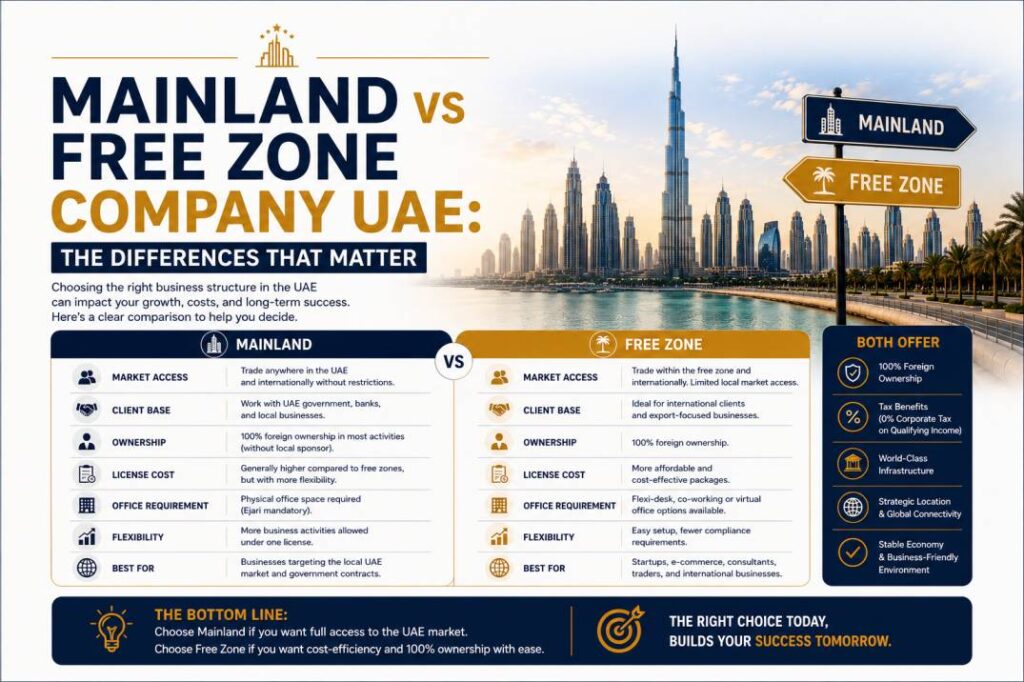
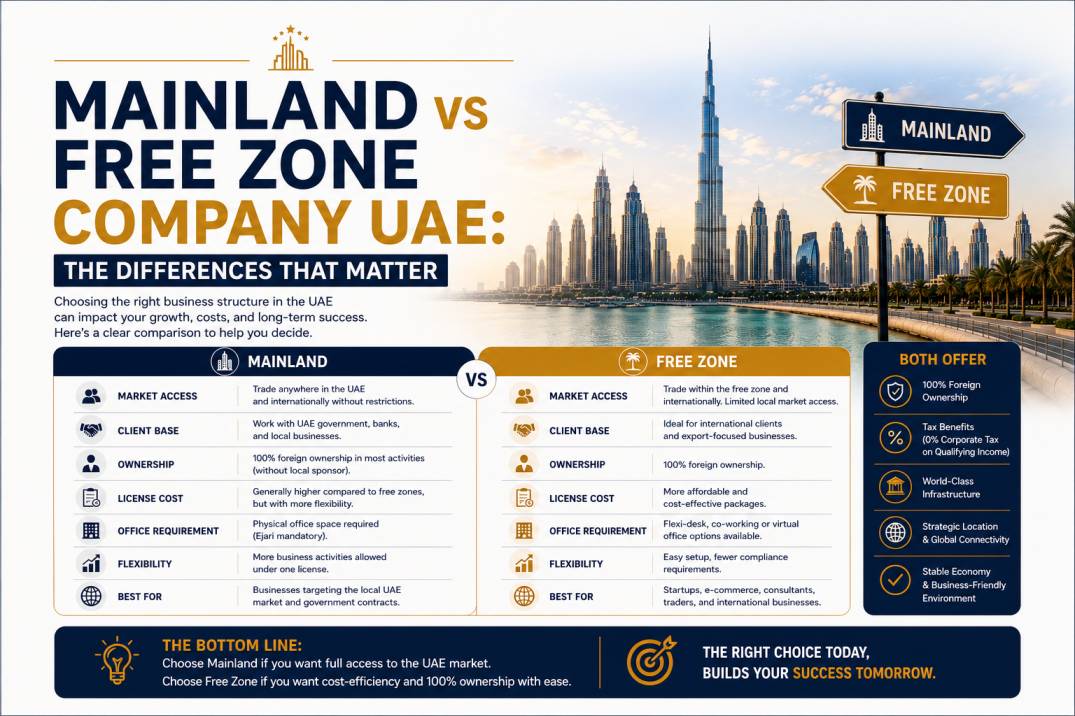 Here is a question I hear almost every week, usually from someone who has already started comparing licence packages online: “What is the difference between a mainland and a free zone company in the UAE?”
It is a fair starting point. But the answer that most articles give – a table of ownership percentages, office requirements, and a line about 0% tax – skips over everything that actually affects what your business costs, who you can sell to, and what you pay in tax from year two onward.
In over 200 UAE company formations across both structures, I have seen the same expensive mistake repeated: choosing based on the headline package price without understanding the operational and tax differences that only show up later. Getting the difference between mainland and free zone company decision right from day one avoids that mistake entirely. This guide covers the difference between mainland and free zone company the way it should be covered – with the detail that actually helps you decide.
Quick Answer
- Ownership is no longer the deciding factor between mainland and free zone, since 100% foreign ownership is now available in both structures for most activities.
- The bigger cost driver is market access: who you can legally invoice directly affects revenue far more than the headline package price most guides compare.
- The tax comparison goes beyond the “0% headline,” since free zone tax benefits apply only to qualifying income under specific conditions.
- Office requirements and visa quotas differ meaningfully between the two structures and should be matched to your actual hiring plan, not chosen after the fact.
- Banking approval is treated differently by structure, a practical difference most comparison guides do not explain.
What Each Structure Actually Is
Before comparing them, it helps to understand what each one was designed to do.
A mainland company is licensed by the Department of Economy and Tourism (DET) in Dubai, or the equivalent Department of Economic Development (DED) in other emirates. It operates under UAE Commercial Companies Law and can trade with any customer anywhere in the UAE – individuals, businesses, and government entities – without restriction. Think of it as a standard UAE business licence with no geographic ceiling.
A free zone company is incorporated inside one of the UAE’s 40+ designated economic zones – DMCC, IFZA, JAFZA, RAKEZ, Meydan, SHAMS, and dozens of others. Each free zone has its own licensing authority, its own activity list, its own visa quotas, and its own fee structure. They were originally created as industry-specific incentive zones, and that origin shapes how they work today.
The simplest summary: mainland gives you unrestricted UAE market access. Free zone gives you a faster, often cheaper setup with specific rules around who you can invoice and how. Both sit under the same federal tax regime, including the anti-evasion rules that took effect in 2026.
Ownership – No Longer the Deciding Factor
For years, the main reason people chose free zones was ownership. Free zones offered 100% foreign ownership from the start, while mainland companies required a UAE national to hold 51% of the shares.
That changed with Federal Decree-Law No. 26 of 2020, which revised the UAE Commercial Companies Law. Today, 100% foreign ownership is available on the mainland for the vast majority of business activities. Certain strategic sectors – defence, oil and gas, some utilities – still require Emirati shareholding, but for most professional services, trading, consulting, tech, and retail businesses, the ownership argument no longer tips the decision.
If someone is telling you to choose a free zone specifically because of ownership, ask them whether that restriction still applies to your activity on the mainland. In most cases, it does not.
Market Access – The Difference That Costs People the Most
This is the core operational difference between the two structures, and the one that catches the most people out.
A mainland company can invoice any customer in the UAE directly – no intermediary, no workaround, no additional structure. A retailer, a construction firm, a consulting practice, a healthcare provider. Direct relationship, direct contract, direct invoice.
A free zone company cannot do the same. Without an additional arrangement, a free zone entity is restricted to trading within its zone or internationally. To serve UAE mainland customers, it traditionally needed a licensed mainland distributor or a separate mainland entity – adding both cost and friction.
There is now a third option. Executive Council Resolution No. 11 of 2025 introduced structured pathways for Dubai-registered free zone companies to conduct business on the mainland without forming a separate entity. Three models are available: a branch licence with a dedicated mainland office, a branch operating from the free zone headquarters, and a six-month temporary permit for project-based or pilot activity. No local UAE national sponsor is required for any of them, and existing free zone employees can work on mainland projects without transferring their visas. Fees typically run AED 5,000–10,000 per year.
Abu Dhabi has operated a similar system through ADDED for longer, and RAKEZ in Ras Al Khaimah offers a dual licence package combining a free zone licence with a RAK DED branch. Other emirates are developing their own frameworks.
One important note: companies that were already trading on the mainland before Resolution 11 were required to regularise their status by March 2026. If you are running a free zone company and have been informally serving mainland clients, check your compliance position before assuming it is fine.
The Tax Comparison Nobody Explains Properly
Here is where most articles fail their readers. The typical framing is: mainland pays 9% corporate tax, free zone pays 0%. That framing is wrong in both directions.
What mainland companies actually pay
Mainland companies follow the standard UAE corporate tax regime introduced under Federal Decree-Law No. 47 of 2022. The rate is 0% on the first AED 375,000 of taxable profit, and 9% above that. For businesses with annual revenue below AED 3 million, Small Business Relief (SBR) allows you to elect zero taxable income for the period – meaning no corporate tax at all, regardless of profit, through 31 December 2026.
For most early-stage mainland businesses, the effective corporate tax in their first two or three years is zero. The 9% rate only becomes real when revenue is above AED 3 million (no SBR) and profit is above AED 375,000. That is a meaningful threshold – not the day-one liability it is often presented as. Speak to a qualified adviser about UAE corporate tax registration before assuming either extreme.
What free zone companies actually pay
Free zone companies are not automatically exempt from UAE corporate tax. The 0% rate applies only to companies that qualify and maintain status as a Qualifying Free Zone Person (QFZP). The conditions are specific and require active management:
- Core income-generating activities must be conducted within the free zone
- The company must maintain adequate economic substance – proportionate staff and operating expenditure, not just a registered address
- Non-qualifying income must stay below 5% of total revenue, or AED 5 million, whichever is lower
- Audited financial statements must be filed annually
- From June 2026, FTA Decision No. 6 of 2026 requires free zone companies claiming the distribution activity to file an annual Independent Agreed-Upon Procedures report from an external auditor
The part that trips businesses up most: non-qualifying income is taxed at 9% with no AED 375,000 band. On the mainland, the first AED 375,000 of profit is tax-free regardless. In a free zone, if your mainland-sourced revenue pushes you past the de minimis threshold, all of your income becomes subject to 9% – not just the excess. One UAE corporate contract can flip your effective rate on everything.
The practical picture for most small businesses
For businesses below AED 3 million in revenue, Small Business Relief applies to both mainland and free zone companies. Both can elect zero corporate tax through 2026. SBR and QFZP are mutually exclusive in any single tax period, so if you are below the threshold, SBR is the simpler path. The QFZP regime becomes the meaningful choice when you are above AED 3 million and your income is genuinely international in character.
The tax comparison is not “mainland pays, free zone doesn’t.” It is a question of which structure fits your revenue mix now and in three years.
Office Requirements and Visa Quotas
These two requirements connect to each other in ways most people do not think through at setup.
Mainland: a physical office is mandatory. The minimum varies by emirate and activity but is typically at least 200 square feet for a standard DED licence in Dubai. Your visa allocation is linked to office size – one visa per 9 square metres in most configurations – with no hard cap. If you plan to hire a team of 20 people, a mainland office with sufficient floor space can support that without requiring a structural change. PRO services help manage the government liaison, approvals, and documentation that come with physical office registration.
Free zone: the visa quota is tied to your office package. A flexi-desk typically gives you 1–3 visas. A serviced office gives you 4–6. A physical space gives you more, proportional to area. That ceiling matters. If your business plan involves hiring 10 people within 18 months, a flexi-desk package does not support that – regardless of your budget. You would need to either upgrade to a larger office package (at meaningfully higher cost) or open a mainland entity to handle the additional headcount. Factor the visa growth path into the cost comparison from day one, not after you hit the ceiling.
Banking – The Practical Difference Nobody Writes About
Setting up the company takes days to a few weeks. Opening a corporate bank account is where real friction appears, and it is almost entirely absent from the standard mainland vs free zone comparison.
UAE banks operate under strict Central Bank AML and KYC frameworks that tightened significantly through 2025 and 2026, following the UAE’s removal from the FATF grey list in February 2024. Banks now look for genuine evidence of economic substance and clear beneficial ownership before approving accounts. Free zone companies – where minimal physical presence is legally possible – face elevated scrutiny.
Not all free zones carry the same banking reputation. DMCC, DAFZA, JAFZA, and Dubai South are well-established, have direct relationships with major UAE banks, and bank cleanly. Newer, budget, or lighter-regulated free zones – even perfectly legitimate ones – carry more friction. Some banks will decline to open accounts for companies registered in zones they have limited experience with.
The common triggers for rejection or delay: a vague dual activity on the licence with no clear primary business; multi-layer foreign ownership structures; a flexi-desk address with no documented operations; and high-risk activity categories like forex, crypto, or international trading with unclear invoicing chains.
Mainland companies generally have a smoother path. Physical office, local employees, UAE market operations – these demonstrate the kind of substance banks look for. The corporate bank account conversation should be part of the structure decision, not something you think about after the licence is issued.
Setup Costs and Ongoing Costs – A Realistic Comparison
Cost comparisons between the two structures are often misleading because they compare the headline licence fee against total annual cost, or compare a budget free zone against a premium mainland setup. Here is a realistic like-for-like picture for 2026.
Free zone (single visa, flexi-desk, mid-tier zone): AED 12,000–25,000 first year all-in for setup and licence. Annual renewal AED 10,000–20,000 depending on the zone. No mandatory physical office cost, but visa and medical costs on top. Premium zones like DMCC run AED 35,000–60,000+ for first-year setup.
Mainland (single visa, minimum office, Dubai DED): AED 25,000–45,000 first year including licence, office lease, and visa. Annual renewal AED 15,000–25,000 depending on activity and location. The office cost is the main variable – and in some configurations mainland ends up comparable to a mid-tier free zone once the free zone’s add-on costs (visa fees, medical, establishment card, etc.) are included.
The better cost question is not which is cheaper to set up, but which is cheaper over three years when you factor in: your likely headcount, whether you will need mainland market access (and the cost of adding it later), and the tax path your revenue mix puts you on. Getting the structure wrong and restructuring 18 months later typically costs AED 30,000–60,000 on top of normal operating expenses.
Which Sectors and Business Types Suit Each Structure
Generic decision guides ask “do you want UAE market access?” Every business wants UAE market access. Here is what the decision actually looks like by business type.
Retail, F&B, and consumer-facing businesses: mainland, without question. You need to operate physical premises across the UAE, serve walk-in customers, and in most cases apply for additional approvals (municipality, Civil Defence, food safety authority) that require a mainland entity. No free zone structure reaches your customer directly.
Construction, contracting, and infrastructure: mainland. Most government and semi-government tenders specify a mainland DED licence as a hard requirement. A free zone company cannot bid for public sector contracts without additional arrangements, and the dual licence route does not resolve all procurement conditions.
International consultants and professional services: free zone is usually the better fit, provided the majority of your clients are outside the UAE mainland. Choose a zone with strong banking recognition (DMCC, IFZA, Meydan are common choices), keep your UAE-sourced revenue below the QFZP de minimis threshold, and the 0% rate is genuinely achievable. If your client base is predominantly UAE-based businesses, mainland is cleaner – no distributor requirement, no QFZP threshold to monitor.
Freelancers: most free zones offer single-visa flexi-desk packages starting from AED 12,000–15,000 per year – the lowest-cost legitimate entry into UAE residency visa and a work permit. It works well when your income is invoiced to clients outside the UAE. The key distinction: visiting mainland client offices is fine operationally; what matters for QFZP purposes is where the income is contractually invoiced and to whom.
Exporters and traders: for pure re-export – sourcing goods internationally and selling to non-UAE buyers – a free zone in a Designated Zone can be highly efficient. The moment you want to sell to UAE mainland buyers or end consumers, the structure needs supplementing. Also worth knowing before you build your pricing model: CEPA tariff preferences follow the origin of the goods, not the nationality of your company. A UAE free zone licence alone does not unlock preferential tariff rates. Your goods need to qualify through substantial transformation under the relevant rules of origin. The full picture is in the guide to UAE CEPA trade agreements.
E-commerce: this is where the structure decision carries the most hidden tax risk. Free zone distribution qualifies for 0% corporate tax only when carried out from a Designated Zone and the buyer is a reseller or processor – not an end consumer. Direct-to-consumer sales are non-qualifying income, taxed at 9% with no AED 375,000 band. Most e-commerce businesses selling to UAE individuals are better served by a mainland structure, or by understanding this tax position clearly before committing to a free zone. The full breakdown is in the guide to the UAE e-commerce market and setup costs.
The Questions That Actually Determine the Right Structure
Cut through the comparison tables and the promotional language. Five questions determine the answer for almost every business:
- Where are your clients? Primarily UAE-based > lean mainland. Primarily international > free zone is worth serious consideration. Mixed > map your revenue split against the QFZP de minimis threshold before deciding.
- Will you bid for government or semi-government contracts? If yes, you need a mainland licence. No free zone structure reliably satisfies UAE public sector procurement requirements.
- How many visas will you need in 24 months? If the honest answer is above 6, a flexi-desk free zone package does not get you there without an office upgrade or a mainland entity. Plan the visa path now, not when you hit the ceiling.
- Does your revenue mix pass the QFZP de minimis test? If more than 5% of your revenue will come from UAE mainland clients, the 0% free zone rate is at risk on all your income. The free zone tax advantage requires active management, not just registration.
- What does your banking profile look like? Complex ownership structures, high-risk activity descriptions, or registration in a less-established free zone all increase the likelihood of banking friction. If fast, clean banking access matters to your business model, factor free zone selection into the structure decision.
My Approach: Strategy Before Paperwork
Most business setup consultants help you register a company. My work starts before any paperwork is signed.
Before recommending a structure, I work through: what your business model actually is, where your clients are and where they will realistically be in three years, what your headcount plan looks like, what the tax position is under each structure at your expected revenue, and what the banking requirements mean for your jurisdiction choice. That is the advisory layer that determines whether your setup cost becomes a productive investment or an expensive problem to fix later.
Every piece of content I publish follows the same process – UAE regulatory research cross-referenced against current FTA decisions and Commercial Companies Law, reviewed against real scenarios from client engagements, written for people who want to make informed decisions rather than just be told which package is on offer.
The difference between mainland and free zone is not a simple answer. It is a function of your clients, your team size, your tax position, and your growth plan. If you want to work through which structure fits your specific situation – or if you have already set up and are not sure the structure matches where your business is heading – book a structure review consultation. You will leave with a clear recommendation and the reasoning behind it. No obligation.
Have a question about how the QFZP conditions apply to your activity, or whether the Resolution 11 mainland permit is the right route for your free zone company? Drop it in the comments or reach out directly.
Frequently Asked Questions
What is the main difference between a mainland and a free zone company in the UAE?
A mainland company is licensed by the emirate's Department of Economic Development and can trade with any customer in the UAE without restriction, including government entities. A free zone company is incorporated in one of the UAE's 40+ designated economic zones and is restricted to trading within its zone or internationally, unless it obtains a mainland operating permit or appoints a distributor. The core difference is market access, not ownership – 100% foreign ownership is now available on the mainland for most business activities.
Do free zone companies really pay 0% corporate tax in the UAE?
Not automatically. A free zone company must qualify and maintain Qualifying Free Zone Person (QFZP) status to access the 0% rate, and that rate applies only to qualifying income. Non-qualifying income – including most UAE mainland revenue – is taxed at 9% with no AED 375,000 exemption band. Mainland companies pay 9% only above the AED 375,000 threshold, and both mainland and free zone companies with revenue below AED 3 million can elect Small Business Relief for zero corporate tax through 31 December 2026.
Can a free zone company do business with UAE mainland clients?
Yes, but not directly without an additional arrangement. Options include appointing a licensed mainland distributor, opening a mainland branch, or – for Dubai-registered free zone companies – obtaining a permit under Executive Council Resolution No. 11 of 2025, which allows mainland operations without forming a separate entity. Revenue earned through this channel still counts as non-qualifying income for QFZP purposes and may affect the 0% tax rate if it exceeds the de minimis threshold.
How do visa quotas differ between mainland and free zone companies?
Mainland visa allocation is linked to office size – typically one visa per 9 square metres – with no hard cap, making it scalable as your team grows. Free zone visa quotas are tied to the office package: a flexi-desk gives 1–3 visas, a serviced office gives 4–6, and a larger physical space gives more. If you plan to hire more than 6 people within 24 months, a flexi-desk free zone package will not support that without an upgrade or a separate mainland entity.
Is it cheaper to set up a mainland or free zone company in the UAE?
Free zone packages typically start lower – AED 12,000–25,000 for a mid-tier zone with one visa and a flexi-desk. Mainland first-year costs typically run AED 25,000–45,000 once office lease and visa are included. However, the cheaper structure is the one that fits your business model for three years. A free zone licence that forces a mainland restructuring 18 months later typically costs an additional AED 30,000–60,000 to correct.
Sources & References
- Department of Economic Development Dubai
- UAE Ministry of Finance – Corporate Tax
- UAE Government Portal – Business Setup
The real difference between mainland and free zone company structures comes down to where you plan to trade, not which option sounds simpler on paper. Get clear on your actual customer base first, and the mainland versus free zone company decision becomes far easier.