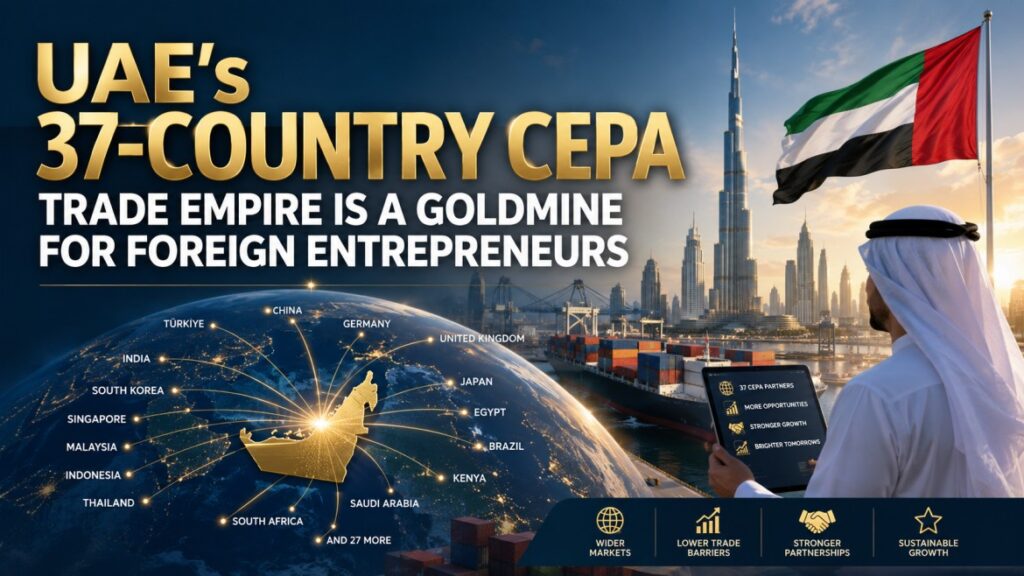
 In five years the UAE has built something most countries spend a generation attempting: a bilateral trade network reaching roughly a quarter of the world’s population. For entrepreneurs who understand how it actually works, the UAE CEPA network is one of the most useful structural advantages available anywhere. For those who misread it, it is an expensive assumption.
In this guide
Quick Answer
- The UAE has concluded 37 CEPAs, of which 18 are now in force – up from six in force at the start of 2025.
- UAE non-oil foreign trade passed USD 1 trillion (roughly AED 3.8 trillion) for the first time in 2025, rising around 26% year-on-year. H1 2026 reached AED 1.937 trillion, up 13.1%.
- Non-oil trade with CEPA-in-force partners alone reached AED 304.3 billion in H1 2026.
- Negotiations continue with around 20 more countries. Canada’s agreement was concluded in 47 days – the fastest on record.
- The critical point most summaries get wrong: a UAE licence does not, by itself, give you CEPA tariff benefits. Preference follows the origin of the goods, not the nationality of the company. That distinction decides whether your model works.
1. What the UAE CEPA network actually is
A Comprehensive Economic Partnership Agreement is a bilateral trade agreement that goes considerably further than a conventional free trade deal. Alongside tariff reduction, a CEPA typically covers trade in services, investment protections, intellectual property, digital trade, customs procedures, government procurement and dispute resolution.
The UAE launched the programme in 2021 with a deliberate strategic choice: rather than wait for slow multilateral or regional blocs, it would negotiate quickly and bilaterally with high-growth economies and major population centres.
The pace has been remarkable, and it is now feeding directly into cross-border e-commerce trade volumes. The first agreement, with India, was signed in February 2022 and entered into force that May. As of July 2026, the UAE Minister of Foreign Trade confirms 37 agreements concluded and 18 in force, with negotiations underway with roughly 20 more.
For context on how recent most of this is: only six agreements were in force at the beginning of 2025. Three-quarters of the operational network came into effect within eighteen months.
2. Which agreements are actually in force
This distinction matters more than any other in this article, and it is where most published summaries mislead.
Concluded means negotiations finished and the text is agreed. In force means both countries completed domestic ratification and the tariff schedules are legally operative. Only the second category reduces your duty bill today.
In force (18)
India (May 2022, the cornerstone corridor), Israel, Indonesia, Türkiye, Cambodia, Georgia, South Korea, Costa Rica, Mauritius, Serbia, Jordan, Vietnam (February 2026), Azerbaijan and Ukraine (1 July 2026), among others. Several Eurasian agreements are expected to take effect within months.
Concluded, awaiting entry into force
Canada, Australia, New Zealand, Malaysia, Kenya, Colombia, Chile and the Philippines – with the Philippines targeted to come into force before the end of 2026. Negotiations are at final stages with Rwanda, Ghana and Zambia, and progressing with Bangladesh and Peru. A seventh round with the European Union has concluded, though at a slower pace than the bilateral track.
Practical implication: if your business case depends on a specific corridor, verify that corridor’s current status with the UAE Ministry of Economy before you commit capital. An agreement concluded in principle does not reduce the duty on a container arriving next month.
3. The four ways CEPA changes the commercial maths
Non-oil trade at record levels
The programme was designed to decouple UAE economic performance from oil, and on that measure it is working. Non-oil foreign trade surpassed USD 1 trillion for the first time in 2025, growing around 26% year-on-year, with non-oil exports up roughly 45% to USD 221 billion. H1 2026 reached AED 1.937 trillion, up 13.1% on the same period in 2025 – and 78.8% above H1 2022.
The national target is AED 4 trillion (USD 1.089 trillion) in non-oil foreign trade by 2031.
Tariff elimination on most product lines
CEPAs typically remove or sharply reduce duties across the large majority of tariff lines. For goods that do not qualify for preference, the standard UAE customs duty is 5% of CIF value under the GCC common external tariff, plus 5% VAT. On thin-margin traded goods, moving from 5% to zero is often the difference between a viable and unviable line.
Services and mobility, not just goods
This is the underused half of the programme. The India CEPA alone covers 11 service sectors and over 100 subsectors – IT, professional services, financial services, logistics, tourism – and introduces three-year intra-corporate transfer visas and 90-day business visitor visas. If you run a services business rather than a trading company, the mobility and market-access provisions may matter more to you than any tariff schedule.
A genuine re-export and value-addition hub
The UAE’s position between Asia, Africa and Europe, combined with world-class port and logistics infrastructure, makes it a natural place to import components, add value, and export into CEPA markets under preferential terms.
Note the phrase add value. It is doing all the work in that sentence, and Section 5 explains why.
4. Where the real opportunity sits for foreign entrepreneurs
The headline framing – “access a quarter of the world’s population” – is true and largely useless as a business plan. Here is where the practical opportunity concentrates.
Manufacturing and assembly with genuine transformation. If you can perform real processing in the UAE that meets origin thresholds, you gain preferential access into multiple markets from a single base. This is the strongest CEPA play available.
Corridor-specific trading. Businesses built around one deep corridor – India, Türkiye, Vietnam, Indonesia – where you understand both regulatory environments, tend to outperform generalist traders chasing whichever agreement was signed most recently.
Services exporters. Consulting, IT, engineering, professional services and logistics firms can use the services chapters and mobility provisions without ever touching a rule of origin.
Trade infrastructure and compliance services. Customs brokerage, origin certification advisory, trade finance, freight forwarding, warehousing and compliance software. Every new corridor creates demand for people who can operate it correctly – and as Section 5 shows, correct operation is not trivial.
5. The part most CEPA articles get wrong
If you take one thing from this article, take this.
A UAE trade licence does not give you CEPA tariff benefits. Preference attaches to goods that satisfy the rules of origin in the relevant agreement. Incorporating in a free zone, warehousing imported goods and re-exporting them unchanged does not create UAE origin, and will not attract preferential treatment.
Under the India–UAE CEPA, goods generally qualify one of two ways:
- Wholly obtained – entirely produced in the exporting country. Most agricultural goods fall here.
- Substantial transformation – typically a change in tariff classification at the six-digit HS level and a minimum 40% regional value content, calculated on FOB value. Chemicals require 40% value addition; steel is subject to a “melt and pour” requirement.
Transshipped goods are excluded. Certificates of origin must be obtained through the proper channel – the UAE Ministry of Economy for UAE-origin exports, DGFT for Indian-origin goods – and are issued per shipment, with fees scaling by invoice value.
These provisions exist deliberately. They prevent third-country goods from routing through a CEPA partner to capture preferences they were never intended to receive. They are enforced, and getting them wrong means duty demands and penalties at the destination port, not a polite correction.
The commercial consequence: before you build a model around zero tariffs, establish whether your specific product, under its specific HS code, can actually meet the origin test in your target corridor. That is a technical question with a definite answer, and it should be settled before incorporation – not after your first shipment is held. This is precisely the kind of assumption I test in pre-launch feasibility work.
6. Choosing the right structure to trade under
Once the origin question is settled, structure becomes the next decision – and it is genuinely consequential rather than administrative.
Mainland
A mainland company can trade directly across the UAE domestic market and bid for government contracts, with 100% foreign ownership now permitted across most activities. If your customers are UAE businesses and consumers, this is usually the stronger position.
Free zone
A free zone company suits import, value-addition and re-export models, with straightforward capital repatriation and customs-duty suspension on goods held inside the zone.
One correction worth making, because it appears in almost every promotional article on this subject: free zone companies are not automatically exempt from corporate tax. A Qualifying Free Zone Person may access a 0% rate on qualifying income only, subject to substance requirements and a defined list of qualifying activities. Distribution qualifies only when carried out in or from a Designated Zone and the buyer is a reseller or processor – sales to end users are taxed at 9%. Non-qualifying income does not receive the AED 375,000 threshold that ordinary companies enjoy.
From tax periods beginning 1 January 2026, FTA Decision No. 6 of 2026 also requires an annual independent agreed-upon-procedures report from an external auditor for free zone persons claiming the distribution activity. The regime remains attractive. It is simply no longer the automatic exemption that marketing copy suggests. See Tax Registration & Filing and Financial Reporting & Auditing.
Offshore and branch structures
An offshore entity serves holding and asset-structuring purposes but cannot trade within the UAE. Existing overseas businesses extending into the market should look at foreign company setup. I have compared these routes in detail in Mainland vs Free Zone vs Offshore.
Trading businesses also face practical sequencing questions around corporate banking – cross-border trade flows attract longer compliance review – and around visas and PRO support for the team who will run the operation.
7. A realistic qualification checklist
- Confirm your corridor is in force. Not concluded. In force, with published tariff schedules.
- Find your HS code and check the product-specific rule. Thresholds vary by chapter; the 40% figure is common but not universal.
- Model whether you can genuinely meet the value-addition test. If your plan is warehousing and relabelling, you likely cannot.
- Choose jurisdiction against customer and activity – and, if free zone, against the Designated Zone and qualifying-activity rules.
- Build certification into your operating cost. Certificates of origin are per-shipment, with fees and lead times.
- Confirm destination-side requirements. The importing country’s customs authority decides whether your certificate is accepted.
8. My Approach: Qualifying for CEPA Properly
Most business setup consultants help you register a company. I help you make informed business decisions before you invest.
CEPA access sounds like an automatic win for any trading business, but the tariff benefit only applies if your structure, product classification and documentation are set up correctly from day one. Before recommending an entity for CEPA-linked trade, I check which specific agreements your target markets fall under and whether your business model can actually meet the rules-of-origin requirements.
My advisory process focuses on helping you reduce uncertainty and make confident decisions, not just complete documentation.
What You Can Expect
- Business idea validation
- Market research
- Competitor analysis
- Business plan development
- Startup cost estimation
- Financial feasibility analysis
- Business structure recommendations
- Licence selection guidance
- Investor and employment visa planning
- Business bank account strategy
- Risk assessment
- Business expansion planning
The objective is simple: help you start your business with clarity, confidence and a long-term strategy.
9. Is the UAE the right choice for your business?
If you are planning to launch a new venture, expand internationally, or relocate your business to the UAE, do not base the decision solely on promotional offers or the lowest licence price – and do not base a trade strategy on a headline tariff number without checking whether your goods qualify.
Build your business on research, planning and informed decision-making. The right strategy today can save you thousands in cost and position your business for sustainable growth tomorrow.
The CEPA network is a real and durable advantage. Eighteen operative agreements, a quarter of the world’s population within preferential reach, and a government adding corridors faster than almost any other trading nation. Entrepreneurs who do the technical work – origin, structure, certification – will find few better places to build a trading business this decade.
Ready to build your business with confidence?
If you are considering setting up a business in the UAE, let’s start with strategy – not paperwork. Together we will evaluate your goals, analyse the market, identify the right setup options, and create a roadmap tailored to your vision.
Because successful businesses aren’t built by chance – they’re built on informed decisions.
Book a free consultation or message me directly on WhatsApp.
Frequently asked questions
How many UAE CEPA agreements are currently in force?
As of July 2026 the UAE has concluded 37 CEPAs, of which 18 have entered into force. Negotiations continue with around 20 further countries, and several more agreements are expected to take effect within months.
Does a UAE free zone licence automatically give me CEPA tariff benefits?
No. CEPA preference depends on the origin of the goods, not the nationality of the company. Goods must be wholly obtained or substantially transformed – commonly a change in tariff classification plus at least 40% regional value content – and must be supported by a valid certificate of origin. Simply re-exporting unchanged imported goods does not qualify.
What is the value-addition threshold to qualify for CEPA benefits?
Under the India–UAE CEPA, the common test is a change in tariff sub-heading at six-digit HS level combined with a minimum 40% regional value content on FOB value. Thresholds and product-specific rules vary by chapter and by agreement, so the rule for your specific HS code should be checked directly.
Are free zone companies exempt from UAE corporate tax?
Not automatically. A Qualifying Free Zone Person may access 0% on qualifying income only, subject to substance and activity conditions. Non-qualifying income is taxed at 9% without the AED 375,000 threshold, and from tax periods beginning January 2026 an annual independent auditor report is required for those claiming the distribution activity.
Which CEPA corridor is the largest for UAE businesses?
India remains the cornerstone. It was the first agreement, in force since May 2022, and bilateral non-oil trade has grown to well over USD 65 billion with more than 240,000 certificates of origin issued since inception.
Sources
- The National – UAE to conclude up to seven CEPAs by year-end
- Economy Middle East – 37 CEPAs concluded, 18 in force
- The National – UAE finalises CEPA with Canada
- Middle East Briefing – UAE–Vietnam CEPA enters into force
- Middle East Briefing – India–UAE CEPA, rules of origin and transshipment
- UAE Ministry of Economy & Tourism – Certificate of Origin service
This article is general commentary, not legal, customs or tax advice. Agreement status, tariff schedules and rules of origin change – verify current requirements with the UAE Ministry of Economy and the destination customs authority before acting.
Related reading: the UAE defence industry’s AED-scale economic footprint.
Related reading: how RBI’s new rules make Bharat Mart Dubai a trade hub for Indians.
Related reading: UAE GDP Q1 2026 growth and the 17.3% finance-sector spike.
UAE CEPA agreements keep expanding, and each new one is a fresh reason for exporters and re-exporters to base their regional operations here rather than watch from outside. The UAE CEPA network rewards businesses that are already set up to use it.
Pingback: Bharat Mart Dubai: RBI Rules and Setup Guide for Exporters
Pingback: Dubai South Logistics 2026: Corridor, Costs and Setup Guide
Pingback: UAE E-Commerce Market 2026: Data, Costs and Setup Guide