
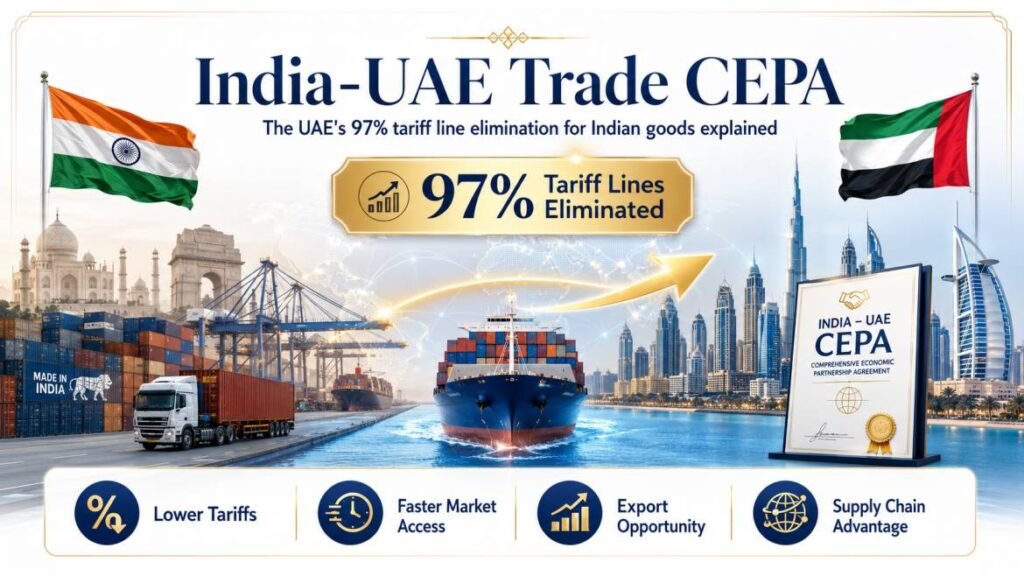
India-UAE bilateral trade reached $101.25 billion in the 2025-26 financial year, crossing $100 billion for the second consecutive year, driven by the Comprehensive Economic Partnership Agreement that took effect in May 2022. Under CEPA, the UAE eliminated tariffs on 97% of its tariff lines for Indian-origin goods, covering roughly 99% of India’s exports to the UAE by value. Both figures are accurate, and a meaningful share of current coverage uses them to imply something that is not quite true: that this makes it broadly cheaper for Indian businesses to expand to Dubai. The 97% figure describes the cost of moving goods across the border. It says nothing about the cost of forming a company, renting an office, or running a services business in the UAE. Here is what the milestone actually covers, what it does not, and what genuinely matters for an Indian business weighing a Dubai expansion.
Quick Navigation
Quick Answer
- India-UAE bilateral trade reached $101.25 billion in FY2025-26, up from $100.03 billion the year before, crossing $100 billion for the second consecutive year under CEPA.
- The UAE eliminated tariffs on 97% of its tariff lines for Indian-origin goods, covering 99% of India’s exports by value. This is a goods-trade tariff figure, not a business-setup cost reduction.
- India’s reciprocal commitment is smaller and slower: roughly 90% of tariff lines eliminated or reduced for UAE-origin goods, with a larger exclusion list concentrated in agriculture and sensitive manufacturing.
- India’s own exports to the UAE grew only about 2% in FY2025-26, while imports from the UAE grew faster, leaving India with a $26.53 billion trade deficit.
- The provisions most directly relevant to a services, technology or professional business expanding to Dubai are CEPA’s services chapter and professional mobility visas, not the goods tariff schedule.
India UAE Trade CEPA 100 Billion: The Milestone, Verified
India-UAE bilateral trade reached $101.25 billion in the 2025-26 financial year, up from $100.03 billion the year before, according to India’s Commerce and Industry Minister Piyush Goyal. This is the second consecutive year trade has crossed the $100 billion mark, not a one-off spike.
The scale of growth since CEPA is genuinely significant. Bilateral trade stood at roughly $60 billion when CEPA took effect in May 2022, and has since grown to the current figure, with both countries setting a further target of $200 billion by 2032. Non-oil trade now accounts for nearly two-thirds of the total, a meaningful shift from a relationship historically weighted toward energy and traditional commodities.
CEPA itself was signed on 18 February 2022 and entered into force on 1 May 2022, India’s first comprehensive trade agreement with a Gulf country. In May 2026, on the occasion of the agreement’s fourth anniversary, the UAE-India CEPA Council marked the milestone alongside an official visit to the UAE by Indian Prime Minister Narendra Modi, underlining the relationship’s continued political priority on both sides.
What the 97% Tariff Figure Actually Covers
This is the number driving most of the current headlines, and it deserves to be stated precisely rather than loosely.
Under CEPA, the UAE committed to eliminating tariffs on 97% of its tariff lines for goods originating in India, covering approximately 99% of India’s exports to the UAE by value. Of that 97%, roughly 80.3% of lines received immediate tariff elimination on entry into force, 14.4% phase out over five years, 2.4% phase out over ten years, 0.5% receive a partial reduction of up to 50%, and the remaining 2.4%, concentrated in sensitive categories, are excluded entirely.
This is a customs duty schedule for physical goods crossing the border. It applies to a company exporting jewellery, textiles, engineering products, pharmaceuticals or similar goods from India into the UAE, and it materially reduces what those goods cost once landed. It has no direct application to a services business, a technology company, a consultancy, or a business setting up in Dubai to sell locally within the UAE rather than to export goods into it. A SaaS company incorporating in Dubai gains nothing from this 97% figure, because there is no tariff line for software.
The distinction matters because a large share of current coverage cites the 97% figure in the same breath as encouraging Indian businesses broadly to expand to the UAE, without clarifying that the benefit is specific to goods trade. If your business physically exports products into the UAE, this figure is directly and substantially relevant to your cost base. If it does not, the 97% figure is context, not a reason.
India UAE Trade CEPA 100 Billion: The Reciprocal Side Almost Nobody Mentions
In this story, trade agreements are reciprocal by definition, and India’s side of the tariff commitment is consistently underreported relative to the UAE’s.
India committed to eliminating or reducing tariffs on a smaller and slower schedule than the UAE offered: broadly around 90% of India’s tariff lines for UAE-origin goods, with immediate elimination on a smaller initial share, roughly 64.6% of lines by one detailed account, and a larger exclusion list, roughly 9.7% of tariff lines, concentrated in agriculture and sensitive manufacturing sectors India has chosen to protect.
This asymmetry is not a flaw in the agreement. India, as the more protection-conscious party in several sensitive sectors, negotiated a structurally different, more gradual commitment than the UAE did. It is, however, a piece of context that almost never appears alongside the celebratory 97% figure, and it matters for any business trying to understand the full shape of the tariff relationship rather than only the half that favours Indian exporters.
The Imbalance Inside the Celebration
The headline figure is real and the growth inside it is not evenly distributed between India’s exports and imports.
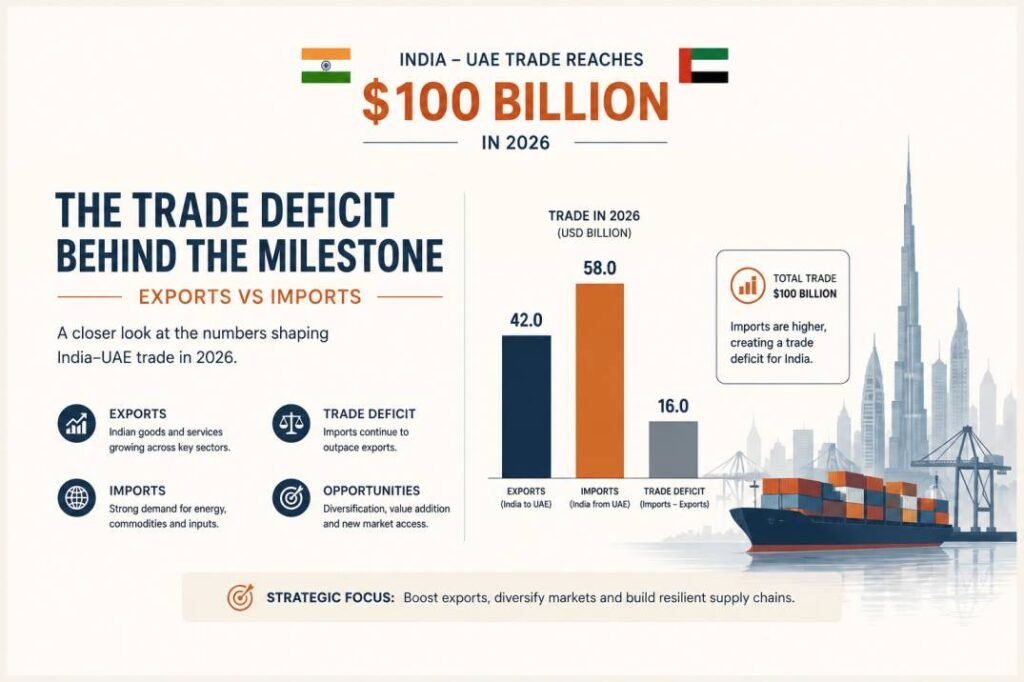
In FY2025-26, India’s exports to the UAE rose only about 2%, to $37.36 billion. Imports from the UAE grew faster, reaching $63.89 billion, leaving India with a trade deficit of $26.53 billion for the year. The headline $100 billion figure is accurate. The underlying composition shows import growth outpacing export growth, which is a meaningfully different story than “Indian exports are booming,” the framing several pieces of coverage lean toward.
This is not a reason to discount the milestone. It is a reason to read past the headline number before drawing conclusions about which side of the trade relationship is actually driving the growth in a given year.
India UAE Trade CEPA 100 Billion: What Genuinely Matters for a Business Expanding to Dubai
Separating the goods tariff story from the business-expansion question, here is what actually applies depending on what your business does.
If you manufacture, trade or export physical goods, the 97% tariff elimination is directly and substantially relevant. Setting up a UAE trading or distribution entity to warehouse, re-export or distribute goods leveraging duty-free access is a genuine, quantifiable structural advantage, and the case for a UAE base strengthens further given the UAE’s own separate network of trade agreements that can extend market access beyond the CEPA relationship itself, covered in why the UAE’s CEPA network is a goldmine for foreign entrepreneurs and, for the specific re-export and rupee-settlement angle relevant to Indian exporters, in how Bharat Mart Dubai is reshaping trade for Indian exporters.
If you run a services, technology, professional or consulting business, the goods tariff figure is largely irrelevant to you. What actually matters is CEPA’s services chapter, covering 11 sectors and more than 100 sub-sectors, mutual recognition of professional qualifications, and mobility provisions including 3-year intra-corporate transfer visas and 90-day business visitor visas. These provisions reduce genuine friction for a services business establishing UAE operations, and they receive a fraction of the attention the goods tariff figure gets.
If your business is pharmaceuticals or medical devices, a specific and useful CEPA provision grants automatic UAE registration and marketing authorisation within 90 days for Indian generic medicines already approved in the US, EU, UK, Canada or Australia, a meaningfully faster route to UAE market access than starting from scratch.
Whichever category applies, the underlying structural decision, mainland versus free zone, and the broader UAE opportunity set are covered in mainland vs free zone vs offshore in the UAE, and for goods-focused businesses specifically, why global traders are choosing the UAE as a re-export hub.
The UAE-India Start-Up Series, and Where the Next Growth Actually Is
One genuinely fresh, under-covered development worth knowing directly.
In May 2026, at CEPA’s four-year anniversary event, the UAE-India CEPA Council signed a new Memorandum of Understanding to advance a second edition of the UAE-India Start-Up Series, a programme specifically designed to fast-track cross-border market access, growth and collaboration for Indian start-ups entering the UAE ecosystem. The first edition reportedly attracted over 10,000 applications, a concrete signal of demand from Indian founders specifically for this kind of structured entry pathway, independent of the goods tariff schedule entirely.
This lines up with what industry experts are already saying about where the relationship’s next phase of growth will come from. With tariffs already eliminated on roughly 97% of trade lines, further trade growth is expected to come less from additional tariff cuts and more from services and the digital economy, an area officials have reportedly begun referring to as CEPA 4.0, with fintech, AI, deep-tech, healthcare, pharma, agri-tech and logistics infrastructure named as the clearest untapped sectors. For a business in any of these categories, this is a more current and more relevant signal than the tariff milestone most coverage leads with.

My Approach: The Right Reason to Expand, Not the Trending One
Most business setup consultants help you register a company. I help you make informed business decisions before you invest.
The India UAE trade CEPA 100 billion headline is genuinely exciting, and it is not, on its own, a business case for every kind of Indian company to expand to Dubai. The businesses that get real, structural value from this moment are specific: goods exporters and traders who can use the 97% tariff elimination directly, and services and technology businesses positioned to take advantage of CEPA’s genuinely under-used services chapter and the newer start-up pathways now being built. Getting clear on which category your business actually falls into, before treating a trade statistic as your reason to expand, is the difference between a decision grounded in your business and one grounded in a headline.
My advisory process focuses on helping you reduce uncertainty and make confident decisions, not just complete documentation. In practice:
- Honest assessment of whether your business is genuinely a goods-trade beneficiary of CEPA’s tariff schedule, or whether the services chapter and mobility provisions are the more relevant CEPA benefit for you.
- Structure and jurisdiction guidance suited to whether you are setting up a trading and re-export entity or a services and professional business.
- Business setup and licensing execution once the actual opportunity, not the headline statistic, has been properly assessed.
- Corporate tax registration and filing planning appropriate to a goods-trading or services activity respectively.
- Banking setup guidance suited to cross-border trade flows or services billing, depending on your business model.
The objective is simple: help you start your business with clarity, confidence and a long-term strategy, expanding to Dubai for the reason that actually applies to your business, not the one making headlines this month.
If you are an Indian business weighing what this deal actually means for a Dubai expansion, and want the real, applicable case assessed properly before you commit, get in touch.
Frequently Asked Questions
Has India-UAE trade actually crossed $100 billion?
Yes, and for the second consecutive year. Bilateral trade reached $101.25 billion in FY2025-26, up from $100.03 billion in FY2024-25, according to India’s Commerce and Industry Minister Piyush Goyal, driven substantially by the CEPA agreement in force since May 2022.
Does the 97% CEPA tariff elimination make it cheaper to set up a business in Dubai?
Not directly. The 97% figure describes UAE tariff lines eliminated on goods imported from India, reducing the cost of moving physical products across the border. It does not reduce company formation costs, licensing fees, office rent or other business-setup expenses. It is directly relevant to goods exporters and traders, and largely irrelevant to services, technology or professional businesses.
What did India commit to under CEPA, compared to the UAE?
India’s reciprocal commitment is smaller and slower than the UAE’s: roughly 90% of India’s tariff lines eliminated or reduced for UAE-origin goods, with a larger exclusion list, around 9.7% of tariff lines, concentrated in agriculture and sensitive manufacturing, and a more gradual phase-in schedule than the UAE’s.
Is India-UAE trade balanced?
Not currently. In FY2025-26, India’s exports to the UAE grew about 2% to $37.36 billion, while imports from the UAE grew faster to $63.89 billion, leaving India with a $26.53 billion trade deficit for the year, even as total bilateral trade crossed $100 billion.
What CEPA provisions matter most for a services or technology business expanding to Dubai?
The services chapter, covering 11 sectors and more than 100 sub-sectors, mutual recognition of professional qualifications, 3-year intra-corporate transfer visas, and 90-day business visitor visas are more directly relevant to a services or technology business than the goods tariff schedule, which does not apply to services in the same way.
What is the UAE-India Start-Up Series?
A programme launched via the UAE-India CEPA Council, designed to fast-track market access, growth and collaboration for Indian start-ups entering the UAE. Its first edition reportedly attracted over 10,000 applications, and a second edition was announced via a new MoU in May 2026.
What is CEPA 4.0?
An informal term some officials and industry experts are using to describe the next phase of the India-UAE trade relationship, focused on services and the digital economy, including fintech, AI, deep-tech, healthcare, pharma, agri-tech and logistics infrastructure, since goods tariff cuts under the current agreement are largely exhausted as a growth lever.
What to check before acting on the headline
Trade figures at this scale move policy conversations quickly, and the practical detail that matters for a specific product line can shift faster than the headline number suggests. Before committing to a supply chain or pricing decision based on the tariff outcome, confirm the current HS code classification for your specific product against the latest published schedule, since tariff treatment is set at that level of detail rather than at the level of the overall agreement.
It is also worth checking rules of origin requirements separately from the tariff rate itself. A product assembled in the UAE from components sourced elsewhere does not automatically qualify for preferential treatment simply because the finished item ships from a UAE address. The origin rules determine eligibility, and they are usually the detail that catches businesses moving quickly to capture a headline opportunity without confirming the underlying mechanics first.
Confirming these two details, HS code classification and rules of origin, before acting on the headline is the single step most coverage of this trade milestone skips entirely.