How Dubai’s strategic location, free zones, logistics infrastructure and global connectivity are transforming the UAE into a powerful gateway for international trade.
Quick Answer
- Dubai’s strategic location, free zones, logistics infrastructure and global connectivity are what actually make the UAE a genuine global re-export hub, not marketing language.
- Jebel Ali Port and its surrounding free zone infrastructure are the practical backbone behind the UAE’s re-export volume.
- 37 trade agreements widen market access for goods moving through the UAE, though the compliance side is rarely explained properly.
- Whether a re-export business should structure as free zone or mainland depends on the specific trade flow, not a default assumption either way.
In this guide
A client of mine buys electronics components from South Korea, has them relabelled and consolidated in a Dubai free zone, and ships them onward to distributors in East Africa – and never once touches the UAE mainland market. He isn’t an outlier. He’s the model. Somewhere between Jebel Ali’s cranes and a customs officer’s stamp on a Mirsal 2 declaration, the UAE has quietly built itself into one of the world’s busiest re-export hub economies, and most of the traders benefiting from it can’t fully explain why it works.
This isn’t a new story – Dubai has been a trading post for a century. What’s changed is the scale and the machinery behind it: a re-export hub built on port capacity, UAE free zones purpose-built for goods that pass through rather than stay, and a trade agreement network that didn’t exist five years ago. Ask why Dubai is increasingly described as a trading hub in its own right rather than just a shopping and tourism destination, and the answer is this infrastructure, not marketing. If you’re weighing whether to route your international trade through the UAE for your own UAE business setup, here is what’s actually driving that decision for other global traders, and what the fine print looks like once you’re inside it.
Why the UAE Has Quietly Become a Global Re-Export Hub
Re-export, in plain terms, means goods enter the UAE, are stored, consolidated, relabelled or lightly processed, and then leave again to a third destination – without ever being sold into the domestic mainland market. It sits apart from ordinary import-export because the goods rarely change ownership within the UAE in any way that alters their tax or customs character; the UAE’s role is logistics, consolidation and re-routing, not consumption. The same routing logic now underpins the region’s cross-border e-commerce flows, which is the subject of the Yalla Commerce 2026 summit.
The UAE re-export hub story isn’t hype – the numbers behind that role are becoming hard to ignore. The World Trade Organization’s 2026 review put the UAE among the world’s top 10 goods exporters for the first time – 9th globally, up from 17th just five years earlier, with total goods and services trade reaching roughly $1.637 trillion (Dh6.014 trillion) in 2025 and the country now accounting for 3.3% of global goods exports. That is not a domestic-consumption number. A market of roughly 10 million residents does not organically generate trade flows at that scale; a re-export and transhipment economy does.
Three things make that possible at once: a port and logistics network built for scale, a free zone system purpose-built for goods that pass through rather than stay, and a growing web of trade agreements that make the UAE a more useful base with every year that passes. The rest of this guide walks through each one, and what it actually means if you’re the one deciding where to route your trading business.
Jebel Ali and the Free Zone Infrastructure Behind the Numbers
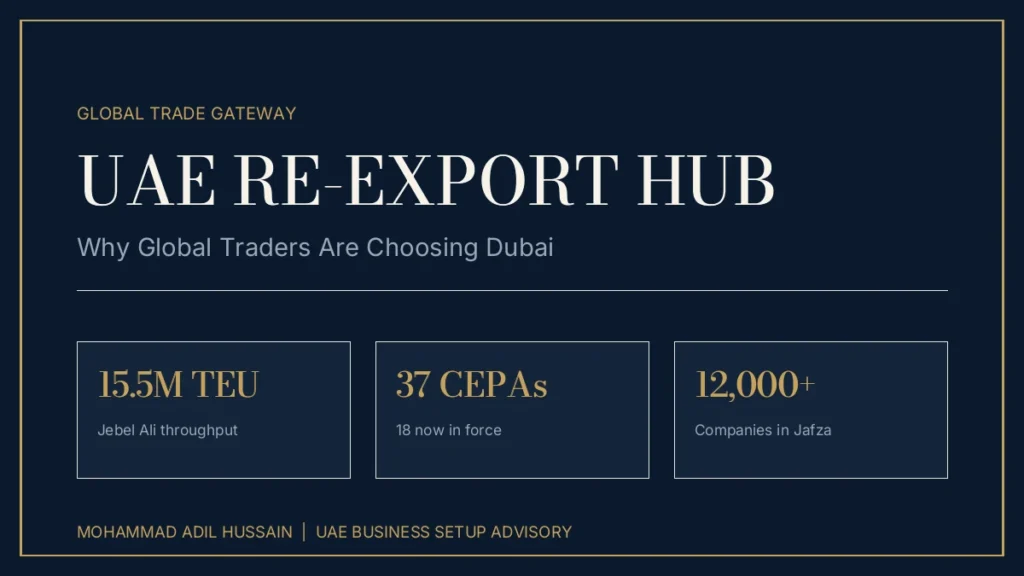
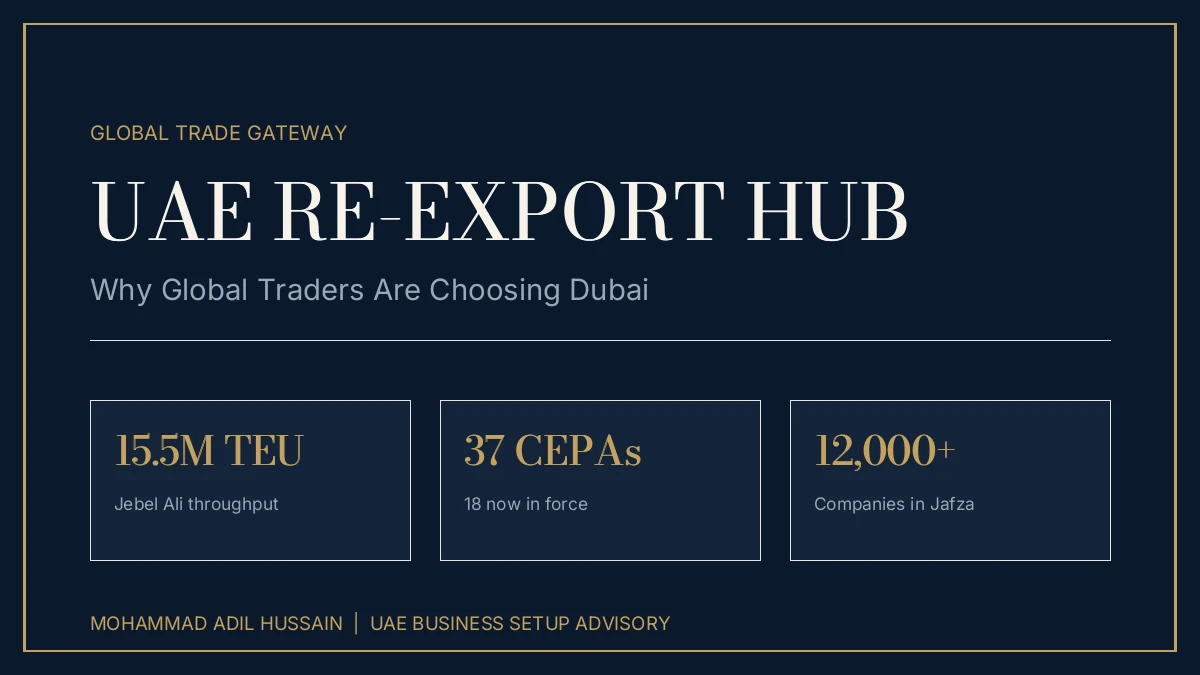
Start with the port, because everything else in this article sits on top of it. Jebel Ali is the world’s largest man-made harbour – roughly 134.68 square kilometres of it – and it handled 15.5 million TEU of containers in 2024, its highest throughput since 2015, putting it 9th in Lloyd’s List’s 2025 ranking of the world’s top 100 container ports. It runs on four terminals, more than 100 berths, a 25-kilometre quay line, and an annual capacity of 19.4 million TEU, with over 5,000 companies from 120 countries operating around it. That last figure matters more than the throughput number: Jebel Ali isn’t just moving boxes, it’s hosting the businesses that decide where those boxes go next.
This is the physical machinery that turns “Dubai trading hub” from a marketing phrase into a measurable claim. Wrapped around the port is Jebel Ali Free Zone (Jafza), which just marked its 40th year since launching in 1985 and is still accelerating rather than coasting. Jafza recorded AED 854 million in new investment commitments in the first four months of 2026 alone, now hosts close to 12,000 companies, and processed roughly $190 billion in trade volume – up 15% year-on-year. Every one of those companies is a potential supplier, buyer or logistics partner for a re-export business, which is a large part of why traders base themselves inside the zone rather than simply shipping through it.
The broader trade numbers tell the same story from a different angle. Dubai Chamber of Commerce recorded its highest-ever annual member exports and re-exports in 2025 – AED 356.5 billion (roughly $97.07 billion), up 15.1% year-on-year – with growth accelerating through the year rather than tapering off. None of this happened by accident. It’s the direct output of decades of deliberate investment in logistics corridors like Dubai South, purpose-built free zones designed specifically for trading companies, and port capacity that keeps expanding ahead of demand rather than behind it.
How 37 Trade Agreements Widen the Door
Infrastructure gets goods into and out of the country efficiently. Trade agreements decide how much it costs to do that. This is the part of the UAE’s re-export hub story that’s moved fastest and gets the least attention outside trade circles.
As of mid-2026, the UAE has concluded 37 Comprehensive Economic Partnership Agreements (CEPAs) and has 18 of them in force – up from just six in force at the start of 2025. Non-oil foreign trade passed USD 1 trillion (roughly AED 3.8 trillion) for the first time in 2025, rising around 26% year-on-year, and H1 2026 alone reached AED 1.937 trillion, up 13.1%. Trade with CEPA-in-force partners specifically hit AED 304.3 billion in H1 2026. Negotiations continue with roughly 20 more countries, and the UAE has shown it can move fast – the Canada agreement was concluded in 47 days, the quickest on record.
Here’s the detail that changes how a re-export business should actually think about this: CEPA preference follows the origin of the goods, not the nationality of the company holding the licence. Basing your trading entity in the UAE does not, by itself, unlock CEPA tariff benefits for goods that neither originate in nor undergo sufficient transformation within the UAE. What it does give you is a base positioned inside 18 live preferential trade corridors, from India to Indonesia to Israel, from which you can structure sourcing, light processing and distribution deliberately – which is a genuinely different opportunity than simply having a UAE address. I go through how the origin rules actually work, corridor by corridor, in the UAE’s CEPA network for foreign entrepreneurs, and it’s worth reading in full before you assume a tariff benefit applies to your specific goods.
The Compliance Side Almost Nobody Explains Properly
This is where most “UAE is a trade hub” content stops, and where I think it should actually start. Getting the compliance mechanics right is what separates a re-export business that keeps its margins from one that loses them to an unplanned customs bill.
- Customs duty is suspended, not waived. Goods held in a designated free zone don’t attract the standard 5% CIF-based import duty. That duty only becomes payable if goods move onto the UAE mainland. Re-exports to destinations outside the GCC are duty-exempt outright, provided they’re properly declared and documented.
- VAT works the same way. Goods sitting in a Designated Zone are treated as outside the UAE for VAT purposes. VAT is only triggered if goods enter the mainland; a genuine re-export that exits the country avoids it entirely.
- Documentation is not optional paperwork – it’s your proof of exit. Every re-export declaration needs the commodity’s HS code, shipment value, origin and destination, consignee details, commercial invoice, packing list, certificate of origin, bill of lading or airway bill, and, for controlled goods, an export permit and end-user certificate. It’s filed through Mirsal 2 as an “Export from Free Zone to Rest of World” declaration, and that finalized declaration is what proves the goods actually left – it’s also what releases any bank guarantee held against the shipment.
- Dual-use and controlled goods need advance permits. Under Federal Decree-Law No. 43 of 2021, goods in nine strategic categories – nuclear materials, electronics, telecommunications, sensors, navigation, marine, aerospace and propulsion equipment among them – require a permit from the Executive Office for Control and Non-Proliferation before they can be re-exported. Processing takes up to 20 working days, so this is a planning item, not a same-week task.
- Keep records for five years. That’s the standard UAE customs retention period, and it’s the window in which Dubai Customs can conduct a post-clearance audit and ask you to produce exactly the documentation above.
None of this is difficult once it’s built into your operating process from day one. It becomes expensive when it’s treated as an afterthought – which, in my experience, is precisely how most re-export businesses end up losing the margin advantage they set up in the UAE to capture in the first place.
Free Zone or Mainland: Which Structure Actually Fits a Re-Export Business
For a genuine re-export model – goods coming in and going straight back out to a third country – a free zone company is usually the right starting structure. You get the duty-suspension and VAT treatment described above, 100% foreign ownership, and, in zones like Jafza and Fujairah, direct proximity to port and logistics infrastructure built for exactly this kind of flow.
That changes the moment any part of your model touches the UAE mainland market – selling to a local distributor, holding inventory a mainland buyer purchases directly, or providing services to mainland clients. At that point a mainland company, or a dual structure that pairs a free zone entity for re-export with a mainland entity for domestic sales, tends to make more sense. I’ve written a full comparison of how these structures actually differ in practice, not just on paper, in mainland vs free zone: what actually matters in 2026 and the three-way breakdown in mainland vs free zone vs offshore, which is worth reading before you commit to either.
An offshore structure occasionally comes up for traders who need a holding entity for invoicing or asset protection rather than a physical operating base, but it can’t hold the free zone’s operational advantages – it’s a different tool for a different job, not a cheaper substitute for a free zone licence.
My Approach to Structuring a Re-Export Business
Most business setup consultants help you register a company. I help you make informed business decisions before you invest.
A re-export business is a good example of why that distinction matters more than it sounds. Most consultants will get you a free zone licence in a week and call the job done. But a licence isn’t a strategy – it doesn’t tell you whether your specific goods actually qualify for CEPA preference, whether your product category needs an export control permit before you can move it, or whether your banking setup can actually handle the trade finance and letters of credit a re-export flow depends on.
My approach is to start with strategy, not paperwork: map where your goods actually originate, where they’re going, and what happens to them while they’re here, before choosing a zone or a structure. That decision shapes everything downstream – which free zone gives you the right proximity to port and logistics, whether you need a dual free zone and mainland structure, and how your UAE corporate banking needs to be set up to support trade finance from day one rather than being bolted on once your first shipment is stuck at customs. Successful trading businesses aren’t built by chance – they’re built on decisions made with the full compliance picture in front of you, which is also why I treat corporate tax and VAT registration as part of the initial structuring conversation, not a Year 2 problem to fix later.
That’s the difference between a consultant who sells you a licence and one who helps you build a trading business that still works the way you planned two years in.
What This Means If You Are Setting Up a Trading Business in 2026
If you’re currently sourcing from Asia, the Indian subcontinent or Africa and distributing elsewhere, the case for routing through the UAE has genuinely strengthened over the past two years – not because of one single number, but because port capacity, free zone infrastructure and the CEPA network are all expanding at the same time. That’s a narrow window worth taking seriously while it’s still opening rather than after it’s already priced in.
The practical sequence I’d walk a new client through: confirm which free zone actually sits closest to your specific trade lanes rather than defaulting to the best-known one, verify whether your goods qualify for CEPA preference under the corridors that are actually in force today, get your business setup and licensing structured around that answer rather than a generic template, and build your customs and VAT documentation process before your first shipment moves, not after a Dubai Customs audit asks for it. If you want a second opinion before you commit to a zone or a structure, start with a strategy conversation rather than a licence quote.
Frequently Asked Questions
What makes the UAE a re-export hub?
A combination of Jebel Ali Port’s scale – 15.5 million TEU handled in 2024 and 19.4 million TEU of annual capacity – purpose-built free zones like Jafza that host close to 12,000 trading companies, and a network of 37 CEPA trade agreements (18 in force) that give UAE-based traders preferential access to major economies. Together they let goods move in, be consolidated or lightly processed, and move out again efficiently and at a lower duty cost than most alternative bases.
Do I pay customs duty on goods re-exported from a UAE free zone?
Duty is suspended, not charged, while goods sit in a designated free zone. It only becomes payable if goods enter the UAE mainland. Genuine re-exports to destinations outside the GCC are duty-exempt, provided the shipment is properly declared through Mirsal 2 with the required documentation.
Does a UAE company automatically get CEPA tariff benefits?
No. CEPA preference follows the origin of the goods, not the nationality or location of the company holding the licence. A UAE base gives you access to 18 CEPA corridors currently in force, but your specific goods still need to meet the agreement’s origin rules to qualify for reduced tariffs.
Should a re-export trading business set up in a free zone or on the mainland?
A free zone company is generally the right fit for a pure re-export model, since it preserves the customs duty suspension and VAT treatment. A mainland company, or a dual free zone and mainland structure, becomes necessary once any part of the business sells directly into the UAE domestic market.
What documentation do I need to re-export goods from the UAE?
At minimum: the HS code, shipment value, origin and destination, consignee details, commercial invoice, packing list, certificate of origin, and bill of lading or airway bill, filed through Mirsal 2 as an export from free zone to rest of world. Controlled or dual-use goods additionally require an export permit and end-user certificate, and all records should be retained for five years.
Related reading: the UAE’s 37-country CEPA network explained for foreign entrepreneurs.
Related reading: why global logistics companies are moving to Dubai South.
Related reading: setting up a trading company in Fujairah’s free zones.
Sources & References
- The National – UAE ranks among global top 10 exporters, WTO, April 2026
- Lloyd’s List Top 100 Container Ports 2025 – Jebel Ali ranking
- Container News – DP World Jebel Ali record container volumes
- Kayrouz & Associates – Re-Export Compliance for UAE Free Zone Companies
Building a genuine re-export hub operation in the UAE takes more than a trade licence. Get the customs and documentation side right from day one and the re-export hub advantage compounds instead of quietly eroding your margins.
Further reading: If you plan to trade vehicle parts through the UAE, I worked through whether an automotive spare parts trading business in Dubai makes sense, including re-export stock in JAFZA.