
Most guides to IT company setup in Dubai start with the licence. That is the cheapest decision you will make. The ones that decide whether the business survives are who will pay you, how much cash you need before they do, and whether your licence, visa plan and bank account all tell the same story.
Last updated: 14 October 2026. Written by Mohammad Adil Hussain, UAE business setup advisor. Prices, promotions and rules were checked against official free zone, Federal Tax Authority and UAE Government sources on that date and are linked in the Sources section.
Quick Answer
- Validate first. Confirm the customer, price and break-even revenue before you pay for any licence. The licence is usually under 5% of the real first-year budget.
- Pick activities, then jurisdiction. AI development, AI consultancy, software development and IT consultancy are different licence activities. Choose the ones that match how you earn.
- Free zone or mainland. A free zone suits export, remote and startup models. A Dubai mainland licence suits founders who need government tenders or direct onshore operations.
- SRTIP (now branded SPARK), Sharjah. A cost-conscious technology free zone with an AI Hub, labs and an accelerator. My packages: zero-visa AED 5,500, and two one-visa options at AED 12,500 or AED 13,990 that differ in renewal terms (inclusions confirmed per client).
- Visas, banking and tax are separate decisions. A visa slot is not a processed visa, a licence is not a bank account, and a free zone does not mean 0% tax on all income.
For a deeper look at the Sharjah option on its own, see my SPARK free zone guide.
Table of Contents
1. Executive Summary: How to Start an AI or IT Company in the UAE
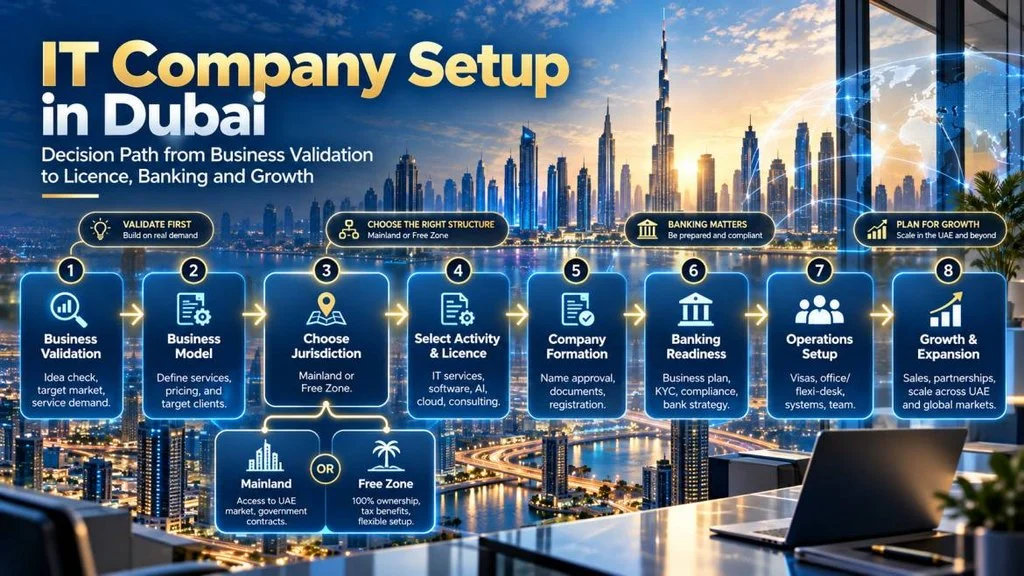
The short answer: whether you are planning an AI startup or a straightforward IT company setup in Dubai or elsewhere in the UAE, validate the business model first, then choose licence activities that match your revenue, then choose a jurisdiction (mainland or a technology free zone such as SRTIP/SPARK, IFZA, DMCC or Dubai Silicon Oasis). Budget for the licence, each visa, workspace, VAT and renewal, not just the headline package. Prepare documents, visas and Emirates ID, then register for corporate tax and build a bank-ready file. Licensing can take days. Banking and first revenue usually take longer, so keep at least six months of operating cash.
| If your situation is… | Usually consider | Why |
|---|---|---|
| Solo AI or IT consultant, clients mostly abroad or remote | Low-cost technology free zone (for example SRTIP/SPARK) | Lowest fixed cost while you prove demand |
| Need government tenders or on-site work across Dubai | Dubai mainland licence | Many public buyers and onshore contracts expect a mainland entity |
| Venture-backed product company | DIFC, DTEC/Dubai Silicon Oasis or Dubai Internet City | Investor familiarity and startup programmes |
| Need a Dubai address and moderate cost | IFZA, Meydan or DMCC | Dubai location with free zone flexibility |
| R&D, robotics or hardware prototyping | SRTIP/SPARK or Masdar City | Access to labs and prototyping facilities, subject to separate terms |
2. Why Consider the UAE for an AI or IT Business in 2026?
Short answer: because the government is both a policymaker and a buyer, and because the UAE is a practical base for selling into the GCC, Africa and South Asia. That does not make every AI idea viable, which is why the rest of this guide is about checking yours.
Policy and governance
The UAE launched its National Strategy for Artificial Intelligence in 2017 with a 2031 horizon, and appointed the world’s first Minister of State for Artificial Intelligence the same year. On 14 June 2026, the UAE Cabinet approved the establishment of the Artificial Intelligence and Data Authority, a single federal body for data, AI and digital government reporting to the Cabinet.
One correction worth making early: as of 14 October 2026 there is no single comprehensive federal “AI Act” in force. AI businesses are governed through the federal personal data law, cybercrime and consumer laws, sector regulators and free zone rules such as DIFC’s data protection regulations. Treat any article that describes a fully tiered federal AI law as already in force with caution.
Demand drivers
- Government adoption. Federal and emirate-level digital government programmes create demand for automation, data and AI services.
- Regulated enterprises. Banks, insurers, healthcare, logistics and real estate buy AI, but care where data sits and who is accountable.
- Infrastructure. Major cloud regions and sovereign AI providers operate in the UAE, which lowers data-residency barriers for local clients.
- Regional reach. The UAE is a common base for serving Saudi Arabia and the wider GCC, though each market has its own data and procurement rules.
A note on market size figures
Market reports for “AI”, “AI software”, “AI services”, “IT services” and “digital economy” measure different things, and estimates for the same category can differ several times over between publishers. I do not combine them into one headline number here. If you need a figure for a business plan, use one publisher’s series consistently and label it. My AI development services market study shows how I separate the broad AI market from the services revenue a company can actually address.
3. Which IT and AI Business Models Can You Start?
Short answer: almost any technology services or software model can be licensed in the UAE, but each one has a different cost base, team and activity list. Final permitted activities are always set by the licensing authority you apply to.
| Model | Typical customers | Revenue model | Capital intensity | Team to start | Possible licence activity | Regulatory points | SRTIP/SPARK fit |
|---|---|---|---|---|---|---|---|
| AI development services | Enterprises, government-linked entities | Projects, retainers | Medium to high | 3 to 9 | AI development | Client data, contracts | Strong |
| Generative AI apps | SMEs, consumers, enterprises | Subscription, usage | Medium | 2 to 6 | AI development, software development | Content, IP, data | Strong |
| AI automation consultancy | SMEs, mid-market | Setup fee plus retainer | Low | 1 to 3 | AI consultancy, IT consultancy | Access to client systems | Strong |
| Machine learning engineering | Data-rich enterprises | Projects, staff augmentation | Medium | 2 to 6 | AI development, data analytics | Data handling | Good |
| SaaS product | Global SMEs | Recurring subscription | Medium to high | 2 to 8 | Software development and publishing | Payments, data, IP | Good |
| Custom software development | SMEs, startups | Fixed-price projects | Low to medium | 2 to 10 | Software development | Contracts, IP assignment | Good |
| Cloud consulting | Mid-market, enterprise | Projects, managed services | Low to medium | 2 to 5 | IT consultancy, cloud services | Data location | Good |
| IT infrastructure support | Local SMEs, offices | Monthly contracts | Medium | 3 to 10 | IT support, network services | On-site work may favour mainland | Moderate |
| Cybersecurity consulting | Regulated sectors | Assessments, retainers | Medium | 2 to 6 | Cybersecurity consultancy | Some work needs sector approval | Good |
| ERP/CRM implementation | SMEs, mid-market | Implementation plus support | Low to medium | 2 to 8 | IT consultancy, software implementation | Vendor partner terms | Good |
| Data analytics services | Retail, finance, logistics | Projects, dashboards | Low to medium | 1 to 5 | Data analytics | Personal data rules | Good |
| Robotics software and AI research | Industry, universities | Grants, pilots, licensing | High | 3 to 10 | Robotics, R&D | Lab access, hardware import | Strong (labs and prototyping) |
Fit ratings are my assessment, not SPARK’s. For how software, SaaS, ERP and automation businesses map onto SPARK activities, see SRTIP (SPARK) for digital and IT companies. If you are building autonomous agents, read how to start an AI agent business in Dubai.
4. Before You Buy a Licence: Validate Your AI or IT Business
Short answer: a cheap licence does not make a business viable. A AED 5,500 licence on a business that needs AED 40,000 a month in revenue to break even, with no signed client, is still a AED 5,500 mistake plus everything you spend after it. Most business setup consultants help you register a company. I help you make informed business decisions before you invest, and this checklist is the core of that.
The 10-point pre-investment checklist
- Define the customer problem. One sentence, in the customer’s words, describing what costs them time or money today.
- Identify target segments. Name the first 20 companies or buyer types you will approach, not “SMEs in the GCC”.
- Estimate realistic demand. How many of those buyers have budget this year, and who signs?
- Analyse competitors. Direct competitors, global platforms, offshore freelancers and in-house teams are all alternatives.
- Validate price and willingness to pay. A paid pilot or signed letter of intent beats a survey.
- Estimate startup and operating costs. Licence, visas, desk, software, marketing, insurance and your own living costs.
- Build conservative, base and upside scenarios. If only the upside case works, the plan does not work.
- Define acquisition channels. Referrals, LinkedIn, partners, marketplaces or tenders, each with a cost and a timeline.
- Analyse licensing, data and regulatory risk. Does your activity cover what you sell? Do clients’ data rules limit where you host?
- Evaluate break-even, runway and expansion. Know the monthly revenue that covers costs and how many months of cash you have to reach it.
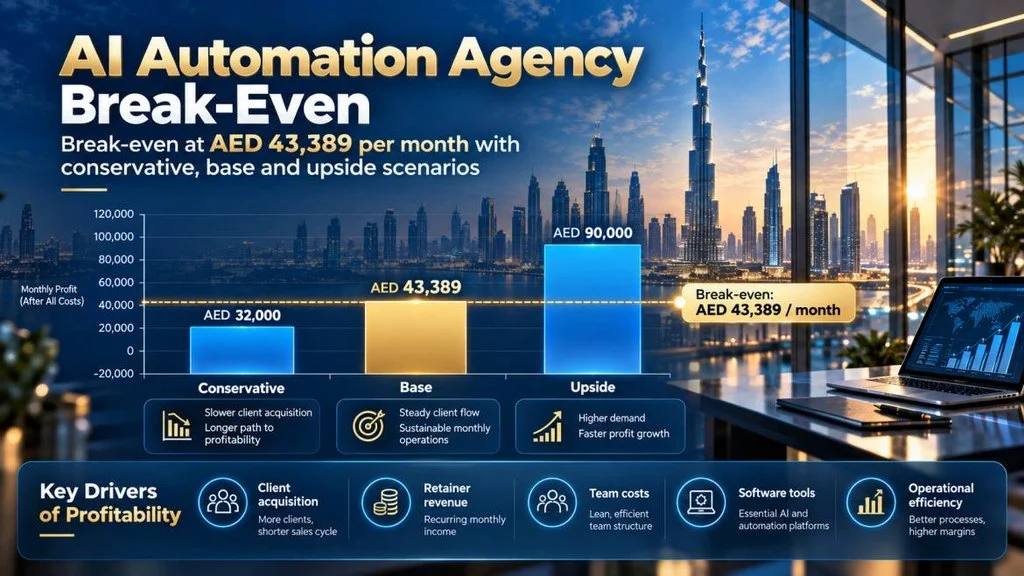
Worked example: an illustrative AI automation agency
Hypothetical illustration. All figures are planning assumptions, not quotations or client results.
A founder plans to sell workflow automation to SMEs: a one-off build at AED 15,000, then an optional maintenance retainer at AED 3,000 a month. Direct delivery costs (tool usage and freelancers) are assumed at 25% of revenue, so the contribution margin is 75%.
| Monthly fixed cost (assumption) | AED |
|---|---|
| Licence package spread over 12 months (12,500 / 12) | 1,042 |
| Flexi desk or coworking | 1,500 |
| Software and cloud | 2,000 |
| Part-time contractor | 8,000 |
| Marketing | 4,000 |
| Accounting and insurance | 1,000 |
| Founder living draw | 15,000 |
| Total fixed cost | 32,542 |
Formula: Break-even monthly revenue = Fixed monthly cost / Contribution margin = 32,542 / 0.75 = AED 43,389 a month.
That is roughly three new builds a month, or two builds plus five active retainers. Notice that the licence is about 3% of the monthly cost base. The founder’s draw is 46%.
| Scenario (12 months) | New builds per month | Builds converting to retainer | Month 12 revenue (AED) | First month at break-even | Cumulative 12-month result (AED) |
|---|---|---|---|---|---|
| Conservative | 1 | 40% | 28,200 | Not reached | -196,100 |
| Base | 2 | 50% | 63,000 | Month 6 | +28,000 (peak cash need about 27,700) |
| Upside | 3 | 60% | 104,400 | Month 1 | +281,800 |
Method: each month’s revenue = new builds x AED 15,000 + active retainers x AED 3,000; monthly result = revenue x 0.75 – 32,542. Retainers start the month after a build.
The lesson is not the specific numbers. It is that the conservative case needs close to AED 200,000 of cash to survive a year, and no licence price changes that. Two levers do: selling the first builds before you incorporate, and reducing the founder draw in the first six months.
Before Investing in an AI or IT Licence, Validate Your Business Model.
Send me your idea, target clients and budget. I will test the break-even, flag licence and data risks, and tell you honestly whether to proceed, adjust or wait.
5. Mainland vs Free Zone: Which Is Better for IT Company Setup in Dubai and the UAE?
Short answer: neither is better in general. A free zone is usually cheaper and simpler for export, remote and startup models. Mainland is usually better when you need government tenders, a physical presence across Dubai or direct onshore operations. The pillar guide on mainland vs free zone vs offshore covers the legal differences in depth.
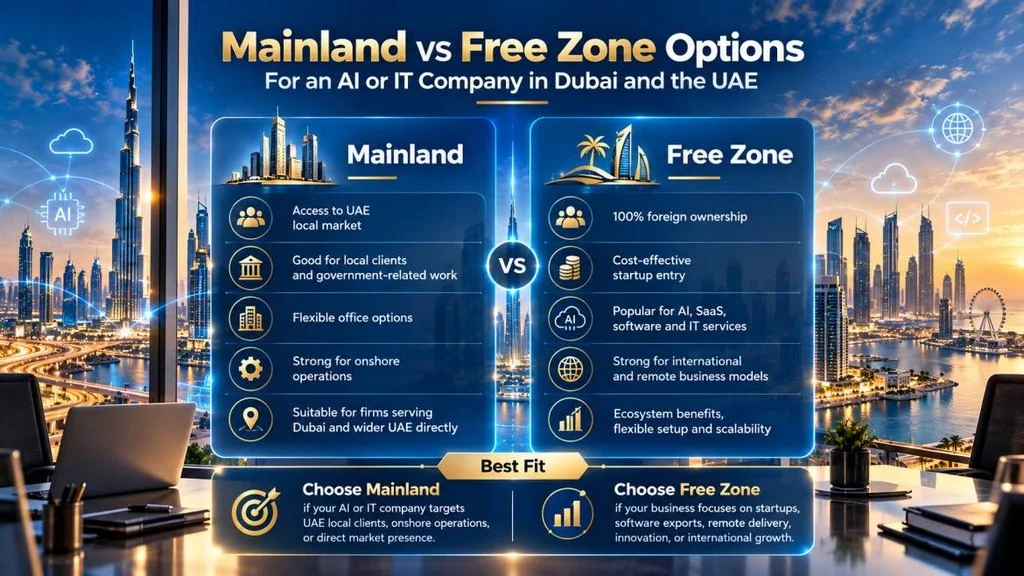
| Jurisdiction | Best-fit model | Indicative entry cost (licence, before visas) | Office | Client access | Ecosystem and support |
|---|---|---|---|---|---|
| Dubai mainland (DET) | Onshore services, tenders, on-site IT support | Varies by activity and premises; request a current quote | Ejari-registered premises required | Direct across UAE mainland and government | Broad market access, no dedicated tech campus |
| SRTIP/SPARK, Sharjah | AI, software, R&D, consultancy | My zero-visa package AED 5,500; SPARK’s own direct pricing is promotional and changes, so check the official page | Innovation Lounge access; flexi desk and offices extra | International and free zone clients; onshore work needs care | AI Hub, labs, SoiLab prototyping, SAIA accelerator (selective) |
| Dubai Internet City | Established tech and media firms | Not published publicly; request quote | Office or desk required | Free zone rules apply | Large tech community, premium cost |
| Dubai Silicon Oasis / DTEC | Startups, hardware-adjacent tech | Not published publicly; request quote | Desk or office; visa quota tied to space | Free zone rules apply | DTEC startup campus and programmes |
| IFZA (Dubai) | Consultants, IT services, holding | About AED 12,900 zero-visa (partner-published; IFZA does not publish a price list) | Flexi desk typically included | Free zone rules apply | Low-cost Dubai address, limited tech programming |
| DMCC | Dubai-based enterprise sales, AI Centre | AI Centre package widely reported at AED 27,900 to 31,000 (confirm on DMCC) | AI Centre co-working desk in package | Free zone rules apply | DMCC AI Centre community |
| DIFC | AI and tech startups needing a financial-centre address | See my DIFC innovation licence guide | Innovation One campus space | DIFC rules, separate data protection law | Strong investor and fintech network |
For IT company setup in Dubai specifically, the realistic choice is usually between a mainland licence, IFZA or Meydan, DMCC, DTEC and Dubai Internet City. Sharjah’s SPARK is the main lower-cost alternative within commuting distance.
Prices are entry points checked on 14 October 2026 and exclude visas, workspace upgrades and renewal. Where an authority does not publish prices, I say so rather than quote a reseller figure as official.
When mainland or another free zone is the better call
- Government or semi-government buyers drive year one. Check tender rules first; a mainland licence is often expected.
- Your team works on client sites across Dubai daily. On-site IT support and managed services usually fit mainland better.
- Your investors want a common-law jurisdiction. DIFC or ADGM may suit the holding structure, with an operating company elsewhere.
- You need a Dubai address for brand or client reasons. IFZA, Meydan, DMCC or DTEC can be worth the higher fixed cost.
6. Why SRTIP/SPARK May Be a Strong Choice for IT and AI Companies
Short answer: SRTIP, the Sharjah Research, Technology and Innovation Park free zone, now branded SPARK, combines low entry pricing with things most low-cost zones do not have: an AI Hub, R&D labs, a prototyping centre and a university district next door. It is located next to University City in Sharjah, not in Dubai.
What exists in the ecosystem
- SPARK AI Hub. Launched on 31 March 2026, according to WAM, as a one-stop shop for AI consulting, applied R&D, data analytics, prototyping and computing infrastructure, run with a partner consortium.
- R&D labs and SoiLAB prototyping. See my guide to SoiLAB at SRTIP.
- Research and universities. SPARK sits beside Sharjah’s University City, with research partnership options.
- Events, community and investors. SPARK runs events and lists the Sharjah Business Angels Network among its programmes.
- Partner services. SPARK’s free zone page lists banking support, legal, immigration, PRO, accounting and compliance help through partners.
What a package includes versus what needs a separate application
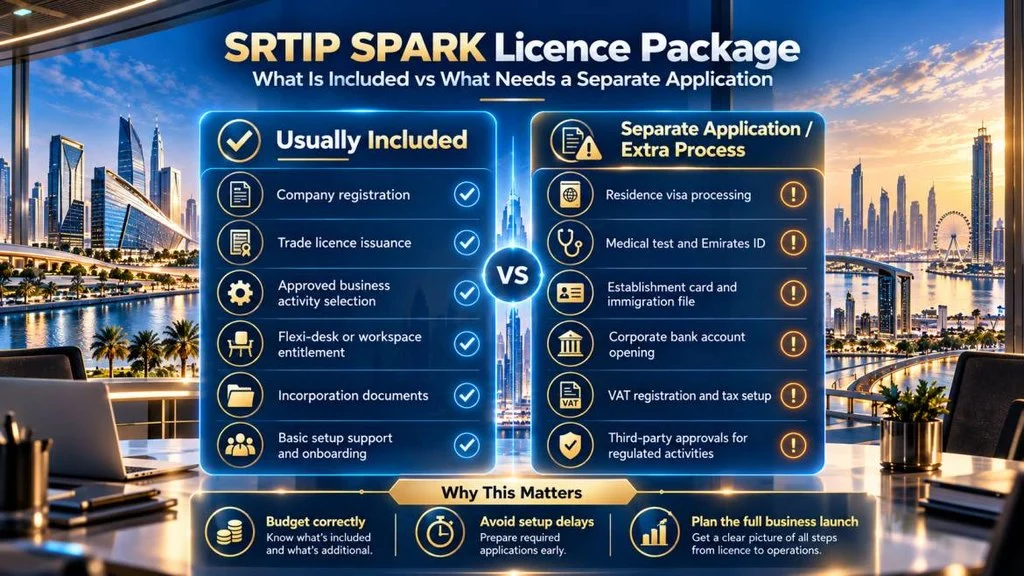
| Category | Examples | Automatic? |
|---|---|---|
| Generally available in the ecosystem | Events, community, partner service desks, venue hire | Access varies; some are paid |
| Included in a specific package (per SPARK’s published pages) | Licence, lease agreement, Innovation Lounge or co-working access, bank account opening assistance on SPARK’s own packages | Only what the package sheet lists |
| Subject to separate application, eligibility or fees | SAIA accelerator places, lab and SoiLAB use, investor introductions, private offices, AI Hub computing services | No |
The accelerator deserves precision. The Sharjah Advanced Industry Accelerator (SAIA) is a selective scale-up programme that accepts up to 10 startups per cohort in focus areas such as healthcare, sustainability and advanced manufacturing. It is not part of a licence. Separately, “SRTIP Accelerator” (srtipacc.ae) is the name of a Dubai-based business setup channel that sells SRTIP licences; it is not the SAIA programme. My guides to SAIA and the wider SPARK accelerator ecosystem explain the difference.
Innovation Lounge: check the hours in writing
SPARK’s own pages are not consistent. The AI Hub landing page describes Innovation Lounge access of up to 8 hours a day for one company representative, while SPARK’s April 2026 articles describe 4 hours a week. Ask for the current allowance in your package documents before relying on it as a workspace.
7. SPARK AI Hub Costs and Packages in 2026
Short answer: my SRTIP/SPARK IT and AI setup packages start at AED 5,500 with zero visas. With one visa there are two options, AED 12,500 and AED 13,990, and the difference is in the renewal terms, so compare them over three years rather than on year one alone. SPARK’s own published prices are different and change with promotions, and visa processing on SPARK’s own route is a separate charge of about AED 8,465 per visa. The real first-year cost of a one-visa company is therefore well above any headline licence figure.
SRTIP/SPARK IT & AI Company Setup Packages
| Package | Price | Visa allocation | Inclusions, VAT and renewal |
|---|---|---|---|
| Zero-visa package | AED 5,500 | 0 | Confirm with advisor |
| One-visa package (option A) | AED 12,500 | 1 | Renewal terms differ from option B. Renewal fee and inclusions: confirm with advisor |
| One-visa package (option B) | AED 13,990 | 1 | Renewal terms differ from option A. Renewal fee and inclusions: confirm with advisor |
Package pricing confirmed by Mohammad Adil Hussain. Exact inclusions, applicable government charges, VAT treatment, renewal fees and banking assistance terms should be confirmed before application. These are my package prices, not universal official SRTIP prices.
Visa allocation is not visa processing
SPARK’s own setup guide separates visa costs into two parts:
- Government and admin fees: AED 4,675 per visa (security deposit, immigration card, e-channel)
- Processing: AED 3,790 per visa, excluding medical insurance and status change fees
Total: AED 8,465 per visa, before medical insurance and status change.
Licence cost vs real first-year cost (official SPARK route)
| Visas | Standard package + 5% VAT + AED 10 | Visa costs (x 8,465) | Year-one total before insurance and workspace (AED) |
|---|---|---|---|
| 0 | 5,785 | 0 | 5,785 |
| 1 | 7,360 | 8,465 | 15,825 |
| 2 | 8,410 | 16,930 | 25,340 |
| 4 | 13,135 | 33,860 | 46,995 |
Formula: (package price x 1.05) + 10 + (visas x 8,465). I have applied VAT to the package fee only. Confirm VAT treatment of each line on your invoice.
Why two one-visa prices? A lower year-one price can come with a higher renewal, and a higher year-one price with a lower one. The package that is cheaper over three years depends on the renewal fee and on how long you keep the licence, so ask for year-two and year-three figures in writing before choosing either.
The rest of the startup capital
Workspace upgrades, medical insurance, document attestation, accounting, a website, equipment, marketing and your own living costs sit on top of all of this. In the scenarios in section 12, the licence and visa together are between 2% and 10% of first-year capital. For every layer of SPARK pricing, see my SPARK free zone cost guide and the SPARK visa guide.
Not Sure Whether SRTIP or Another UAE Free Zone Fits Your Business?
Tell me your activities, team plan and where your clients are. I will compare SPARK with mainland and Dubai free zones on total three-year cost, visa needs and banking readiness, and tell you if SPARK is not the right fit.
8. Which Business Activities Can Be Licensed?
Short answer: you license activities, not “an AI company”. The activity names decide what you can legally invoice for, so they should match your revenue model.
| Activity type | What it covers in practice | Watch out for |
|---|---|---|
| IT consultancy | Advice, IT strategy, system selection | Does not always cover building and selling software |
| Software development | Building applications and custom systems | SaaS subscription revenue may need a publishing or platform activity too |
| AI development | Designing, training and deploying AI systems | Some authorities attach approvals or conditions; check current wording |
| AI consultancy | Strategy, use-case design, readiness assessments | Advice only; add development if you deliver builds |
| AI research | R&D, prototypes, academic collaboration | Lab use is separate from the licence |
| Data analytics | BI, dashboards, data services | Personal data processing obligations |
| Cloud services | Migration, architecture, managed cloud | Hosting data for clients raises residency questions |
| Cybersecurity | Assessments, consulting, managed security | Some sectors and government work require extra approvals |
| Robotics | Robotic systems, smart machines | Hardware import and safety rules |
| Technology trading | Buying and selling hardware or devices | Trading licences and customs rules differ from services |
SPARK’s AI Hub lists eligible activity groups as AI development and training, research and consultancy, robotics systems and smart machines, and trading and rental of AI and smart devices, with up to five activities per package. Activity codes and exact wording differ between authorities and are updated, so I do not quote codes here without the current list in front of a client. My SPARK business activities guide explains how to read SPARK’s list, including pre- and post-licensing approvals.
Combining and amending: most free zones allow several compatible activities on one licence. Adding activities later is possible but costs fees and admin, and may trigger new approvals. Map what you will sell in year two, not only on day one.
9. Documents Required and Step-by-Step Company Formation
Short answer: the steps below apply to IT company setup in Dubai, Sharjah or any other emirate. With complete documents, a free zone licence can be issued in days; SPARK says most companies can complete licensing in as little as five working days. Visas, Emirates ID and especially banking take longer and depend on third parties. Plan for six to twelve weeks from decision to operating bank account, without treating any of these as guaranteed.
| Step | What happens | Typical time (not guaranteed) | Depends on |
|---|---|---|---|
| 1. Business model validation | Checklist in section 4 | 1 to 3 weeks | Founder, market evidence |
| 2. Activity identification | Map revenue to activities | 1 to 3 days | Authority’s activity list |
| 3. Jurisdiction recommendation | Compare total three-year cost and fit | 2 to 5 days | Client, visa and banking needs |
| 4. Trade-name selection | Name check and reservation | 1 to 2 days | Naming rules, trademarks |
| 5. Shareholder documents | Passports, photos, addresses; corporate documents and attestation for company shareholders | Days to weeks | Attestation in home country |
| 6. Licence and facility selection | Package, workspace, visa quota | 1 day | Visa count |
| 7. Application and approval | Submit, initial approval, security checks | 2 to 10 working days | Authority and security approval |
| 8. Incorporation documents | Licence, lease, MOA or articles, share certificate | On approval | Fees paid |
| 9. Immigration establishment | Establishment or immigration card, e-channel | 3 to 10 working days | Immigration systems |
| 10. Visas and Emirates ID | Entry permit, status change, medical, biometrics | 2 to 4 weeks | Medical, biometrics appointments |
| 11. Corporate tax registration | Register with the FTA; assess QFZP position | Days | FTA deadlines |
| 12. Bank account preparation | KYC file, business plan, contracts | 2 to 8 weeks | Bank risk appetite |
| 13. Accounting and compliance | Bookkeeping, VAT check, UBO, ESR where relevant | Ongoing | Revenue level |
| 14. Commercial launch | Contracts, invoicing, client onboarding | From day one of the account | Pipeline |
For SPARK specifically, see the SPARK setup process. A free printable planner for these decisions is on my UAE business setup checklist page.
10. Opening a Corporate Bank Account for an IT or AI Company
Short answer: banking is the step of IT company setup in Dubai that most often delays launch. It is achievable, but no licence guarantees it. Banks assess risk, not paperwork volume. AI and software startups are often harder to assess because revenue is cross-border, intangible and early, so the file has to explain the business clearly.
What banks typically review
- KYC on every shareholder and manager: passports, residence, CV or professional background, sometimes reference letters.
- Source of funds and wealth: where the capital came from, with statements.
- Expected transactions: monthly volumes, countries paid from and to, typical invoice size.
- Customers and suppliers: named clients, letters of intent, cloud and software vendors.
- Business plan: a short, specific plan that matches the licence activities.
- Contracts and invoices: existing or draft agreements show real activity.
- Website and operational evidence: a live site, LinkedIn presence and product description consistent with the licence.
- Presence in the UAE: some banks prefer a resident signatory or a visit; requirements vary.
Why AI and software companies get stuck
The common problem is inconsistency: a licence that says IT consultancy, a website that says AI agents, invoices that say software subscriptions and a plan that describes a marketplace. Payment flows from many countries with no explanation, crypto-related revenue, and payment processors acting as intermediaries also trigger questions.
Preparation improves readiness; it does not guarantee approval, timing or fee waivers. Banks may apply minimum balances and service charges. SPARK lists bank account opening assistance in its own published packages; that is assistance with the application, not an approved account. For my packages, banking assistance terms are confirmed per client. Read my full guide to opening a UAE business bank account and my banking services page.
11. UAE Taxes, Data Protection and AI Regulatory Considerations
Short answer: a free zone company is not automatically tax-free. Corporate tax is 0% on taxable income up to AED 375,000 and 9% above it. A Qualifying Free Zone Person can pay 0% on qualifying income only, and ordinary software development and IT consultancy services are not listed qualifying activities. This is general information, not tax advice.
Corporate tax
- Standard regime: under Federal Decree-Law No. 47 of 2022, 0% up to AED 375,000 of taxable income and 9% above.
- Free Zone Person vs Qualifying Free Zone Person: every company registered in a free zone is a Free Zone Person. Only one that meets all conditions (adequate substance, qualifying income, transfer pricing compliance, audited financial statements, the de minimis test, and no election out) is a QFZP. See the FTA’s Corporate Tax Guide on Free Zone Persons.
- Qualifying activities: Ministerial Decision No. 229 of 2025 replaced Ministerial Decision No. 265 of 2023, with effect from 1 June 2023. Its list does not include general software development or IT consultancy services. Income from qualifying intellectual property, which can include copyrighted software, is treated under separate rules in Cabinet Decision No. 100 of 2023 and needs specialist analysis.
- Small business relief: available for revenue up to AED 3 million for eligible periods, but not to Qualifying Free Zone Persons. See small business relief extended to 2029.
- Registration: all companies must register for corporate tax, whatever their revenue. See tax registration and filing.
VAT, records and audit
VAT is 5%. Registration is mandatory once taxable supplies exceed AED 375,000 over 12 months and voluntary from AED 187,500. Services exported outside the UAE may be zero-rated if conditions are met. Keep accounting records and invoices for the statutory periods, and note that a QFZP must prepare audited financial statements. See VAT registration and compliance and UAE company audit requirements.
Data protection, cybersecurity and AI rules
- Personal data: Federal Decree-Law No. 45 of 2021 applies outside DIFC and ADGM, which have their own data protection laws. Data processing agreements, consent, security and cross-border transfer rules all matter for AI work.
- No single federal AI Act yet: the Artificial Intelligence and Data Authority was approved in June 2026. Watch for rules it issues, and follow the UAE Charter for the Development and Use of AI as guidance.
- Sector regulators: health, financial services, telecoms and government work can require additional approvals. Financial AI may fall under the Central Bank, DFSA or FSRA.
- Cybersecurity and cybercrime: client contracts in regulated sectors usually impose security standards and incident duties.
Intellectual property and cross-border contracts
Make sure the company, not the founder or a freelancer, owns code, models and datasets through written assignments. For clients abroad, contracts should state governing law, data location, liability caps for AI output and who pays for model and cloud usage. Each foreign market (for example Saudi Arabia or the EU) has its own data and AI rules that a UAE company does not escape.
12. Realistic Startup Budget and Financial Feasibility
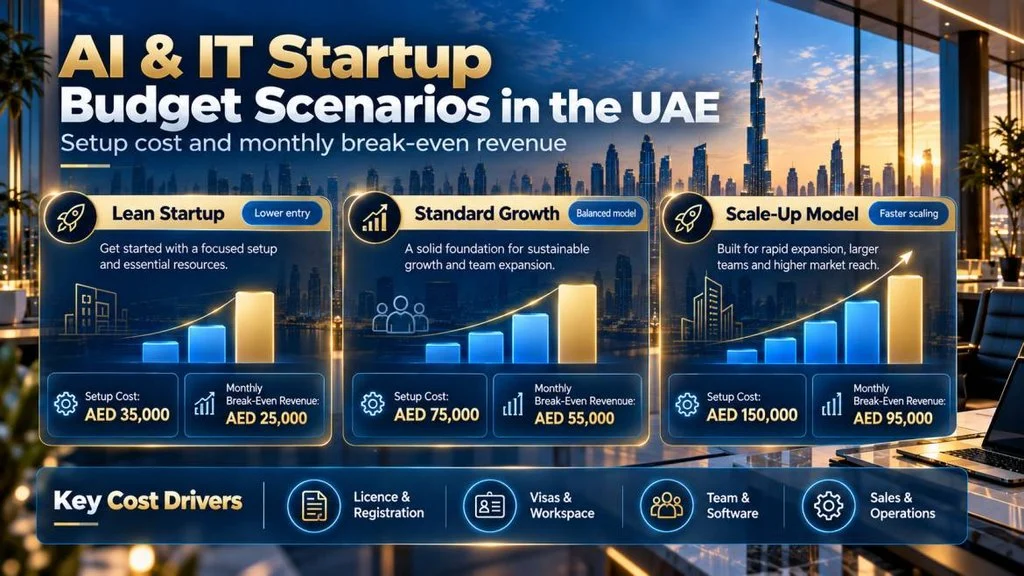
Short answer: a solo AI consultant can start with roughly AED 30,000 of setup cost but should hold far more for runway. A small IT services firm needs around AED 115,000 of setup plus six to nine months of operating cash. An AI software startup needs hundreds of thousands to millions. All figures below are illustrative assumptions, not quotations. The same structure applies to IT company setup in Dubai; only the licence, desk and visa lines change.
Formulas used: Break-even monthly revenue = Monthly fixed cost / Contribution margin. Monthly burn = Monthly fixed cost – (Revenue x Contribution margin). Runway in months = (Starting cash – Setup cost) / Monthly burn. Licence and visa lines use SPARK’s published standard prices and visa costs from section 7; if you use one of my one-visa packages (AED 12,500 or AED 13,990), replace those lines once inclusions are confirmed.
| Line item (AED) | A: Solo AI automation consultant (1 visa) | B: IT services, 3 staff plus founder (4 visas) | C: AI software startup, team of 6 |
|---|---|---|---|
| Licence and registration | 7,360 | 13,135 | 30,000 (assumption; confirm tier) |
| Visas | 8,465 | 33,860 | 50,790 |
| Medical insurance (assumption) | 1,500 | 6,000 | 9,000 |
| Office deposit, fit-out, equipment | 6,000 | 40,000 | 100,000 |
| Professional services, legal, attestation | 3,500 | 8,000 | 25,000 |
| Website, brand, recruitment | 5,000 | 15,000 | 50,000 |
| Setup total | 31,825 | 115,995 | 264,790 |
| Monthly: office or coworking | 1,000 | 4,000 | 10,000 |
| Monthly: staffing incl. founder | 12,000 | 51,000 | 120,000 |
| Monthly: software and cloud | 1,500 | 4,000 | 15,000 |
| Monthly: marketing and acquisition | 3,000 | 8,000 | 15,000 |
| Monthly: insurance, compliance, accounting, other | 1,500 | 4,300 | 9,500 |
| Monthly fixed cost | 19,000 | 71,300 | 169,500 |
| Contribution margin (assumption) | 85% | 70% | 75% |
| Break-even monthly revenue | 22,353 | 101,857 | 226,000 |
| Starting cash (assumption) | 120,000 | 500,000 | 1,800,000 |
| Working capital after setup | 88,175 | 384,005 | 1,535,210 |
Runway under three outcomes
Conservative = average revenue at 40% of break-even; base = 80%; upside = 120%.
| Scenario | Conservative runway | Base runway | Upside |
|---|---|---|---|
| A: Solo consultant | 7.7 months (burn 11,400/month) | 23.2 months (burn 3,800/month) | Self-funding (+3,800/month) |
| B: IT services firm | 9.0 months (burn 42,780/month) | 26.9 months (burn 14,260/month) | Self-funding (+14,260/month) |
| C: AI software startup | 15.1 months (burn 101,700/month) | 45.3 months (burn 33,900/month) | Self-funding (+33,900/month) |
Read the conservative column first. If it is under nine months, either raise more capital, cut fixed costs, or secure revenue before you hire. For a deeper model of an eight- to nine-person AI development company, including a AED 1.7 million to AED 3.15 million capital range, see my AI development services feasibility study.
13. Common Mistakes Founders Make
- Buying the cheapest licence without checking activities. Consequence: you cannot legally invoice what you sell, or the bank rejects the mismatch. Fix: map revenue lines to activities first.
- Ignoring market demand. Consequence: a licence and visa with no clients. Fix: get paid pilots or letters of intent before incorporating.
- Underestimating renewal and visa costs. Consequence: promotional year-one prices double at renewal. Fix: compare three-year totals.
- Choosing the wrong jurisdiction. Consequence: a free zone company that needed government tenders, or a costly mainland setup for a remote consultancy. Fix: decide by client location and procurement rules.
- Assuming banking is automatic. Consequence: weeks or months without the ability to invoice properly. Fix: prepare a consistent KYC file in parallel with licensing.
- Confusing visa slots with visa costs. Consequence: a “4-visa package” that still needs about AED 33,860 of visa processing on SPARK’s published figures. Fix: ask for per-visa processing cost in writing.
- No budget for customer acquisition. Consequence: a good product nobody hears about. Fix: budget marketing as a fixed monthly cost.
- Misreading free zone tax. Consequence: unexpected 9% corporate tax and missed audit duties. Fix: assess QFZP status and qualifying income before year one.
- Assuming accelerator places are included. Consequence: a plan built on mentoring or investor access that never materialises. Fix: treat SAIA and similar programmes as competitive applications.
- Ignoring data and contract obligations. Consequence: liability for client data or AI output. Fix: data processing agreements, IP assignments and liability caps from day one.
- No post-formation plan. Consequence: missed tax registration, renewals and filings. Fix: a compliance calendar on day one.
- Spending all the capital on incorporation. Consequence: no runway when sales take longer than planned. Fix: keep at least six months of fixed costs in reserve.
More in my list of UAE business setup mistakes to avoid and why the cheapest licence may not be the right setup.
14. Who Should Choose SRTIP, and Who Should Consider Alternatives?
| SRTIP/SPARK may suit | Other jurisdictions may suit |
|---|---|
| Eligible AI development startups | Companies that need a Dubai address for clients or brand |
| Software and SaaS businesses selling internationally | Businesses that need a specific regulated permission (financial, health, telecom) |
| Technology and AI consultants | Large firms with substantial office and staff needs |
| Research-oriented and hardware-adjacent companies using labs | Firms whose year-one revenue depends on government tenders |
| Founders who want an innovation community, not just a licence | Founders prioritising another industry cluster (for example DMCC commodities or DIFC finance) |
| Cost-conscious startups that will use the support on offer | Teams with daily on-site work across Dubai |
If your plan is IT company setup in Dubai mainly because of the city’s name, test whether your clients actually require it. The recommendation always comes from eligibility, total cost and how you operate, not from the zone’s marketing. I set out the cases against SPARK in who should not choose SPARK free zone, and compare it with other zones in best free zones for AI and technology companies and the Sharjah free zone comparison.
15. My Approach: Beyond Company Formation for AI and IT Founders
Most business setup consultants help you register a company. I help you make informed business decisions before you invest.
For an AI or IT founder, that means the first conversation is about your first ten buyers, your price and your break-even, not about which licence is on offer this month. A software developer billing projects, a SaaS founder building subscriptions and an AI consultancy selling retainers can all end up in the same free zone with three different activity lists, visa plans and tax positions. Whether it ends in SPARK or an IT company setup in Dubai, getting that right before incorporation is cheaper than correcting it at renewal or in front of a bank compliance officer.
- Business discovery. Your objectives, customers, available capital and growth plans.
- Commercial validation. Market demand, competition, pricing, profitability and the risks that would stop the business.
- Structure and jurisdiction. Activities, approvals, free zone versus mainland, and a three-year cost comparison.
- Company setup planning. Licensing, documents, visa strategy and a bank-ready file.
- Post-formation strategy. Launch plan, financial monitoring, compliance calendar and expansion.
My advisory process focuses on helping you reduce uncertainty and make confident decisions, not just complete documentation.
What you can expect
- Business idea validation
- Market research
- Competitor analysis
- Business plan development
- Startup cost estimation
- Financial feasibility analysis
- Business structure recommendations
- Licence selection guidance
- Investor and employment visa planning
- Business bank account strategy
- Risk assessment
- Business expansion planning
The objective is simple: help you start your business with clarity, confidence and a long-term strategy. See startup and pre-launch consulting, free zone company formation and mainland company formation, or read how I research and check this content.
16. Frequently Asked Questions
Can a foreigner own 100% of an IT company in the UAE?
Yes. Free zones allow 100% foreign ownership, and most commercial and professional activities on the Dubai mainland can also be 100% foreign-owned. A few strategic activities have restrictions, so confirm your specific activity with the licensing authority.
What is the cheapest way to start an AI company in Dubai?
The lowest entry costs are usually zero-visa free zone licences, including Sharjah options such as SRTIP/SPARK, where my zero-visa package is AED 5,500. Cheapest is not the same as best value: compare activities, visa costs, renewals and banking before choosing.
Is SRTIP in Dubai or Sharjah?
Sharjah. SRTIP, the Sharjah Research, Technology and Innovation Park, is next to University City in Sharjah and now uses the SPARK brand. Some setup agents selling SRTIP licences have offices in Dubai, but the free zone itself is in Sharjah.
Can I run my AI company from Sharjah and serve clients in Dubai?
Generally you can serve clients across the UAE remotely and contract with them, but direct onshore trading and on-site operations can be restricted for free zone companies. If most of your work is on-site in Dubai, check whether a mainland licence or branch is needed.
Is SRTIP better than Dubai Silicon Oasis for AI development?
It depends. SRTIP/SPARK is usually cheaper to enter and has labs and an AI Hub. Dubai Silicon Oasis and DTEC give a Dubai address and a startup campus, with prices quoted on request. Compare total three-year cost, workspace and client location.
How much does an AI licence cost in the UAE?
There is no single “AI licence” price. SPARK’s AI Hub lists a standard zero-visa package at AED 5,500, Dubai free zones commonly start around AED 12,500 to AED 13,000, and premium zones cost more. Visas, VAT, workspace and renewals are additional.
Do I need an office for my AI startup?
Most free zones let a startup begin with a flexi desk or lounge access rather than a private office, although your visa quota may depend on the space you take. Mainland licences require registered premises.
What is SPARK AI Hub?
SPARK AI Hub is SRTIP’s AI initiative, launched in March 2026, combining AI services such as consulting, R&D, data analytics and computing infrastructure with discounted licence packages for new AI companies. Its launch discount’s current validity should be confirmed with SPARK.
Can an IT consultancy operate from SRTIP?
Yes. IT and technology consultancy activities are available at SRTIP/SPARK. Combine them with software or AI development activities if you will also build and deliver systems, and confirm the exact activity wording first.
Can an AI company obtain UAE residency visas?
Yes. A licensed company can sponsor investor and employee residence visas up to its visa quota, which depends on the package and workspace. Each visa carries separate processing, medical and Emirates ID costs.
Does SRTIP help with banking?
SPARK lists banking support through partners and bank account opening assistance in its own published packages. Assistance helps prepare and submit the application; the bank still decides whether to open the account.
Can I get a free corporate bank account?
Some offers waive the setup or assistance fee, but no one can guarantee approval, and banks may still apply minimum balances and monthly charges. Ask what exactly is free and what the bank’s ongoing fees are.
Can I receive international payments?
Yes, once your account is open. Tell the bank in advance which countries clients pay from, typical amounts and which payment platforms you use, because unexplained cross-border flows are a common reason for reviews.
Are AI companies tax-free in UAE free zones?
No, not automatically. Corporate tax is 9% on taxable income above AED 375,000. Only Qualifying Free Zone Persons get 0% on qualifying income, and general software or IT services are not listed qualifying activities. Get tax advice on your income mix.
Do AI developers need additional approvals?
Some do. Certain activities carry pre- or post-licensing approvals, and AI used in health, finance, telecoms or government work may need sector regulator approval. There is no single federal AI licence, so check activity conditions and your clients’ sectors.
Can an Indian entrepreneur start an AI company in the UAE?
Yes. Indian nationals can own 100% of a free zone company and many mainland companies. Plan for Indian rules too, such as FEMA and RBI requirements on overseas investment, and keep your personal tax residence position clear.
How long does AI company formation take?
Licensing can take as little as a few working days with complete documents. Visas and Emirates ID typically add two to four weeks, and bank accounts can take several more. Treat all timelines as typical, not guaranteed.
What is the best UAE free zone for SaaS?
There is no single best. Cost-conscious SaaS founders often consider SRTIP/SPARK or IFZA; venture-backed teams often consider DIFC, DTEC or Dubai Internet City. Choose by investor expectations, payment and data needs, and three-year cost.
Can I establish a company remotely?
Often, yes. Many free zones, including SPARK, support remote applications for zero-visa setups. Visas need a UAE entry and medical, and some banks expect a visit or a resident signatory.
What should I validate before starting an AI business?
Validate the customer problem, who pays, the price, the competitors, your break-even revenue and how many months of cash you have to reach it. Then check that your licence activities, data obligations and banking story all fit the model.
Planning to Start an IT or AI Company in the UAE? Get a Strategic Business Setup Consultation.
We will look at feasibility, jurisdiction, three-year cost, visa plan and banking readiness together, before you commit capital.
Book a consultation | WhatsApp +971 50 928 9880 | info@mohammadadilhussain.com
Sources and How This Was Checked
Prices and programme details were read directly from official SPARK pages and articles on 14 October 2026. Where official pages disagreed, both figures are shown. Where an authority does not publish prices, I say so. Tax points were checked against FTA and Ministry of Finance material and reputable professional summaries of Ministerial Decision No. 229 of 2025. Nothing here is legal or tax advice.
- SPARK AI Hub packages and eligibility
- SPARK: 5 things to know before setting up an AI company (visa costs)
- SPARK free zone and partner services
- Sharjah Advanced Industry Accelerator (SAIA)
- WAM: Sharjah Innovation Park unveils AI Hub (31 March 2026)
- WAM: Artificial Intelligence and Data Authority approved (14 June 2026)
- Federal Tax Authority: Corporate Tax Guide on Free Zone Persons
- Ministry of Finance: tax legislation
- PwC: Ministerial Decisions No. 229 and 230 of 2025
- DMCC business setup packages