Stress-test your UAE setup before you spend a dirham.
Most consultants hand you a UAE business setup checklist of documents to collect. I run AI-powered market, cost and jurisdiction research first, so the licence you buy, the visas you budget for and the bank you approach are decisions, not guesses.
- See the real number. Licence, visas, office, deposits and year-two renewals, before a sales quote hides them.
- Compare jurisdictions on your model. Mainland, free zone or offshore judged against your customers, not a brochure.
- Arrive bankable. The documents, substance and story UAE banks actually approve accounts on.
Delivered instantly as a fillable PDF. Rev. 2026-01.
The licence is cheap. The wrong decision is not.
Four failures account for most of the money founders lose in their first UAE year. None of them are paperwork problems.
The quote that grows
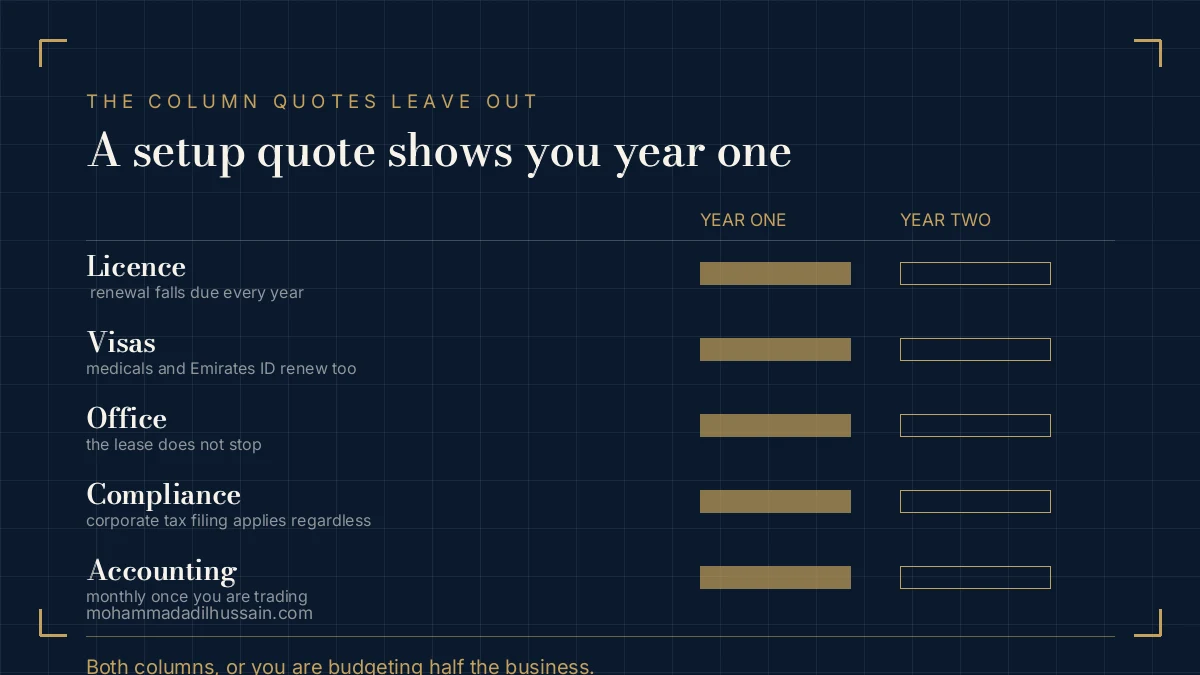
A headline setup price, then establishment cards, medicals, deposits, attestation, PRO fees and renewal, often 40 to 60% above the number you signed for.
The wrong free zone
Chosen on price, discovered later: you cannot invoice mainland clients, cannot hold the visa quota you need, cannot add the activity your growth depends on.
No banking strategy
The company is live, the account is not. Weeks of compliance rejections while a trade licence sits idle and burn continues with zero revenue capability.
Zero market evidence
Capital committed before anyone checked who already serves the customer, at what price, and whether the margin survives UAE cost structures.
Strategy over paperwork. In that order.
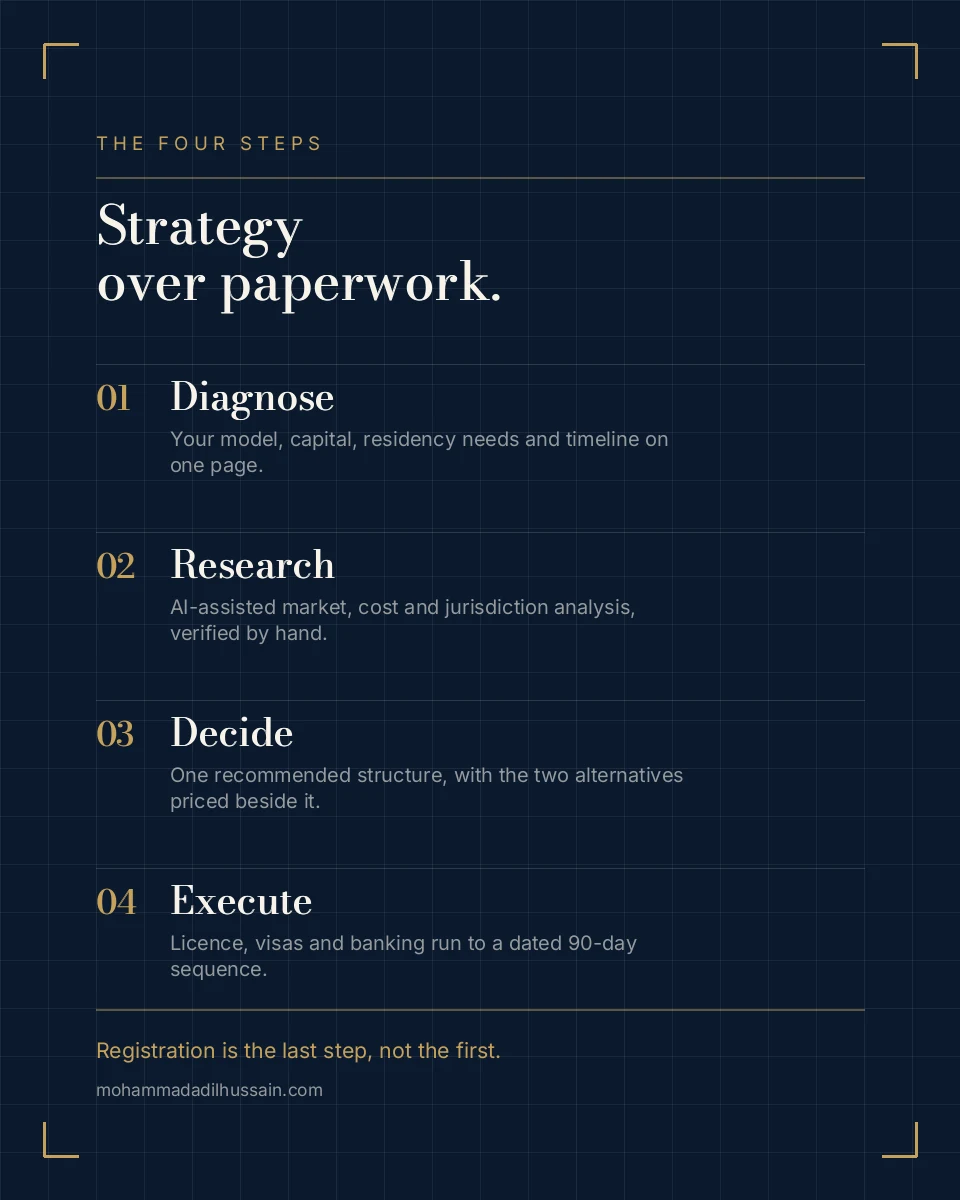
Registration is the last step, not the first. Before anything is filed, we settle the questions that decide whether the business works: who buys, at what cost, under which structure, funded how.
AI-augmented research does the heavy lifting behind the scenes: competitor sets, cost benchmarks, regulation and activity lists compressed from weeks into days. Then it is one advisor and you, reading the evidence together and deciding.
Twelve decisions, settled before you register
Every pillar in the planner is a question you will be asked eventually, by a bank, a landlord, an auditor or your own P&L. Answer them in the right order.
Idea validation
Demand evidence before capital: who pays, how often, at what price.
Competitor analysis
Who already owns the customer in the UAE, and where the gap actually is.
Cost estimation
Setup, renewal and hidden line items modelled across two years.
Legal structure
Mainland, free zone or offshore, chosen against your customer base.
Licence selection
The exact activity codes your revenue needs, now and at scale.
Visa planning
Investor, employee and dependant quota mapped to your hiring plan.
Space requirements
Flexi-desk, office or warehouse, and what the licence and the bank expect.
Tax & compliance
Corporate tax, VAT thresholds and ESR obligations known up front.
Runway model
Months of cover after setup costs, and the revenue date you must hit.
Partner reality
Where local service agents, distributors or sponsors genuinely apply.
90-day sequence
Every filing, payment and appointment in the order it must happen.
Mohammad Adil Hussain
AI Business Consultant · UAE Business Setup Advisor
Eight-plus years advising founders across the UAE and India: cross-border trade, licensing, residency and the practical mechanics of getting a company banked and operating. I have seen which shortcuts cost money later.
My work pairs AI-driven research speed with a single point of human accountability: you deal with me, not a call centre, and every recommendation arrives with the reasoning and the numbers attached. You can see the full range of business setup services or get in touch directly.
Why this is not a standard UAE business setup checklist
Search for a UAE business setup checklist and you will find the same list everywhere: passport copies, trade name options, application forms, attestation, licence payment. That list is real, and it is also the easy half. Every consultant can produce it, and none of it tells you whether the business works.
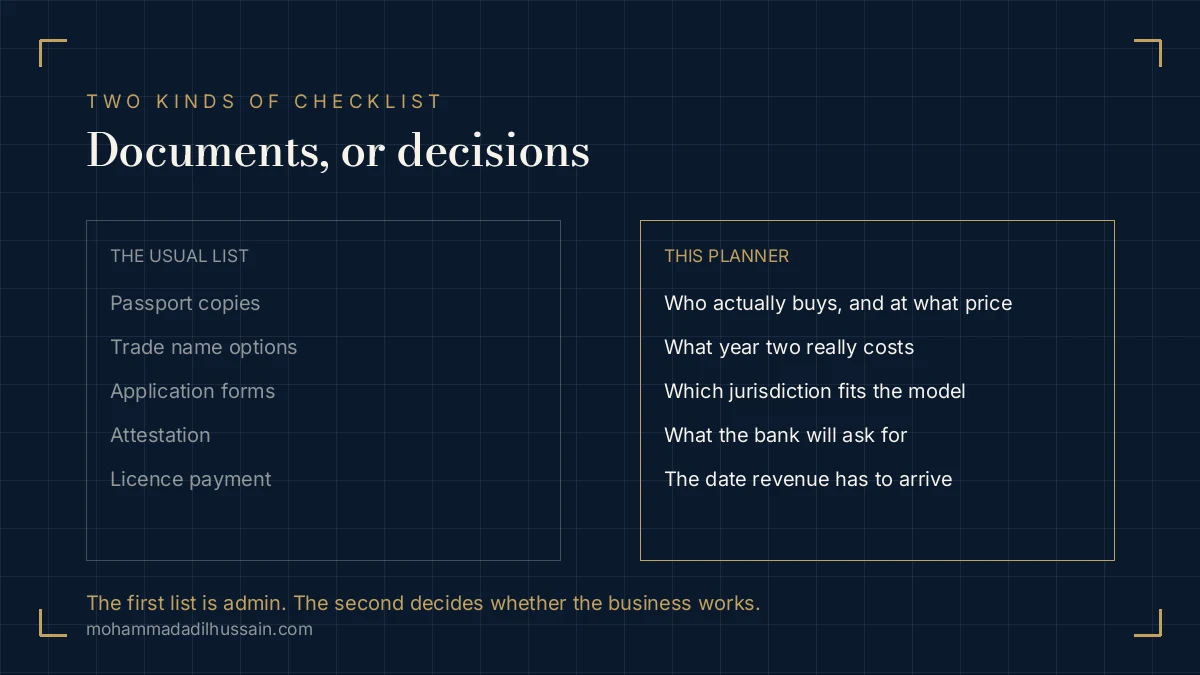
The planner covers the other half. Who actually buys, at what price, under which structure, funded how, and what the second year costs once the first year is paid for. Answer those and the paperwork becomes a formality. Skip them and the paperwork is the most expensive part of the process, because you will do it twice.
Decide with evidence. Or pay to find out later.
The planner takes about 25 minutes to work through and will change what you ask every consultant you speak to next. Sent immediately, no call required.
- No obligation, no setup pitch in the download.
- Your details stay with me, never sold to agents.
- Unsubscribe in one click, keep the planner.
Four fields. Nothing else is needed to send you a PDF.
Frequently asked questions
What should a UAE business setup checklist actually include?
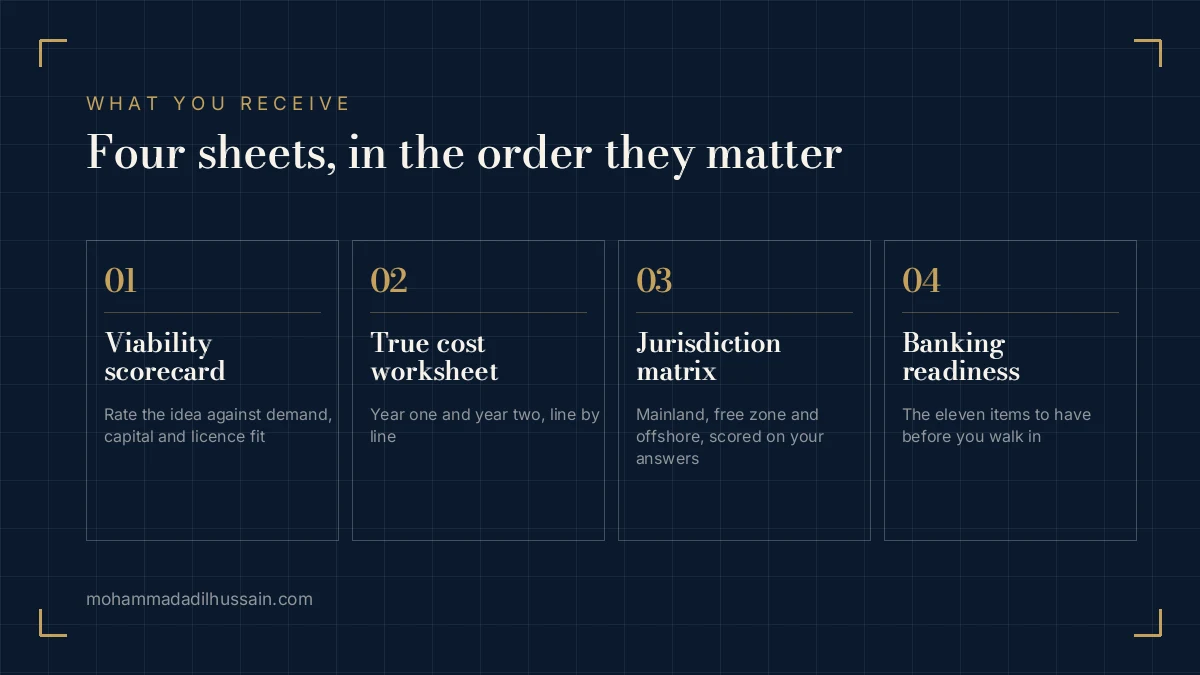
Most cover documents only. A useful one settles four things before any form is filled: evidence that someone will pay for what you sell, the full two-year cost rather than the first-year quote, a jurisdiction chosen against your customers rather than on price, and the bank's requirements gathered before the licence is issued.
How much does it really cost to set up a company in the UAE?
The licence is the smallest part. A quote usually covers licence issuance, registration and the establishment card. What follows is visas and medicals per person, office or flexi-desk, attestation, PRO fees, corporate tax registration, accounting, and the renewal of nearly all of it twelve months later. The planner lists sixteen cost lines across both years so the real total is visible before you commit. Official fee schedules are published by each authority, and the UAE government portal is the reliable starting point.
Should I choose mainland or free zone before I apply?
Yes, and it should be decided against who your customers are rather than on price. A free zone company cannot invoice mainland clients directly without additional arrangements, and a mainland licence carries different office and visa obligations. The planner scores both against your own answers instead of naming a winner in the abstract.
How long does it take to open a UAE corporate bank account?
Two to four weeks is typical when the file meets the bank's expectations, and most applicants are asked for something further, which adds time. The delay is usually a missing document rather than a refusal, which is why the last sheet of the planner lists the eleven items to have in hand before you walk in.
Can I set up a UAE company without living in the UAE?
Yes. A licence does not require you to be resident, and many free zone structures can be arranged remotely. What usually forces a visit is the bank, because most UAE banks want to meet at least one signatory in person before they open an account. Plan the trip around the banking step rather than the licence, and plan visa quota separately again, since sponsoring staff has its own requirements.
When should I use an advisor rather than a setup agent?
A setup agent is paid to complete a registration, which is exactly what you want once the decisions are made. The questions that come earlier are different: whether the business works at UAE cost structures, which structure fits how you sell, and what the whole thing costs across two years. If you already know precisely what you want, an agent is enough. If you are still choosing, the order of those decisions will cost or save you more than the licence fee.
Is the planner useful if I have already registered a company?
Often yes. The cost worksheet and the banking sheet apply at any stage, and the jurisdiction matrix shows what a restructure would cost if the original choice no longer fits how you actually sell. Restructuring later is more expensive than deciding upfront, but it is a normal thing to do.