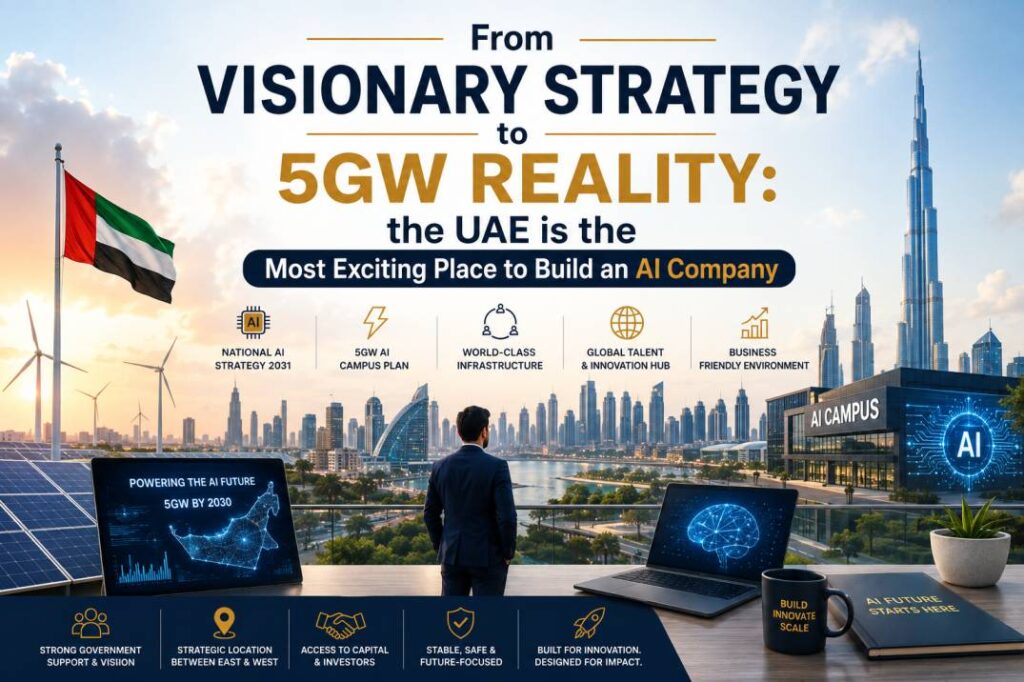
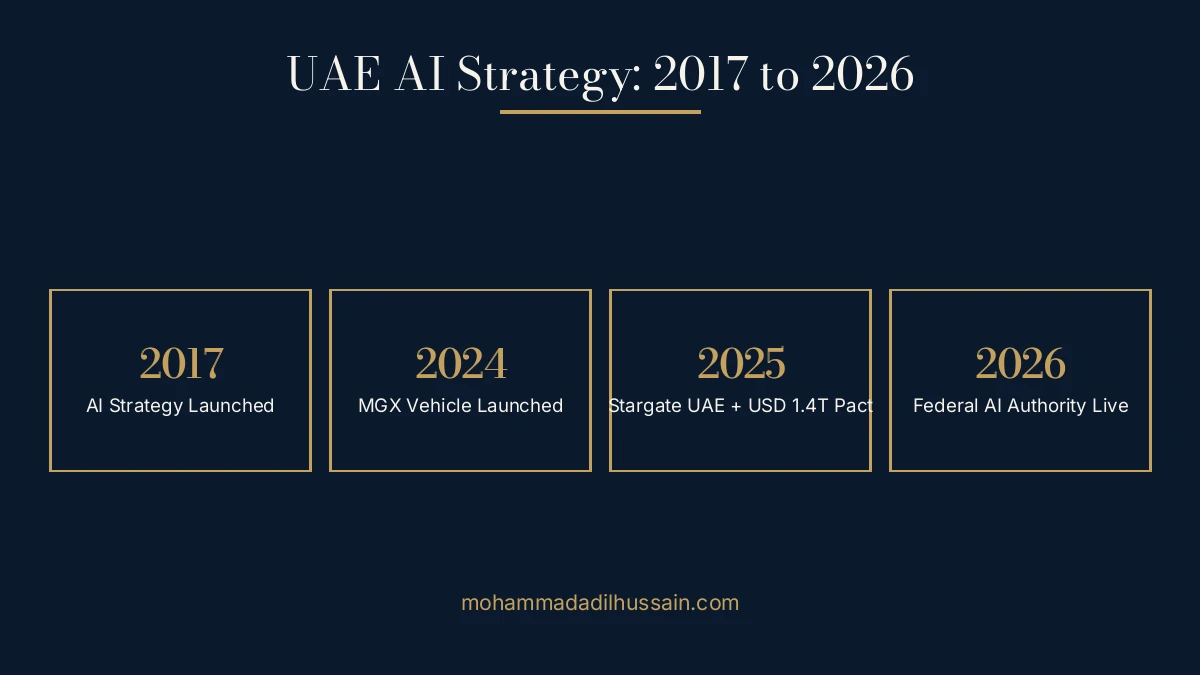
In 2017, the UAE appointed the world’s first Minister of State for Artificial Intelligence. He was 27 years old, and the country had no AI infrastructure to speak of. Eight years later, a 19.2 square kilometer campus outside Abu Dhabi is under construction to hold 5 gigawatts of AI compute capacity, backed by OpenAI, Oracle, Nvidia, Microsoft and Cisco. This is what it actually takes to build an AI company in the UAE right now, not eventually, and the difference between the two is the whole point of this piece.
Related reading: how AI, Web3 and renewable energy are reshaping Dubai’s economy, for the wider economic picture behind this build.
Quick Navigation
Quick Answer
- The UAE launched its National AI Strategy in October 2017, targeting an AED 335 billion cumulative economic contribution and roughly 14% of GDP from AI by 2031.
- Stargate UAE, part of the 5-gigawatt UAE-US AI Campus in Abu Dhabi, has its first 200-megawatt phase on track for completion in Q3 2026.
- The US approved export of up to 500,000 Nvidia AI chips a year to the UAE, starting with Blackwell and moving to Rubin and Feynman architectures.
- Microsoft is spending USD 15.2 billion in the UAE between 2023 and 2029, including a USD 1.5 billion equity stake in G42.
- Most of this capacity is licensed to named hyperscaler partners under strict US operator rules, not open to any AI startup that wants to rent it, and that distinction matters more than the headline numbers.
Eight Years From a Ministry to a Data Center
The UAE’s National AI Strategy 2031 launched in October 2017 with eight stated objectives: building a global reputation in AI, deploying it competitively across priority sectors, developing the ecosystem around it, adopting it inside government, attracting and training talent, building research capability, building data infrastructure, and putting governance around all of it. Omar Sultan Al Olama became Minister of State for Artificial Intelligence the same year, the first person anywhere to hold that title.
The strategy named ten priority sectors: energy, logistics, tourism, healthcare, cybersecurity, transport, technology, education, environment and traffic. The projected payoff was an AED 335 billion cumulative contribution to the economy, with AI itself expected to account for close to 14% of GDP by the strategy’s 2031 horizon.
What makes this worth writing about in 2026 is not the strategy document. Government strategies get published everywhere, and most of them stay documents. What changed is that the UAE spent the years after 2017 building the three things a strategy like this actually needs to become real: capital, compute, and rules a company can build against with confidence. For the fundamentals of how UAE company structures actually work before you get to any of that, see mainland vs free zone vs offshore.
What 5 Gigawatts Actually Means
Stargate UAE launched on 22 May 2025 as the first Stargate campus built outside the United States. It sits inside a larger 5-gigawatt UAE-US AI Campus in Abu Dhabi, developed by Khazna Data Centres, a G42 subsidiary, with Mubadala backing and OpenAI, Oracle, Nvidia, SoftBank and Cisco as technology partners. The Stargate UAE cluster itself is a 1-gigawatt compute facility, spanning roughly 10 square miles (19.2 square kilometers), about nine times the size of Monaco.
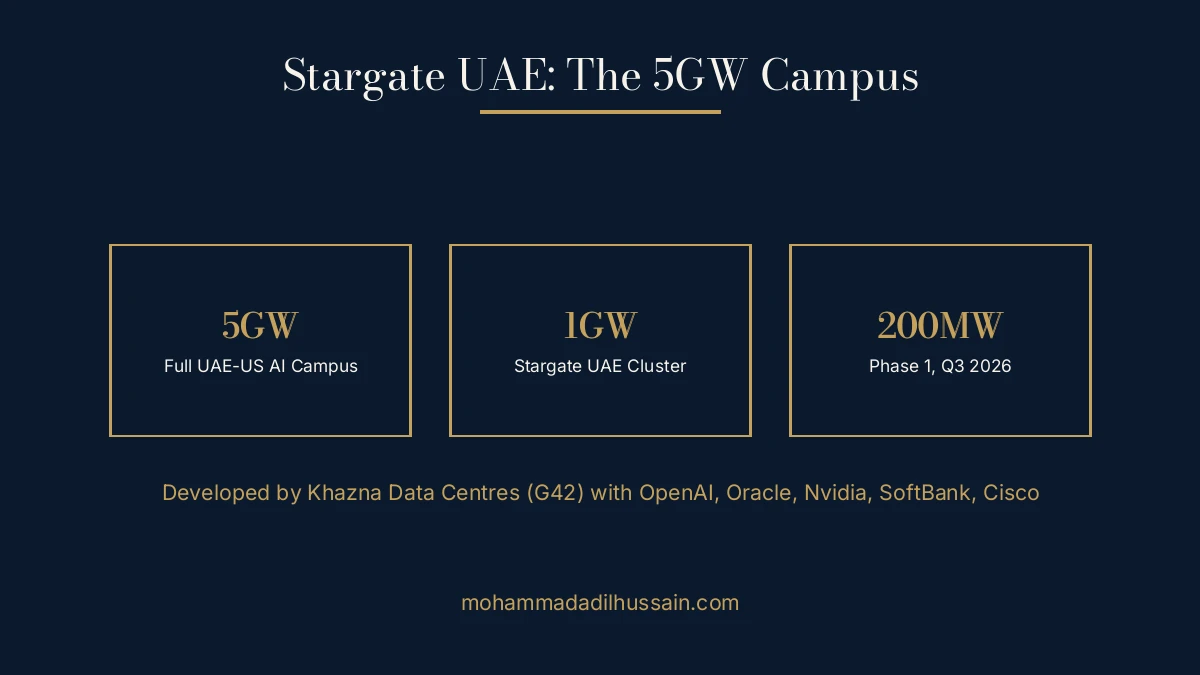
The first phase, 200 megawatts, is on track for completion in the third quarter of 2026, according to Mubadala managing director Khaldoon Al Mubarak. As of spring 2026, more than 5,000 workers were on site, over 100,000 cubic meters of concrete had been poured, and the steel used so far weighs one and a half times the Eiffel Tower. That phase alone is expected to run on roughly 35,000 Nvidia Grace Blackwell GB300 chips.
For comparison, a single gigawatt of AI data center capacity is enough to power hundreds of thousands of homes. Five gigawatts, the scale of the full campus once built out, puts the UAE in a category of AI infrastructure that only a handful of countries are attempting at all.
The Chip Access Most Countries Don’t Have
Infrastructure is only useful with chips running inside it, and this is where UAE policy diverges from most of the region. In late 2025, the US approved export of up to 500,000 Nvidia AI processors a year to the UAE, starting with the Blackwell generation and moving to Rubin and then Feynman architectures in the years after. On 20 November 2025, the US Commerce Department specifically authorized G42, alongside Saudi Arabia’s Humain, to receive AI compute equivalent to 35,000 GB300 processors, conditional on what the department called rigorous security and reporting requirements.
This access did not come free. In March 2025, following a meeting between UAE and US leadership, the UAE committed to a 10-year, USD 1.4 trillion investment framework in the United States, covering AI, semiconductors and energy, with the chip access tied to matching that commitment dollar for dollar. The UAE reaffirmed the pledge in March 2026, in the middle of the regional conflict that began that February, which is its own signal about how central this partnership is to UAE strategy regardless of what else is happening around it.
Microsoft’s own chip access illustrates the scale involved outside the Stargate project entirely. The company holds export licenses covering roughly 81,900 Nvidia-chip equivalents in the UAE (21,500 A100s already deployed, plus 60,400 more including advanced GB300 units), running through its USD 15.2 billion UAE investment program.
Where the Capital Is Coming From
Three separate capital tracks are funding this build, and it helps to keep them apart rather than treat “billions of dollars of AI investment” as one undifferentiated number. If you are building on top of that infrastructure rather than inside it, the practical starting point is starting an AI agent business in Dubai.
| Capital track | Amount | Timeframe | Key backers |
|---|---|---|---|
| Microsoft UAE investment | USD 15.2 billion | 2023 to 2029 | Microsoft, G42 |
| US-UAE investment framework | USD 1.4 trillion | 10 years from 2025 | UAE government, US government |
| MGX sovereign AI vehicle | Not fully disclosed | Ongoing since 2024 | Abu Dhabi government, BlackRock, Microsoft |
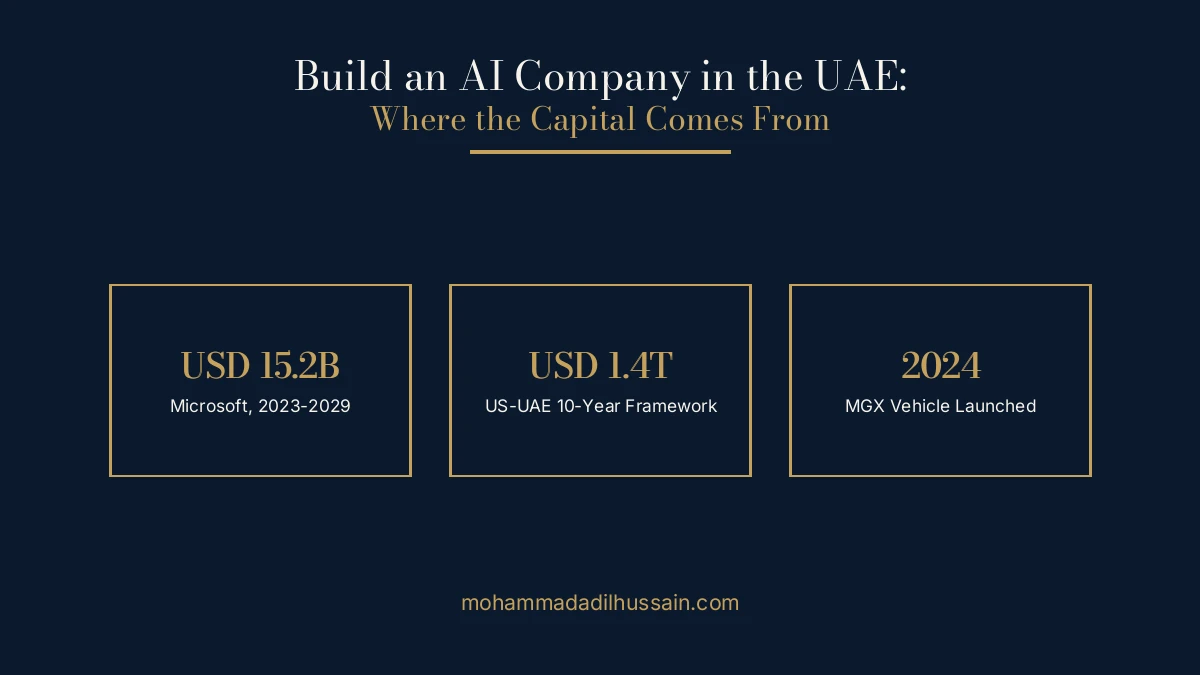
Microsoft confirmed on 3 November 2025 that its total UAE investment runs to USD 15.2 billion between 2023 and 2029. Of that, USD 7.3 billion was already spent by the end of 2025: a USD 1.5 billion equity stake in G42, USD 4.6 billion in AI and cloud data center capital expenditure, and USD 1.2 billion in local operating costs. The remaining USD 7.9 billion, planned for 2026 through 2029, splits into USD 5.5 billion for further AI and cloud infrastructure and USD 2.4 billion in operating costs.
MGX, the Abu Dhabi sovereign AI investment vehicle launched in 2024, sits behind a separate layer of global AI infrastructure deals, including partnerships alongside BlackRock and Microsoft on data center financing outside the UAE itself. That is worth knowing if you assume Stargate UAE is the whole picture. It is the most visible project, not the only one.
And above both of those sits the USD 1.4 trillion, 10-year bilateral investment framework, which is the political and financial commitment that made the chip export approvals possible in the first place.
Related reading: what Blackstone’s return signals about where institutional capital is heading in the UAE.
The Regulatory Groundwork
None of this compute matters to a company if the rules around using it are unclear. The UAE’s four-tier, risk-based AI legislation took effect in March 2026, with a Federal AI Authority established as the primary regulator. That structure, tiering obligations by how much risk a given AI use case actually carries rather than applying one blanket rule to every application, is closer to how the EU AI Act is built than to the lighter-touch, sector-by-sector approach still being debated in the US.
On talent, the national target is one million AI-trained people by 2027. Microsoft’s own UAE commitment folds directly into that number: skilling one million people by 2027, including 120,000 government employees and 214,000 students and teachers. Whether that target is fully met on schedule is a separate question, but the direction, treating AI talent supply as a policy target with a number and a date attached, is not something every country building AI infrastructure is doing at the same time.
Related reading: how the UAE built a regulatory framework for tokenization, a comparable case of rules catching up to a new technology fast.
What It Actually Takes to Build an AI Company in the UAE
Here is the honest part. Almost everything above describes infrastructure being built for named hyperscaler partners, OpenAI, Oracle, Microsoft, G42, under specific US export licenses and bilateral agreements. An early-stage AI startup cannot walk up to Stargate UAE and rent a rack. That compute is spoken for.
So what does it actually take to build an AI company in the UAE, once you strip away the hyperscaler headlines? Three things reach a founder that the gigawatt numbers do not: a licensing environment that has caught up to AI specifically, a growing bench of AI-trained talent to hire from, and a capital and vendor ecosystem expanding because the hyperscalers are physically present.
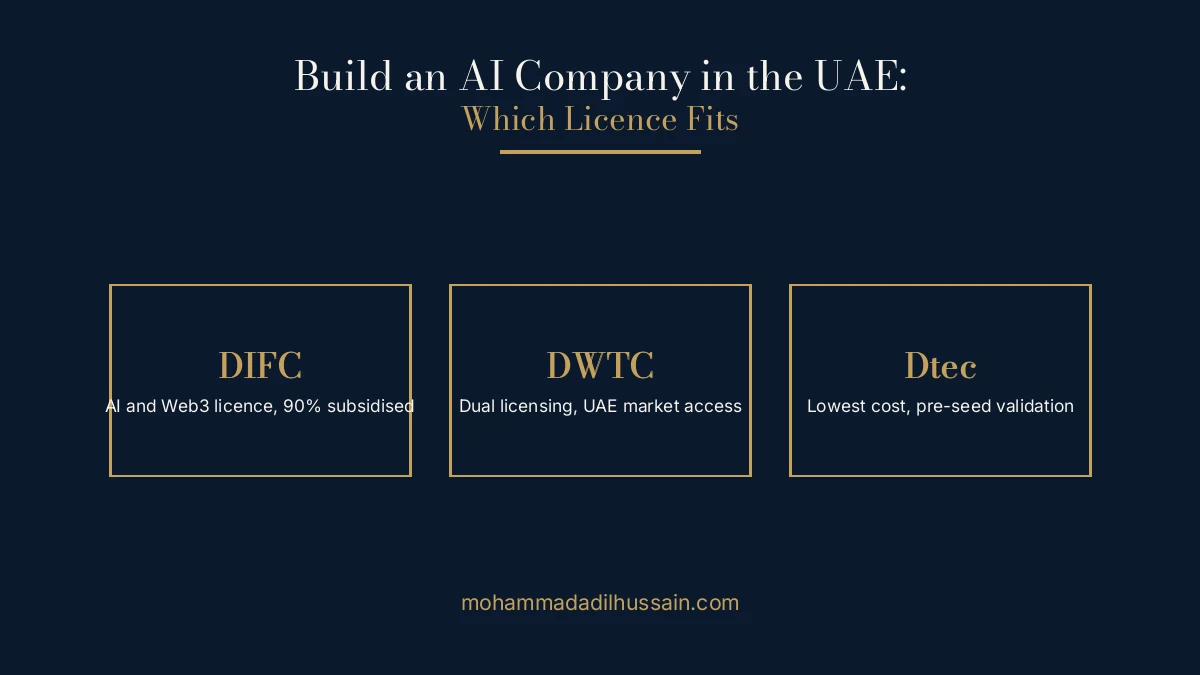
DIFC’s AI and Web3 licence is a commercial licence subsidized at 90% for early-stage AI and Web3 founders, run out of the DIFC Innovation One campus, targeting more than 500 startups and 3,000 jobs by 2028. It is not a tax exemption, and it excludes financial services and crypto exchange activity specifically, so it fits a machine learning or applications company far better than a fintech-adjacent one. Where an AI company actually registers, DIFC, DWTC or Dtec, follows the same funding-stage logic as any other tech startup chasing venture capital in Dubai, which I have written about separately.
The honest downside is that none of this is a plug-and-play version of Silicon Valley. Compute access still runs through named US-approved operators. The AI law is new enough that case-by-case interpretation is still forming. And the talent target is aspirational, not yet delivered. What the UAE has actually built, past the headline gigawatt figures, is the surrounding environment: capital, regulatory clarity, and a visible commitment durable enough to survive a regional conflict without wavering. That is a real advantage.
It is just a different advantage than “you can rent Stargate compute,” and a founder deciding where to build should know the difference before choosing a jurisdiction on the strength of a press release. For the mechanics of how mainland and free zone structures actually differ once you get past the headline decision, see mainland vs free zone: what actually matters in 2026.
My Approach: Structuring an AI Company Around Infrastructure That’s Still Being Built
Most business setup consultants help you register a company. I help you make informed business decisions before you invest.
An AI company raises a specific version of the free zone and licensing question every tech startup faces, because the DIFC AI and Web3 licence that looks like the obvious answer comes with real restrictions on financial services and crypto activity, and because data residency and Federal AI Authority compliance are still new enough in practice that the right structure depends on exactly what your product does, not just that it uses AI. I don’t open a conversation with a licence type. I open it with the product: what the model does, where the training and inference data lives, who your investors are likely to be, and what compliance load your specific application actually carries under the new AI law.
My advisory process focuses on helping you reduce uncertainty and make confident decisions, not just complete documentation. Here is what that looks like in practice.
- Idea validation against the actual regulatory and infrastructure environment, not the version of the UAE AI story that shows up in a press release.
- Market research specific to your AI use case and sector, not a generic UAE tech market overview.
- Competitor analysis, including who else is building in the same space inside DIFC, DWTC or Dtec.
- A business plan built for the investor conversations you’re actually likely to have.
- Startup cost estimation, license fees, compliance costs, and the real cost of hiring against a still-forming AI talent pool, disclosed together.
- Financial feasibility modeling before you commit to a jurisdiction or a headcount plan.
- A structure recommendation matched to your product, not the free zone that is fastest to set up.
- License selection that accounts for what your AI application is actually permitted to do under the licence you choose.
- Investor and employment visa planning, including for specialized AI talent you may need to bring in from outside the UAE.
- Banking strategy, since AI companies handling data and payments face closer scrutiny than a standard services business.
- Risk assessment covering data residency, model governance, and the Federal AI Authority’s compliance expectations.
- Expansion planning for scaling past your first jurisdiction as the company grows.
The objective is simple: help you start your business with clarity, confidence and a long-term strategy. If you want to talk through your specific AI use case, you can review business setup services, look at what growth and market expansion involves once you’re past formation, or get in touch directly.
Frequently Asked Questions
What’s the fastest way to build an AI company in the UAE?
Start with the product, not the licence. The fastest path is choosing a structure that matches what your AI application actually does, DIFC’s AI and Web3 licence for most machine learning and applications companies, DWTC or Dtec if your product doesn’t fit DIFC’s financial services and crypto restrictions, and confirming that up front rather than restructuring later.
Can an early-stage AI startup actually use Stargate UAE’s compute capacity?
No, not directly. Stargate UAE’s capacity is licensed to named partners, OpenAI, Oracle, Microsoft and G42, under specific US export authorizations. A startup benefits from the surrounding ecosystem those partners create, not from renting the compute itself.
What license does an AI company need to register in the UAE?
It depends on what the company does. DIFC’s AI and Web3 licence is built for AI and Web3 founders and is subsidized at 90%, but it excludes financial services and crypto exchange activity. A company outside those restrictions may fit better in DWTC or Dtec, following the same funding-stage logic as any VC-track tech startup.
How does the UAE’s AI law, effective March 2026, affect a startup?
The law applies a four-tier, risk-based classification system, meaning obligations scale with how much risk your specific AI use case carries, under the new Federal AI Authority. A company processing sensitive data or making automated decisions in a regulated sector carries a heavier compliance load than one building a lower-risk application.
Is the UAE’s AI talent pool large enough to hire from yet?
It is growing toward a national target of one million AI-trained people by 2027, with Microsoft alone committed to skilling a million people, including 120,000 government employees and 214,000 students and teachers, as part of that goal. It is a target with real investment behind it, not a finished talent market, so hiring plans should account for both the growth and the gap that still exists today.
Related reading: mainland vs free zone vs offshore: which UAE structure is right for your business.
Sources & References
- G42 – Global Tech Alliance Launches Stargate UAE
- The National – Stargate UAE’s First Phase to Be Completed in Q3 2026
- Gulf News – G42 Gets US Approval for Advanced AI Chip Exports
- Tom’s Hardware – US Grants Nvidia License to Ship AI GPUs to UAE
- Microsoft – Microsoft’s USD 15.2 Billion Investment in the UAE
- CNBC – UAE Commits to USD 1.4 Trillion Investment Framework in US
- Bloomberg – UAE Stands by USD 1.4 Trillion US Investment Pledge Despite War
- The AI Insider – UAE National AI Strategy 2031, Decoded