On 15 October 2025, Federal Decree-Law No. 20 of 2025 came into force, amending the UAE’s Commercial Companies Law for the first time since its major 2021 overhaul. The changes are real, significant, and were announced by the Minister of Economy and Tourism in the same briefing where he outlined the UAE’s target of growing to over 2 million registered companies by 2031, up from roughly 1.2 million at the time. Nearly every piece of coverage treats these as two separate stories: dense legal client alerts analysing the amendment’s mechanics, and news coverage of an ambitious growth target. They are the same story. Here is what actually changed, what is genuinely usable today, and what, despite being widely reported as “introduced,” is still waiting on Cabinet implementing regulations.
Quick Navigation
Quick Answer
- Federal Decree-Law No. 20 of 2025 amended the Commercial Companies Law (Federal Decree-Law No. 32 of 2021), effective 15 October 2025.
- Free zone companies are now expressly recognised as UAE juridical persons, and their mainland branches or representative offices fall under the Commercial Companies Law when operating onshore, closing a previous legal ambiguity.
- Companies can now redomicile, transferring registration between mainland authorities, between free zones, and between mainland and free zone, without liquidation, subject to shareholder approval and regulatory conditions.
- Multiple share classes for onshore LLCs are now legally recognised, but as of the most recent detailed reporting available, the Cabinet’s implementing regulations specifying how to actually create and register them had not been published, with the Ministry of Economy indicating 2026.
- The UAE’s Minister of Economy and Tourism has stated a target of over 2 million registered companies by 2031, up from approximately 1.2 million in September 2025, and connected this target directly to the Commercial Companies Law reforms in the same public briefing.
UAE Commercial Companies Law Amendments 2026: What Actually Changed, and When
On 1 October 2025, the UAE issued Federal Decree-Law No. 20 of 2025, amending Federal Decree-Law No. 32 of 2021, the Commercial Companies Law. It was published in the Official Gazette on 14 October 2025 and took effect the following day, 15 October 2025.
This is the first substantial amendment since the original law’s major 2021 reform, which had already removed the requirement for majority UAE national ownership across most commercial activities. The 2025 amendment does not replace that framework. It refines it: clarifying which entities and activities fall within the law’s jurisdiction, adding new shareholder and governance tools, and introducing corporate structures the original 2021 law did not address.
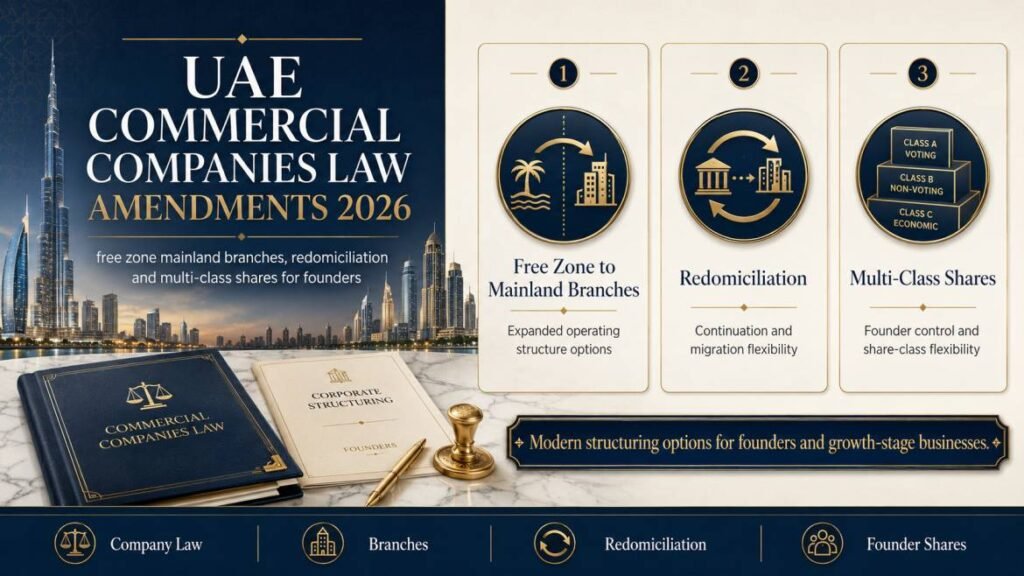
Five UAE Commercial Companies Law amendments 2026 changes matter most for anyone choosing or restructuring a UAE company right now, and each is covered in its own section below: free zone companies operating mainland branches, redomiciliation between jurisdictions, multiple share classes for LLCs, new governance tools including drag-along and tag-along rights, and the law’s explicit connection to the UAE’s national growth target for registered companies.
Free Zone Companies and Mainland Branches: The Federal Clarification, and What It Doesn’t Do
This is where getting the UAE Commercial Companies Law amendments 2026 distinction right matters most, because conflating two different things here leads directly to wrong assumptions.
The amendment expressly clarifies that the Commercial Companies Law applies to branches or representative offices of free zone companies operating on the UAE mainland. Free zone companies continue to be governed by their own zone’s regulatory framework for activities conducted within the zone. But when a free zone company establishes a branch or representative office on the mainland, or otherwise carries out activities onshore, that branch must comply with the Commercial Companies Law and other applicable federal legislation. The amendment also confirms that free zone companies are recognised as UAE juridical persons for the purposes of federal law, reducing a genuine, long-standing area of legal ambiguity in cross-jurisdictional structuring.
What this amendment does not do is create the administrative mechanism for actually obtaining a mainland branch licence in a specific emirate. This is a federal legal clarification of which law governs, not an emirate-level operating permit process. Dubai, for instance, has its own separate framework under Executive Council Resolution No. 11 of 2025 for free zone companies obtaining mainland trading rights, administered through the Department of Economy and Tourism, with its own eligibility conditions, permitted activity list and fee structure. Other emirates may have different, or less developed, equivalent mechanisms. A founder reading that free zone companies can now “branch onto the mainland” should understand this as a federal clarification of legal status, and then separately confirm the actual administrative pathway with the relevant emirate’s authority, since the mechanics genuinely differ by location.

UAE Commercial Companies Law Amendments 2026: Redomiciliation Between Emirates and Free Zones
This is a genuinely new capability under the UAE Commercial Companies Law amendments 2026, not simply a clarification of an existing one.
The amendment introduces a mechanism for redomiciliation, transferring a company’s registration between competent authorities, including from one mainland authority to another, from mainland to free zone and vice versa, between different free zones, and into the UAE from a foreign jurisdiction, without requiring liquidation and reincorporation. The company’s legal identity, contracts, licences and obligations continue under the new registration rather than being extinguished and recreated.
This is not, however, an automatic or unconditional process. It requires:
- Shareholder approval, typically via a special resolution or other prescribed majority.
- Compatibility between the originating and receiving registries, since not every free zone or mainland authority’s systems and rules align cleanly with every other.
- Absence of prohibitive annotations or blocks on the company, such as pending disputes or regulatory holds.
- Approval from the relevant licensing authorities, and, where applicable, the Ministry of Economy or the Securities and Commodities Authority.
- Compliance with publication and disclosure requirements during the transfer.
For regional groups and multinationals, this is a genuinely useful tool to realign licensing, tax and operational structure without the cost and disruption of full liquidation and reincorporation. For a smaller founder considering a future move, for example from a free zone into mainland structure as the business grows, it means that decision no longer has to mean starting over from a blank legal slate, though the conditions above still need to be met in practice.

Multi-Class Shares: Legally Real, Not Yet Fully Usable
This is the section of the UAE Commercial Companies Law amendments 2026 worth reading most carefully if a headline about “new share classes” is the reason you are considering restructuring right now.
The amendment introduces the legal concept of multiple share classes for onshore LLCs, a significant departure from the traditionally uniform share structure UAE LLCs have operated under. In principle, this opens the door to structures long familiar in venture-backed companies elsewhere: preferred shares with different rights, liquidation preferences, and voting arrangements between founder and investor shareholders.
Here is the caveat that matters. As of the most recent detailed reporting available, the Cabinet had not yet published the implementing regulations specifying the actual categories of share classes permitted, the procedures for creating them, and the documentation required to register them. The Ministry of Economy has indicated these regulations are expected during 2026. Until they are published, the practical mechanics of actually issuing a second share class inside an onshore LLC remain genuinely uncertain, even though the underlying legal concept is now real.
The practical takeaway: the direction is confirmed and significant, particularly for founders anticipating a future funding round who want a structure eventually capable of issuing preferred shares. The specific mechanism to do so today is not yet fully published. Anyone structuring around this specific feature right now should confirm the current state of the implementing regulations directly, rather than assuming the capability is immediately available in practice simply because the law has been amended.

Drag-Along, Tag-Along and Deadlock Tools: What They Mean for Founders
Beyond share classes, the UAE Commercial Companies Law amendments 2026 add statutory governance tools that previously existed only where shareholders negotiated them privately into a shareholders’ agreement.
Drag-along rights allow majority shareholders, under specified conditions, to compel minority shareholders to join a sale of the company on the same terms, preventing a small minority stake from blocking an otherwise agreed exit. Tag-along rights work in the other direction, allowing minority shareholders to participate in a sale on the same terms a majority shareholder has negotiated, rather than being left behind with reduced leverage.
The amendment also introduces deadlock resolution tools, mechanisms for addressing situations where shareholders with equal or blocking voting power cannot agree on a key decision, historically a genuine structural weakness in equally-split UAE LLCs with no built-in resolution path.
For a founder bringing on a co-founder or an early investor, these tools now exist with statutory backing rather than depending entirely on how carefully a shareholders’ agreement was drafted. This does not replace the value of a well-drafted shareholders’ agreement, but it does provide a stronger statutory floor than existed before the amendment.
Why This Connects to the UAE’s 2 Million Company Target
This is the connection almost no source on the UAE Commercial Companies Law amendments 2026 currently makes explicit, despite the UAE government making it directly.
In September 2025, Abdullah bin Touq Al Marri, Minister of Economy and Tourism, announced a target of growing the UAE’s registered company count to over 2 million by 2031, up from approximately 1.2 million companies at the time, alongside a goal of nurturing 10 unicorns in the same period. By January 2026, the UAE had added roughly 250,000 new companies in 2025 alone, pushing the total past 1.4 million. The target was outlined as part of a national campaign, and the Minister connected it directly to the Commercial Companies Law reforms during the same public discussion.
Read together, the logic is straightforward. Redomiciliation without liquidation removes a real friction point for companies considering restructuring or relocating within the UAE, rather than exiting and reforming elsewhere. The mainland-branch clarification for free zone companies removes legal ambiguity that previously complicated cross-jurisdictional growth. Multi-class shares, once the implementing regulations land, are specifically the kind of tool that makes the UAE more attractive to venture-backed growth companies, exactly the profile of company the unicorn target depends on. The Commercial Companies Law amendment is not a separate legal story from the 2 million company target. It is the legal infrastructure that target is being built on.
Practical Implications for Founders Choosing a Structure Now
Pulling the UAE Commercial Companies Law amendments 2026 into direct guidance for a founder deciding how to structure today.
If you are choosing between mainland and free zone, the mainland-branch clarification makes free zone-to-mainland expansion a somewhat clearer legal path than before, but the actual administrative process still depends on your specific emirate, so this should not be the deciding factor on its own.
If you are planning a future funding round involving preferred shares, the direction of travel is now confirmed, but the specific mechanism is not yet fully published. Structure your current formation with this eventual capability in mind, and revisit the actual share class mechanics once the Cabinet’s implementing regulations are published.
If you are considering relocating an existing company between a free zone and the mainland, or between free zones, redomiciliation is now a genuine option worth evaluating against the cost and disruption of liquidation and reincorporation, subject to the shareholder approval and registry conditions covered above.
If you are bringing on a co-founder or an early investor, the new statutory drag-along, tag-along and deadlock tools are worth understanding even if you still want a fully negotiated shareholders’ agreement, since they now set a stronger default floor than existed previously.
My Approach: Structuring for a Law That Is Still Catching Up to Its Own Reforms
Most business setup consultants help you register a company. I help you make informed business decisions before you invest, and the UAE Commercial Companies Law amendments 2026 are exactly the kind of change that decision should account for.
The founders who get the most value from a legal reform like this are rarely the ones who react to the headline. They are the ones who understand precisely which parts are immediately usable, which parts are directionally confirmed but still awaiting implementing detail, and how to structure today in a way that positions them to use the fuller capability once it lands, rather than restructuring twice. Multi-class shares are the clearest example of this in the current amendment, and it will not be the last time a UAE legal reform arrives ahead of its own implementing regulations.
My advisory process focuses on helping you reduce uncertainty and make confident decisions, not just complete documentation. In practice:
- Structure assessment that separates what is legally confirmed and usable today from what is directionally real but still pending implementing detail.
- Free zone versus mainland guidance that accounts for both the federal legal clarification and the specific emirate-level administrative process that actually governs your branch application.
- Redomiciliation feasibility review for companies considering a move between free zones or into the mainland, checked against the real shareholder approval and registry conditions involved.
- Governance and shareholder agreement structuring that uses the new statutory drag-along, tag-along and deadlock tools as a foundation, not a replacement, for a properly negotiated agreement.
- Business setup and licensing execution that anticipates a future share class or investor structure, even where the current formation cannot yet fully implement it.
- Corporate tax registration and filing planning coordinated with any redomiciliation or structural change, since moving between jurisdictions carries tax implications that need to be assessed alongside the legal ones.
- Coordination with the underlying mainland versus free zone structural decision this amendment sits on top of.
The objective is simple: help you structure with clarity, confidence and a long-term strategy, understanding exactly which parts of a fast-moving legal reform you can rely on today and which parts are still being written.
If you are weighing how the UAE Commercial Companies Law amendments 2026 affect a mainland branch, a redomiciliation, or a future share class structure, and want the current state of the law confirmed properly before you commit, get in touch.
Frequently Asked Questions on the UAE Commercial Companies Law Amendments 2026
What is the UAE Commercial Companies Law amendment 2025/2026?
Federal Decree-Law No. 20 of 2025, which amended Federal Decree-Law No. 32 of 2021, the Commercial Companies Law, effective 15 October 2025. It clarifies the law’s jurisdiction over free zone companies operating mainland branches, introduces a redomiciliation mechanism between jurisdictions, adds multiple share classes for LLCs, and introduces new statutory shareholder governance tools.
Can free zone companies now open a mainland branch anywhere in the UAE?
The amendment confirms that free zone companies are UAE juridical persons and that their mainland branches fall under the Commercial Companies Law when operating onshore. This is a federal legal clarification, not an automatic administrative process. The actual mechanism for obtaining a mainland branch licence still depends on the specific emirate, and differs, for example Dubai’s own separate framework under Executive Council Resolution No. 11 of 2025.
Can I create preferred shares for my UAE LLC now?
The legal concept of multiple share classes for onshore LLCs is now recognised under the amended Commercial Companies Law. However, as of the most recent detailed reporting available, the Cabinet had not yet published the implementing regulations specifying how share classes are actually created and registered, with the Ministry of Economy indicating these are expected during 2026. Confirm the current status before assuming the mechanism is immediately usable.
What is redomiciliation under the UAE Commercial Companies Law?
A mechanism allowing a company to transfer its registration between mainland authorities, between free zones, between mainland and free zone, or into the UAE from abroad, without liquidation. The company’s legal identity continues under the new registration. It requires shareholder approval, registry compatibility, absence of blocking annotations, and approval from relevant licensing authorities.
What are drag-along and tag-along rights under the amended law?
Drag-along rights allow majority shareholders, under specified conditions, to compel minority shareholders to join a company sale on the same terms. Tag-along rights allow minority shareholders to participate in a sale on the same terms negotiated by a majority shareholder. Both now have statutory backing under the amendment, rather than depending entirely on a privately negotiated shareholders’ agreement.
Why does the UAE want 2 million registered companies by 2031?
The UAE’s Minister of Economy and Tourism announced this target in September 2025, up from approximately 1.2 million companies at the time, as part of a national campaign to position the UAE as a global entrepreneurship hub. The Commercial Companies Law amendments were discussed in the same briefing and are directly connected to this target as the legal infrastructure supporting it.
Does the Commercial Companies Law amendment affect my existing company automatically?
The amendment applies to onshore and free zone companies generally, but specific implications, particularly around share classes, governance tools and any mainland branch activity, depend on your company’s current structure and activities. Reviewing your specific structure against the amendment, rather than assuming automatic changes, is the safer approach.
Sources & References
- UAE Ministry of Economy and Tourism
- UAE Legislation Portal
- Gulf News – UAE aims for two million companies, 10 unicorns by 2031
- The National – UAE launches campaign to become start-up capital of the world
- Norton Rose Fulbright – Key amendments to the UAE Commercial Companies Law
The UAE Commercial Companies Law amendments 2026 open up structuring options that were not previously available, and founders who understand them early can build cap tables that would not have been possible under the old UAE Commercial Companies Law amendments 2026 framework.