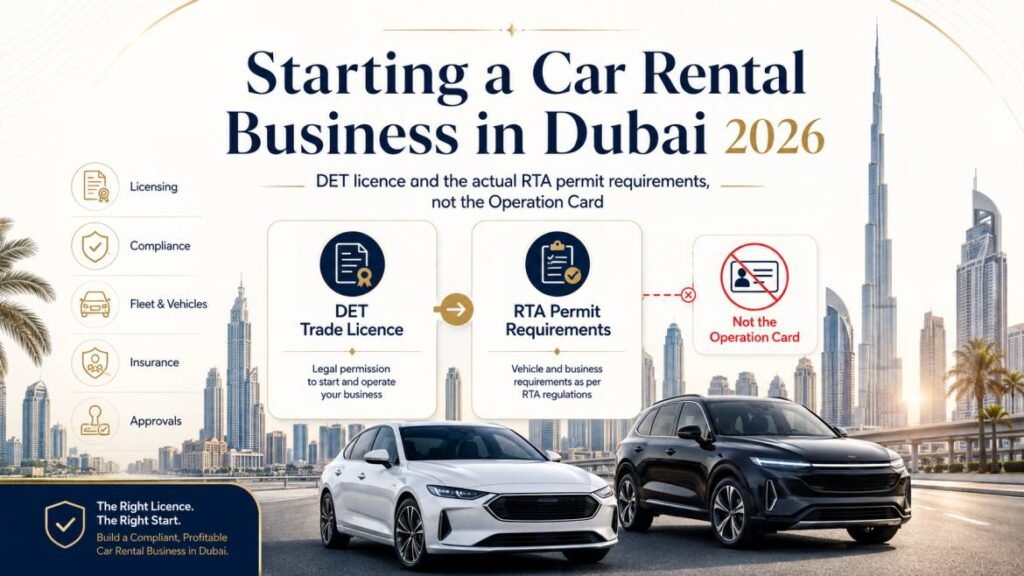
Search for how to start a car rental business in Dubai and RTA Operation Card requirements and you are, in a meaningful number of cases, searching for the wrong credential. The RTA Operation Card authorises commercial transport-for-hire: buses, taxis, cargo fleets, paid passenger transport. Self-drive car rental is a separate, distinctly regulated activity under Executive Council Resolution No. 47 of 2017, administered through the RTA’s TARS platform, with its own permit that specialist sources never actually call an Operation Card. That terminology gap runs through a meaningful share of current content on this topic. Here is what the DET licence and the correct RTA permit actually require, what fleet numbers are genuinely sourceable and what is not, and where most guides quietly stop being specific.
Quick Navigation
Quick Answer
- A car rental business in Dubai needs two separate approvals: a DET commercial trade licence carrying the car rental activity, and a separate RTA vehicle rental permit under Executive Council Resolution No. 47 of 2017, not the RTA Operation Card used for commercial transport-for-hire.
- The widely repeated “10-vehicle minimum” for a car rental licence is not traceable to any published RTA source. RTA’s fee schedule tiers from 100 vehicles and below with no floor stated, and the governing resolution leaves fleet approval to RTA’s discretion.
- RTA publishes maximum vehicle age and replacement bands by class for rental fleets, reported at 3, 4, 6, 7 and 10 years, after which a vehicle must be withdrawn from rental service.
- Car rental must be mainland-licensed. A free zone company cannot hold the RTA vehicle rental permit or register a fleet for public-road rental in Dubai.
- Confirmed RTA-side fees are modest, roughly AED 1,000 for the permit and AED 100 for training, plus an annual fee tiered by fleet size. The real capital cost of this business is the fleet, not the licensing.
The Operation Card Is Probably Not the Permit You Need
Start here, because this single distinction changes how you should read every other guide to a car rental business Dubai RTA licence.
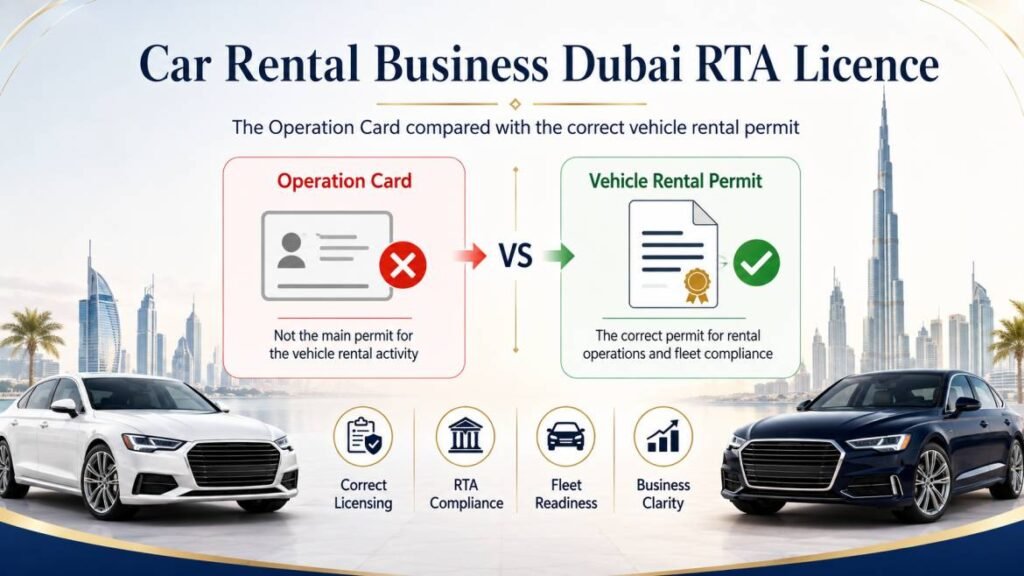
The RTA Operation Card is the credential that authorises a company to conduct commercial transport-for-hire: operating buses, taxis, cargo fleets and paid passenger transport. It is issued once a company completes RTA’s operator approval process for that specific activity, and it is the term used consistently across guides covering general commercial transport company setup in Dubai.
Self-drive car rental is a different, separately regulated activity. It falls under Executive Council Resolution No. 47 of 2017, which regulates vehicle rental activity in Dubai specifically, and it is administered through the RTA’s Transport Activities Rental System (TARS), not through the same operator-approval track that produces an Operation Card. Detailed sources describing the car rental permit process consistently avoid the term “Operation Card” entirely, referring instead to the vehicle rental permit issued under this resolution.
Why this matters practically: if you search for car rental RTA Operation Card requirements, a meaningful share of what you find either uses the term loosely, borrowing it from general transport-licensing content, or never actually names the correct credential at all. If your business is genuinely self-drive car rental, not a chauffeur-driven, ride-hailing or general transport fleet, confirm with RTA directly that you are applying for the correct permit under the correct resolution, rather than assuming the Operation Card terminology you have read elsewhere applies to you. The mechanics of the Operation Card itself, and the businesses that genuinely need it, are covered in RTA approval for a transport or logistics company in Dubai.
Car Rental Business Dubai RTA Licence: What DET Actually Requires
The Department of Economy and Tourism side of this business is a commercial trade licence, not a professional or tourism licence, carrying an activity registered as “Passenger Cars Rental,” “Rent a Car” or “Vehicle Leasing,” depending on the current activity list naming.
Confirming the exact activity name at application time matters more than it sounds like it should. If the licensed activity does not carry the correct car rental classification, RTA will not issue its approval, and amending the licence afterward costs time and money that a five-minute confirmation upfront avoids.
Car rental is open to 100% foreign ownership on the Dubai mainland, with no Emirati partner or local service agent required, following the Commercial Companies Law reform that removed activity-specific national ownership requirements for most commercial activities.
The Real RTA Permit, and What TARS Changes
This is the section that actually answers what this application needs beyond the DET licence: the separate approval that lets you legally put a rental car on Dubai’s roads.
You cannot rent vehicles to the public in Dubai without this separate RTA approval. Requirements consistently reported across specialist sources include a trade licence naming car rental as an approved activity, a registered office with Ejari tenancy and dedicated parking for the fleet, vehicles registered in Dubai under the company name with insurance written specifically for rental use, RTA-approved vehicle tracking, and enrolment in TARS.
TARS itself is a meaningful, relatively recent operational change. RTA requires rental contracts to be issued and registered through this system using a standardised digital contract, recording vehicle condition at handover and return, setting liability terms, and giving deposit refunds a defined timeframe rather than an open-ended hold. Paper-only contracting is not a viable fallback. Build your booking and contracting process around TARS from the outset, since retrofitting it after launch is more disruptive than designing for it from day one.
Car Rental Business Dubai RTA Licence: The Fleet Minimum Nobody Can Source
This is worth stating plainly rather than repeating the number every other guide repeats.
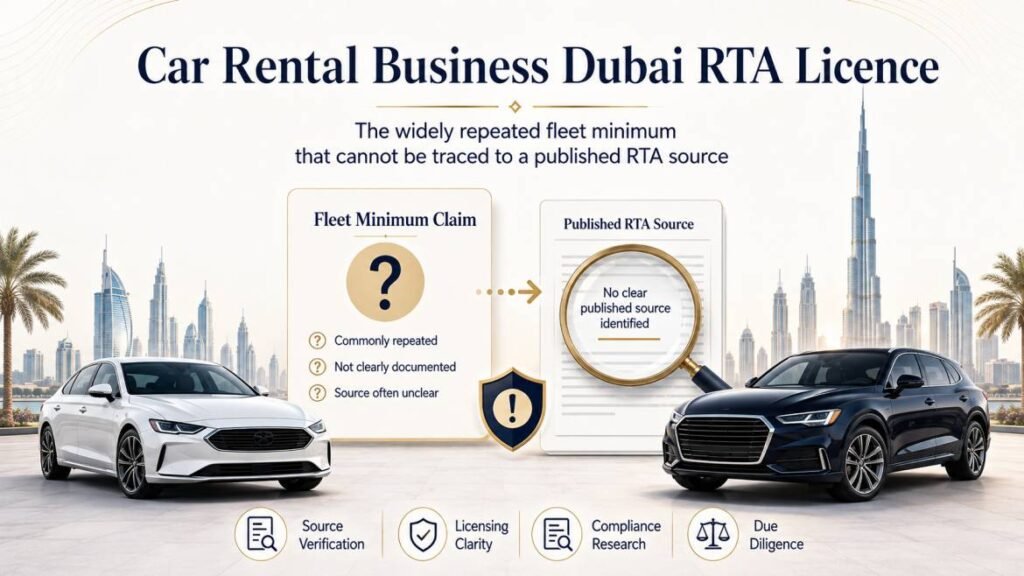
Search for Dubai car rental fleet requirements and a ten-vehicle minimum appears across a large number of consultancy pages, stated as settled fact. Checking this against RTA’s own published fee schedule, which tiers annual fees starting at “100 vehicles and below” with no floor specified, and against Executive Council Resolution No. 47 of 2017 itself, which leaves fleet size approval to RTA’s discretion based on the business plan submitted, no fixed published minimum could be confirmed.
That does not mean no practical expectation exists. RTA evaluates fleet plans against the business model presented, and a single-branch daily-hire operation is likely assessed differently than a corporate long-term leasing plan. The honest description is discretionary approval against a stated plan, not a fixed published number. If a consultant tells you a specific vehicle count is mandatory, ask them to point to the RTA page or clause that states it. Put your intended fleet size and phasing to RTA in writing with your application, and keep RTA’s written confirmation of what it will approve on file.
The Vehicle Age Schedule Most Guides Skip Entirely
This is arguably the single most financially important number in any car rental business Dubai RTA licence plan, and it is largely absent from general setup guides.
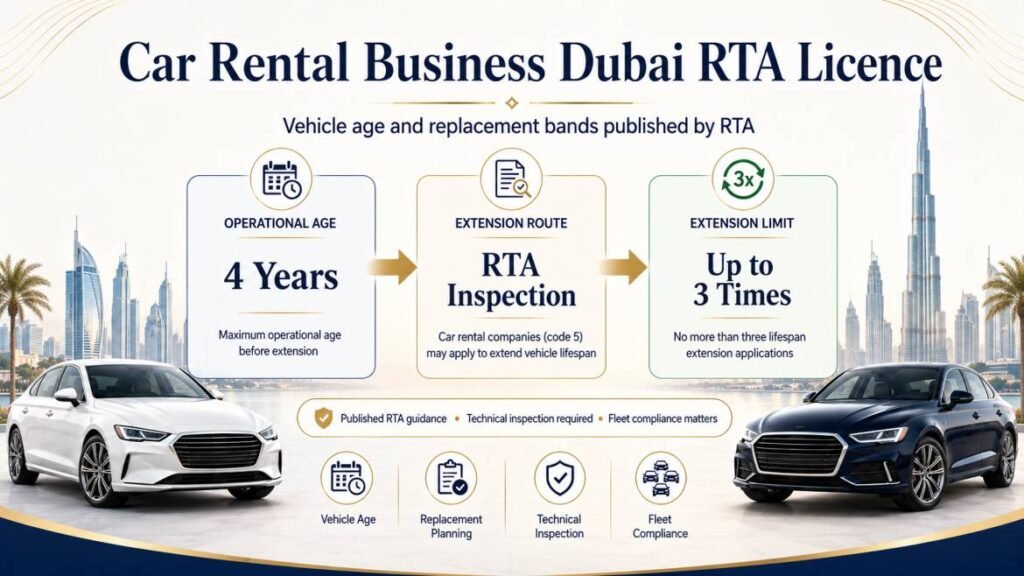
RTA sets a maximum permitted age for rental fleet vehicles by class, after which the vehicle must be withdrawn from rental service and replaced. Reported bands run at 3, 4, 6, 7 and 10 years, with lighter passenger vehicle classes typically at the stricter end and heavier or specialist classes at the more permissive end. This is a scheduled capital event, not a discretionary maintenance decision, and it should shape your finance term and depreciation model from day one, not be discovered partway through a five-year vehicle loan.
The vehicle’s class, confirmed with RTA, determines which band applies, and the clock runs against the published schedule rather than resetting on the date you personally acquired the vehicle. A widely repeated separate claim, that rental cars must be under two years old at registration, could not be traced to any published RTA text and should be treated with the same caution as the fleet-minimum figure above.
Why Mainland Is Not Just “Recommended,” It Is Required
Several guides describe mainland structuring for this kind of business as advisable or preferred, which understates what is actually a hard constraint.
Renting vehicles onto Dubai’s public roads is an RTA-regulated activity tied to a DET mainland licence. The entity holding the RTA vehicle rental permit and registering the fleet for rental use must be mainland-licensed. A free zone company cannot hold this permit and cannot register a fleet for public-road rental in Dubai, regardless of what a free zone’s own marketing material may imply. If a provider suggests a free zone route exists with RTA support attached, ask them to confirm the permit pathway for that specific entity type in writing before proceeding. The broader trade-offs between mainland and free zone structures generally are covered in mainland vs free zone vs offshore in the UAE.
What It Actually Costs, Licence Versus Fleet
Confirmed RTA-side fees for this licence are modest relative to everything else in this business: a permit fee in the region of AED 1,000, a training fee around AED 100, and an annual fee tiered by fleet size, rising from roughly AED 2,000 at the smallest published band. These sit on top of the DET licence itself, the Ejari-registered office and parking, establishment card and visa costs, and insurance.
None of that is where the real capital sits. The fleet is. A realistic small launch, factoring in the licence, approvals, office and a modest economy fleet, commonly runs well into six figures in dirhams once vehicles are included, with the vehicles themselves representing the overwhelming majority of that figure. Treat any guide quoting a low “total cost to start” figure with caution unless it states plainly whether the fleet is included.
The VAT Detail Most Car Rental Guides Miss
For anyone assembling this budget, this is a specific, checkable point that general business-setup content routinely omits.
UAE VAT rules generally block recovery of input tax on a motor vehicle available for private use. A vehicle acquired specifically for a rental business and used solely for a taxable business purpose is treated as an exception to that general block. On a genuine fleet purchase, this distinction affects a meaningful share of your acquisition cost, and the documentation supporting it, the stated acquisition purpose, a clear business-use policy and consistent contract records, is far easier to establish at the point of purchase than to reconstruct later under review. If a partner or family member is permitted to drive a fleet vehicle outside its rental use, that changes the underlying facts the exception depends on.
My Approach: Getting the Right Permit Before You Buy a Single Car
Most business setup consultants help you register a company. I help you make informed business decisions before you invest, and a car rental business Dubai RTA licence is exactly the kind of decision where that distinction matters.
The founders who get into trouble with a Dubai car rental business are rarely the ones who picked the wrong car brand. They are the ones who assumed the wrong RTA permit applied, financed a fleet on a term that outran the vehicle’s age ceiling, or bought ten cars because a consultant repeated an unsourced minimum, when a smaller, RTA-confirmed fleet would have started the business with less capital at risk. Confirming the correct permit, the real fleet plan, and the financing terms against the actual published rules, before signing for a single vehicle, is the difference between a business built to last and one that discovers its assumptions were wrong after the capital is already committed.
My advisory process focuses on helping you reduce uncertainty and make confident decisions, not just complete documentation. In practice:
- Correct permit identification from the outset, distinguishing self-drive car rental from transport-for-hire activities that require the Operation Card instead.
- Fleet planning put to RTA in writing as part of the application, rather than relying on an unsourced industry figure.
- Finance term structuring matched to the actual RTA age band for your vehicle class, so the vehicle earns for its full financed life.
- Business setup and licensing execution sequenced correctly between DET and RTA.
- Corporate tax registration and filing and VAT planning that accounts for the input-recovery treatment on fleet vehicles specifically.
- Banking setup guidance suited to a fleet-financing and high-transaction-volume business model.
The objective is simple: help you start your business with clarity, confidence and a long-term strategy, with the correct permit and a realistic fleet plan confirmed before you commit capital, rather than assumed from a figure nobody can source.
If you are setting up a car rental business and want the correct RTA permit and fleet plan confirmed properly before you buy, get in touch.
Frequently Asked Questions
Is the RTA Operation Card the right permit for a car rental business in Dubai?
Not for a car rental business Dubai RTA licence application specifically. The Operation Card authorises commercial transport-for-hire, such as buses, taxis and cargo fleets. Self-drive car rental is regulated separately under Executive Council Resolution No. 47 of 2017 and administered through RTA’s TARS system, and specialist sources describing this route do not refer to it as an Operation Card.
What licences do I need to start a car rental business in Dubai?
Two, not one: a DET commercial trade licence carrying the car rental or vehicle leasing activity, and a separate RTA vehicle rental permit. A DET licence alone does not authorise putting a rental car on the road.
Does RTA require a minimum of 10 vehicles for a car rental licence?
No published RTA source confirming a 10-vehicle minimum could be found. RTA’s fee schedule tiers from 100 vehicles and below with no floor stated, and the governing resolution leaves fleet size approval to RTA’s discretion against your submitted business plan. Treat this widely repeated figure with caution and confirm your fleet plan directly with RTA.
How old can a rental car be in Dubai before it must be replaced?
RTA publishes maximum age bands by vehicle class for rental fleets, reported at 3, 4, 6, 7 and 10 years depending on class, after which the vehicle must be withdrawn from rental service. This should shape your finance term and depreciation planning from the outset.
Can a free zone company run a car rental business in Dubai?
No, not as the operating entity. The RTA vehicle rental permit and fleet registration for public-road rental require a mainland-licensed company. A free zone company cannot hold this permit, regardless of any marketing suggesting otherwise.
What does an RTA car rental permit cost?
Confirmed RTA-side fees are modest: roughly AED 1,000 for the permit and AED 100 for training, plus an annual fee tiered by fleet size starting around AED 2,000. These sit separately from the DET licence, office costs, and the fleet itself, which represents the overwhelming majority of the real launch cost.
Can I recover VAT on vehicles bought for a rental fleet?
UAE VAT rules generally block input tax recovery on a motor vehicle available for private use, but a vehicle acquired specifically for a rental business and used solely for a taxable business purpose is treated as an exception. Confirm your specific position with a tax adviser and maintain clear documentation of business-only use.