
Quick Answer
The UAE most tax-friendly country ranking is now official: Global Citizen Solutions named the UAE the world’s most tax-friendly country for global citizens in its September 2026 “Tax Optimisation for Global Citizens” report, ranking first out of 48 jurisdictions on zero personal income tax, no exit tax on departing residents, and a flat 5% VAT. That ranking is real, but it measures personal tax exposure, not what it actually takes to move a business or a life here. For anyone reading the headline and wondering what to do next, the honest answer is that the UAE’s tax position is only ever as good as the business structure and visa route built underneath it, and this covers what the ranking actually measured, what it leaves out, and how structure and visa choice turn a tax ranking into an actual UAE presence.
Table of Contents
What the UAE Most Tax-Friendly Country Ranking Actually Measured
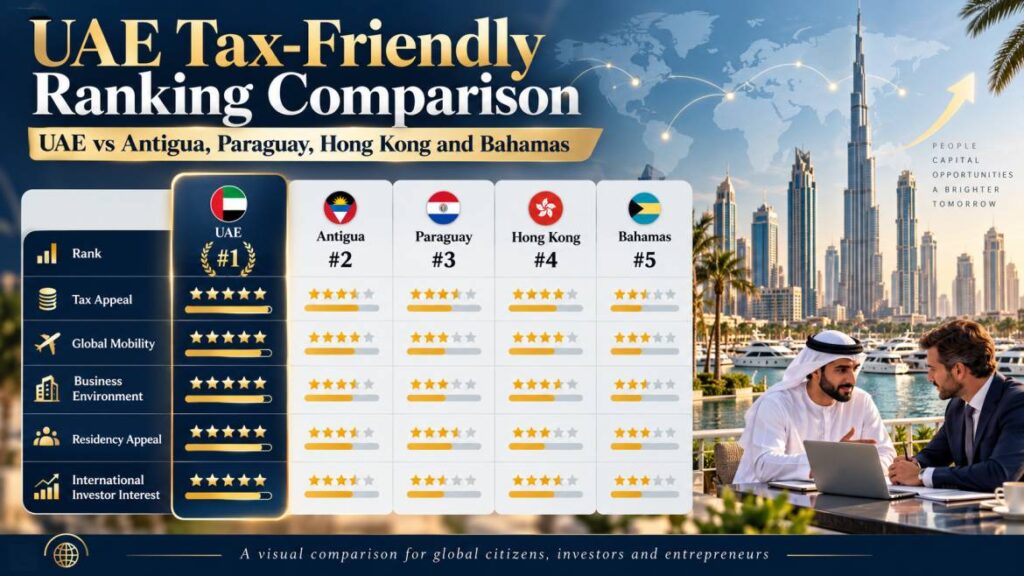
Global Citizen Solutions’ Global Intelligence Unit scored 48 jurisdictions across 11 indicators grouped into three weighted pillars: tax burden (42.5%), tax structure (42.5%), and investment migration (15%), reported in full by Khaleej Times. The UAE topped the overall table on the strength of zero personal income tax, no net wealth tax, no inheritance tax, and no exit tax charged to residents who leave. Antigua and Barbuda, Paraguay, Hong Kong and the Bahamas rounded out the leading non-European jurisdictions, with Malta and Cyprus leading Europe’s own list.
GCS founder Artur Saraiva’s own framing is worth reading closely: the jurisdictions that combine a favourable tax position with genuine quality of life “don’t get there through a zero-tax model” alone. The UAE’s score reflects tax burden and structure heavily, at 85% of the total weighting, with investment migration, meaning how accessible residency and citizenship pathways are, worth only 15%. That weighting matters for how the headline should actually be read.
| Jurisdiction | Headline tax position | Where it stood out |
|---|---|---|
| UAE | 0% personal income tax, 5% VAT, no exit tax | Overall #1, strongest combined tax burden and structure score |
| Antigua and Barbuda | 0% personal income tax | Investment migration via citizenship-by-investment |
| Paraguay | Territorial tax system | Low-cost residency, tax only on local-source income |
| Hong Kong | Territorial tax, no VAT | Tax structure simplicity |
| Bahamas | 0% personal income tax | No corporate or capital gains tax for most entities |
| Malta & Cyprus | EU tax residency programmes | Leading European jurisdictions, EU market access |
What a Personal Tax Ranking Doesn’t Tell You
A “most tax-friendly” ranking is built around personal tax exposure, income tax, wealth tax, inheritance tax, exit tax. It isn’t a business setup ranking, and it doesn’t factor in corporate tax, VAT registration thresholds, or the compliance calendar a company actually has to run once it’s formed. The UAE’s 0% personal income tax headline is accurate and genuinely rare among major economies, but a UAE company still carries its own obligations: corporate tax registration and filing, VAT where applicable, and from 2026 onward a phased move to mandatory e-invoicing, covered in full in the confirmed UAE e-invoicing timeline. None of that contradicts the ranking, it just sits outside what the ranking was ever measuring.
The other thing a personal tax ranking can’t tell a reader is which visa route actually gets them resident enough to benefit from any of it. Zero personal income tax only applies to someone who is a UAE tax resident, and tax residency itself runs through a specific visa and physical-presence test, not through simply forming a company on paper.
Why the Ranking Only Matters Once the Structure Is Right
Most coverage of the UAE most tax-friendly country story stops at the headline. What it skips is that the UAE’s tax position is delivered through the structure a founder or investor actually chooses, mainland, free zone, or offshore, and each carries a different practical path to residency and a different real cost of compliance, broken down in mainland vs free zone vs offshore. A free zone company with the wrong activity scope, or a mainland structure taken on for the wrong reason, can leave someone technically tax resident but operationally worse off than if they’d matched the structure to what they actually needed. The tax ranking describes the destination, not the route, and the route is where most of the actual decisions live.
Matching the Visa Route to the Business, Not the Other Way Around

Most UAE business setup guides treat the visa step as something that happens after the licence is issued, a formality rather than a decision. In practice it’s the opposite: the visa route someone qualifies for, and wants, should shape the structure decision from the outset, not follow it.
- Investor or partner visa, tied to holding shares in a UAE company, the standard route for a founder forming their own structure and the one most directly connected to the tax ranking’s personal tax position.
- Golden Visa, a longer-term residency route for qualifying investors, entrepreneurs and specialists, worth evaluating before choosing a structure since eligibility and the underlying company structure interact, covered in full in the UAE Golden Visa rule half the guides still get wrong.
- Employee visa, sponsored by the company rather than tied to ownership, the route for anyone joining as staff rather than as a shareholder.
- Remote work and long-term residency routes, relevant for global citizens who want UAE tax residency without necessarily running day-to-day operations from here, worth reading against the real cost of the Dubai remote work visa before assuming it’s the cheaper path.
The practical guides most people find when researching “UAE business setup and visa” list these routes side by side without connecting them back to which company structure actually supports each one, or what tax residency requires beyond simply holding a visa. That gap is exactly where a tax-friendly headline turns into a real decision, and it’s the gap this is written to close.
Who This Ranking Genuinely Suits, and Who Should Look Closer
This UAE most tax-friendly country ranking is most directly relevant to founders and investors already weighing a genuine relocation, high-net-worth individuals consolidating where they hold tax residency, and remote-first business owners who can legitimately base themselves anywhere, this pattern is covered in more depth from the founder-relocation angle in UK and European founders moving to Dubai and from the wealth-planning angle in why long-term residency and 0% tax structures matter more than ever. The UAE most tax-friendly country ranking is less directly relevant to someone whose income is genuinely tied to a fixed location elsewhere, since UAE tax residency benefits depend on actually meeting the physical presence and visa requirements, not on where a company happens to be registered.
My Approach: Turning the Ranking Into a Structure, Not Just a Headline
Every founder who reads the UAE tax-friendly country for global citizens headline asks a version of the same question: does this actually apply to me, and if it does, what do I do about it? I start from the visa route someone actually wants or qualifies for, then work backward to the structure, mainland, free zone or offshore, that supports it without adding compliance the business doesn’t need. The tax position is real, but it only pays off when the structure underneath it is built for the business, not just for the headline. The fuller case for working this way is in why founders choose to work with me.
If you’ve read this ranking and want to know what it actually means for your own setup, get in touch.
Frequently Asked Questions
Why was the UAE named the world’s most tax-friendly country for global citizens?
Global Citizen Solutions ranked the UAE first out of 48 jurisdictions in its September 2026 report, based on zero personal income tax, no exit tax on departing residents, no net wealth or inheritance tax, and a flat 5% VAT, scored across tax burden, tax structure and investment migration.
Does this tax ranking include UAE corporate tax?
No, the ranking measures personal tax exposure. A UAE company still has its own separate obligations, including corporate tax registration and, for many businesses, VAT and the incoming e-invoicing mandate.
Do I need to live in the UAE to benefit from this tax position?
Generally yes, in a meaningful sense. UAE tax residency depends on holding a valid visa and meeting physical presence requirements, not simply on registering a company here.
Which UAE visa route should I look at first?
It depends on whether you’re forming your own company (investor or partner visa), qualify for longer-term residency (Golden Visa), or are joining as staff (employee visa). The right structure follows from the visa route, not the other way around.
Is the UAE actually cheaper than Malta or Cyprus for tax residency?
The comparison depends on what’s being measured. The UAE scored higher on personal tax burden and structure, while Malta and Cyprus offer EU market access as part of their own residency programmes, a trade-off worth weighing against your own priorities rather than the ranking alone.
Does a free zone or mainland company change my personal tax position?
Not directly, personal income tax is 0% regardless of structure. What the structure changes is visa quota, operational scope, and corporate tax and compliance exposure, which is why matching structure to the actual business still matters.
What’s the first step if I want to act on this ranking?
Start from the visa route you actually want or qualify for, then choose the business structure that supports it. Working out that order first avoids forming a company that doesn’t actually deliver the residency or tax position a tax-friendly country for global citizens ranking seemed to promise.
Related Reading
- The UAE Golden Visa Rule Half the Guides Still Get Wrong
- Mainland vs Free Zone vs Offshore: Which UAE Structure Is Right for Your Business
- Global Bond Sell-Off: Why Long-Term Residency & 0% Tax Structures Matter More Than Ever
- UK and European Founders Moving to Dubai
- UAE E-Invoicing 2026-2027: Deadlines and How to Prepare