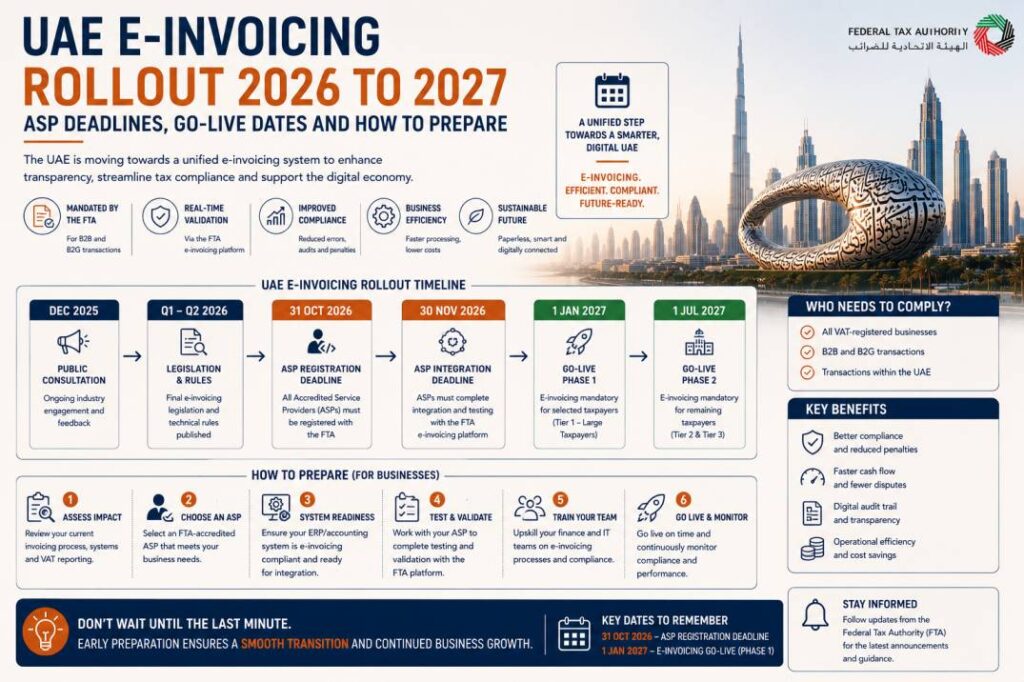
On 10 May 2026 the Ministry of Finance quietly moved a deadline. Large businesses now have until 30 October 2026, not 31 July, to appoint an Accredited Service Provider for UAE e-invoicing. Read that as relief and you have misread it. The go-live date has not moved. What moved is how much runway you have to get the integration right, and most of the coverage of this extension does not explain what to actually do with the extra time. Here is the full timeline, what changed and why, and how a new company should build this in from day one rather than retrofit it later.
Quick Navigation
Quick Answer
- UAE e-invoicing becomes mandatory in phases under a Peppol-based five-corner model. A voluntary pilot opened 1 July 2026.
- Businesses with annual revenue of AED 50 million or more must appoint an Accredited Service Provider by 30 October 2026, extended from 31 July 2026 under Ministerial Decision No. 66 of 2026.
- The mandatory go-live date for that group is unchanged at 1 January 2027.
- Smaller VAT-registered businesses follow later in 2027. The exact date is not yet confirmed in the same way Phase 1 is, and sources currently disagree on the details.
- Invoices must be issued in structured PINT AE (UBL 2.1 XML) format through an ASP. PDF, scanned and Excel invoices are not accepted for in-scope transactions.
The Confirmed UAE E-Invoicing Timeline
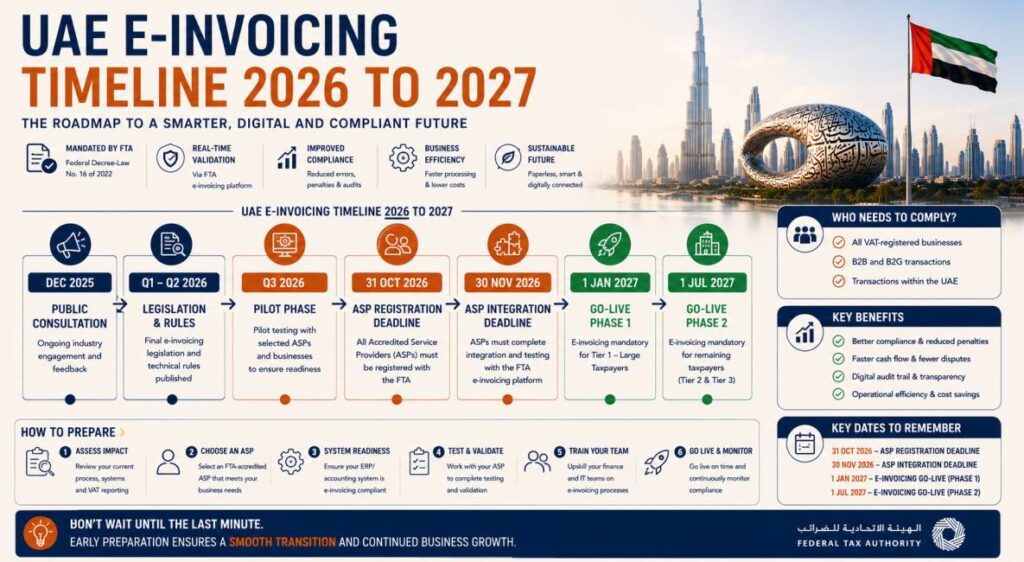
Four dates matter. Two are confirmed and unchanged. One moved. One is genuinely still unsettled, and I will say so plainly rather than pretend otherwise.
| Date | Milestone | Applies to |
|---|---|---|
| 1 July 2026 | Voluntary pilot phase opens | Selected taxpayers, opt-in |
| 30 October 2026 (moved from 31 July 2026) | ASP appointment deadline | Businesses with AED 50 million+ annual revenue |
| 1 January 2027 | Mandatory go-live, Phase 1 | Same AED 50 million+ group |
| 2027, date not yet finalised | Phase 2 rollout | VAT-registered businesses below the AED 50 million threshold |
The legal basis is Ministerial Decision No. 243 of 2025 and Ministerial Decision No. 244 of 2025, both issued 28 September 2025, amended by Ministerial Decision No. 66 of 2026 to extend the ASP appointment date. The Ministry of Finance published Version 1.1 of the Electronic Invoicing Guidelines on 1 June 2026.
This UAE e-invoicing rollout runs on a decentralised continuous transaction control and exchange (DCTCE) model, built on the international Peppol five-corner framework. In plain terms: your ASP talks to your customer’s ASP, and both report the transaction data to the FTA. No party manually sends a PDF anywhere in a compliant transaction.
Why the UAE E-Invoicing Deadline Moved, and What That Tells You
Most coverage of this extension reports the new date and stops. The reason behind it is worth reading properly.
The Ministry stated the extension followed a comprehensive assessment of market readiness and direct feedback from the business sector, specifically requests for broader technical options and more competitive pricing. At the point the extension was announced, roughly 32 service providers had been accredited, with more in the final stages of approval.
Read plainly, that means two things. The ASP market was still thin in May 2026, with limited price competition. And the Ministry judged that businesses needed more choice before being forced to commit to a provider.
The practical takeaway is the opposite of what deadline extended usually implies. This is not permission to relax. It is the Ministry telling you the vendor market was not mature enough in July, and giving it, and you, until October to get there. If you appoint an ASP today from a shortlist of three, you may be choosing from a materially smaller field than someone appointing in September. The extension is worth using to shop properly, not to delay starting.
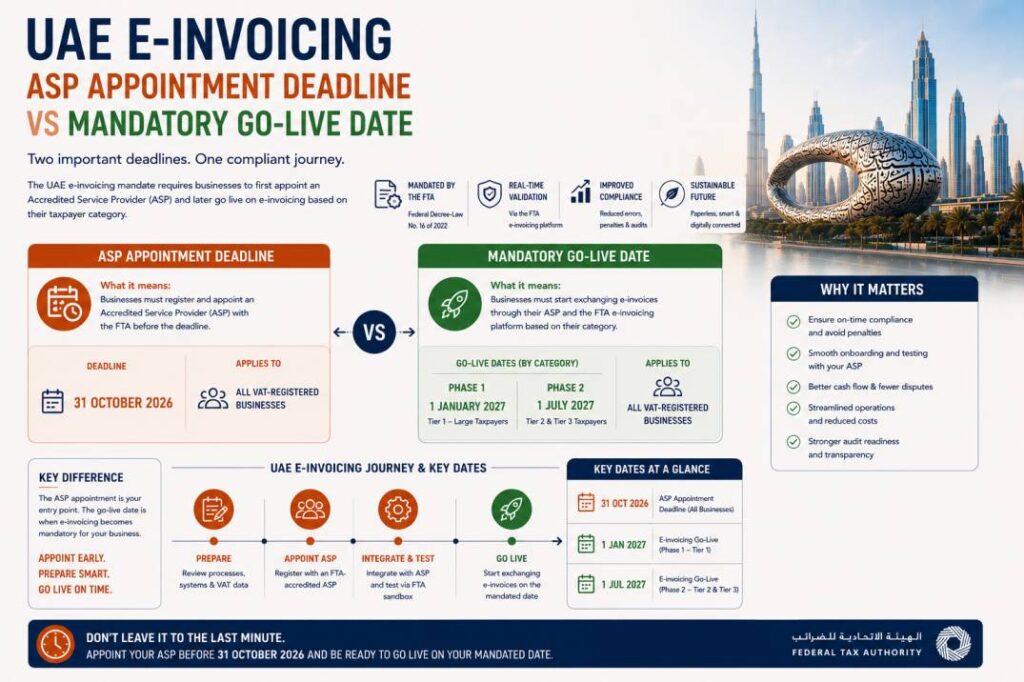
Appointment Is Not Go-Live, and the Gap Matters
This is the distinction several competing articles blur, and it changes how you should plan.
30 October 2026 is when you must have formally appointed an ASP through EmaraTax. It is a contracting and onboarding deadline.
1 January 2027 is when your invoices must actually flow through that ASP in the correct structured format, validated and reported to the FTA.
Between those two dates sits roughly nine weeks of the work that actually determines whether your go-live succeeds: ERP integration, data mapping, testing invoice exchange end to end, training the finance team, and fixing whatever breaks in testing. Treating 30 October as the real deadline and 1 January as a formality is backwards. Appointment is the easy step. Integration is where projects slip.
If your revenue is anywhere near the AED 50 million threshold, the working assumption should be that your real deadline is early October, not late October, so the integration work has genuine runway before January.
What UAE E-Invoicing Phase 2 Actually Says, and Where Sources Disagree
I want to be direct about something most competing pages are not: the details for businesses under AED 50 million are not settled in the same way Phase 1 is, and current published sources conflict.
What is consistent across sources: smaller VAT-registered businesses will be brought into the mandate later in 2027, following the same ASP-based model.
What is inconsistent: some sources state a Phase 2 go-live of 1 July 2027. At least one names an ASP appointment deadline of 31 March 2027 for this group. Another frames the rollout as three phases rather than two, with a mid-2027 stage for mid-sized businesses ahead of a final July 2027 stage for everyone else.
I am not going to state a Phase 2 date here as though it were confirmed, because I cannot verify which of these is accurate against a primary Ministry source at the time of writing, and repeating an unverified date as fact is exactly the kind of error this article is trying to correct in the coverage. What I can tell you with confidence: if your revenue sits below AED 50 million, you are not exempt, you are simply later, and the FTA has not yet published the taxpayer group thresholds that will fix your exact date. Treat mid-2027 as the working planning horizon and confirm the specific date directly from Ministry of Finance and FTA publications as they are released, not from a secondary blog.
What Counts as a Valid UAE E-Invoice
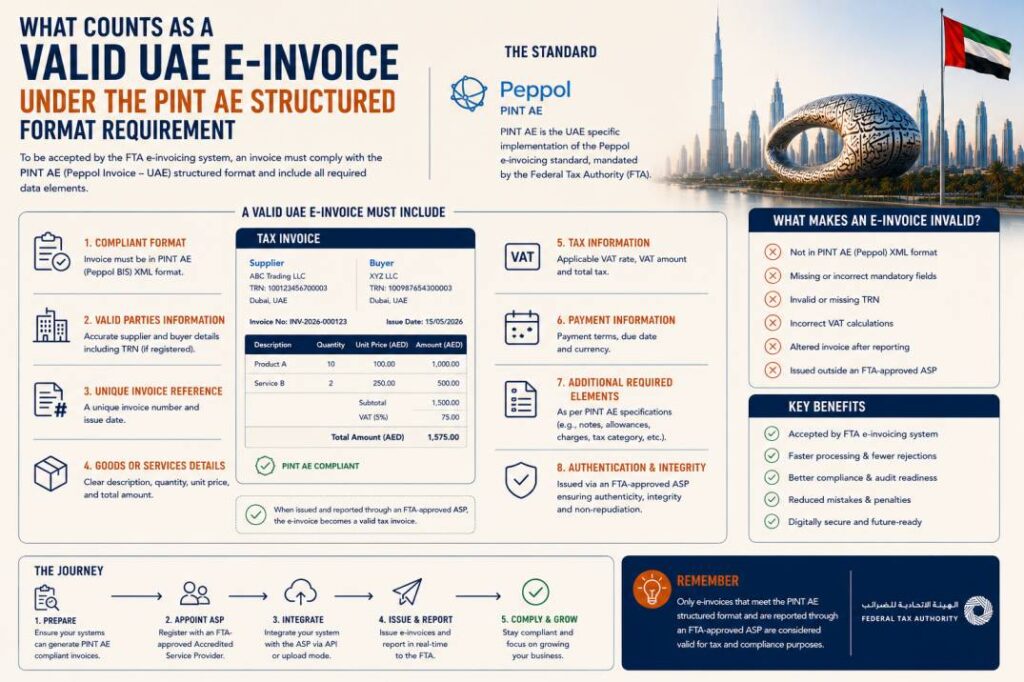
Under the UAE e-invoicing mandate, a valid invoice for an in-scope transaction has three characteristics.
Structured format. Issued in PINT AE, a UAE-specific implementation of UBL 2.1 XML. Not a PDF, not a scanned document, not a spreadsheet, regardless of how professionally formatted it looks.
Issued through an ASP. The Accredited Service Provider validates and transmits the invoice. You do not send structured XML directly to the FTA yourself.
Reported in near real time. The exchange model means tax authorities receive transaction data close to the point of issuance, not at the next VAT return.
Three document types sit inside the framework: the Electronic Tax Invoice for taxable supplies requiring a VAT invoice, the Electronic Tax Credit Note for corrections and cancellations, and the Commercial Invoice for exempt, out-of-scope or non-VAT transactions, which does not require a TRN. If you are not VAT-registered, a commercial invoice remains available to you, but Electronic Tax Invoices and Credit Notes must still carry a TRN where one applies.
What Happens If You Miss a UAE E-Invoicing Deadline
Non-compliance under the UAE e-invoicing framework can trigger Federal Tax Authority penalties, reported at up to AED 50,000 per violation. That figure needs unpacking rather than repeating as a headline number.
A violation is not a single missed year. It is typically assessed per non-compliant invoice or per compliance failure, which means the exposure scales with transaction volume, not with how many months you were late. A business issuing thousands of invoices a month that fails to transition on time is not looking at one AED 50,000 fine. It is looking at a fine multiplied by every non-compliant transaction until the failure is corrected.
This sits alongside, not instead of, existing VAT compliance obligations. E-invoicing failure and VAT filing failure are separate exposures that can both apply to the same period. For the wider compliance picture, including how enforcement has sharpened generally, see the new UAE anti-evasion tax laws.
If You Are Forming a Company Now, Build UAE E-Invoicing In From Day One
Every piece of e-invoicing coverage I read was written for an existing business retrofitting its systems. If you are incorporating in the UAE now, or planning to, the position is genuinely different and better.
You are not retrofitting anything. A business formed today can choose accounting and ERP software that is PINT AE compliant from the outset, rather than migrating a legacy system under deadline pressure. That decision costs nothing extra if made at setup and costs real money if made as an emergency project eighteen months from now.
The AED 50 million threshold is a growth question, not an immediate one, for most new companies. If you are starting below that revenue level, you have longer before mandatory compliance, which is precisely the window to build the right invoicing infrastructure without the pressure a Phase 1 business is under right now.
But do not treat later as never. The threshold is measured on your actual revenue, and if your business plan involves scaling past AED 50 million, e-invoicing readiness belongs in that plan alongside your corporate tax and audit obligations, not as a surprise the year you cross the line.
ERP selection is now a compliance decision, not just an operational one. Choosing accounting software at setup should account for e-invoicing and ASP integration capability from the start. That is covered in more depth on the ERP systems page.
My Approach: UAE E-Invoicing Compliance That Does Not Need Retrofitting
Most business setup consultants help you register a company. I help you make informed business decisions before you invest.
For UAE e-invoicing specifically, the founders I see struggle are not the ones who misjudge the deadline. They are the ones who choose their accounting system for the wrong reasons at formation, cheapest available, whatever a previous business used, whatever a friend recommended, and then discover two years later that it cannot talk to an Accredited Service Provider without a costly rebuild. The decision that actually matters happens at company formation, quietly, long before the compliance deadline creates any pressure to think about it.
My advisory process focuses on helping you reduce uncertainty and make confident decisions, not just complete documentation. In practice:
- Revenue trajectory modelling against the AED 50 million threshold, so you know which phase applies to you and when.
- Accounting and ERP selection at formation that accounts for e-invoicing and ASP integration from day one.
- Corporate tax registration and filing planning that sits alongside e-invoicing readiness rather than treating them as separate projects.
- VAT registration and compliance review, since e-invoicing obligations interact directly with your existing VAT position.
- Structure and jurisdiction guidance, since mainland vs free zone vs offshore selection affects how your invoicing infrastructure should be built.
- Business setup and licensing sequenced so compliance requirements are known before systems are chosen, not after.
- Banking setup coordinated with your invoicing and reporting infrastructure.
The objective is simple: help you start your business with clarity, confidence and a long-term strategy, which for a company forming today means UAE e-invoicing is a feature of your systems from the start rather than a retrofit under deadline pressure.
If you are setting up now and want your accounting stack chosen with this mandate already accounted for, get in touch.
Frequently Asked Questions
When does UAE e-invoicing become mandatory?
In phases. A voluntary pilot opened 1 July 2026. Businesses with AED 50 million or more in annual revenue must go live by 1 January 2027, having appointed an Accredited Service Provider by 30 October 2026. Smaller VAT-registered businesses follow later in 2027, with the exact date not yet finalised by the FTA.
Why was the UAE e-invoicing ASP appointment deadline extended?
The Ministry of Finance moved the deadline from 31 July 2026 to 30 October 2026 under Ministerial Decision No. 66 of 2026, citing a market readiness assessment and business feedback requesting broader technical options and more competitive ASP pricing. The mandatory go-live date of 1 January 2027 did not change.
Does the extended deadline mean I have more time before I need to comply?
Only for appointing your Accredited Service Provider, not for going live. The mandatory date your invoices must actually flow through that ASP remains 1 January 2027 for businesses above AED 50 million in revenue. Treat the extension as more time to choose the right provider, not less urgency overall.
What is an Accredited Service Provider?
A third-party entity licensed and approved by the Ministry of Finance and the FTA to validate and transmit structured e-invoices on a business’s behalf under the UAE’s Peppol-based five-corner exchange model. All in-scope businesses must appoint one before their applicable go-live date.
Can I still use PDF or scanned invoices after UAE e-invoicing applies to me?
No. For in-scope transactions, invoices must be issued in structured PINT AE (UBL 2.1 XML) format through an Accredited Service Provider. PDF, scanned and Excel invoices are not valid for VAT-relevant transactions once your phase becomes mandatory.
What happens if my business misses its UAE e-invoicing deadline?
The FTA can impose penalties reported at up to AED 50,000 per violation. Because violations are typically assessed per non-compliant invoice, exposure scales with transaction volume, and can apply alongside separate existing VAT compliance penalties.
Should a new company forming in the UAE now worry about e-invoicing?
Not urgently if projected revenue is well below AED 50 million, but it should still be planned for. The better move is choosing e-invoicing capable accounting and ERP software at formation, so the business never has to retrofit its systems later under deadline pressure.
Sources & References
- UAE Ministry of Finance – Electronic Invoicing System
- Gulf News – UAE to launch pilot phase of electronic invoicing system in July 2026
- Deloitte Middle East – UAE e-invoicing ASP appointment deadline extended
- Federal Tax Authority – EmaraTax
- e-invoicing.org – United Arab Emirates mandate status and deadlines
UAE e-invoicing is coming regardless of how the deadlines shift, and the businesses that treat this extra runway as preparation time rather than a reason to wait will be the ones ready when UAE e-invoicing becomes mandatory for their bracket.