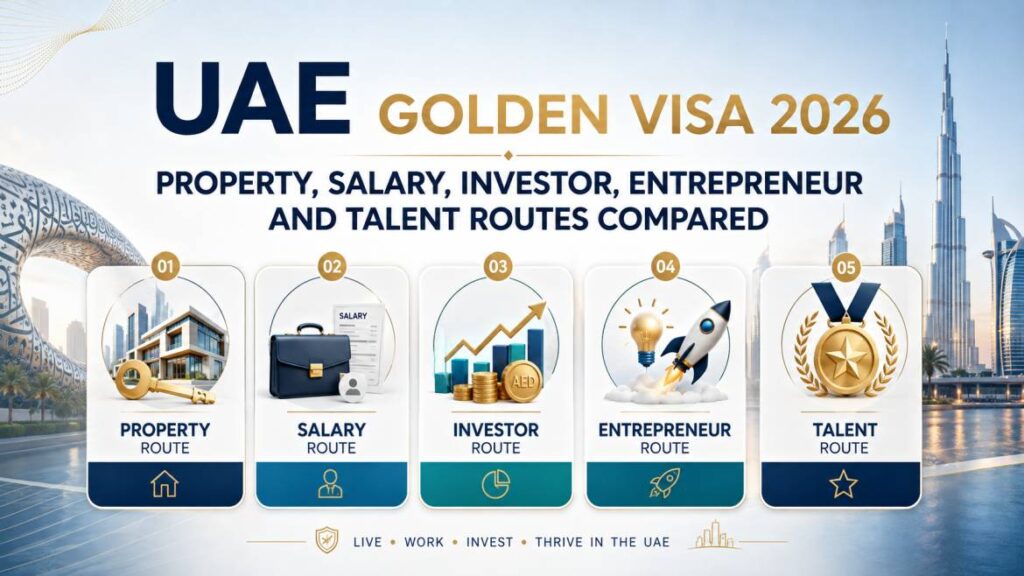
Every UAE Golden Visa 2026 guide covers the same five categories and quotes the same AED 2 million and AED 30,000 figures. Fewer of them tell you that the AED 30,000 salary rule has meant basic salary only, not total package, since May 2024, and a real share of 2026-dated content still gets that wrong. Fewer still have caught up with February 2026, when the requirement to have paid half a property’s value before applying was quietly removed, opening the route to off-plan and mortgaged buyers for the first time. This is the full picture: every route, what actually changed, where guides disagree, and what it really costs once the investment and the government fees are counted separately.
Quick Navigation
Quick Answer
- The UAE Golden Visa is a self-sponsored residency permit, issued for 5 or 10 years depending on category, administered federally by the ICP with Dubai applications routed through GDRFA.
- Property route: AED 2 million or more in UAE real estate. Since February 2026, the requirement to have paid 50% of the value upfront was removed; the total DLD-certified value is what counts, so mortgaged and off-plan properties now qualify.
- Salary route: AED 30,000 or more in basic monthly salary, excluding allowances. This has been the rule since May 2024, not the earlier gross-salary standard some guides still cite.
- Entrepreneur route: two separate paths — an established business with AED 1 million or more in annual revenue, or an incubator-endorsed early-stage project worth AED 500,000 or more.
- Investor and talent routes: public investment of AED 2 million or more, or federal tax payments of AED 250,000 or more annually, for investors; recognition-based nomination for scientists, specialists, creatives and other talent categories, with no fixed financial threshold.
- Total real-world cost is usually AED 3,000 to AED 10,000+ in government and processing fees, separate from any qualifying investment you retain ownership of.
What the UAE Golden Visa 2026 Actually Is
Introduced under Cabinet Resolution No. 56 of 2018, the UAE Golden Visa is a long-term, renewable residence permit issued for 5 or 10 years depending on category. It is self-sponsored, meaning the holder is not tied to an employer or a local sponsor and can live, work, study, or run a business in the UAE independently.
Applications are administered federally by the Federal Authority for Identity, Citizenship, Customs and Port Security (ICP). In Dubai, applications route through the General Directorate of Residency and Foreigners Affairs (GDRFA Dubai), and property-based applications specifically through the Dubai Land Department. Abu Dhabi applications run through TAMM and the Abu Dhabi Residents Office.
The programme covers several distinct categories, each with its own qualifying test: real estate investors, capital investors, entrepreneurs, skilled professionals, scientists and specialists, outstanding students and graduates, and a smaller set of humanitarian and frontline categories added more recently. It grants no voting rights and does not lead to citizenship, but it removes the sponsorship dependency that shapes most other UAE residency.
UAE Golden Visa 2026 Property Route, and What Changed in February
This is the most popular route into the UAE Golden Visa 2026 landscape, and the one that changed most recently.
The threshold itself has not moved. You need UAE real estate valued at AED 2 million or more, certified by a current Dubai Land Department valuation. That figure is unchanged.
What changed is how much of it you need to have paid. Until early 2026, a mortgaged or part-paid property required evidence that at least 50% of the value, or a minimum of AED 1 million, had already been paid, along with a bank no-objection certificate. That barrier excluded the majority of off-plan buyers and anyone financing through a mortgage in the early stages of a purchase plan.
Most sources date the removal of that requirement to February 2026, with one source citing a Dubai Land Department policy circular dated 20 February 2026 specifically. This is treated as the primary date because it carries the more specific sourcing. At least one other source dates a related change to April 2026, and the two may be conflated with the separate 2-year visa change covered in the next section. If you are relying on the exact date for a legal or financial decision, confirm it directly against a current Dubai Land Department or GDRFA circular rather than any single guide, including this one.
What the change means in practice: eligibility now rests on a single test, whether your property, or combined portfolio of properties, reaches a DLD-certified value of AED 2 million. Off-plan units with a valid Oqood certificate from a RERA-approved development qualify on their full purchase price, regardless of how much has actually been paid to date. Mortgaged completed properties qualify on certified value with a bank NOC, regardless of outstanding loan balance. Joint ownership is permitted, with each co-owner needing to hold a minimum share of AED 400,000.

Don’t Confuse This With the 2-Year Property Investor Visa
A short section, because the mistake it corrects is common and expensive to make.
There is a separate, shorter, cheaper product: the 2-year Property Investor Visa. It is not the Golden Visa, and a genuinely distinct rule change affected it, at a different point in 2026.
Sources indicate that in April 2026, Dubai removed the previous AED 750,000 minimum property value for a sole owner applying for this 2-year visa, and set a minimum share of AED 400,000 for joint owners. Multiple sources explicitly caution against treating this as a change to the 10-year Golden Visa’s AED 2 million threshold, which is a different rule under a different product and was not affected by the April change.
If your property is worth less than AED 2 million, you may still have a residency option through the 2-year investor visa. If it is worth AED 2 million or more, the 10-year Golden Visa is the stronger route and should generally be the target. Conflating the two products, or their respective 2026 rule changes, is the single most common confusion in the coverage reviewed for this article.
UAE Golden Visa 2026 Salary Route: Basic Salary, Not Gross
This is the correction that matters most for anyone applying through employment, and it is not new, which is exactly why it keeps catching people out.
Skilled professionals qualify with a minimum monthly salary of AED 30,000. That figure itself is unchanged and has been the headline number for years, which is why it survives in every guide. What changed, under Article 17 of Cabinet Resolution 65-2022, is what counts toward it.
Before May 2024, the standard was gross salary, meaning total compensation including housing and transport allowances. As of May 2024, the requirement shifted to basic salary specifically, excluding all allowances. A professional whose total package reached AED 30,000 through a mix of base pay and housing allowance no longer automatically qualifies if the basic component alone falls short.
This is a genuine tightening, not a technicality. Several currently-ranking guides, some carrying 2025 or 2026 dates, still describe the old gross-salary standard, or quote inconsistent figures entirely. If you are assessing your own eligibility, the number that matters is the base salary line on your employment contract, not your total monthly compensation.
Beyond the salary figure itself, the skilled professional route also requires a bachelor’s degree or equivalent, classified at the first or second level by the UAE Ministry of Education, an employer-issued salary certificate, and in most current guidance, an occupation classified at MOHRE skill level 1 or 2. Two years of continuous employment with the current employer is generally expected as evidence of stability, though this varies by processing channel.
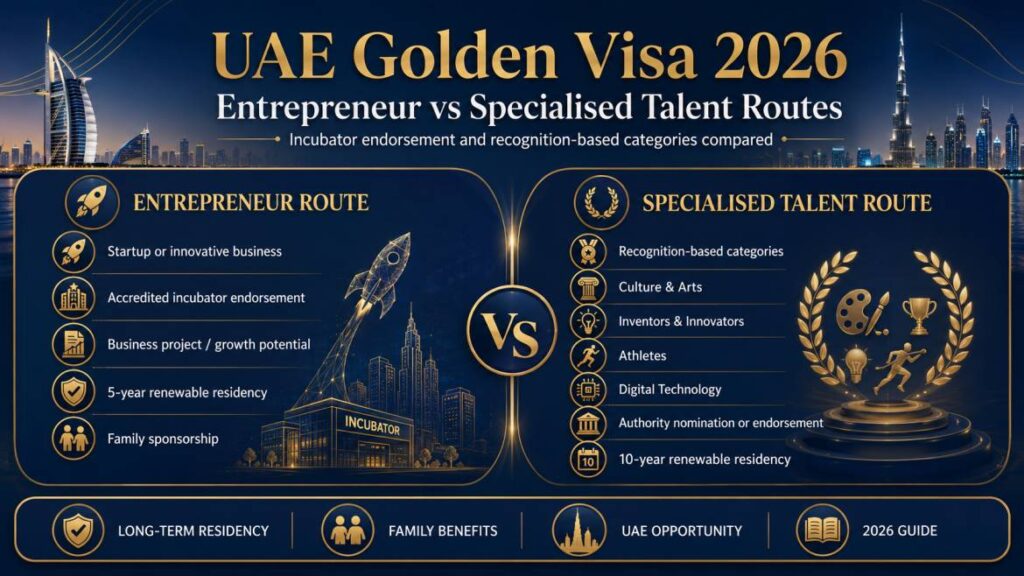
The UAE Golden Visa 2026 Entrepreneur Route Is Really Two Routes
Guides routinely present the entrepreneur category as a single test. It is not. It is two separate qualifying paths, with different evidence requirements, and confusing them wastes an application cycle.
Route one: an established business. Founders of an existing company with annual revenue exceeding AED 1 million qualify directly, generally supported by a business plan, audited or verifiable revenue records, and proof of ongoing operational activity.
Route two: an early-stage, incubator-endorsed project. A technical or future-oriented project valued at AED 500,000 or more, with formal approval from a UAE-accredited business incubator, qualifies through a different chain: a submitted business plan with market analysis and multi-year financial projections, a pitch or interview process specific to the incubator, and an endorsement letter that is typically valid for a limited window, commonly around six months, within which the Golden Visa application must be filed.
The UAE Cabinet maintains an approved list of accredited incubators and accelerators, with Hub71 in Abu Dhabi and in5 in Dubai among the most active for Golden Visa endorsements specifically. Approval rates through this route vary meaningfully by incubator, which is worth knowing before you commit weeks to a single application.
The practical distinction: if your business already has revenue, route one is faster and more direct. If you are pre-revenue with a strong project, route two exists specifically for you, but it depends on securing an incubator endorsement first, which is itself a competitive process with its own timeline.
UAE Golden Visa 2026 Investor and Talent Categories
Two further UAE Golden Visa 2026 categories worth setting out clearly, because each has a route beyond the obvious one.
Investors most commonly qualify through the same AED 2 million threshold as the property route, but placed in an approved UAE public investment fund or company rather than real estate. A less commonly discussed alternative: businesses or individuals paying AED 250,000 or more annually in federal tax to the UAE government can also qualify as investors, evidenced by a letter from the Federal Tax Authority. This route is rarely mentioned in general guides and is most relevant to an already-established, tax-paying UAE business, of the kind covered in corporate tax registration and filing.
Specialised talent categories operate on an entirely different logic: recognition rather than a financial threshold. Doctors and scientists qualify with approval from the Ministry of Health or the UAE Scientists Council. Creative and cultural professionals need endorsement from the relevant emirate’s Department of Culture and evidence of recognised achievement. Engineers and specialists in fields such as AI, data science, genetics and biotechnology qualify on demonstrated expertise. Executives generally need a minimum basic salary of AED 30,000, a bachelor’s degree, and a Level 1 or 2 job classification, aligning this sub-category closely with the skilled professional route above. Athletes qualify on a proven record of international achievement.
According to Dubai residency data reported via Gulf News in 2026, specialised talent applications, taken together across sub-categories, outnumber every other single category, with real estate investors a clear second. For an applicant who can secure a credible endorsement, this route can move faster than assembling a full AED 2 million paper trail, though it depends entirely on having the underlying recognition to support it.
What a UAE Golden Visa 2026 Actually Costs
This is the section where guides disagree most, and understanding why the numbers differ is more useful than picking one figure and repeating it.
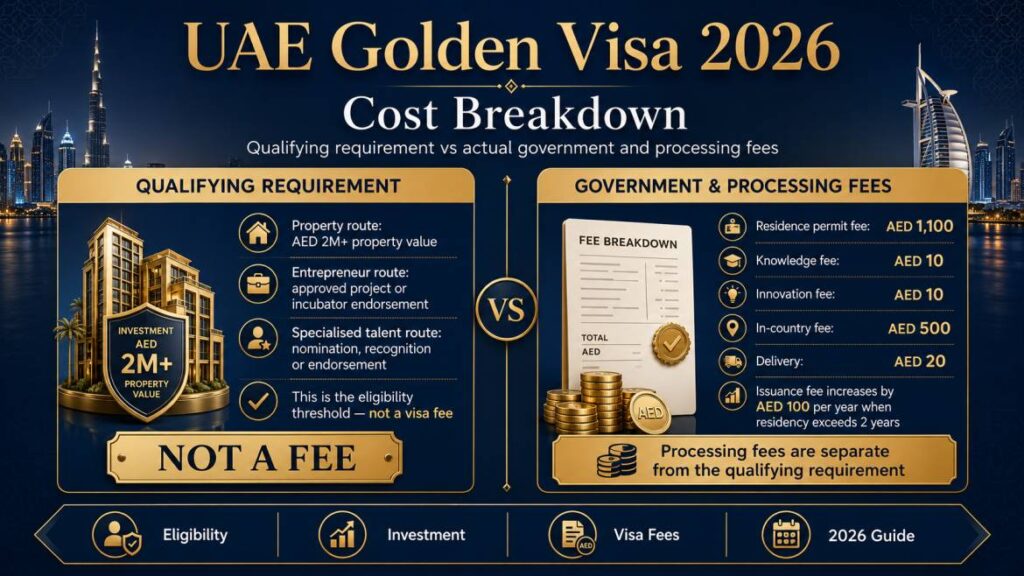
The confusion has one root cause: guides mix two entirely different kinds of number. Your qualifying investment, typically AED 2 million in property or an approved fund, is capital you continue to own. Your government fees are what you actually spend to obtain the permit. Merging the two into a single headline “Golden Visa cost” inflates the real out-of-pocket figure by roughly a hundred times, and it is the single biggest source of inconsistency across the guides reviewed for this article.
Separated properly, the government-fee side looks like this. GDRFA Dubai’s published issuance package for an investor’s Golden Visa runs at a stated total in the region of AED 2,790, though a detailed line-item breakdown of that package’s own components does not fully reconcile to the stated total in at least one close reading, so treat any single headline government figure as indicative rather than exact. The ICP’s federal application fee runs separately, in the low hundreds of dirhams. Add the Emirates ID (AED 600 for a 5-year visa, AED 1,100 for 10-year), a mandatory medical fitness test (roughly AED 500 to 700), and document attestation for any foreign-issued paperwork (commonly AED 2,000 to 5,000 per document set, varying significantly by country of origin), and a realistic solo-applicant, all-in government and processing figure lands somewhere in the range of AED 3,000 to AED 10,000, before any advisory or PRO service fee.
The property route carries one additional real cost worth stating plainly: the standard 4% Dubai Land Department transfer fee on the property purchase itself, which is a transaction cost of the property, not of the visa, but is routinely the largest single line item anyone budgeting for this route actually pays.
If you are comparing quotes from different consultants or reading different guides and the total figures do not match, ask specifically whether the number includes the AED 2 million investment or not. That single question resolves most of the apparent disagreement.
How to Apply for a UAE Golden Visa in 2026, and Realistic Timelines
The mechanical steps for a UAE Golden Visa 2026 application are broadly consistent across categories, though the supporting documents differ by route.
Applications are submitted through the ICP Smart Services portal for federal processing, or through GDRFA Dubai and its associated app for Dubai-based applicants. As of 2026, Dubai has moved to unify property-based residency applications, including the Golden Visa property route, retiree residency and the 2-year property visa, onto a single digital portal shared between GDRFA and the Dubai Land Department, which several sources credit with meaningfully compressing processing times for straightforward files.
After submission, applicants typically receive an entry permit, complete a medical fitness test, provide biometric data for an Emirates ID, and receive final visa stamping. Realistic end-to-end processing commonly runs from roughly one to six weeks for a clean, complete file, with the property route sometimes quoted at the faster end following the 2026 portal unification, and routes requiring third-party endorsement, such as the incubator-backed entrepreneur path, taking longer due to the endorsement step itself.
The most common cause of delay is not the government processing time. It is incomplete or inconsistent documentation, particularly around foreign document attestation and mismatches between the investment or salary evidence submitted and what the application form states.
My Approach: The Golden Visa Question Comes After the Business Question
Most business setup consultants help you register a company. I help you make informed business decisions before you invest.
For most of the people who ask me about the UAE Golden Visa 2026 routes, the visa is not actually the first decision. It is downstream of one that has not been made yet: whether to buy property, form a company, or restructure an existing business, and which of those choices also happens to open a Golden Visa route as a consequence rather than as the primary goal. The broader UAE residency and visa landscape is covered separately for routes outside the Golden Visa categories. Treating the visa as the starting point, rather than the outcome of a sound business or investment decision, is how founders end up choosing a structure that qualifies for residency but does not actually serve the business.
My advisory process focuses on helping you reduce uncertainty and make confident decisions, not just complete documentation. In practice:
- Route assessment across property, entrepreneur, investor and talent categories, matched to your actual situation rather than the most commonly advertised route.
- For the entrepreneur category specifically, an honest read on whether the established-business route or the incubator-endorsed project route genuinely fits, before time is spent on the wrong one.
- Sequencing the underlying business or investment decision correctly, since company formation, structure selection and Golden Visa eligibility are connected, not separate projects.
- Full cost modelling that separates the qualifying investment you retain from the government and processing fees you actually spend.
- Document and attestation planning, since this is where most applications lose time, not in government processing itself.
- Coordination with banking and corporate tax and compliance planning where the investor or entrepreneur route intersects with an active UAE business.
The objective is simple: help you enter the UAE market, and secure the residency that follows from it, with clarity, confidence and a long-term strategy rather than a visa chosen in isolation from the business decision behind it.
If you want your specific route assessed properly before you commit capital or file an application, get in touch.
Frequently Asked Questions
What is the minimum property value for a UAE Golden Visa in 2026?
AED 2 million or more, certified by a current Dubai Land Department valuation. Since February 2026, the requirement to have paid 50% of that value upfront was removed, so mortgaged and off-plan properties can qualify on their full certified or purchase value regardless of how much has actually been paid to date.
Is the AED 30,000 Golden Visa salary requirement gross or basic salary?
Basic salary, excluding all allowances such as housing and transport. This has been the standard since May 2024 under Article 17 of Cabinet Resolution 65-2022, replacing the earlier gross-salary standard. Several guides still incorrectly describe the older rule.
What is the difference between the Golden Visa property route and the 2-year Property Investor Visa?
They are different products. The Golden Visa property route requires AED 2 million or more and grants 10-year residency. The 2-year Property Investor Visa is a separate, shorter product with its own lower threshold, which changed independently in April 2026. The two are frequently confused in published guidance.
How does the entrepreneur category work for the UAE Golden Visa?
There are two separate routes. An established business with annual revenue of AED 1 million or more qualifies directly. A pre-revenue or early-stage project valued at AED 500,000 or more can qualify instead through endorsement from a UAE-accredited business incubator, which involves a separate application and pitch process with its own timeline.
How much does a UAE Golden Visa actually cost?
Government and processing fees typically total AED 3,000 to AED 10,000 or more per applicant, covering visa issuance, Emirates ID, medical testing and document attestation. This is separate from any qualifying investment, such as the AED 2 million property or fund investment, which you continue to own rather than spend. Conflating the two is the most common source of cost confusion across published guides.
Can I qualify for the Golden Visa without investing AED 2 million?
Yes. The skilled professional route qualifies on a AED 30,000 basic monthly salary with no investment requirement. The entrepreneur route can qualify at a AED 500,000 project value through incubator endorsement. Specialised talent categories qualify through professional recognition rather than any financial threshold.
Does the UAE Golden Visa lead to citizenship?
No. It grants long-term, renewable residency and removes the requirement for employer or local sponsorship, but it does not carry voting rights and does not lead to UAE citizenship.
Sources & References
- Federal Authority for Identity, Citizenship, Customs and Port Security (ICP) – Golden Residency
- The Official Platform of the UAE Government – Golden Visa
- GDRFA Dubai
- Dubai Land Department
- Fragomen – UAE Golden Visa Changes: Key Insights for Highly-Skilled Professionals
The UAE Golden Visa 2026 rules reward applicants who understand the current detail, not the version that circulated a year ago. Getting your UAE Golden Visa 2026 application structured around the actual salary and asset rules saves real time.