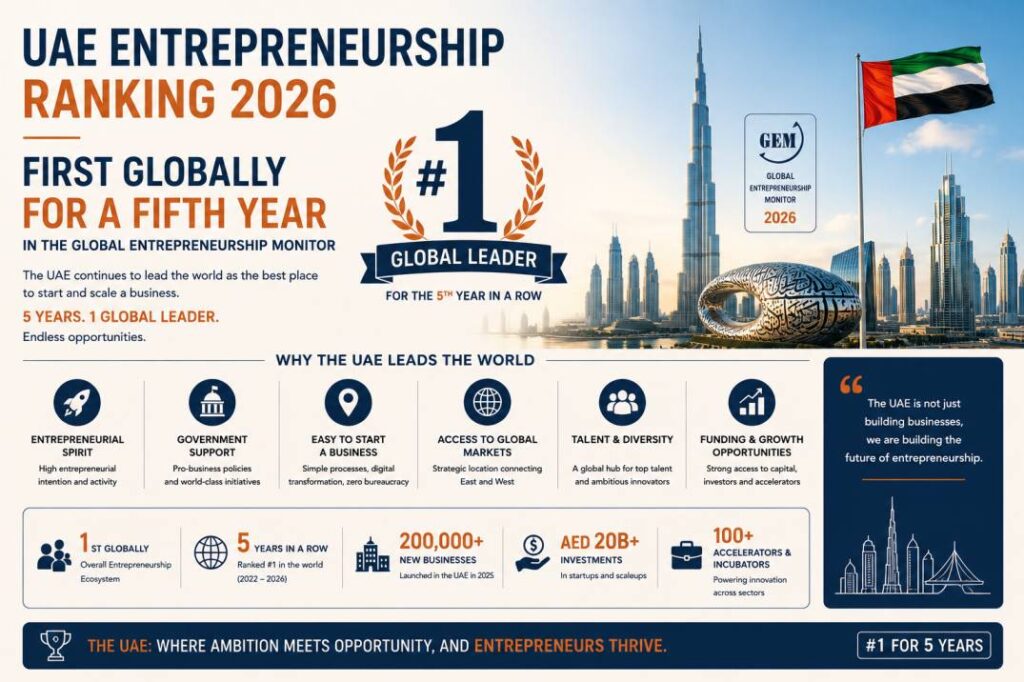
The UAE entrepreneurship ranking held at number one for a fifth consecutive year in the Global Entrepreneurship Monitor 2025/2026 report. That is a real achievement and the coverage has been enthusiastic. It has also been almost entirely uncritical, which is a shame, because the same report contains a falling score, a warning about business survival, and one competitive fact that matters more to a founder choosing a Gulf base than the headline does. Here is the whole picture, and why I still think this is a good moment to set up.
Quick Navigation
Quick Answer
- The UAE ranked first in GEM’s National Entrepreneurship Context Index for the fifth consecutive year, scoring 7.0 out of 10 in the 2025/2026 report covering 53 economies.
- NECI measures expert opinion on framework conditions, not business survival rates, profitability or returns. It tells you the environment is good, not that your business will work.
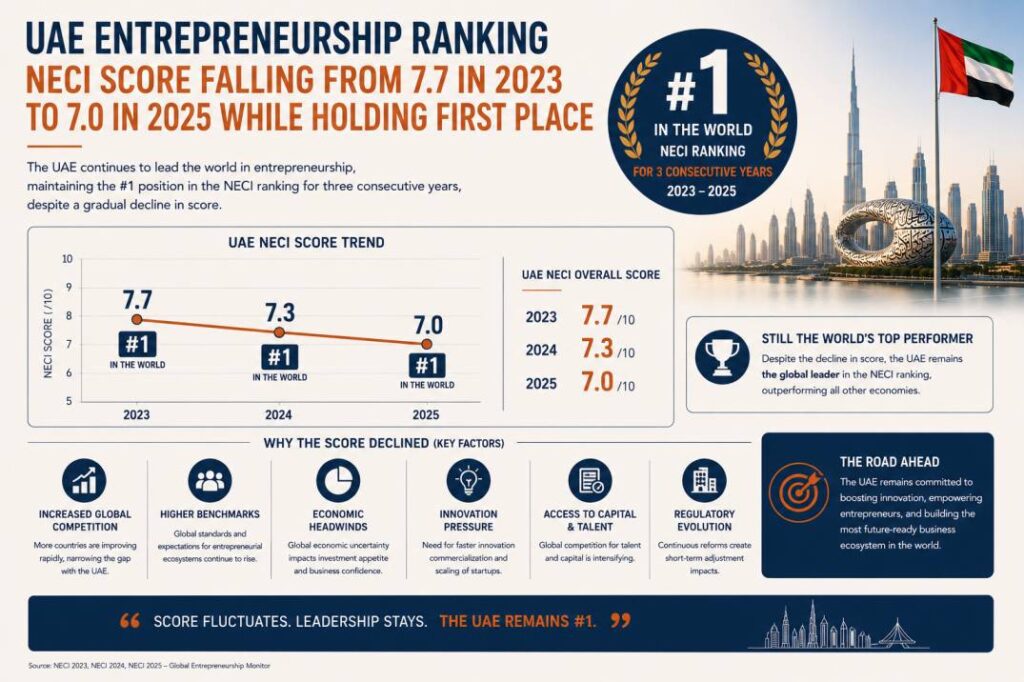
- The UAE’s NECI score has fallen three years running: 7.7 in 2023, 7.1 in 2024, 7.0 in 2025. It held first place because other economies declined further.
- In the IMD World Competitiveness Ranking 2026 the UAE placed first globally for economic performance and fifth overall, with a top-10 position in 118 indicators.
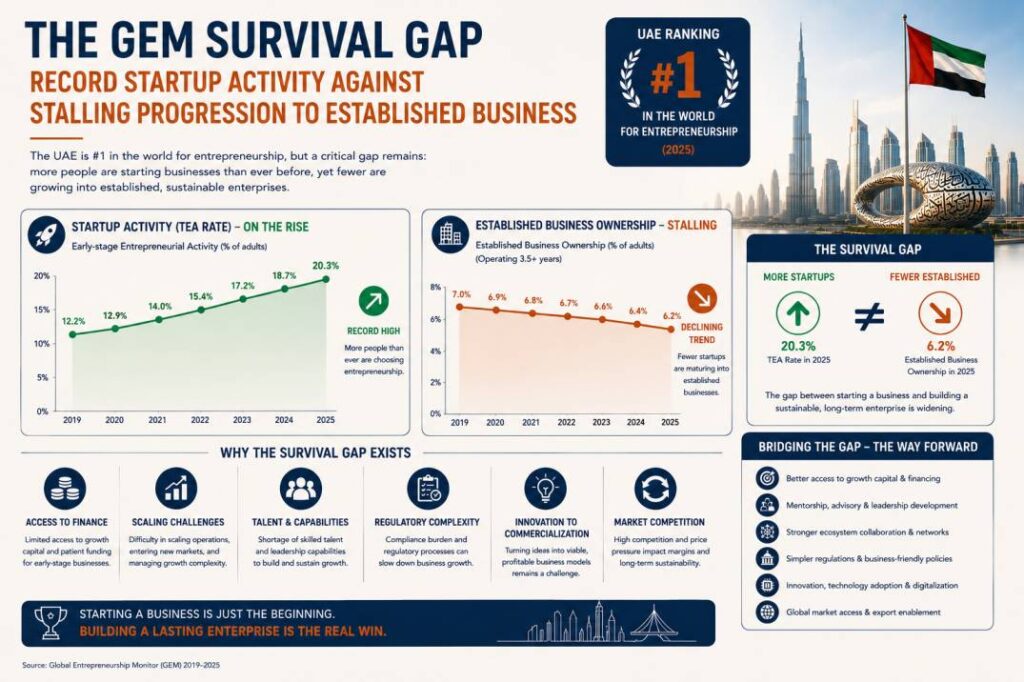
- GEM’s own headline for the same report warns of a widening Survival Gap, where too few startups progress to established business status.
What the UAE Entrepreneurship Ranking Actually Won
Let me set out the achievement properly before examining it, because it is substantial and this article is not a debunking.
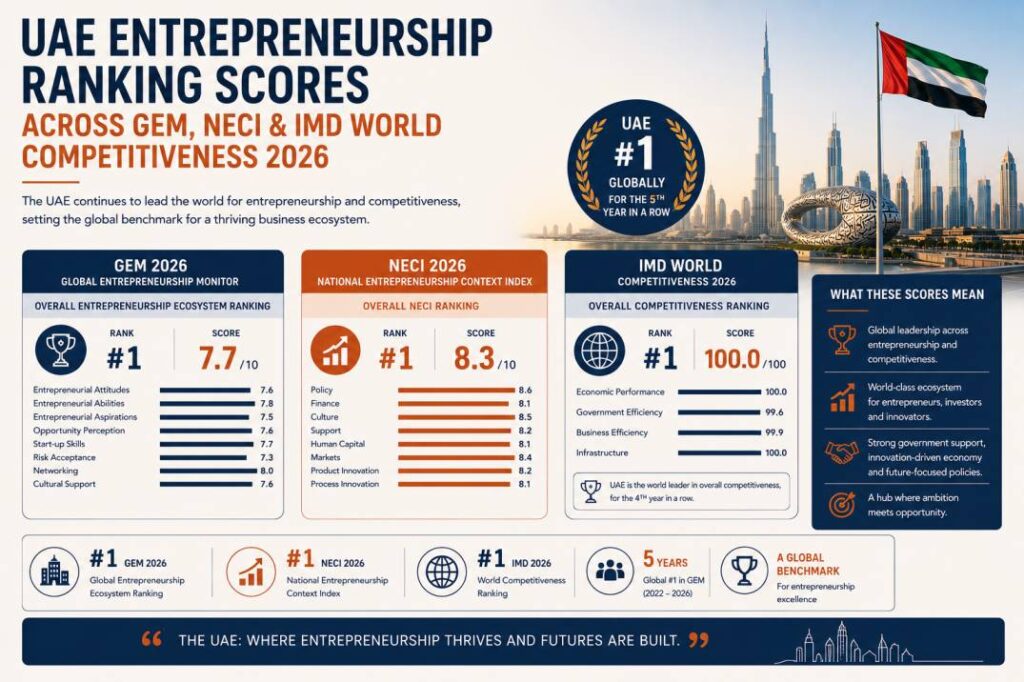
Global Entrepreneurship Monitor 2025/2026. The UAE ranked first in the National Entrepreneurship Context Index for the fifth consecutive year, with a score of 7.0. The report covered 53 economies representing roughly 43% of the world’s population and 57% of global GDP. The UAE ranked first among high-income economies in eight major indicators, including physical infrastructure, government policy support and relevance, tax and bureaucracy policy, government entrepreneurship programmes, research and development transfer, ease of market entry, regulatory burden, and entrepreneurial education. It placed second globally for entrepreneurial finance and access to funding.
IMD World Competitiveness Ranking 2026. The UAE ranked first globally for economic performance and fifth overall, holding its regional lead for a tenth consecutive year. Fourth worldwide for government efficiency, corporate investment in artificial intelligence, and the legal and regulatory framework. Top 10 in 118 competitiveness indicators and top five in 67.
And two others worth knowing. First globally for the second year running in the Henley Private Wealth Migration Report 2026, with a Wealth Mobility Competitiveness Index score of 85.3 out of 100. First globally in the 2026 Edelman Trust Barometer for public trust in government.
That is not a marketing exercise. Those are independent bodies with published methodologies, and the consistency across four unrelated indices is genuinely hard to fake.
Now the parts the press releases leave out.
What the UAE Entrepreneurship Ranking Actually Measures
This is the part that changes how you should read the headline.
NECI is built from GEM’s National Expert Survey. A panel of entrepreneurship experts in each economy rates 13 framework conditions: finance, government policy, taxes and bureaucracy, government programmes, education, research transfer, commercial infrastructure, market dynamics, market entry burdens, physical infrastructure, and social and cultural norms.
The Ministry of Economy and Tourism’s own announcement says it directly. The index is evaluated based on a points system derived from the opinions of entrepreneurship experts.
So the UAE entrepreneurship ranking is a measure of how good informed observers think the conditions are. It is not a measure of:
- How many businesses survive their first three years
- What return investors actually make
- How profitable the median new business is
- How many startups reach meaningful scale
Those are different questions, and NECI does not answer any of them.
This is not a criticism of GEM. The index does exactly what it says, and expert assessment of framework conditions is genuinely useful. The problem is the translation into marketing, where the best environment in the world to start a business quietly becomes your business will do well here. Those are not the same claim, and only one of them is supported.
A good environment lowers the barrier to entry. Lower barriers mean more entrants, which means more competition for the same customers. Read honestly, a top NECI score tells you it will be easy to start and harder to stand out.
The Number Nobody Reports Behind the UAE Entrepreneurship Ranking
Here is the fact I could not find in a single piece of coverage of the UAE entrepreneurship ranking.
The UAE’s NECI score has declined for three consecutive years, and the longer arc is more interesting still:
| Year | NECI score |
|---|---|
| 2019 | 5.8 (ranked 5th) |
| 2021 | 6.8 |
| 2022 | 7.2 |
| 2023 | 7.7 (highest ever recorded) |
| 2024 | 7.1 |
| 2025 | 7.0 |
The full arc of the UAE entrepreneurship ranking matters more than the last three years alone. The UAE climbed from fifth place on 5.8 in 2019 to the highest score in the index’s history at 7.7 in 2023, then gave back most of a point over two years. It stayed at number one throughout, and it did that because the field declined too, not because conditions improved.
The 2024 drop is worth a second look. GEM’s commentary notes that the fall came from score reductions in 12 of the 13 framework conditions. Only physical infrastructure improved, rising from 7.6 to 7.8.
GEM says plainly what caused the most recent dip. Its United Arab Emirates economy profile attributes the marginal 2025 decline to lower scores for entrepreneurship education and for social and cultural norms, while noting that overall performance remains exceptional. That is a specific, addressable diagnosis rather than a general softening, and it is more useful than the headline it sits beneath.
The decline is also not across the board. In the same 2025 data, entrepreneurs’ awareness of the need to develop and implement AI solutions scored 8.3, up from 7.7 in 2024, ranking first globally. Physical infrastructure scored 8.0. Government policy on support and relevance and ease of entry on market dynamics both scored 7.6. All thirteen framework conditions remain rated sufficient or better, unchanged from 2024. What fell was education and social norms; what rose was AI readiness.
Context matters here and I want to be fair. Even after three years of decline, the UAE’s lowest framework score is still rated good, and most conditions remain classified very good. This is a strong ecosystem getting slightly less strong, not a collapse. Small movements in expert survey scores also carry real noise, and one year is not a trend.
But three years is a direction. And number one for the fifth year is a materially different statement from number one for the fifth year, with the score down seven tenths of a point since 2023. Only one of those is in the press release.
If you are making a ten-year decision, the direction of travel behind the UAE entrepreneurship ranking deserves the same attention as the rank.
The Warning Inside the Same Report
The UAE entrepreneurship ranking sits inside a report whose own headline is not a celebration. It reads, in substance: record startup activity, but growing survival and AI readiness gaps.
The two divides GEM identifies:
The Survival Gap. Total early-stage entrepreneurial activity has reached record highs, but progression to established business status, meaning firms operating beyond three and a half years, is stalling across many economies. Lots of businesses are starting. Too few are lasting.
The AI Readiness Gap. GEM describes a two-tier entrepreneurial economy emerging, split by technological capability and access. The UAE is named among the economies with the highest AI expectations among entrepreneurs.
Two more findings from the same report are worth having. In 36 of 53 economies, both the provision of and access to entrepreneurial finance are rated insufficient. And entrepreneurship education at school is the lowest-rated framework condition in 33 of 53 economies, which is the same condition GEM identifies as one of the two that pulled the UAE’s own score down.
One domestic datapoint from GEM’s UAE profile is worth sitting with. Just over one in four adults in the UAE reported that their household income fell in 2025, slightly up on 2024. At the same time, more than one in two adults intend to start a business. Strong intent and softening household finances in the same population is worth knowing if your customer is the UAE consumer rather than an overseas client.
None of this contradicts the UAE entrepreneurship ranking. It is context for it. The report says the environment for starting is the best it has been in many places, and the environment for lasting is getting harder. That is a different message from the one being marketed, and it happens to be the more useful one if you are about to commit capital.
Saudi Arabia Cleared the Same Bar
The single most commercially relevant line in the report, for anyone choosing a Gulf base, appears in none of the coverage of the UAE entrepreneurship ranking.
Only four economies met or exceeded sufficiency across all 13 framework conditions: India, Lithuania, Saudi Arabia, and the UAE. The UAE entrepreneurship ranking is first among them, but it is no longer alone in clearing every bar.
The UAE entrepreneurship ranking still puts it first. Saudi Arabia is in the same small group that cleared every condition. That does not make them equivalent, and the UAE’s advantages in banking access, established free zone infrastructure, expatriate depth and English-language commercial practice remain real and substantial.
But if your business is targeting Gulf customers, the honest position is that you now have two credible ecosystem options rather than one obvious one, and the right answer depends on where your customers and your talent actually are. Anyone telling you the choice is self-evident has not read the same report they are quoting.
What the Rankings Genuinely Do Tell You
Having spent three sections on the caveats, here is the case for taking them seriously, because it is strong.
Consistency across unrelated indices. GEM measures expert assessment of entrepreneurial conditions. IMD measures competitiveness across economic performance, government efficiency, business efficiency and infrastructure. Henley tracks where wealthy individuals actually move. Edelman measures public trust. Four different methodologies, four different sponsors, four top placements. Any single ranking can be gamed or coincidental. Four converging is a signal.
Economic performance is an outcome, not an opinion. The IMD first place for economic performance is built on measured data, not survey responses. That is a harder number than NECI and it points the same way.
Wealth migration is revealed preference. Henley’s ranking reflects where people with capital and options are actually going. That is not sentiment. It is behaviour, and behaviour is better evidence than opinion.
Government efficiency and regulatory framework at fourth globally is the ranking that most directly affects your daily experience of operating here. Company formation timelines, licence renewals, visa processing. That is where the theory meets your calendar.
The picture that emerges is of an economy that is genuinely well run, genuinely open to new entrants, and genuinely attractive to capital. What it is not is a guarantee about your specific business, and no index can be.
So Is Now a Good Time to Set Up?
Yes, and I would say so even after everything above. But for reasons that are more specific than the headline.
The regulatory environment has stabilised. Corporate tax arrived in 2023, the qualifying income rules have been clarified, Small Business Relief has been extended to 2029, and the commercial companies law now permits full foreign ownership for most activities. Two years ago the honest answer to what will my tax position be involved more hedging than it does now. Predictability is worth more to a founder than any ranking.
Access to capital is measurably strong. Second globally for entrepreneurial finance and access to funding, in a report that finds finance insufficient in 36 of 53 economies. That is the most decision-relevant single number in the whole exercise.
The costs of entry are still low relative to the market access. That will not last indefinitely. Ecosystems that attract this much attention tend to get more expensive.
And the counterweight, stated plainly. The Survival Gap is the part to take personally. Easy entry means crowded markets. A business that would have been distinctive here in 2019 may now have six competitors. The ranking measures how easy it is to start. Nothing in it measures how hard it is to be chosen.
If your plan depends on the UAE being easy, that is well supported. If it depends on the UAE being empty, it is not.
My Approach: Rankings Do Not Survive Contact With a Business Plan
Most business setup consultants help you register a company. I help you make informed business decisions before you invest.
The UAE entrepreneurship ranking is a genuinely useful input and a genuinely poor decision. It tells you the conditions are good. It cannot tell you whether your specific product has a market here, who is already selling something similar, what your breakeven looks like at UAE cost levels, or whether you will still be trading in year four when the Survival Gap becomes your problem rather than a statistic.
That gap between a good environment and a good business is the entire reason my first conversation with a client is never about licences. It is about the business: what you are building, who is buying, what the competition already looks like on the ground here, and what a realistic first-year revenue scenario is. The ranking makes the case for the country. It makes no case at all for the company.
My advisory process focuses on helping you reduce uncertainty and make confident decisions, not just complete documentation. In practice:
- Idea validation against the UAE market specifically, including who is already serving your customers here.
- Market research grounded in current demand rather than national indices.
- Competitor analysis, because a top-ranked environment means more competitors, not fewer.
- Realistic first-year revenue scenarios and breakeven, at UAE cost levels.
- Startup cost estimation covering licence, visas, office and renewal together.
- Financial feasibility modelling before a structure is chosen.
- Structure and jurisdiction selection matched to the business, not to whichever authority processes fastest.
- Business setup and licensing once the model holds up.
- Corporate tax registration and filing planning, including whether Small Business Relief applies.
- Banking strategy, which remains the step most new entrants underestimate.
- Visa and residency planning for you and your team.
Sometimes that conversation ends with me saying the idea does not work here yet. That is a better outcome than a licence you regret, and it is why I would rather show you the falling score than the trophy.
The objective is simple: help you start your business with clarity, confidence and a long-term strategy.
Is This the Right Moment for Your Business?
It is, if you have a validated product, a route to a first customer, and enough capital to reach year four rather than year one. The environment is measurably excellent, capital access is genuinely strong, and the regulatory picture is more settled than at any point since corporate tax arrived.
It is not, if the plan rests on the ranking itself. The UAE is number one for entrepreneurship is a reason to look here. It is not a business model, and the Survival Gap in GEM’s own report is what happens to people who treat it as one.
For which sectors are actually performing rather than which country is ranked highest, see top performing businesses in Dubai 2026. For the underlying economic data, UAE GDP and the finance sector, and for the demand side, Dubai’s population growth. The structural options are compared in mainland vs free zone vs offshore.
If you want your specific idea tested against the market rather than against a ranking, get in touch.
Frequently Asked Questions
Why is the UAE ranked first for entrepreneurship?
The UAE ranked first in GEM’s National Entrepreneurship Context Index for the fifth consecutive year in the 2025/2026 report, scoring 7.0 out of 10 across 53 economies. It ranked first among high-income economies in eight major indicators and second globally for entrepreneurial finance and access to funding.
What does the UAE entrepreneurship ranking actually measure?
NECI measures expert opinion on 13 entrepreneurial framework conditions, gathered through GEM’s National Expert Survey. It assesses the quality of the environment for starting a business. It does not measure business survival rates, profitability or investor returns.
Has the UAE entrepreneurship ranking score been improving?
No. The NECI score has declined for three consecutive years, from 7.7 in 2023 to 7.1 in 2024 and 7.0 in 2025. The UAE retained first place because other economies also declined. GEM attributes the 2025 dip to lower scores for entrepreneurship education and social and cultural norms.
Where does the UAE rank in the IMD World Competitiveness Ranking 2026?
First globally for economic performance and fifth overall, holding its regional lead for a tenth consecutive year. It ranked fourth worldwide for government efficiency, corporate investment in artificial intelligence, and the legal and regulatory framework, with top-10 placings in 118 indicators.
What is the Survival Gap in the GEM report?
GEM’s 2025/2026 report identifies a widening gap between record early-stage startup activity and the number of businesses that progress to established status beyond three and a half years. Many businesses are starting; fewer are lasting. It is one of two structural warnings in the same report that gave the UAE first place.
Is Saudi Arabia a credible alternative to the UAE?
On this measure it is closer than the coverage suggests. Only four economies met or exceeded sufficiency across all 13 framework conditions: India, Lithuania, Saudi Arabia and the UAE. The UAE still ranks first overall and retains advantages in banking access, free zone infrastructure and expatriate depth, but the choice now depends on where your customers and talent are.
Does a high ranking mean my business will succeed in the UAE?
No. The ranking measures how favourable conditions are for starting a business, which is a statement about the country rather than about any individual company. A strong environment lowers barriers to entry, which also means more competitors. Validation of your specific product and market matters more than the national score.
Sources & References
- Global Entrepreneurship Monitor – 2025/2026 Global Report
- Global Entrepreneurship Monitor – United Arab Emirates economy profile
- UAE Ministry of Economy and Tourism – UAE ranks first globally in GEM 2025/2026
- IMD World Competitiveness Center
- GEM 2024/2025 Global Report
The UAE entrepreneurship ranking headline is genuinely earned, and the founders who benefit most from it are the ones who read past the ranking itself into what is actually driving it. That is where the real UAE entrepreneurship ranking story sits.