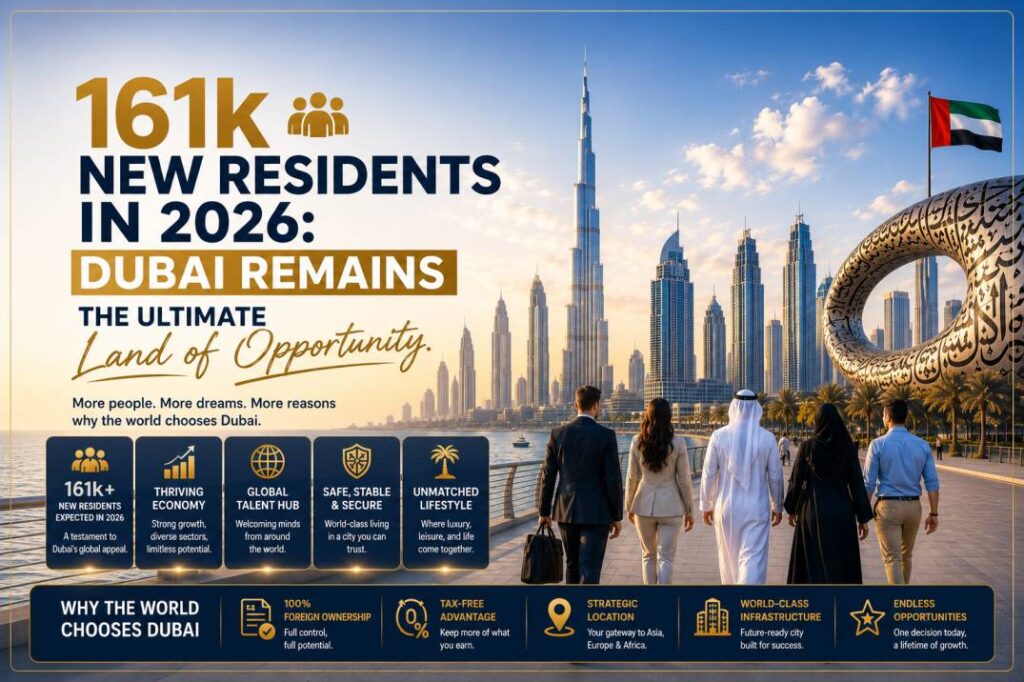
Dubai population 2026 reached 4.74 million – 161,000 new residents in a single year – and for founders and investors, that number is the most underrated market signal in the region.
In this guide
On 30 July 2026, Dubai’s live population clock read 4,741,335. That is 161,335 more people than lived in the emirate on 1 January – added in seven months, during a period when a good deal of commentary suggested residents were leaving. The number is worth understanding properly, because population is the most reliable demand signal any business planner has.
Quick Answer
- Dubai’s population reached 4,741,335 on 30 July 2026 – up 161,335 from the 4.58 million recorded at the end of 2025.
- That is roughly 767 new residents every day, and it annualises to around 276,000 for the full year – ahead of 2024’s 208,000.
- The figures run counter to claims circulated during the regional conflict that residents were leaving in large numbers. They were not.
- Dubai’s daytime population reaches 6.392 million as around 1.81 million commuters, tourists and visitors enter the emirate – roughly 40% above the resident figure.
- The commercial point: population growth is the demand signal underneath almost every business case in Dubai – housing, schooling, healthcare, retail, F&B, services. It is also the signal most likely to be misread, because arrivals and spending power are not the same thing.
1. What the number actually measures
Every figure quoted for Dubai population 2026 traces back to one official source. The data comes from the Dubai Population Clock, part of the “Dubai Population Now” real-time census and growth monitoring initiative approved by Sheikh Hamdan bin Mohammed bin Rashid Al Maktoum. It is official statistics, updated continuously, rather than an estimate from a property portal. That population growth is the demand side of the AED 419.94 billion recorded across Dubai real estate in H1 2026.
The definition matters. These figures represent Dubai’s usual resident population – people who have lived in the emirate for at least six months, or who intend to remain for that long.
That definition excludes tourists and short-stay visitors. It captures people who rent or buy, enrol children in school, register with clinics, open bank accounts and buy furniture. In other words, it captures exactly the population a business planner should care about.
It also means the number lags reality slightly. Someone who arrived in June 2026 intending a two-year stay counts now; someone who arrived intending three months does not, even if they later stay.
2. Putting 161,335 in proportion
Context matters when reading any Dubai population 2026 headline. Seven months of growth is not a full year, and this is where commentary tends to go wrong in both directions.
| Measure | Figure |
|---|---|
| Population, 30 July 2026 | 4,741,335 |
| Population, end 2025 | ~4,580,000 |
| Added in 2026 to date | 161,335 |
| Implied daily average | ~767 people |
| Annualised run rate | ~276,000 |
| Added during 2024 | 208,000 (+5.5%) |
| Daytime population | 6,392,000 |
| Largest age group (2025) | 30–34, at 15.45% |
| Highest growth rate on record | 8.2% (1980 census) |
Three observations.
The pace is accelerating, not slowing. A run rate of roughly 276,000 would exceed 2024’s 208,000 by a wide margin. Dubai crossed four million residents for the first time during 2025; it is now approaching 4.75 million.
The conflict narrative was wrong. Reporting during the regional escalation earlier this year suggested an exodus. The official data shows the opposite. That is worth knowing, because business decisions were being deferred on the strength of that narrative.
The daytime figure is the underused statistic. An additional 1.81 million people enter Dubai on an average day – commuters from the northern emirates, tourists, business visitors. For anyone planning retail, F&B, transport-adjacent services or anything location-dependent, the addressable population is 6.39 million, not 4.74 million. Most business plans I see use the resident number and understate their own market.
3. Why people keep arriving
The mechanisms behind Dubai population 2026 growth are deliberate policy choices, not chance. Migration-led growth of this scale is unusual, and it is not accidental. Several mechanisms compound.
Residency was decoupled from employment. The Golden Visa, remote work permits, retirement visas and the property investor route mean residency no longer depends solely on holding a local job offer. Someone can arrive as an investor, a founder, a remote employee or a retiree.
The tax position is genuinely distinctive. No personal income tax, no capital gains tax for individuals, no annual property tax. For a high earner relocating from Europe, India or the UK, the arithmetic is not marginal.
Wealth migration is running at record levels. The UAE has led global net millionaire inflows, and those arrivals bring businesses, staff, service demand and dependants rather than arriving alone.
The working-age concentration is striking. The 30–34 bracket alone accounts for 15.45% of residents. This is a population in its household-formation and peak-earning years – the demographic that starts companies, buys property, has children and consumes services.
And safety and continuity underpin all of it. People do not relocate families to places they consider unstable, and they do not commit ten-year capital to jurisdictions they expect to be disrupted. The fact that growth continued through a period of regional tension is itself the evidence.
4. What this means commercially
Population growth is the demand curve underneath almost every consumer-facing business case in Dubai. Roughly 767 additional residents per day need housing, schooling, healthcare, groceries, connectivity, banking, transport, entertainment and professional services.
Where that translates into opportunity:
Education and childcare. A population concentrated in its early thirties produces children. School places, nurseries, tutoring and children’s activities follow demographic arithmetic more predictably than almost any other sector.
Healthcare and wellness. Clinics, diagnostics, physiotherapy, dentistry, mental health services. Insurance-backed and demographically driven.
Relocation services. Everything a new arrival needs in their first ninety days – housing search, schooling placement, licensing, banking introductions, furniture, connectivity, driving licences.
Food, retail and hospitality. Sized against 6.39 million daytime population, not 4.74 million residents.
Professional and financial services. Accounting, legal, insurance, wealth management, HR. Every new business formed by an arriving founder needs several of these.
Housing and property services. Property management, maintenance, fit-out, short-term rental operations, moving and storage.
If you are working out which of these your capability actually fits, that is a market-entry question before it is a licensing question – the territory covered in Growth & Market Expansion Services and, for earlier-stage ideas, Startup / Pre-Launch Consulting.
5. Reading the number honestly
Reading Dubai population 2026 honestly means separating the headline from the caveats. I would be doing you a disservice if I presented population growth as an automatic business case. Four qualifications matter.
Arrivals are not uniform in spending power. The 161,335 includes senior professionals, founders and investors – and also construction, hospitality and logistics workers whose consumption patterns are entirely different. A premium concept sized against the headline number will overstate its market considerably. Segment before you size.
Population growth does not automatically lift property prices. Supply matters as much as demand. Dubai faces a substantial residential handover pipeline through 2026, and rents in several apartment segments have already softened even as population climbed. I have set out that picture in detail in the 2026 UAE real estate analysis. Population is one input, not the whole model.
Competition arrives with the customers. The same growth that creates your market attracts other operators to serve it. Fast-growing cities are not easy markets – they are contested ones. Differentiation matters more here, not less.
Costs move with the population. Commercial rent, salaries, school fees and staff accommodation all rise in a growing city. A feasibility model built on 2024 cost assumptions is already wrong.
None of this argues against the opportunity. It argues for sizing it properly.
6. Structuring an entry
Acting on Dubai population 2026 growth still means choosing the right structure. If the growth story is what draws you, the structure question follows immediately – and it is decided by who your customers are.
Selling to Dubai residents and businesses? A mainland licence is generally the stronger position. Consumer-facing businesses serving a growing resident population almost always belong here.
Selling internationally from a Dubai base? A free zone company is typically more efficient – though note that free zone status delivers 0% corporate tax on qualifying income only, with 9% applying above AED 375,000 otherwise. See Tax Registration & Filing and Financial Reporting & Auditing.
Extending an existing overseas business? Look at foreign company setup via branch or subsidiary.
Holding assets rather than trading? An offshore structure may be the right instrument. I have compared all three routes in Mainland vs Free Zone vs Offshore.
Around the licence sit the practical steps most people underestimate: residency visas and PRO services for you and your team, and corporate banking, where sequencing the account opening against licensing saves weeks.
7. My Approach: Turning Growth Into a Plan
Most business setup consultants help you register a company. I help you make informed business decisions before you invest.
Population growth is a demand signal, not a business plan. Before recommending a structure for a business betting on Dubai’s continued population growth, retail, F&B, services or real estate, I look at whether the specific segment you are targeting is actually where that growth is concentrated, and whether your capital can survive the ramp-up period before demand catches up.
My advisory process focuses on helping you reduce uncertainty and make confident decisions, not just complete documentation.
What You Can Expect
- Business idea validation
- Market research
- Competitor analysis
- Business plan development
- Startup cost estimation
- Financial feasibility analysis
- Business structure recommendations
- Licence selection guidance
- Investor and employment visa planning
- Business bank account strategy
- Risk assessment
- Business expansion planning
The objective is simple: help you start your business with clarity, confidence and a long-term strategy.
8. Is the UAE the right choice for your business?
If you are planning to launch a new venture, expand internationally, or relocate your business to the UAE, do not base the decision solely on promotional offers or the lowest licence price – and do not build a market size estimate on a headline population figure without segmenting who those people actually are.
Build your business on research, planning and informed decision-making. The right strategy today can save you thousands in cost and position your business for sustainable growth tomorrow.
161,335 people chose Dubai in seven months. They did it during a period of regional tension, against a widely repeated narrative that people were leaving. They came for work, for safety, for tax treatment, for opportunity, and increasingly because family and colleagues were already there.
That is about as clear a demand signal as any market gives you. The businesses that benefit will be the ones that worked out precisely which of those 161,335 they serve.
Ready to build your business with confidence?
If you are considering setting up a business in the UAE, let’s start with strategy – not paperwork. Together we will evaluate your goals, analyse the market, identify the right setup options, and create a roadmap tailored to your vision.
Because successful businesses aren’t built by chance – they’re built on informed decisions.
Book a free consultation or message me directly on WhatsApp.
Frequently asked questions
What is Dubai’s population in 2026?
Dubai’s population reached 4,741,335 on 30 July 2026 according to the Dubai Population Clock, an increase of 161,335 since the start of the year. The daytime population reaches approximately 6.392 million as commuters, tourists and visitors enter the emirate.
How many people move to Dubai each day?
Based on 161,335 new residents across the first seven months of 2026, the average is approximately 767 people per day, which annualises to roughly 276,000 for the year.
Did people leave Dubai during the regional conflict?
Official population data shows the opposite. Dubai added more than 161,000 residents in the first seven months of 2026, running counter to claims circulated during the regional conflict that residents were leaving in large numbers.
What counts as a Dubai resident in these figures?
The figures represent the usual resident population – people who have lived in the emirate for at least six months, or who intend to remain for the same period. Tourists and short-stay visitors are excluded.
Does population growth mean property prices will rise?
Not automatically. Supply matters as much as demand, and Dubai faces a substantial residential handover pipeline through 2026, with rents in several apartment segments softening even as population grew. Population is one input into a property model, not the whole model.
What does this growth mean for service businesses specifically?
Population growth of this scale feeds through to service demand unevenly. Consumer-facing sectors tied to daily life, healthcare, education, food and beverage, and personal services, tend to see demand rise roughly in line with resident numbers. B2B service sectors respond more to business formation rates than to population directly, which is why the more reliable signal for a B2B services business is new company registration data alongside the population figures, not the population number in isolation.
Timing also matters. New residents typically take several months to establish spending patterns in a new city, from finding permanent housing to settling schools and routines, so a service business built around this growth should expect demand to build progressively over the following two to three quarters rather than immediately.
Cross-checking a population-driven business plan against business formation data, rather than population figures alone, is usually the more reliable way to confirm the opportunity is real before committing capital to it.
Checking business formation data alongside the population figures, rather than relying on the population number alone, remains the more reliable way to size a genuine opportunity here.
Watching this figure through the next two or three quarterly updates, rather than treating one release as the whole picture, keeps the planning honest and grounded in what is actually happening on the ground rather than in a single headline.
That discipline costs nothing and protects against building a plan on a figure that later gets revised down.
Confirm the trend before building the business case around it.
That single check takes minutes and prevents months of misplaced effort.
Sources
- Khaleej Times – Dubai population passes 4.74 million, July 2026
- Gulf News – Dubai crosses four million residents
This article is general commentary, not legal, tax or investment advice. Population data updates continuously via the Dubai Population Clock – verify the current figure before relying on it in a business plan.
Related reading: the top-performing businesses in Dubai 2026 and their startup costs.
What Dubai population 2026 growth means for your market
Dubai population 2026 growth of 161,000 new residents is not evenly distributed across income levels or nationalities – and for founders, the composition matters as much as the number. Dubai population 2026 data consistently shows that the majority of new arrivals are economically active adults, skewing toward the 25-44 bracket and toward high-income professional roles. A growing Dubai population in 2026 means growing demand for professional services, housing, education, healthcare, food and beverage, logistics and tech – and the lead time between arrival and first consumption is measured in weeks, not years.