The UAE defence industry is one of the most sophisticated in the world – but that is not the story this guide is here to tell. This guide is about the economic footprint it creates, and what that means for founders and investors. The UAE defence industry is where that opportunity concentrates first.
In this guide
The UAE operates one of the most sophisticated integrated air defence networks in the world. That is the story most coverage tells. The more useful story, for anyone building a business here, is what has grown up underneath it: a USD 35.6 billion defence budget, a domestic industrial champion with USD 4.7 billion in revenue, and a procurement policy explicitly designed to pull foreign companies into the country.
Quick Answer
- The UAE’s 2026 defence budget is approximately USD 35.6 billion – around 5.5% of GDP, making it the world’s 15th largest defence spender.
- Its air defence network layers systems from the United States, South Korea, Russia, Israel and domestic manufacturers under a single command architecture – though the Israeli-origin tier rests on press reporting rather than official confirmation. The UAE was the first international customer for THAAD, and in January 2022 became the first operator anywhere to use it in combat.
- EDGE Group, formed in 2019, reached roughly USD 4.7 billion in revenue with 25+ subsidiaries and over 12,000 staff – the only Arab company in SIPRI’s global top 25 defence firms.
- The network is highly effective but not impenetrable. EDGE’s chief executive states its systems eliminated more than 85% of Iranian drones launched at the UAE. That is a strong figure. It is not 100%, and the gap is precisely what is driving procurement.
- The commercial point: UAE policy has shifted from buying finished products to demanding local investment, joint production and technology transfer. For foreign companies, that is an invitation with conditions attached.
1. The six layers, and what each one is for
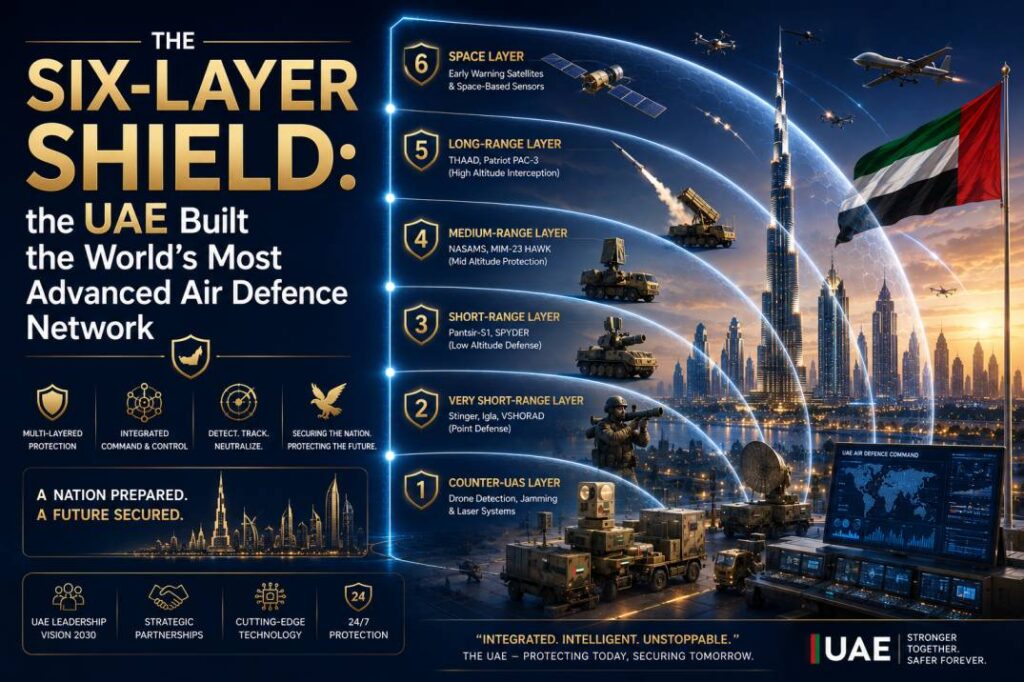
Understanding this architecture is the starting point for anyone studying the UAE defence industry. Modern air defence is not one system. It is a set of overlapping engagement envelopes, each covering the altitude and threat class the layer above cannot economically address, tied together by a shared command and control picture.
Six tiers are commonly described in public reporting on the UAE’s network:
| Layer | System | Origin | Role as publicly described |
|---|---|---|---|
| 1 – Exo-atmospheric | THAAD | USA | High-altitude ballistic missile interception |
| 2 – Upper tier | Patriot PAC-3 | USA | Ballistic, cruise missile and aircraft defence |
| 3 – Mid tier | Cheongung-II (M-SAM) | South Korea | Medium-range ballistic and cruise missile defence |
| 4 – Medium-short | SPYDER and Barak* | Israel | Short and medium-range interception, including drones and cruise missiles |
| 5 – Point defence | Pantsir-S1 | Russia | Low-altitude threats and short-range targets |
| 6 – Counter-drone | SkyKnight / FS-LIDS | UAE / USA | Drones and loitering munitions |
* A note on layer 4. The Israeli-origin element is the least officially documented tier in the network. Reuters reported in September 2022 that Israel had approved a UAE request for Rafael’s SPYDER mobile air-defence system, and Breaking Defense reported in October 2022 that an IAI-made Barak system had been deployed to the country. Both reports rest on unnamed sources, and neither government has issued a public confirmation. The Washington Institute lists both events in its timeline of post-Abraham Accords defence cooperation. Treat this layer as well-reported rather than officially acknowledged.
Two things about that table are more interesting than the hardware.
The sourcing is deliberately diversified. American, South Korean, Russian, Israeli and Emirati systems in one architecture is unusual and politically difficult. It reflects a strategic choice not to depend on any single supplier relationship.
Integration is the actual achievement. Making systems from five countries share a common air picture, deconflict engagements and avoid assigning multiple interceptors to one target is a command-and-control problem, not a missile problem. That integration work – software, data fusion, communications – is where a meaningful share of the spending goes, and it is a far more accessible market for commercial firms than missile manufacturing.
2. The honest record
An honest record of the UAE defence industry matters more than a triumphal one. Coverage of this topic tends toward the triumphal. The record is genuinely impressive and worth stating accurately, because the gaps are what drive the market.
January 2022. A UAE THAAD battery intercepted a medium-range ballistic missile aimed at an oil facility near Al Dhafra Air Base – the first operational use of the system anywhere. It was a landmark. On the same day, however, a separate strike on an ADNOC fuel depot in Musaffah killed three people. The network intercepted the ballistic threat; it did not stop everything.
2026. Following regional escalation earlier this year, the UAE faced very large numbers of drones and missiles. EDGE Group’s chief executive stated publicly that more than 85% of Iranian drones launched at the UAE were eliminated by EDGE systems.
Read that figure carefully. It is a strong performance against saturation attack, and it is a genuine commercial validation of domestically produced equipment. It also means a meaningful minority were not eliminated – and that residual is why counter-drone procurement is accelerating rather than slowing.
There is a related data point worth holding onto: the number of drones detected during the conflict was roughly four times the number of ballistic missiles. The threat has shifted decisively toward cheap, numerous, low-flying systems. Defence economics follow that shift.
3. Why this is an economic story
The UAE defence industry is as much an economic story as a strategic one.
Here is where it becomes relevant to your business rather than merely interesting.
The UAE has not treated defence procurement as an expense. It has treated it as industrial policy.
The budget. Approximately USD 35.6 billion in 2026, at around 5.5% of GDP – an unusually high proportion, and 15th globally in absolute terms.
The champion. EDGE Group was created in 2019 by consolidating more than 25 Emirati defence and advanced technology entities. It now reports roughly USD 4.7 billion in revenue, over 12,000 staff across 25-plus subsidiaries in five clusters, and is the only Arab company on SIPRI’s global top 25 list. Its customer book spans Saudi Arabia, Egypt, Indonesia, India, several African states and parts of Eastern Europe. Tawazun Council policy is to push EDGE exports past 50% of revenue.
The procurement authority. Tawazun Council manages acquisitions for the UAE Armed Forces and Abu Dhabi Police, and runs the country’s offset programme. Its guidelines extend beyond defence into aerospace, transport infrastructure, communications technology, artificial intelligence, education technology, sustainability and food and water security.
The physical infrastructure. Tawazun Industrial Park hosts around 45 global, regional and local companies, and a new defence free zone in Abu Dhabi was announced in May 2026 to expand the industrial base further.
All of this sits inside Operation 300bn, the UAE’s industrial strategy to position the country as a global industrial hub by 2031.
The shift that matters most: analysis of the market describes a transition away from importing finished products toward a full-cycle model of local investment, joint production and technology transfer. The UAE increasingly does not want to buy your product. It wants you to build it here.
4. Where the commercial opportunity actually sits
The commercial layer of the UAE defence industry is wider than headline contracts suggest. Most readers of this article will not be selling interceptor missiles. The addressable opportunity is wider and considerably more accessible.
Counter-drone and detection. The highest-demand category, given that drone detections ran at roughly four times ballistic missile counts. Radar-based detection, vehicle-mounted integrated drone defence, acoustic and RF sensing, and the software layer tying them together.
Cyber, AI and command systems. Zero-trust security architecture, AI-based integrated command and control, and electronic warfare convergence have become priority areas. This is a software and systems market, and its barriers to entry are commercial rather than industrial.
Components and electronics. Electronic communication components and specialised software feed into every layer of the network. Supplying into EDGE subsidiaries as a tier-two or tier-three vendor is a realistic entry route for a mid-sized firm.
Maintenance, repair and sustainment. Long-tail, recurring revenue, and structurally less competitive than initial supply. EDGE has itself moved into sustainment – including a regional MRO partnership for Turkish Bayraktar TB2 drones, servicing a platform it does not manufacture.
Dual-use and adjacent civil markets. Airport and critical-infrastructure protection, port security, drone detection around events and industrial sites. Same technology, commercial buyers, no defence procurement cycle. For most SMEs this is the realistic starting point.
Talent, training and professional services. Engineering recruitment, technical training, certification, export-control compliance advisory, and specialised logistics.
If you are working out which of these your existing capability actually fits, that is a market-entry question before it is a licensing question – the territory covered in my Growth & Market Expansion Services and, for earlier-stage ventures, Startup / Pre-Launch Consulting.
5. How entry actually works
Entry into the UAE defence industry follows a distinct path from most sectors. This sector has a different entry path from most. Four things determine whether you get in.
Tawazun registration and the offset programme
Tawazun partner registration is the formal gateway to defence and security procurement. Separately, the offset programme obliges major foreign suppliers to generate qualifying economic activity in the UAE – which creates a genuine opening for smaller firms able to serve as an offset partner for a prime contractor. Understanding which primes have live offset obligations is often more useful than approaching the end customer directly.
Location: industrial park, free zone or mainland
Tawazun Industrial Park offers proximity and cluster effects. The new Abu Dhabi defence free zone will expand that. A conventional free zone company suits software, services and component supply. A mainland licence is generally the stronger position for direct government contracting, which matters here more than in most sectors because the principal buyer is the government.
Existing overseas manufacturers usually enter through a branch or subsidiary, and group structures often sit above an offshore holding entity. I have compared the three routes in detail in Mainland vs Free Zone vs Offshore.
Joint venture or technology transfer
Given the stated policy shift toward full-cycle cooperation, a foreign company offering only finished goods is at a structural disadvantage against one offering local production. EDGE joint ventures are an established route – a recent European JV agreement carried an estimated commercial pipeline of USD 1.725 billion.
Compliance, banking and people
Defence-adjacent businesses face extended banking compliance review, so sequencing account opening against licensing matters. Add corporate tax registration and the qualifying-income tests that determine whether free zone status delivers anything, audit and reporting, and visas with PRO support for technical staff who are frequently hard to source locally.
6. The constraints worth pricing in
Entering the UAE defence industry is not without real constraints.
I would be doing you a disservice if I presented this as straightforward.
Sales cycles are long. Government defence procurement runs in years. A business plan assuming revenue in month nine is not a defence business plan. Capitalise accordingly.
Export controls bind from both ends. Technology originating in the US, EU or elsewhere carries licensing obligations that follow it into the UAE. This is a compliance function you must budget for, not an afterthought.
Relationships and track record matter disproportionately. Buyers favour proven suppliers. A first-time entrant with no defence record will generally do better as a subcontractor to an established prime than bidding directly.
Localisation requirements have teeth. The full-cycle expectation means capital commitment, not a representative office. Entering to sell without intending to build is increasingly a weak position.
And the dual-use route is genuinely easier. If your technology has a civil application – infrastructure protection, port security, industrial drone detection – that market is open now, has shorter cycles, and builds the regional track record that makes defence procurement possible later.
7. My Approach: Who Actually Qualifies
Most business setup consultants help you register a company. I help you make informed business decisions before you invest.
Defence and dual-use industries carry a different set of setup considerations than most sectors, procurement rules, security clearances and ownership restrictions that a standard mainland or free zone conversation will not cover. Before recommending a structure for a business touching this sector, I check whether you actually qualify to participate, and under which entity type.
My advisory process focuses on helping you reduce uncertainty and make confident decisions, not just complete documentation.
What You Can Expect
- Business idea validation
- Market research
- Competitor analysis
- Business plan development
- Startup cost estimation
- Financial feasibility analysis
- Business structure recommendations
- Licence selection guidance
- Investor and employment visa planning
- Business bank account strategy
- Risk assessment
- Business expansion planning
The objective is simple: help you start your business with clarity, confidence and a long-term strategy.
8. Is the UAE the right choice for your business?
Whether the UAE defence industry fits your business depends on more than interest alone.
If you are planning to launch a new venture, expand internationally, or relocate your business to the UAE, do not base the decision solely on promotional offers or the lowest licence price – and do not enter a defence-adjacent market on the strength of a headline budget figure without understanding how procurement in it actually works.
Build your business on research, planning and informed decision-making. The right strategy today can save you thousands in cost and position your business for sustainable growth tomorrow.
The UAE has done something few countries manage: converted a security requirement into an industrial base, and an industrial base into an export business. A USD 35.6 billion budget, a USD 4.7 billion domestic champion exporting across four continents, a dedicated procurement authority with an offset programme, and new industrial zones being opened to house it all.
For companies with genuine capability in detection, autonomy, cyber, components or sustainment – and the patience the sector demands – there are few better-organised markets to enter.
Ready to build your business with confidence?
If you are considering setting up a business in the UAE, let’s start with strategy – not paperwork. Together we will evaluate your goals, analyse the market, identify the right setup options, and create a roadmap tailored to your vision.
Because successful businesses aren’t built by chance – they’re built on informed decisions.
Book a free consultation or message me directly on WhatsApp.
Frequently asked questions
How large is the UAE defence market?
Within the UAE defence industry, the UAE’s 2026 defence budget is approximately USD 35.6 billion, around 5.5% of GDP, making it the world’s 15th largest defence spender. That budget is the real starting point for sizing the UAE defence industry opportunity as a founder.
Can a foreign company sell into UAE defence procurement?
Yes, though policy has shifted from importing finished products toward local investment, joint production and technology transfer. Tawazun partner registration is the formal gateway, and serving as an offset partner to an established prime contractor is often a more realistic route for a first-time entrant than bidding directly.
What is the Tawazun offset programme?
Tawazun Council manages acquisitions for the UAE Armed Forces and Abu Dhabi Police and runs the national offset programme, which requires major foreign suppliers to generate qualifying economic activity in the UAE. Its guidelines extend beyond defence into aerospace, transport, communications technology, AI, education technology, sustainability and food and water security.
Which sectors are in highest demand?
Publicly reported high-demand areas include drone and counter-drone systems, air defence missiles, cyber and AI systems, electronic communication components and software, and maintenance services. Counter-drone leads, given that drone detections ran at roughly four times ballistic missile counts.
Should I set up in a free zone or on the mainland?
It depends on your buyer. Mainland is generally stronger for direct government contracting, which matters unusually much here because the principal customer is the state. Free zone suits software, services and component supply. Tawazun Industrial Park and the new Abu Dhabi defence free zone offer sector-specific clustering.
Sources
- Missile Defense Advocacy Alliance – THAAD and the UAE deployment
- Defense News – first operational THAAD intercept, January 2022
- Arab Gulf States Institute in Washington – Gulf air defences and layered architecture
- The Middle East Insider – EDGE Group on drone elimination rates
- US International Trade Administration – UAE defence Country Commercial Guide
- KOTRA market analysis – UAE defence budget and procurement shift
This article is general commentary on publicly reported information, not legal, export-control or investment advice. Defence procurement and export-control requirements are complex and jurisdiction-specific – obtain specialist advice before acting.
Related reading: the UAE’s $3 trillion sovereign wealth footprint.