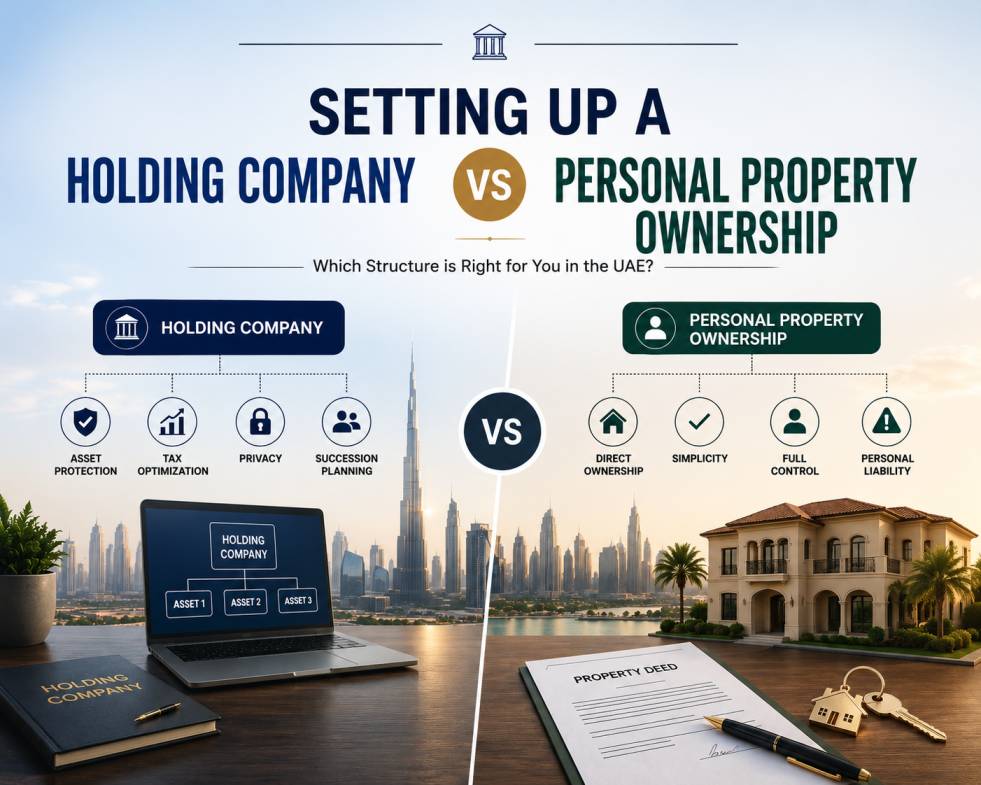
Sooner or later a client asks you whether they should buy in their own name or set up a company. It usually arrives late, often at the SPA stage, and it is not your job to answer it. But the quality of your answer in that moment shapes whether they see you as an agent or an adviser. Here is the framework, including the one point where the standard advice on holding company vs personal property ownership is not just incomplete but backwards.
Quick Navigation
Quick Answer
- Under Article 2(2)(c) of Cabinet Decision No. 49 of 2023, a natural person’s real estate investment income sits outside UAE corporate tax entirely, regardless of amount, where no licence is required.
- Holding the same property through a company converts that income into a Business Activity that is within scope, and taxable at 9% above AED 375,000.
- Moving an already-owned property into a company triggers the 4% DLD transfer fee. On AED 3 million, that is AED 120,000 before any annual cost.
- Since February 2023, Sharia has not applied by default to non-Muslims. The civil default is 50% to the spouse and 50% split equally among children, and a registered will overrides it for a fraction of a company’s cost.
- A holding company earns its keep for multiple co-investors, commercial assets, genuine liability ring-fencing and portfolios at scale. It rarely earns its keep for one apartment.
Why This Question Lands on You
You are the first professional in the transaction. The lawyer arrives later, the tax adviser usually never. So when a client with two or three properties starts wondering whether they should be holding them differently, you hear it first.
That is an awkward position, because the answer has tax and succession consequences you are not licensed to advise on, and getting it wrong is expensive for the client and for your relationship with them.
The useful move is not to answer. It is to frame the question well enough that the client can see it is a real decision with real trade-offs, then hand it to someone who does this for a living. An agent who says that depends on four things, and I know who should walk you through them, is more valuable to a serious buyer than one who says everyone uses a company these days.
The Tax Answer Runs the Opposite Way
This is the part worth reading twice, because most published advice on this topic gets it backwards.
Search the phrase holding company vs personal property ownership and you will find page after page listing tax efficiency as a reason to buy through a company. For straightforward rental yield in the UAE, that is wrong.
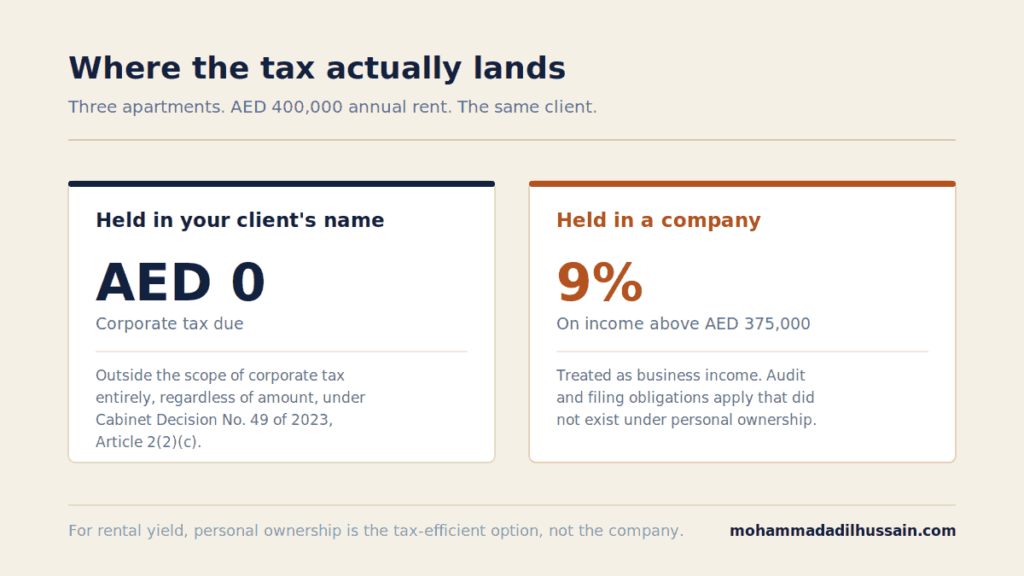
Personal ownership is outside the corporate tax net. Article 2(2)(c) of Cabinet Decision No. 49 of 2023 treats real estate investment by a natural person, meaning the sale, leasing, sub-leasing and renting of land or property in the UAE, as not constituting a Business or Business Activity, provided it is not conducted through a licence and does not require one. That income is excluded when calculating turnover, regardless of the amount. There is no AED 1 million threshold to worry about and no registration obligation arising from it.
Corporate ownership is inside it. A company is a taxable person from the first dirham of taxable income. Rental income earned by that company is business income, taxed at 0% up to AED 375,000 and 9% above it. PwC guidance on the same Cabinet Decision states the point plainly: an individual holding personal real estate investments through a company rather than in their own name should expect that to be treated as a Business Activity under the corporate tax law.
So the client with three apartments generating AED 400,000 a year in rent pays nothing personally. Move the same three apartments into a company and the portion above AED 375,000 becomes taxable, plus audit and filing obligations that did not exist before.
There is a partial offset. Small Business Relief lets businesses under AED 3 million in revenue elect to be treated as having no taxable income, and it was extended through to 2029 by Ministerial Decision No. 131 of 2026. Worth knowing that several articles still say this relief expires in December 2026, which is out of date. The full position is set out in UAE Small Business Relief extended to 2029.
But note what that relief actually does: it brings the company back to roughly where the individual already was, at the cost of a licence, an audit and an annual renewal. It is a repair, not an advantage.
The honest summary for a client: if the plan is to collect rent, the company costs money and saves none. If the plan is something else, keep reading, because there are real reasons, they are just not tax reasons.
The Succession Argument Most Clients Have Heard Is Out of Date
In any conversation about holding company vs personal property ownership, the most common reason clients give for wanting a company is inheritance. Usually a version of: if something happens to me, Sharia law applies and my wife only gets a fraction.
That has not been the default position since February 2023.
Federal Decree-Law No. 41 of 2022 on Civil Personal Status applies to non-Muslim UAE nationals and non-Muslim foreigners resident in the country. Under it, a testator may leave a will covering all property owned in the UAE to whomever they choose. In the absence of a will, half the estate devolves to the spouse and the other half is distributed equally among the children with no distinction between male and female. Non-Muslims also retain the option to apply their home country law.
Two consequences for the conversation you are having.
The scare story is wrong, and repeating it damages your credibility with a sophisticated client who has already checked.
The cheapest fix is a registered will, not a company. Registration fees run from around AED 950 at Abu Dhabi Judicial Department, roughly AED 2,020 at Dubai Courts, up to around AED 10,000 for a DIFC full will, with legal drafting on top. Against that, a holding company carries setup cost, annual renewal, accounting and an audit, every year, forever.
Where a company does help succession is mechanical rather than legal. Transferring shares in a property-owning company can be simpler than transferring a title deed through inheritance procedures. That is a genuine convenience for a large multi-asset estate. It is a poor reason to incorporate around a single apartment when a will does the job for a fraction of the cost.
The Cost Nobody Puts a Number On
The holding company vs personal property ownership question changes completely once the client already owns the asset, because moving it into a company is a transfer. The Dubai Land Department transfer fee of 4% applies, plus admin and title deed issuance fees.
On a AED 3 million apartment, that is AED 120,000 to change the name on the deed. Before the company is even formed. Before the first annual renewal.
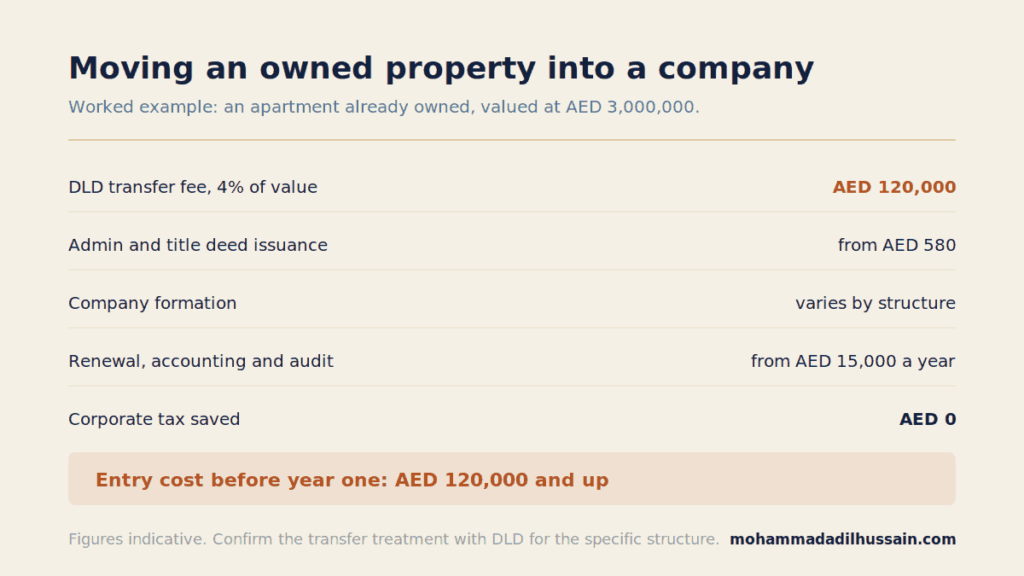
Then the recurring side, which varies by structure and provider but realistically includes licence renewal, registered agent or corporate service fees, accounting, and an audit where required. Published figures for straightforward structures commonly land around AED 15,000 a year and rise from there.
Set that against the tax position above and the arithmetic on a single rental property is not close. A client would be paying a six-figure entry cost plus an annual fee to move income from a zero-tax treatment into a taxable one.
This is the number to put in front of a client who has read that everyone holds property through a company. Not an opinion, just the transfer fee on their specific asset.
One caveat worth flagging rather than glossing. The treatment of subsequent share transfers in property-owning companies is not uniform and has tightened in recent years. Do not let a client assume that future sales via share transfer automatically escape the 4%. That needs confirming with DLD for the specific structure, in advance, not at exit.
Residency, Mortgages and the Practical Friction
Three operational points that decide more holding company vs personal property ownership cases than the theory does.
Golden Visa. Property-linked residency runs off the AED 2 million threshold for the ten-year visa, with a two-year investor permit available from AED 750,000. Where the property sits in a company, DLD looks for proof that the applicant holds 100% or a clear majority of the shares, and layered structures where one company owns another make the application substantially harder. If residency is a primary objective for your client, individual ownership is the path of least resistance and you should say so early, before they commit to a structure that complicates it.
Mortgages. UAE banks lend more readily to individuals. The collateral and recourse path is simpler, the products are more numerous and the pricing is generally better. Corporate borrowing is available but narrower and slower. For a leveraged buyer, this alone often settles the question.
Timeline. A personal purchase can complete quickly. A corporate purchase requires the entity to exist first, be registered with DLD, and produce corporate documents, board resolutions and signatory evidence. That is weeks, not days. If your client is competing for a unit, the structure decision needs to happen before the offer, not after.
When a Holding Company Genuinely Wins
None of the above means the structure is never right. Holding company vs personal property ownership is a real decision, not a foregone conclusion. It means the reasons are different from the ones usually given. A company earns its keep in five situations.
Multiple owners. Two or more investors in one asset. A shareholders agreement handles deadlock, exit, dilution and death far better than joint names on a title deed ever will.
Portfolio scale. Once a client is running a genuine portfolio rather than holding a few units, the administrative case strengthens: consolidated accounts, cleaner reporting, an entity that can borrow and contract in its own name.
Genuine liability exposure. Commercial property, short-term rental operations, anything with staff, public access or operational risk. Ring-fencing is a real benefit when there is something real to ring-fence. It is not a meaningful benefit for a tenanted apartment.
Corporate or institutional buyers. A company already trading in the UAE buying premises it will occupy is a different question entirely, and usually a straightforward yes.
Estate complexity. Multiple jurisdictions, blended families, minor beneficiaries, or a business that has to keep operating after the owner passes. Here the structure is doing work a will cannot.
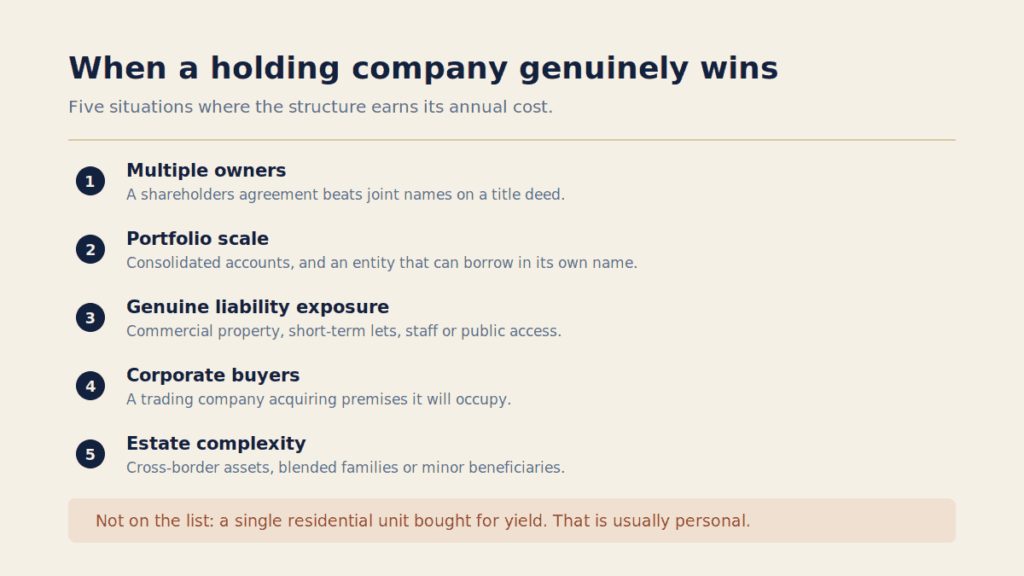
Notice what is absent from that list: a single residential unit bought for yield or capital appreciation. That is the most common transaction you handle, and it is the one where the answer is usually the simple one.
Which Structures Can Actually Hold the Title
Worth knowing at a high level, because once a client has settled the holding company vs personal property ownership question they will ask, and getting it wrong wastes weeks.
A foreign company cannot hold Dubai freehold directly. It needs a UAE vehicle, or one of the offshore structures DLD recognises for this purpose.
A mainland LLC licensed by Dubai’s Department of Economy and Tourism can own property in designated freehold areas, and since Federal Decree-Law No. 32 of 2021 most activities permit full foreign ownership without a local partner.
Free zone and offshore vehicles vary. Some are long established for property holding, others require specific DLD registration or approval, and the list is not static. DIFC Foundations and similar structures sit slightly apart, aimed at governance and succession rather than pure holding.
The practical point for you: do not let a client incorporate somewhere before confirming that DLD will register that specific vehicle against that specific property. Confirm first, then form. For the broader comparison of entity types, see mainland vs free zone vs offshore in the UAE and the difference between mainland and free zone companies.
Four Questions to Ask Before You Refer
You do not need to solve the holding company vs personal property ownership question yourself. You need to gather enough for the specialist conversation to start well. These four do it.
- How many properties, and how many owners? One property, one owner points strongly to personal. Multiple owners points to a structure almost immediately.
- Is residency part of the objective? If yes, flag the visa friction before anything is signed.
- Are they financing it? Mortgage plans push toward personal ownership on availability and pricing.
- Do they already own it, or are they buying now? Buying now means the structure decision is free. Already owning means restructuring costs 4% of value, which usually ends the discussion.
Four questions, two minutes, and you have moved from everyone uses a company to a properly framed decision. That is the difference the client remembers.
My Approach: What Happens When You Send a Client to Me
Most business setup consultants help you register a company. I help people make informed business decisions before they invest.
In this context that means something specific and slightly counterintuitive: a good share of the clients you send me will be told they do not need a company. If someone is buying one apartment in their own name for rental yield, the honest answer is a registered will and no entity at all, and I would rather say that than sell a structure that costs them money every year for no benefit. That is not a loss for you. An agent whose referral produced honest advice gets called again.
My advisory process focuses on helping you reduce uncertainty and make confident decisions, not just complete documentation. For a property client that means:
- Objective mapping first, covering yield, residency, succession and exit, because the structure follows the objective rather than the reverse.
- Tax position analysis under the natural person exclusion versus corporate treatment, with the actual numbers for their portfolio.
- Full cost modelling including the 4% transfer cost where the asset is already owned, plus annual renewal, accounting and audit.
- Succession review, including whether a registered will achieves what they want without an entity.
- Residency and visa planning where property-linked residency is part of the goal.
- Structure selection and DLD eligibility confirmation before anything is incorporated.
- Company formation where the analysis supports it, matched to the objective.
- Corporate tax registration and filing planning, including whether Small Business Relief applies.
- Banking setup for the entity where one is formed.
- A written recommendation the client can act on, so your transaction is not held up waiting for clarity.
I work to your timeline, not mine. If a client is mid-negotiation, the structuring answer needs to arrive in days, and I will tell you upfront if it cannot.
The objective is simple: help your client move forward with clarity, confidence and a long-term strategy.
Is This the Right Conversation for Your Client?
For most residential buyers, holding company vs personal property ownership is a short conversation with a simple answer, and the value you add is closing it down quickly so it does not stall the transaction.
It becomes a real conversation when there are co-investors, a portfolio, commercial exposure, or an estate with genuine complexity. Those are also the clients worth the most to you over time, which is a reasonable argument for handling the question well rather than avoiding it.
If you have a client sitting on this decision right now, get in touch and I will give them a straight answer, including when that answer is that they do not need me.
Frequently Asked Questions
Is it more tax efficient to hold UAE property in a company?
Generally no, for rental income. Under Cabinet Decision No. 49 of 2023, a natural person’s real estate investment income is outside the scope of corporate tax regardless of amount, where no licence is required. The same income earned by a company is business income, taxed at 9% above AED 375,000.
Does Sharia law decide who inherits my client’s Dubai property?
Not by default for non-Muslims. Federal Decree-Law No. 41 of 2022, in force since February 2023, provides that in the absence of a will half the estate passes to the spouse and half is divided equally among children with no gender distinction, and non-Muslims may instead apply their home country law. A registered will overrides the default.
What does it cost to move an existing property into a holding company?
It is treated as a transfer, so the 4% Dubai Land Department fee applies plus admin and title deed fees. On a AED 3 million property that is roughly AED 120,000, before company formation and annual running costs.
Can a client still get a Golden Visa if the property is owned by a company?
It is possible but harder. The AED 2 million threshold still applies, and DLD looks for proof the applicant holds 100% or a clear majority of the shares. Layered structures where one company owns another complicate the application significantly. For a residency-driven buyer, personal ownership is the cleaner route.
Can a foreign company buy property in Dubai directly?
No. A foreign-incorporated company cannot hold Dubai freehold directly. It needs a UAE entity, or one of the offshore structures the Dubai Land Department recognises for property holding, and eligibility should be confirmed with DLD before incorporating.
Will a mortgage still be available if the property is in a company?
Usually, but on narrower terms. UAE banks lend more readily to individuals because the collateral and recourse path is simpler, and personal borrowers typically see more product choice and better pricing. For a leveraged purchase this often settles the structure question on its own.
When is a holding company actually the right answer?
Multiple co-investors, a portfolio at genuine scale, commercial property or operations with real liability exposure, corporate buyers acquiring their own premises, and estates with cross-border or family complexity. For a single residential unit held for yield, it usually is not.
Sources & References
- Ministry of Finance – Cabinet Decision No. 49 of 2023 on Categories of Businesses Conducted by a Natural Person
- Federal Tax Authority – Corporate Tax Guide: Taxation of Natural Persons
- UAE Legislation Portal – Federal Decree-Law No. 41 of 2022 on Civil Personal Status
- Dubai Land Department
- DIFC Courts Wills Service