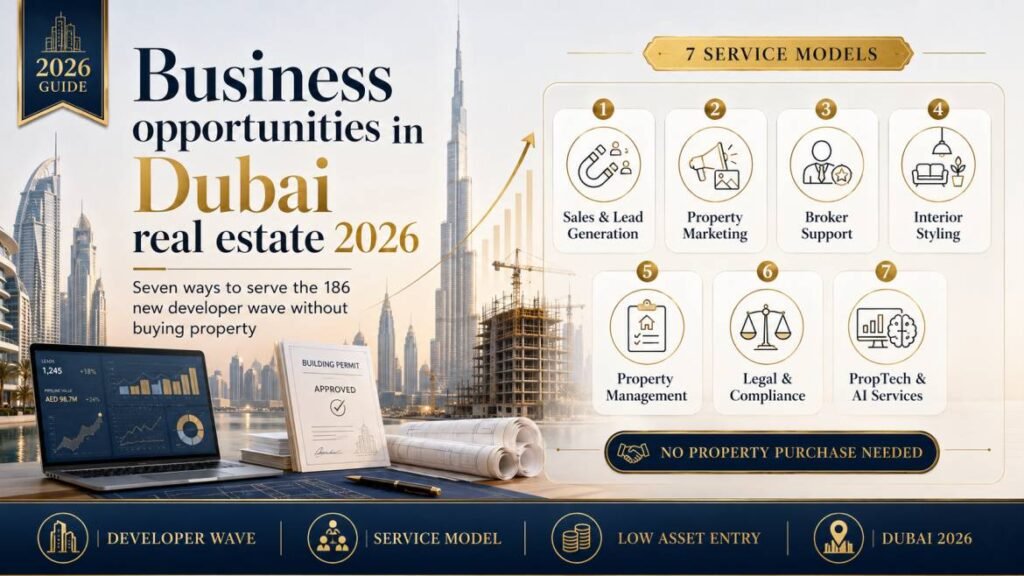
Between January and mid-August 2026, 186 new property development companies registered in Dubai, according to Dubai Land Department data reported by Gulf News. Every article covering that figure does the same thing: restates the number, notes most licences came through the Department of Economy and Tourism, and concludes that buyers will have more projects to choose from. That is a true and fairly thin reading. A wave of 186 mostly small, newly formed development companies does not arrive with an in-house sales network, RERA compliance function, marketing infrastructure or post-handover facilities team already built. That gap, not a 187th development company, is where the actual business opportunities in Dubai real estate for 2026 sit, and this is the piece connecting the statistic to the businesses that can be built around it.
Quick Navigation
Quick Answer
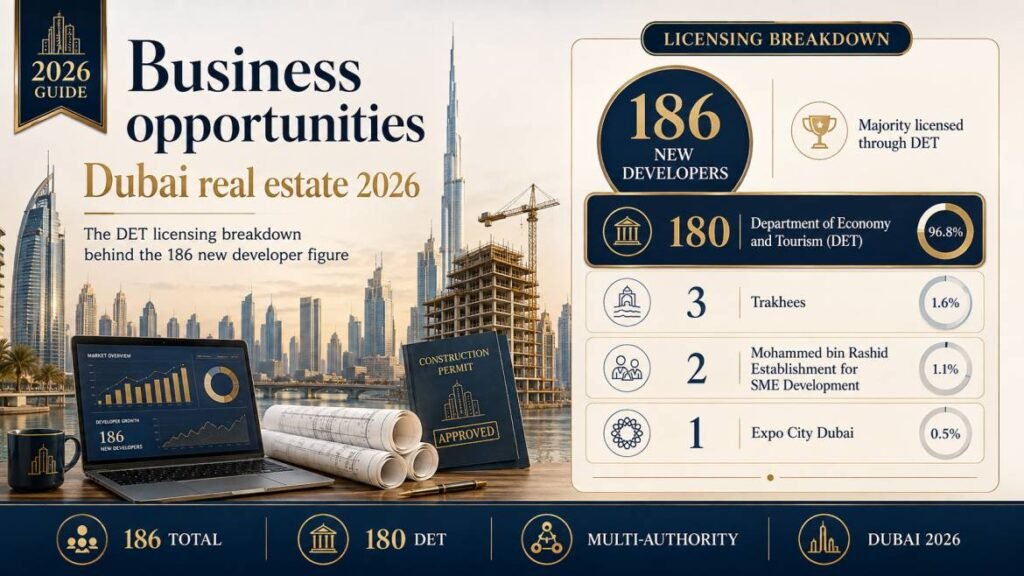
- 186 new property developers registered in Dubai between 1 January and mid-August 2026, per Dubai Land Department data: 180 via the Department of Economy and Tourism, 3 via Trakhees, 2 via the Mohammed bin Rashid Establishment for SME Development, and 1 via Expo City Dubai.
- The figure counts market entrants, not completed projects. In the same period, over 24,000 new units were delivered across 104 completed developments, a separate and equally relevant data point.
- 180 of 186 new developers registered through DET specifically, signalling that most are new mainland companies rather than large free zone or specialised entities, with the smaller in-house capabilities that implies.
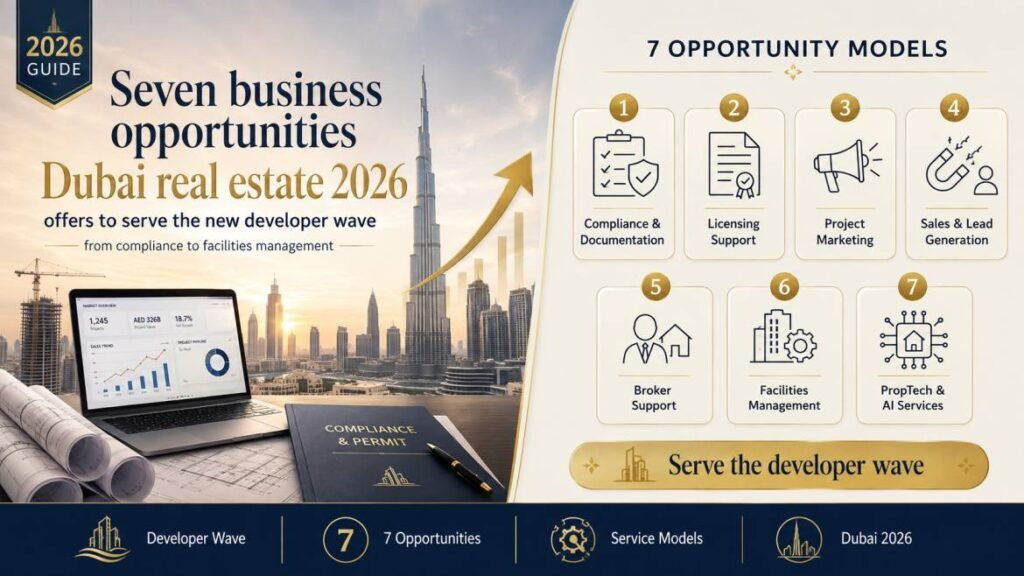
- The genuine opportunities here are service businesses that this developer wave cannot build alone: RERA and escrow compliance advisory, sales and CRM infrastructure, PropTech and platform tools, marketing and visualisation, construction project management support, post-handover facilities management, and company formation and banking for the developers themselves.
- Dubai Land Department has publicly signalled support for specialised real estate technology companies specifically, which is a live, checkable regulatory tailwind for one of these seven opportunities.
Business Opportunities Dubai Real Estate 2026: What Actually Happened, and What the 186 Figure Does Not Tell You
Between the start of 2026 and mid-August, 186 new property development companies registered in Dubai, according to Dubai Land Department data reported by Gulf News. That works out to roughly 25 new developers entering the market every month across the seven-and-a-half-month window.
The breakdown by licensing authority: 180 companies received licences from Dubai’s Department of Economy and Tourism, the clear majority. Trakhees, the licensing arm of Dubai’s Ports, Customs and Free Zone Corporation responsible for development activity in Dubai Maritime City, issued 3 licences. The Mohammed bin Rashid Establishment for SME Development issued 2, and Expo City Dubai granted 1.
One detail worth taking seriously rather than skipping past: this is a count of market entrants, meaning newly licensed companies, not a count of completed developments or delivered units. Confusing the two changes what the number actually implies. A rising count of new developer entrants signals growing confidence in starting a development business here. It says nothing on its own about how many of those companies will still be active in three years, or how prepared they are operationally for what running a development actually requires.
Why the DET Breakdown Matters More Than the Headline Number
The licensing-authority split is usually reported as a footnote. Read properly, it is the single most useful fact in the entire dataset for anyone thinking seriously about business opportunities Dubai real estate 2026 actually offers, not just the headline number.
180 of 186 new developers, roughly 97%, registered through DET rather than through a specialised free zone or a large-scale master-developer structure. That points strongly toward smaller, standard mainland development companies rather than major new institutional players. Companies structured this way are far less likely to have deep in-house departments for sales, compliance, marketing, technology or post-handover management already built out. Larger, established developers build these functions internally over years. A wave of 186 mostly DET-licensed entrants, entering over seven months, has not had that time.
That is the structural reason this wave of developers is a wave of buyers for exactly the kind of specialised service businesses covered below, rather than a wave of self-sufficient competitors to worry about.
Reading Entrants and Completions Together
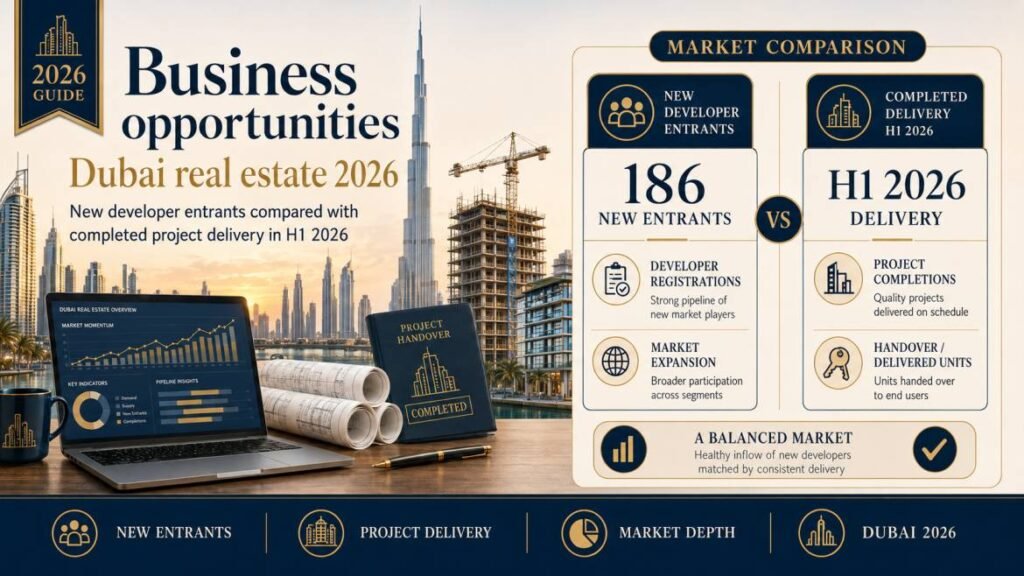
The 186 figure gets more useful, and more directly tied to what this market actually supports, when placed next to a separate number from the same period: more than 24,000 new units delivered across 104 completed projects in Dubai during H1 2026, according to reporting on the same Dubai Land Department dataset.
Read alone, the entrant figure says the market for starting a development company is active. Read alone, the completion figure says supply is landing at real scale. Read together, they describe a market where a large volume of new inventory is hitting handover at the same moment a large wave of smaller, newer companies is entering development for the first time. That combination is precisely where post-handover services, the seventh opportunity below, become most relevant, since newly delivered units from newly formed developers are exactly the properties least likely to already have an established facilities management relationship in place.
For the fuller market picture behind these completion figures, including transaction volumes and sector demand, see Dubai real estate H1 2026.
Business Opportunities Dubai Real Estate 2026: Seven Ways to Serve the New Developer Wave
Not investment advice, and not a case for becoming a developer. These are the seven service businesses that make up the real opportunities on offer, positioned to serve the wave of 186 new developers directly.
1. RERA and escrow compliance advisory. Every Dubai off-plan development must operate under RERA’s escrow account rules, with specific documentation, project registration and Oqood processes to manage correctly. A newly licensed developer with a small internal team is a strong candidate for specialised compliance support rather than building this function from scratch.
2. Sales infrastructure and CRM for developers. Smaller developers frequently lack an established broker network or a sales technology stack on day one. Businesses providing white-label sales infrastructure, CRM systems built for the development sales cycle, or broker network access fill a genuine and immediate gap.
3. PropTech and platform tools. Dubai Land Department’s own platform references an initiative to strengthen the sector’s innovation system and specifically attract specialised real estate technology companies. That is a regulator naming its own priority, and a founder building booking systems, project tracking tools or buyer-facing platforms for smaller developers is building directly into a stated official direction rather than against it.
4. Marketing, visualisation and sales gallery services. A new developer entering a market with established names like Emaar, Nakheel and Meraas already present needs to differentiate quickly. 3D visualisation, sales gallery design, and digital marketing built specifically for pre-launch and off-plan sales cycles are a real, recurring need across a fast-growing entrant pool.
5. Construction and project management consultancy. A rapid influx of new development companies competing for the same pool of experienced project management talent creates genuine demand for outsourced or fractional project management and construction consultancy, particularly for firms not yet large enough to justify a full internal team.
6. Company formation, structuring and banking for the developers themselves. Every one of these 186 companies had to be formed, licensed and banked before development activity could begin, and the wave shows no sign of slowing. Advisory support for structuring a new development entity correctly from the outset, including banking relationships suited to real estate activity specifically, is itself one of the seven opportunities.
7. Post-handover facilities and property management. With over 24,000 units delivered in the same period this developer wave was entering the market, a meaningful share of new supply is coming from companies without an established, in-house post-handover facilities management arm. That gap is a direct, ongoing service opportunity distinct from the development business itself.
Which of These Opportunities Need a Mainland Structure, and Which Don’t
This depends entirely on who the client is and what the service touches, and it shapes how you should structure any of these opportunities.
Businesses serving developers directly as B2B suppliers, PropTech platforms, compliance advisory, project management consultancy, marketing agencies, can often operate from a free zone, since the client relationship does not require mainland trading rights the way a business selling directly to property buyers might. Businesses whose service touches the buyer directly, such as certain sales or brokerage-adjacent activities, are more likely to need a mainland structure specifically. The broader trade-offs are set out in mainland vs free zone vs offshore in the UAE.
For anyone building one of these opportunities while also personally holding property as part of the strategy, the tax and structuring implications of holding real estate personally versus through a company are a separate and important question, covered fully in holding company vs personal property ownership.
My Approach: Building the Business That Serves the Boom, Not Just the One That Buys Into It
Most business setup consultants help you register a company. I help you make informed business decisions before you invest.
Every headline about Dubai’s real estate boom points a reader toward buying property or, less often, becoming a developer, and both miss the business opportunities Dubai real estate 2026 genuinely supports. Both are legitimate paths and neither is the only one. A wave of 186 mostly small, newly formed development companies is itself a market, and the businesses positioned to serve that market well are frequently a lower-capital, faster-to-launch option than competing as a developer directly.
My advisory process focuses on helping you reduce uncertainty and make confident decisions, not just complete documentation. In practice:
- Market opportunity assessment specific to which of the seven service categories above actually fits your skills and capital, rather than a generic “real estate business” recommendation.
- Structure and jurisdiction guidance matched to whether your business serves developers directly or touches property buyers, since the right answer differs.
- Business setup and licensing execution once the opportunity and structure are confirmed.
- Corporate tax registration and filing planning appropriate to a real estate services activity.
- Banking setup suited specifically to businesses operating in or around the real estate sector.
The objective is simple: help you start your business with clarity, confidence and a long-term strategy, built on where the real gaps in this market actually sit rather than the headline everyone else is reading.
If you are considering any of the business opportunities Dubai real estate 2026 supports and want the opportunity and structure tested properly before you commit, get in touch.
Frequently Asked Questions
How many new property developers entered Dubai’s market in 2026?
186 new property development companies registered in Dubai between 1 January and mid-August 2026, according to Dubai Land Department data. Of these, 180 were licensed through the Department of Economy and Tourism, 3 through Trakhees, 2 through the Mohammed bin Rashid Establishment for SME Development, and 1 through Expo City Dubai.
Does the 186 figure mean 186 new developments were completed?
No. The figure counts newly registered development companies entering the market, not completed projects or delivered units. In the same period, more than 24,000 new units were delivered across 104 completed projects, which is a separate statistic from the entrant count.
What business opportunities does Dubai’s real estate boom actually create beyond buying property?
Service businesses that support the wave of new developers directly: RERA and escrow compliance advisory, sales infrastructure and CRM for developers, PropTech and platform tools, marketing and visualisation services, construction and project management consultancy, company formation and banking support for new development entities, and post-handover facilities and property management.
Why does it matter that most new developers were licensed through DET?
180 of 186, roughly 97%, registered through Dubai’s Department of Economy and Tourism rather than a specialised free zone or large master-developer structure, indicating most are smaller mainland companies. Companies of this size and structure typically lack established in-house sales, compliance, marketing and facilities management functions, which is exactly the gap the service opportunities in this article address.
Do I need a mainland licence to build a business serving Dubai property developers?
It depends on the service. Businesses supplying developers directly as B2B providers, such as PropTech platforms, compliance advisory or project management consultancy, can often operate from a free zone. Businesses whose service touches property buyers directly are more likely to need a mainland structure. The right choice depends on your specific business model.
Is Dubai Land Department actively supporting real estate technology companies?
Dubai Land Department’s own platform references an initiative to develop the sector’s innovation system and attract specialised real estate technology companies specifically, indicating this is a stated regulatory priority rather than simply market speculation.
Is now a good time to start a service business targeting Dubai property developers?
The underlying conditions support it: a fast-growing pool of newly licensed developers without established internal infrastructure, alongside genuine completion and delivery volume in the same period. As with any market timing question, the right structure, sector focus and capital plan for your specific business still need proper assessment before committing.
What good positioning looks like in practice
The service businesses that do best alongside this developer wave are rarely the ones trying to serve every project. Specialising in one or two service lines, and becoming genuinely reliable at them, tends to travel further than a generalist offering that competes on price alone. Developers moving quickly on delivery schedules value a supplier who shows up on time and does not need to be chased, more than one who is marginally cheaper but inconsistent.
Relationships also compound. A single satisfied developer client tends to refer the next one, because the developer community in Dubai is smaller and more networked than the total unit count suggests. Building a reputation with two or three developers properly, before trying to scale across the whole market, is usually the more durable route than spreading thin from the outset.
Pricing discipline matters as much as service quality. Underpricing to win an initial contract with a developer can trap a service business into a margin it cannot sustain once volume increases, which is precisely when the relationship should be becoming more profitable, not less. Setting rates that hold up at scale, from the first contract, protects the business more than winning the first deal at any cost.
None of this requires waiting for a project to break ground before approaching a developer. Most developers are already assembling their supplier and service shortlists well before construction starts, which means the businesses that introduce themselves early, with a clear and specific offer, are the ones already on the list when the real spending begins.
None of this requires perfect timing. It requires showing up with a specific, credible offer before the wave of developers has already filled their supplier lists with someone else.