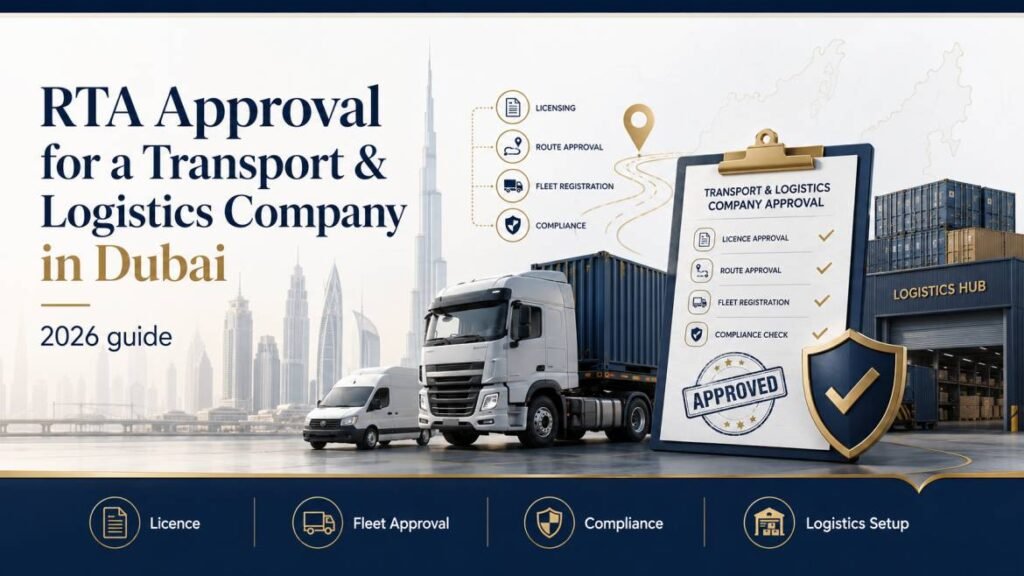
Search for RTA approval for a transport or logistics company in Dubai and every guide describes the same thing: a company-level permit, vehicle registrations, driver badges. That is real and it is half the picture. A second, entirely separate RTA approval process exists for any project that affects roads, traffic flow or Right-of-Way, governed by Dubai Law No. 7 of 2025 with fines reaching AED 200,000, and it applies specifically to warehouses and logistics facilities once they cross a trip-generation threshold that was lowered in 2026. If you are setting up a transport or logistics company and planning to lease or build a facility, you very likely need both approvals, from two different parts of the same authority, and nothing currently ranking tells you that plainly.
Quick Navigation
Quick Answer
- RTA approval for a transport or logistics company in Dubai covers two separate processes: an operator-level permit for running vehicles, and a project-level Right-of-Way and Traffic Impact Study approval for any facility affecting roads or traffic.
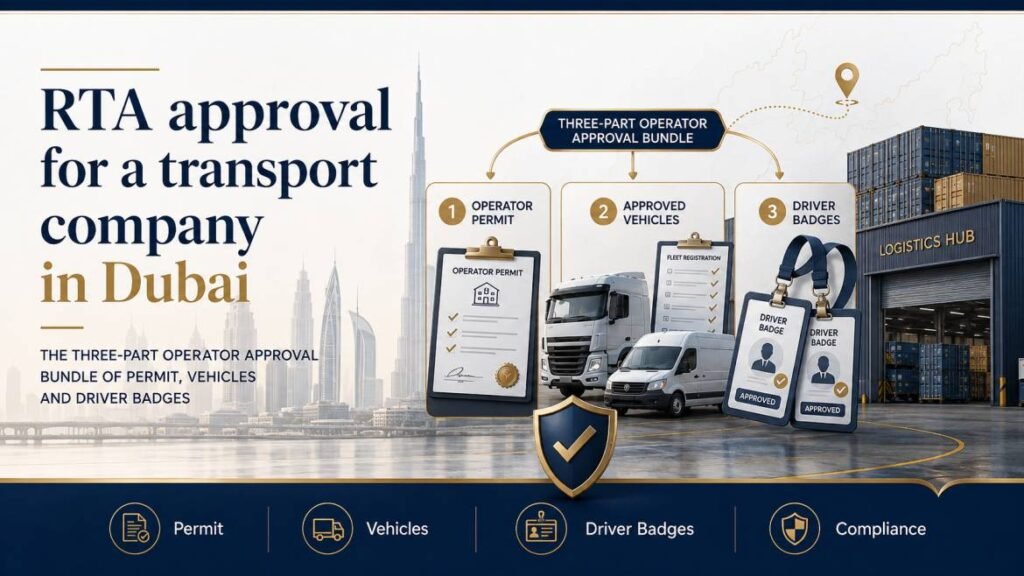
- The operator-level approval is a bundle, not one document: a company transport service permit, individual vehicle permits for every vehicle, and driver badges for every driver.
- From 2026, any project generating more than 100 vehicle trips per peak hour requires a Traffic Impact Study before RTA issues road access approval, reduced from 150 trips previously. Warehouses and logistics facilities over roughly 10,000 square metres commonly cross this threshold.
- Fines for bypassing RTA Right-of-Way approval under Dubai Law No. 7 of 2025 reach AED 200,000.
- Not every transport-adjacent business needs RTA operator approval. Freight forwarders and logistics consultancies that never operate their own vehicles for hire, and many free zone companies, can sit entirely outside this requirement.
The Two RTA Approvals Nobody Puts in One Place
Start with the distinction that changes how you should read everything else about RTA approval for a transport or logistics company in Dubai.
Operator-level RTA approval governs the right to actually run vehicles: taxis, buses, limousines, cargo trucks, or delivery fleets operating commercially on Dubai roads. This is what every “how to start a transport company” guide describes, and it is genuinely the part most founders think of first.
Project-level RTA approval governs anything that physically affects roads, traffic flow, parking, signage or Right-of-Way, under Dubai Law No. 7 of 2025. This covers construction, fit-out, road access points, and critically, any development expected to generate significant additional traffic. A warehouse, distribution centre or logistics yard is exactly this kind of development.
These sit in different parts of the RTA’s regulatory structure, are covered by different guides online, and are almost never mentioned together. A transport company setting up an office needs the first. A logistics company building or leasing a large facility needs both, and the second one is where the more recent and less publicised 2026 change sits.
Do You Actually Need RTA Operator Approval?
Before walking through the process of RTA approval for a transport or logistics company in Dubai, the question worth asking first: does your business actually need it.
RTA operator approval applies specifically to a company physically operating vehicles for hire on Dubai roads, whether for passengers or cargo. A logistics business that arranges transport through subcontracted carriers, provides freight forwarding, customs clearance or supply chain consultancy, and never puts its own vehicles on the road for hire, typically does not need RTA operator approval at all.
This distinction matters most for free zone companies. Free zone entities are generally restricted from operating vehicles directly for mainland clients, which is precisely why free zones such as Dubai South, JAFZA and Sharjah Publishing City work well for logistics support activities, freight brokerage and import-export operations, but not for a business that wants to run its own delivery or passenger fleet across Dubai. For that, a Dubai mainland licence from the Department of Economy and Tourism, paired with RTA operator approval, is the structure that actually fits.
If your business model is genuinely vehicle-operating, continue to the next section. If it is logistics support, freight brokerage or consultancy without your own fleet, RTA operator approval likely does not apply to you, though the project-level approval below may still be relevant if you are building a facility.
RTA Approval for a Transport or Logistics Company in Dubai: The Operator-Level Bundle
This is the part most guides on RTA approval for a transport or logistics company in Dubai cover, and it is worth being precise about, because “RTA NOC” understates what is actually required.
The company-level transport service permit. RTA evaluates the applicant on financial standing, fleet quality, operational infrastructure and the qualifications of the proposed management team before granting this. A company that cannot demonstrate the required fleet size, appropriate premises and a credible operational plan will not receive it.
Individual vehicle permits. Once company-level approval is granted, every vehicle in the fleet must be separately registered with RTA and assigned its own transport permit, inspected for roadworthiness, specification compliance and livery standards.
Driver badges. Every driver operating under the company’s permit needs an individual RTA-issued badge.
Minimum fleet size is not a single published number. It varies by activity, and RTA specifies the requirement at the point of the Operation Card application rather than in a general public schedule. Some activities permit starting with a single vehicle; others require a minimum of three. Treat any guide that states one universal fleet minimum with caution, since the real figure is activity-specific.
Both the RTA operator permit and the DET trade licence must be held and maintained simultaneously. RTA will typically require evidence of the trade licence as part of its application, and DET will require confirmation of RTA approval, or at least an application in progress, before finalising the trade licence, so the two processes run in parallel rather than strictly one after the other.
The Other RTA Approval for a Transport or Logistics Company in Dubai, and the 2026 Threshold That Changed
This is the section that separates this guide to RTA approval for a transport or logistics company in Dubai from every other one on the topic.
Any project in Dubai affecting roads, traffic, parking, signage or Right-of-Way requires RTA approval before it proceeds, under Dubai Law No. 7 of 2025, which sets out a significantly increased penalty structure for Right-of-Way violations. Unauthorised works in the RTA Right-of-Way without a permit can carry fines from AED 10,000 up to AED 200,000, depending on the nature and scale of the works. Unapproved signage carries fines of AED 5,000 to 50,000.
The mechanism that most directly affects a logistics or transport company is the Traffic Impact Study (TIS). A TIS is a technical report, prepared by an RTA-registered traffic engineering consultant, analysing how a proposed development will affect surrounding roads and junctions. From 2026, a TIS is mandatory for any project generating more than 100 vehicle trips per peak hour, reduced from a 150-trip threshold previously in effect. That reduction means meaningfully more commercial and industrial projects now trigger the requirement than did before.
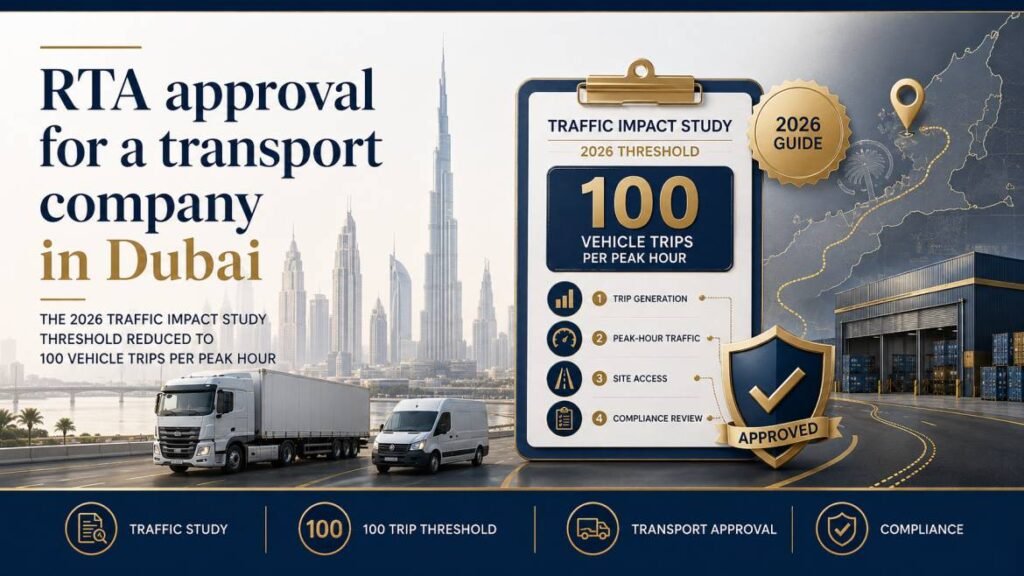
Warehouses and logistics facilities over roughly 10,000 square metres are specifically named as a category that commonly exceeds this threshold. If your business plan involves leasing or constructing a distribution centre, cross-dock facility or large warehouse, confirm the expected peak-hour trip generation with your facility developer or a traffic consultant before committing to a lease, not after signing one and discovering a TIS is required to actually open.
TIS acceptance fees run from roughly AED 5,000 to 15,000, in addition to the traffic consultant’s own preparation cost, and this sits entirely separately from anything spent on the operator-level approval covered above.
Sector-Specific Approvals Beyond RTA
Depending on your specific transport activity, additional approvals sit on top of both RTA approval tracks for a transport company in Dubai above.
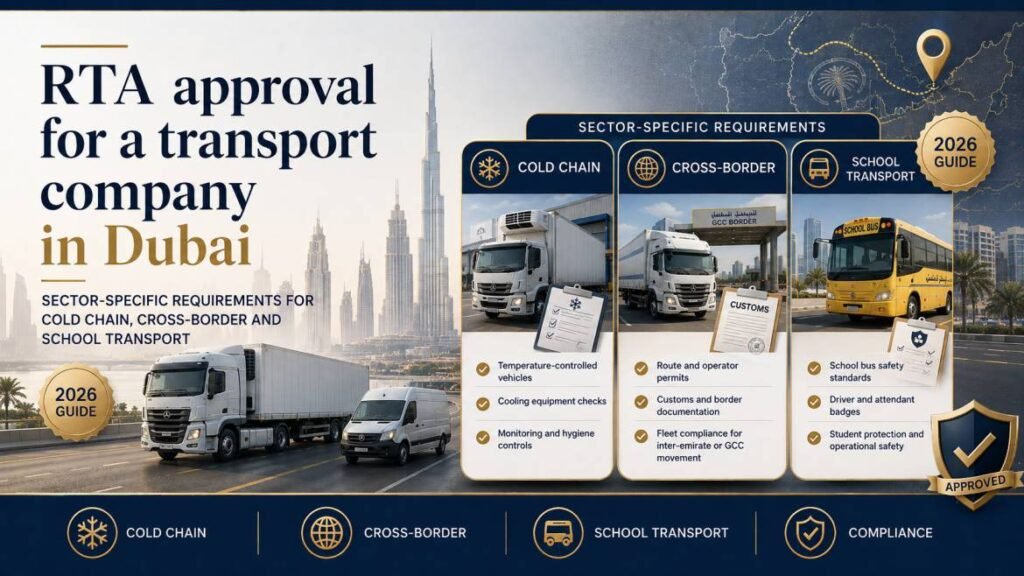
Refrigerated and cold chain transport, carrying temperature-sensitive food, dairy, pharmaceuticals or medical supplies, requires separate approval from Dubai Municipality’s Food Safety Department. Vehicles must meet hygiene standards, maintain documented temperature logs, and operate under a validated cold chain management system. Budget for Dubai Municipality approval fees and vehicle hygiene fit-out costs alongside standard RTA and DET licensing.
Cross-border and inter-emirate cargo transport needs an additional approval from the Ministry of Energy and Infrastructure, which oversees inter-emirate and cross-border commercial vehicle permits, specifying the routes, vehicle categories and cargo types authorised.
School transport requires RTA approval against specific vehicle specifications: yellow bus exterior, CCTV cameras, seatbelts and child-safety alarm systems, on top of the standard operator approval process.
Map your specific sub-activity against this list before assuming the standard operator approval covers everything your business needs.
Mainland or Free Zone, and Why It Decides Everything
This choice determines which type of RTA approval for a transport or logistics company in Dubai actually applies to you, more than any other single decision.
A Dubai mainland DET licence is the appropriate structure for a customer-facing transport business physically operating vehicles across Dubai, since free zone companies are generally restricted from conducting this kind of direct mainland operation. For this route, RTA operator approval is mandatory alongside the trade licence.
A free zone licence suits logistics consultancy, freight brokerage, or import-export support roles that do not involve physically operating vehicles for mainland clients. Zones such as Dubai South, JAFZA and Sharjah Publishing City work well for this category specifically because it sits outside RTA’s operator-licensing scope entirely. The broader trade-offs between these structures are covered in mainland vs free zone vs offshore in the UAE, and for a business genuinely centred on the logistics corridor rather than vehicle operation, Dubai South’s logistics ecosystem is worth reading alongside this guide.
Get this structural decision wrong and you either apply for RTA operator approval you never needed, or discover after signing a free zone lease that your actual business model requires mainland vehicle operation the licence does not support.
Realistic Timeline and What Actually Causes Delay
Operator-level approval, once a complete application with adequate fleet, premises and management evidence is submitted, typically proceeds alongside the DET trade licence process rather than sequentially, so the combined timeline depends more on document readiness than on either single process.
Project-level approval timing depends heavily on whether a TIS is required. Where it is, the traffic consultant’s study preparation, RTA review, and any requested revisions typically add weeks to months to a facility timeline, which is exactly why confirming the trip-generation threshold before signing a facility lease matters. A logistics company that only discovers a TIS is required after committing to a 10,000-square-metre warehouse has built delay into its own launch date.
The most common cause of delay on the operator side is incomplete fleet or premises evidence at the Operation Card application stage. The most common cause on the project side is treating the Right-of-Way and TIS process as an afterthought to be handled once the facility is already under construction, rather than a gating item to confirm before the lease is signed.
My Approach: Getting RTA Approval for a Transport or Logistics Company in Dubai Right From Day One
Most business setup consultants help you register a company. I help you make informed business decisions before you invest, which for RTA approval for a transport or logistics company in Dubai means knowing which track applies before you sign a lease or order a fleet.
For a transport or logistics business, the mistake I see most often is treating RTA approval as a single item on a formation checklist, ticked off once and forgotten. It is two separate regulatory relationships, and getting the sequencing wrong, discovering a TIS requirement after signing a warehouse lease, or applying for RTA operator approval a freight-brokerage business never needed, costs real time and money that proper structuring avoids entirely.
My advisory process focuses on helping you reduce uncertainty and make confident decisions, not just complete documentation. In practice:
- Business model assessment first, to establish whether RTA operator approval genuinely applies to your activity before any application begins.
- Mainland versus free zone structure decisions matched to whether your business physically operates vehicles or provides logistics support.
- Facility planning that checks Traffic Impact Study exposure before a lease is signed, not after.
- Sector-specific approval mapping, so cold chain, cross-border or school transport requirements are identified early rather than discovered mid-application.
- Business setup and licensing execution sequenced correctly between DET and RTA.
- Corporate tax registration and filing planning appropriate to a transport or logistics activity.
- Banking setup guidance for fleet financing and operational accounts.
The objective is simple: help you start your business with clarity, confidence and a long-term strategy, with both RTA approval tracks planned for correctly from the outset rather than discovered under time pressure.
If you need RTA approval for a transport or logistics company in Dubai and want the right structure and approval path confirmed before you commit to premises or a fleet, get in touch.
Frequently Asked Questions
What is RTA approval for a transport or logistics company in Dubai?
It covers two separate processes: an operator-level approval, a bundle of a company transport service permit, individual vehicle permits and driver badges, required to run vehicles commercially; and a project-level Right-of-Way and Traffic Impact Study approval under Dubai Law No. 7 of 2025, required for facilities that affect roads or traffic.
Does my logistics company need RTA approval if I don’t operate vehicles?
Not necessarily for the operator-level approval, which applies specifically to companies physically operating vehicles for hire. A freight forwarder or logistics consultancy that subcontracts transport may not need it. However, if you are building or leasing a large facility such as a warehouse, the separate project-level Right-of-Way approval may still apply depending on expected traffic generation.
What is a Traffic Impact Study and when is it required?
A technical report by an RTA-registered traffic engineering consultant analysing how a proposed development affects surrounding roads and junctions. From 2026, it is mandatory for any project generating more than 100 vehicle trips per peak hour, reduced from 150 previously. Warehouses and logistics facilities over roughly 10,000 square metres commonly cross this threshold.
What are the fines for bypassing RTA Right-of-Way approval?
Under Dubai Law No. 7 of 2025, unauthorised works in the RTA Right-of-Way without a permit can carry fines from AED 10,000 up to AED 200,000, depending on the scale of the works. Unapproved signage carries separate fines of AED 5,000 to 50,000.
Can a free zone company operate a transport business in Dubai?
Generally not directly on the mainland. Free zone companies are typically restricted from operating vehicles for hire across Dubai. They work well for logistics consultancy, freight brokerage and import-export support roles that do not involve physically operating vehicles, which sit outside RTA’s operator-licensing requirement entirely.
How many vehicles do I need to start a transport company in Dubai?
There is no single published minimum. RTA specifies the required fleet size per activity at the point of the Operation Card application, and it varies by transport category. Some activities permit starting with a single vehicle, others require a minimum of three.
What extra approvals apply to specific transport activities?
Refrigerated or cold chain transport needs Dubai Municipality Food Safety Department approval. Cross-border and inter-emirate cargo needs Ministry of Energy and Infrastructure permits. School transport needs RTA approval against specific vehicle specifications including livery, CCTV, seatbelts and child-safety alarms.