Quick Answer
Yes, an automotive spare parts trading business in Dubai can work, but the licence is the cheapest part of it. The UAE parts and components market is about US$1.7 billion (roughly AED 6.3 billion) in 2026, growing at around 3.4% a year, and the wider GCC light-vehicle aftermarket is heading toward US$13 billion by 2030. Growth is steady, not fast, so profit comes from stock turns, margin discipline and collecting what customers owe you.
A lean UAE distributor needs about AED 2.0 to 3.6 million to launch, most of it inventory, and breaks even on cash at roughly AED 6.25 million of annual sales. Mainland suits a business selling mainly to UAE garages and fleets, JAFZA suits a re-export business holding bonded stock, and an asset-light model that sources, brokers or sells through a digital catalogue without a UAE warehouse can start on a SRTIP (SPARK) free zone licence from around AED 5,500. This covers demand, competition, setup costs, break-even and licensing strategy in that order.
Table of Contents
Is There Real Demand for an Automotive Spare Parts Trading Business in the UAE?
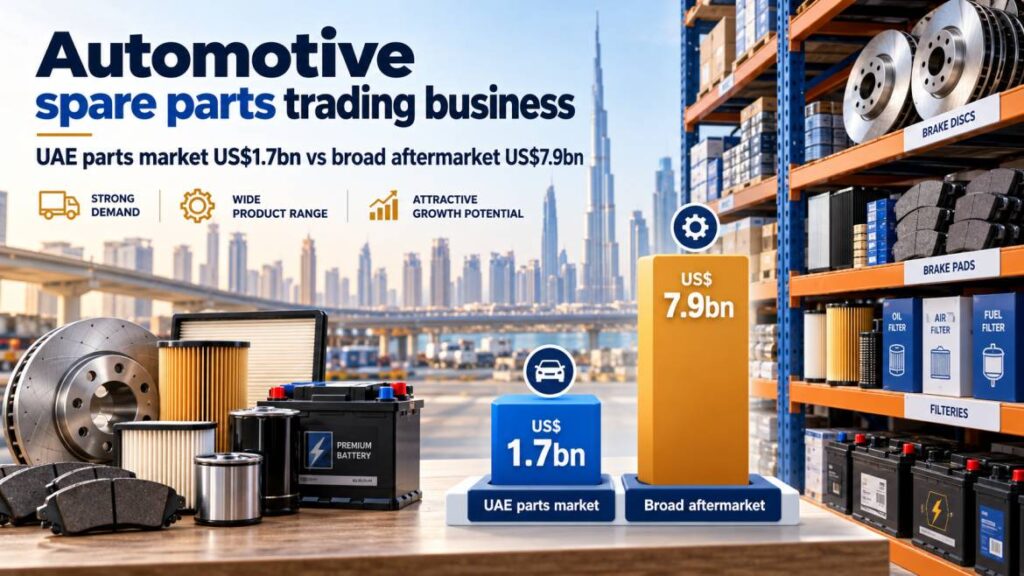
Before you quote a market size in a business plan, check what it measures. You will find UAE “aftermarket” figures anywhere from US$1.6 billion to US$7.9 billion, and both can be correct. The smaller figure counts physical replacement parts and components. The larger one adds repair labour, services and accessories. If you are importing and distributing parts, the smaller number is your real pool.
| Market definition | Latest figure | Forecast | What it tells a parts trader |
|---|---|---|---|
| UAE aftermarket components | US$1.61 billion (2024) | US$2.11 billion by 2032, 3.43% a year | Your realistic addressable market, about US$1.7 billion in 2026 |
| UAE broad automotive aftermarket | US$7.9 billion (2026) | US$10.6 billion by 2034 | The whole ecosystem, including labour and services |
| GCC light-vehicle aftermarket | US$9.7 billion (2022, parts and labour) | About US$13 billion by 2030 | The regional upside if you re-export |
| Global aftermarket e-commerce | US$90.6 billion (2026) | US$208.2 billion by 2030 | Why a digital catalogue is part of the infrastructure |
Four things keep demand recurring. The number of vehicles on the road keeps rising. Cars leaving manufacturer warranty move from dealer workshops to independent garages, which buy from distributors like you. Heat shortens component life, and Bosch Car Service UAE puts typical battery life here at two to three years, roughly half of what it is in cooler markets. And last-mile delivery, construction and mining fleets run high mileage on vans and trucks.
The honest counterweight is growth of 3% to 5% a year. That will not carry a weak business. A new automotive spare parts trading business has to win share from existing suppliers, which is what the rest of this guide is about.
What Sells: Product Categories and Quality Tiers
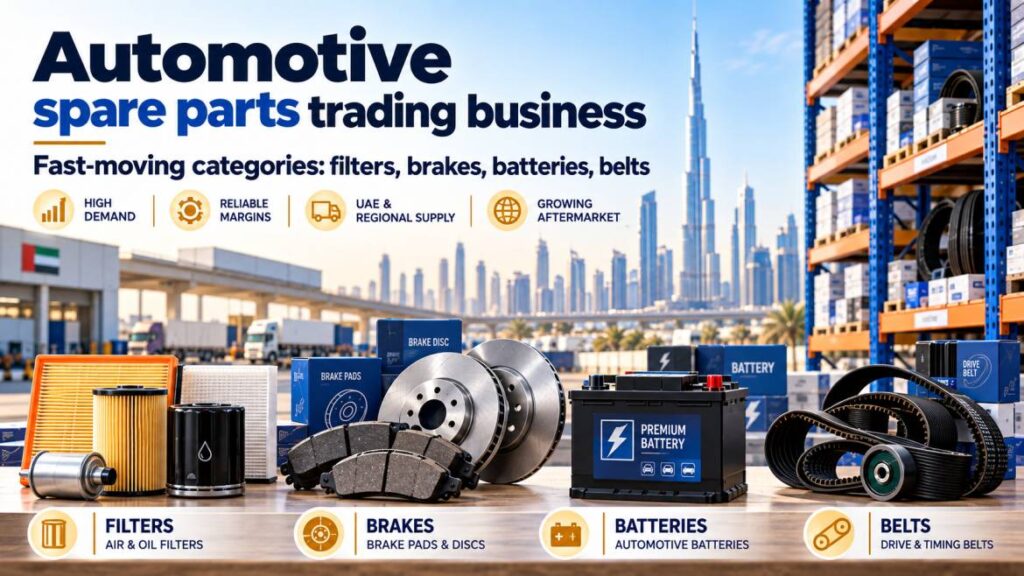
The classic mistake is opening with thousands of slow-moving SKUs. A better opening catalogue holds 2,500 to 5,000 actively stocked fast movers, with a much larger digital catalogue you source only when a customer orders. I would put 60% to 70% of the inventory budget into repeat maintenance and wear items, and keep engines, gearboxes, body panels and rare electronics on special order.
| Category | Stock-turn potential | Margin potential | Main risk |
|---|---|---|---|
| Oil, air, fuel and cabin filters | Very high | Low to medium | Heavy price competition |
| Brake pads, discs and components | High | Medium | Conformity rules and liability |
| Batteries | High | Medium | Heat, shelf age and warranty |
| Belts, tensioners and hoses | High | Medium | Engine-specific fitment |
| Suspension and steering | Medium to high | Medium to high | Fitment accuracy |
| Cooling, radiators and AC parts | Medium to high, seasonal | Medium to high | Higher unit cost and technical returns |
| Sensors and electronics | Medium | High | Wrong diagnosis and return abuse |
| Engine and transmission parts | Low to medium | Medium to high | Capital stuck in slow stock |
Workshops also want a choice of price and quality on the same part. I recommend a simple three-tier offer: genuine OE parts for customers who insist on them (planning margin around 8% to 15%), premium OE-equivalent brands as the core range (around 12% to 22%), and certified independent aftermarket parts for price-sensitive garages and fleets (around 18% to 30%). These margins are planning assumptions, not published UAE averages, and real supplier quotations should replace them before you commit capital. Hold back on your own private label until you have 12 to 18 months of defect and fitment data.
Seasonality matters too. Batteries, cooling and AC parts should be built up between March and May, before the summer failures start, not ordered after them.
Competition: Who You Are Up Against
The market is crowded, but not in the same way at every level. Dealer groups own the genuine-parts channel for their brands, a handful of large independents are building regional scale, and digital platforms have made prices transparent. JAFZA alone hosts more than 629 companies in automotive, transport and aftermarket activity.
| Competitor type | Examples | Where a new entrant can still win |
|---|---|---|
| Dealer-group distribution | Al-Futtaim Automotive, Al Masaood | Out-of-warranty vehicles and multi-brand workshops |
| Large independent and regional distributors | Neweast (building an AED 500 million JAFZA hub), A-MAP | A narrow vehicle or category focus with better service |
| Premium branded distributors | Central Motors & Equipment, ZF Middle East | Brands without strong UAE representation |
| Digital parts platforms | PartSouq | Same-day local delivery and workshop credit |
| Heavy-equipment dealer networks | Komatsu, Caterpillar dealer | Consumables and service kits for mixed fleets |
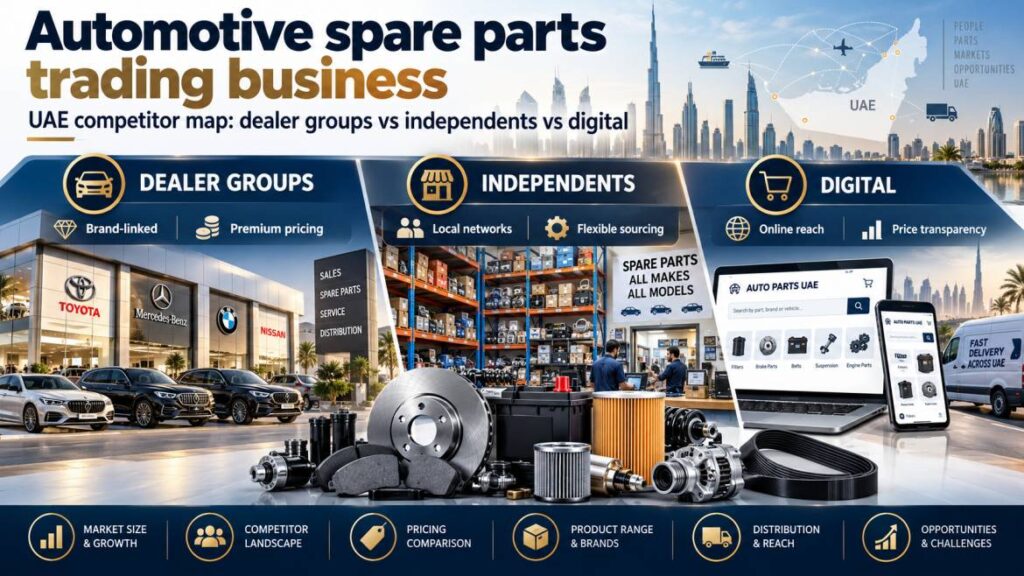
Having parts in stock is not a differentiator. The proposition that wins workshop accounts is fast and correct part identification by VIN or OE number, high fill rates on the vehicle makes you target, three price tiers, same-day delivery and warranty claims that actually get processed. That is why a skilled parts interpreter is often worth more to you than another salesperson: every wrong part costs you two deliveries, a return and a customer’s downtime.
The Free Zone Myth: “No Customs Duty and 0% Tax”
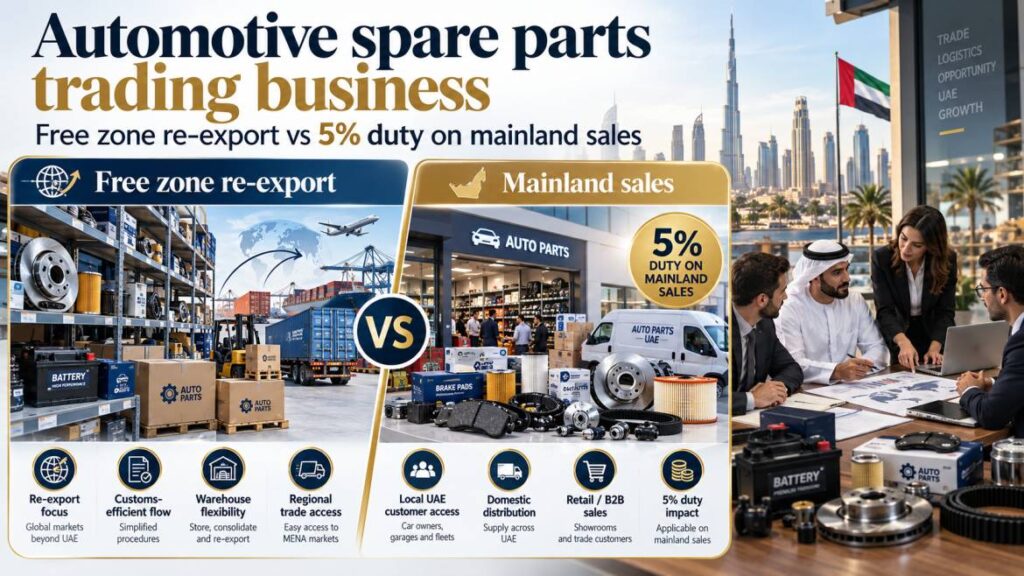
Several setup guides for this exact business still promise 100% customs exemption and 0% corporate tax in a free zone. Both claims are incomplete, and for a parts trader the gap is expensive.
Customs duty. Dubai Customs applies a general duty of 5% of the CIF value (cost, insurance and freight). Goods held in a free zone and re-exported avoid it, but the moment stock moves from the zone to a mainland garage, it is an import and duty applies. If most of your customers are in the UAE, the free zone saves you very little on duty.
Corporate tax. The Ministry of Finance treats free zone companies as taxable persons. Only a Qualifying Free Zone Person earns 0% on qualifying income, and other taxable income is taxed at 9%. Distribution of goods in or from a Designated Zone can qualify, subject to conditions, which is why the contract flow between supplier, free zone warehouse, UAE customer and GCC customer has to be designed before you sign anything. I explained the wider version of this in why your free zone licence and the corporate tax law can both be right.
VAT. At these turnover levels, VAT registration is compulsory from day one, since the mandatory threshold is AED 375,000 of taxable supplies and imports. VAT on imports also hits cash flow before you recover it.
Product conformity. This is the step most competitor guides skip entirely. The UAE has a specific conformity scheme for automotive spare parts, and MoIAT issues conformity certificates for regulated products, including brake systems, brake pads, radiators, seat belts and vehicle batteries. A trade licence does not replace product approval. My rule for clients is simple: no compliance check, no purchase order.
Automotive Spare Parts Trading Business Setup Costs
Licensing is a small share of the total. Inventory, warehouse space and receivables decide your real capital requirement. The figures below are advisory planning ranges for a business that holds its own stock, not government fee schedules, and your actual quote depends on emirate, warehouse size and staffing.
| Cost item | Lean domestic distributor (AED) | Regional distributor (AED) |
|---|---|---|
| Incorporation, licences and professional setup | 25,000 to 50,000 | 40,000 to 80,000 |
| Visas, establishment and admin | 20,000 to 40,000 | 35,000 to 70,000 |
| Warehouse rent and deposit, or 3PL onboarding | 150,000 to 300,000 | 350,000 to 700,000 |
| Racking, fit-out and fire safety | 80,000 to 180,000 | 250,000 to 500,000 |
| ERP, warehouse system, catalogue and e-commerce | 50,000 to 120,000 | 150,000 to 350,000 |
| Delivery vehicles and handling equipment | 120,000 to 250,000 | 300,000 to 700,000 |
| Initial inventory | 1.2 to 2.0 million | 3.0 to 5.0 million |
| Compliance testing and launch | 30,000 to 75,000 | 80,000 to 150,000 |
| Cash contingency | 300,000 to 600,000 | 700,000 to 1.2 million |
| Indicative total | about 2.0 to 3.6 million | about 4.9 to 8.8 million |
Every landed cost should be built from the exact HS code of each product, not one code for the whole catalogue: supplier price, freight, insurance, 5% duty on CIF where it applies, clearance, conformity testing, UAE delivery and a warranty and returns provision. A lean team typically runs 9 to 14 people, including parts interpreters, field sales, warehouse staff and a credit controller.
Working Capital and Break-Even Potential
Spare parts distributors rarely fail on paper profit. They fail on cash. Take an AED 8 million first year at a 24% gross margin, holding 90 days of stock, giving customers 45 days and getting 30 days from suppliers. Inventory ties up about AED 1.5 million, receivables about AED 0.99 million, and supplier credit gives back about AED 0.5 million. That leaves roughly AED 2.0 million of working capital, and it rises to about AED 3.3 million at AED 13.5 million of sales. Growth eats cash even while profit goes up.
| Scenario | Year 1 revenue (AED) | Year 1 EBITDA (AED) | Year 3 revenue (AED) | Year 3 net profit (AED) |
|---|---|---|---|---|
| Conservative (20% to 22% margin) | 5.5 million | -200,000 | 8.5 million | 230,000 |
| Base (24% to 25% margin) | 8.0 million | 420,000 | 13.5 million | about 1.14 million |
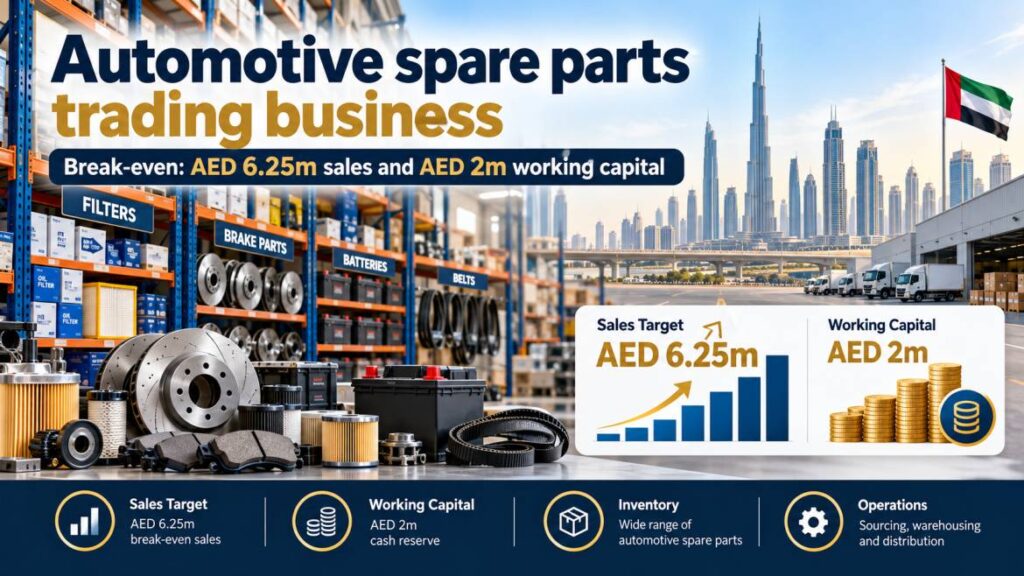
In the base case, cash break-even comes at AED 1.5 million of operating cost divided by a 24% margin, which is about AED 6.25 million of annual sales, or about AED 6.75 million once depreciation is included. In practice, AED 7 to 8 million of first-year sales capacity is the threshold for a full warehouse model. Below that, use a 3PL, outsourced delivery and a narrower range to cut fixed cost.
Margin is the lever that moves everything. At AED 8 million of sales, each percentage point of gross margin is worth AED 80,000 a year, so a four-point slip from 24% to 20% wipes out AED 320,000. That is why I measure procurement on gross margin return on inventory (annual gross profit divided by average inventory cost), fill rate and ageing stock, not on how cheaply they buy. A filter earning 15% that turns ten times a year usually beats an electronic part earning 40% that sits for eighteen months.
Using the UAE as a Base for an International Spare Parts Trading Business
The UAE is not only a local market. It works as a regional stock point between the world’s parts factories and the GCC, Africa and South Asia. In 2024 the UAE imported about US$1.27 billion of HS 8708 parts and accessories from Japan and about US$571 million from China, with Korea, Europe, the US and India also significant sources.
| Sourcing market | Role in your range |
|---|---|
| Japan | Genuine and OE parts for the large Japanese vehicle base |
| China | Value independent aftermarket ranges, with strict quality checks |
| South Korea | Hyundai and Kia applications |
| Europe (Germany, Italy) | Premium braking, suspension and drivetrain brands |
| India | Filters, friction parts and commercial-vehicle categories |
On the selling side, a sensible expansion order is UAE first, then Oman and Saudi Arabia, then the rest of the GCC, then East Africa and the wider region. Saudi Arabia gives scale and Oman gives road access. Each destination needs its own landed-cost model, because duties, conformity rules and payment terms differ market by market. The broader trade logic is in how the UAE works as a re-export hub.
Where you hold stock depends on the model. JAFZA is the strongest base for a re-export distributor, with port adjacency and a dense automotive cluster. Dubai South suits mixed sea-air and urgent e-commerce orders, as I covered in the Dubai South logistics corridor. KEZAD at Khalifa Port suits heavy-vehicle and industrial supply in Abu Dhabi. A domestic-first distributor is often better in Ras Al Khor or Al Quoz, where same-day workshop delivery matters more than being next to a port.
One current risk belongs in every plan. Shipping disruption around the Strait of Hormuz in 2026 means holding 60 to 90 days of safety stock on your fastest movers, keeping an air-freight fallback and never relying on a single supplier for a critical category.
Licensing Strategy: Three Routes for Three Business Models
Automotive spare parts trading is a commercial trading activity, and the right licence follows your revenue model, not the other way round. Confirm the exact activity wording with the authority before you apply, because spare parts, batteries, lubricants, tyres, heavy-equipment parts and e-commerce can each sit under separate activity codes. The broader trade-offs are in mainland vs free zone vs offshore.
| Your model | Best route | Why |
|---|---|---|
| Asset-light: sourcing, brokerage, digital catalogue or direct shipment, no UAE warehouse yet | SRTIP (SPARK) free zone, from about AED 5,500 | Lowest fixed cost while you prove suppliers, buyers and margins |
| Domestic distributor, 60% to 70% or more of sales to UAE garages and fleets | Mainland trading company with a mainland warehouse or 3PL | Cleanest structure for direct UAE sales, with 100% foreign ownership generally available |
| Regional distributor holding bonded stock for re-export | JAFZA or another designated zone | Port access, bonded storage and a possible 0% rate on qualifying distribution income |
Why I Recommend SRTIP (SPARK) for the Asset-Light First Stage
Most founders do not need AED 2 million of stock on day one. They need to prove three things first: that a supplier will give them credible terms, that real buyers will order, and that the margin survives landed cost. For that stage, a SRTIP (SPARK) free zone licence is the most cost-efficient base I work with. SPARK’s packages start from around AED 5,500 for a zero-visa licence, close to AED 13,990 with one visa and around AED 17,795 with two visas. That AED 5,500 covers the licence only, not visas, office upgrades or renewals, and I break down every layer in the full SPARK free zone cost guide.
It fits these models well:
- A sourcing or trading company that ships parts directly from Japanese, Chinese or Indian suppliers to buyers in the GCC or Africa, without holding UAE stock.
- A parts technology business: VIN and OE cross-reference catalogues, B2B ordering platforms or fleet maintenance software, which is the mobility and automotive innovation SPARK is built for.
- An EV and advanced components business, which links to SPARK’s focus on advanced manufacturing, aerospace and automotive.
Beyond the licence, SPARK gives you access to an accelerator, mentorship and an investor network, which matters if your model is a parts platform rather than a warehouse. I cover that in what the SRTIP SPARK accelerator offers founders and SRTIP for mobility and logistics digitisation, and the application steps are in the SPARK setup process.
The honest limit: SPARK is a research, technology and innovation park, not a bonded logistics zone, so it is not where a high-volume stock-holding import and re-export operation should sit. I set that out plainly in who should not choose SPARK free zone. Once you hold significant UAE inventory, the right next step is a mainland entity for domestic sales or a JAFZA entity for re-export, and confirming your exact trading activity with SPARK before you apply is part of my process. Starting lean on SPARK and moving stock into the right zone once the numbers are proven is usually cheaper than funding a warehouse for a model that has not been tested.
My Approach: Prove the Margin Before You Fund the Warehouse
Most business setup consultants help you register a company. I help you make informed business decisions before you invest.
For an automotive spare parts trading business, that means I start with your supplier terms, target vehicle makes and customer mix, then build the landed-cost and working-capital model before we choose between SPARK, mainland and JAFZA. If the numbers only work at AED 8 million of sales and you can fund AED 1 million, I will tell you that, and show you the asset-light route that lets you prove the model first.
My advisory process focuses on helping you reduce uncertainty and make confident decisions, not just complete documentation.
What you can expect when you work with me:
- Business idea validation for your chosen parts category and vehicle makes
- Market research on UAE and GCC demand for your range
- Competitor analysis covering dealer groups, independents and digital platforms
- A landed-cost model built from HS codes, duty, freight and conformity costs
- A working-capital and break-even model for your stock and credit terms
- Business structure selection between SPARK, mainland and JAFZA
- Activity wording that covers parts, batteries, lubricants or e-commerce as needed
- A MoIAT conformity checklist for regulated categories before your first order
- Corporate tax and VAT flow planning for free zone, mainland and GCC sales
- Business bank account strategy for a trading company
- Investor and employment visa planning for your team
- An expansion plan for Oman, Saudi Arabia and beyond
The objective is simple: help you start your business with clarity, confidence and a long-term strategy.
Is This the Right Business for You?
This business fits you if you can secure credible supplier access, have, or can raise, enough capital for both opening stock and about AED 2 million of first-year working capital in a full distribution model, and can name 30 to 50 garages, fleets or resellers likely to buy from you. It also fits if you already have overseas buyers and want a UAE base to supply them, in which case the asset-light route is the place to start.
It does not fit if your plan is a generic shop stocking everything for every car, if you intend to compete only on being the cheapest, or if you are not prepared to run strict customer credit. Bad receivables can erase a 24% gross margin quickly.
Frequently Asked Questions
Is an automotive spare parts trading business profitable in the UAE?
It can be, but margins are thin. In the base-case model, an AED 8 million first year at a 24% gross margin produces about AED 420,000 of EBITDA, rising to about AED 1.14 million of net profit in Year 3. In the conservative case, profit only appears in Year 3.
How much does it cost to start an automotive spare parts trading business in Dubai?
A lean distributor holding its own stock needs about AED 2.0 to 3.6 million, mostly for inventory. A regional distributor needs about AED 4.9 to 8.8 million. An asset-light trading company without a UAE warehouse can start on a SRTIP (SPARK) licence from around AED 5,500, licence only.
Which licence do I need for auto spare parts trading in the UAE?
You need a trading licence with the correct spare parts activity. Choose mainland if most sales are to UAE garages and fleets, JAFZA or another designated zone for bonded re-export stock, and SPARK for an asset-light sourcing, brokerage or parts technology model.
Do free zone spare parts companies pay customs duty and corporate tax?
Goods re-exported from a free zone avoid UAE duty, but goods sold into the mainland pay the 5% CIF duty on entry. Free zone companies are taxable persons, and only a Qualifying Free Zone Person earns 0% on qualifying income, with other income taxed at 9%.
Do spare parts need approval before import into the UAE?
Regulated categories do. The UAE has a conformity scheme for automotive spare parts, and MoIAT issues conformity certificates for products such as brake pads, brake systems, radiators, seat belts and batteries. Check each product’s HS code and conformity status before you place an order.
How long does a spare parts business take to break even?
In the base case, cash break-even comes at about AED 6.25 million of annual sales, so a distributor reaching AED 7 to 8 million in Year 1 can be EBITDA-positive in its first year. A slower start at AED 5.5 million stays loss-making until about Year 3.
Can I use the UAE as a base for international spare parts trading?
Yes. The UAE sources parts from Japan, China, Korea, Europe and India and re-exports across the GCC, Africa and South Asia. Start with Oman and Saudi Arabia, model each market’s landed cost separately, and hold bonded stock in JAFZA once volumes justify it.
Is SRTIP (SPARK) suitable for an automotive spare parts trading business?
It suits the asset-light stage: sourcing, brokerage, direct-shipment trading and parts technology such as VIN catalogues and B2B ordering platforms, from about AED 5,500. It is not a bonded logistics zone, so a stock-heavy re-export operation belongs in JAFZA or on the mainland.
What spare parts sell best in the UAE?
Repeat maintenance and wear items turn fastest: filters, brake pads and discs, batteries, belts and hoses, suspension parts, and cooling and AC components. Heat makes batteries, cooling and AC parts especially strong, so build that stock between March and May.
Related Reading
- SRTIP SPARK Accelerator: What It Offers Founders
- SPARK Free Zone Cost 2026: Licence, Visa, Office and Hidden Setup Costs
- SRTIP for Mobility and Logistics Digitisation
- SRTIP for Advanced Manufacturing, Aerospace and Automotive
- The UAE as a Re-Export Hub
- Why Fujairah Free Zones Suit Trading Companies
- Should You Start an E-commerce Business in the UAE?
- Mainland vs Free Zone vs Offshore in 2026