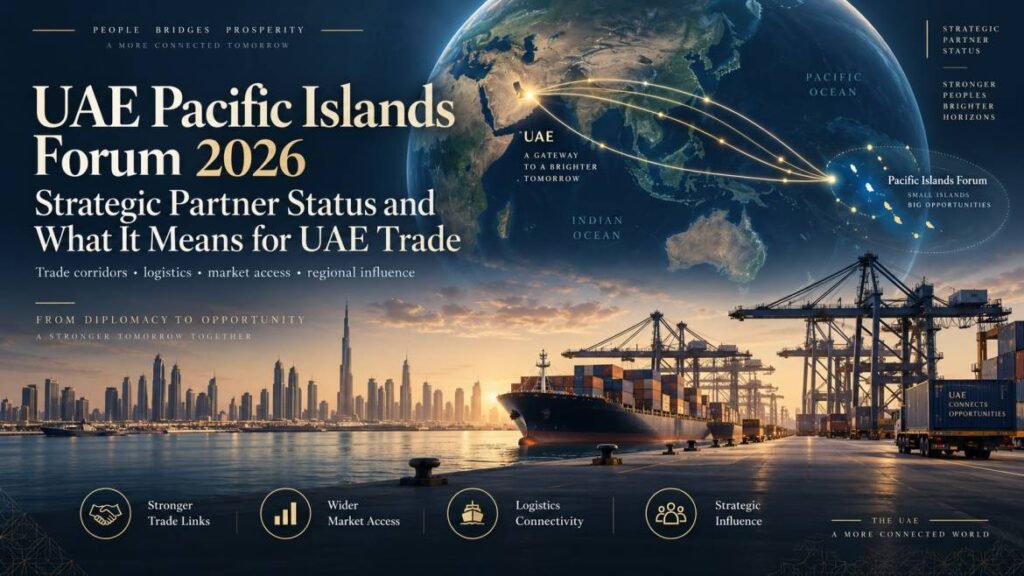
The UAE Pacific Islands Forum partnership didn’t come with a trade agreement attached. The UAE joined a forum, as one of thirteen Strategic Partners, and the difference between that and a binding trade deal is worth understanding before anyone reads more into this than the announcement actually says.
Quick Answer: What the UAE Pacific Islands Forum Partnership Actually Is
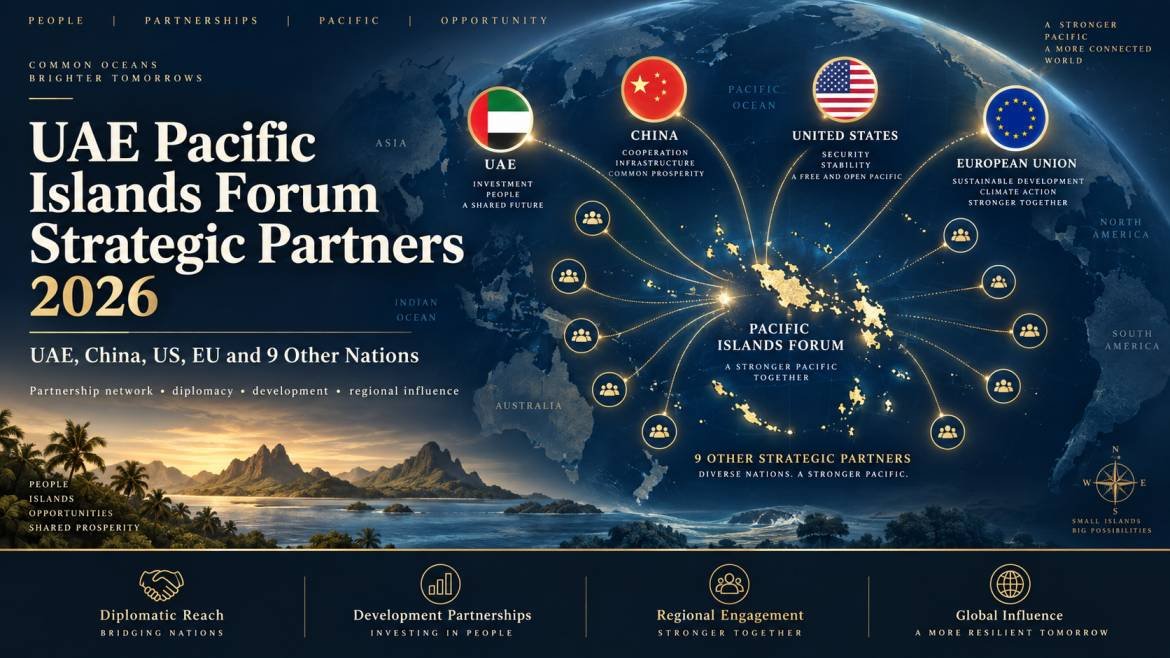
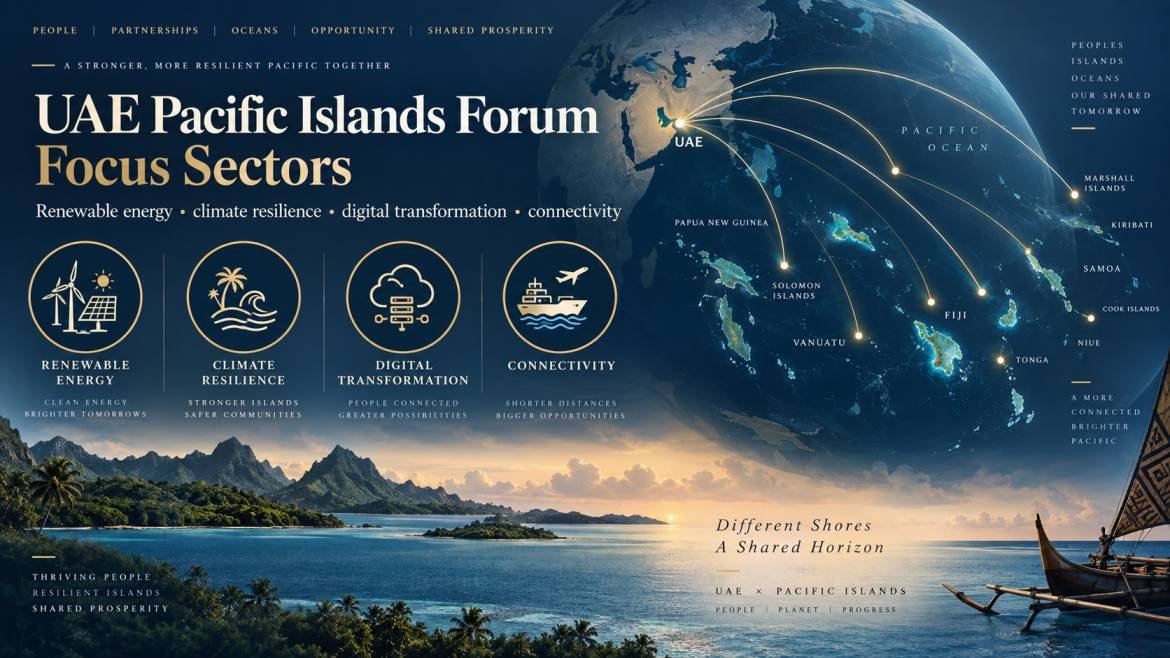
On September 18, 2026, the UAE was named a Strategic Partner of the Pacific Islands Forum (PIF) at the 55th PIF Leaders’ Meeting in Koror, Palau. Minister of State Noura Al Kaabi represented President Sheikh Mohamed bin Zayed Al Nahyan at the announcement. The UAE Pacific Islands Forum partnership places the UAE alongside 12 other Strategic Partners, including China, the US, France, Germany, the UK, Canada, Japan, India, Indonesia, Singapore, South Korea and the EU. It covers renewable energy, climate resilience, education, sustainable development, energy transition, digital transformation and connectivity. It is a cooperation framework, not a binding trade agreement, so it does not itself create tariff or market access changes the way a CEPA does.
- What the Partnership Actually Involves
- Strategic Partner Status Is Not a Trade Agreement
- Why the UAE Keeps Doing This
- The Seven Named Sectors
- What This Actually Means If You’re Building or Expanding a Business
- My Approach: Reading Diplomatic Signals as Business Decisions, Not Headlines
- Is This Worth Acting On Right Now?
- Frequently Asked Questions
- Sources & References
What the UAE Pacific Islands Forum Partnership Actually Involves
The Pacific Islands Forum is the main political and economic grouping of Pacific Island nations. Strategic Partner status is PIF’s mechanism for formalizing cooperation with non-member countries and blocs, and the UAE now sits alongside 12 other Strategic Partners, several of which (China, the US, Japan, India, the EU) are among the world’s largest economies.
Al Kaabi described the partnership as building “on years of close co-operation with the nations of the Pacific, grounded in mutual respect and a shared commitment to sustainable development.” Omar Shehadeh, the Foreign Ministry’s envoy to the Caribbean and Pacific States, framed it as creating “new avenues for collaboration with Pacific nations, strengthening connectivity and working towards our shared goals for a more resilient and prosperous future.” Neither statement names a specific mechanism, investment figure, or timeline, and no outlet covering the announcement has reported one either.
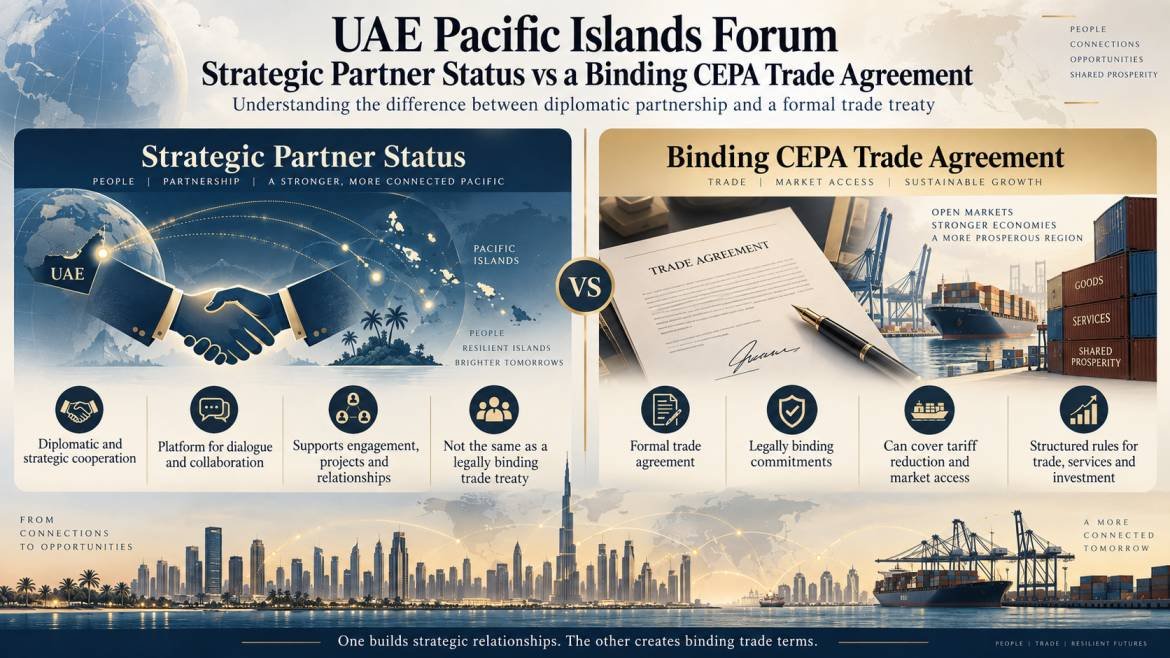
Strategic Partner Status Is Not a Trade Agreement
This is the point most coverage of this story skips, and it’s the one most likely to cause confusion given the UAE’s own track record with actual trade agreements.
A Comprehensive Economic Partnership Agreement (CEPA), which the UAE has now concluded with 37 countries (18 in force as of July 2026), is a binding bilateral agreement that reduces or removes tariffs, sets specific market access terms, and creates enforceable trade rules between the two signing parties. The UAE’s non-oil trade under and around its CEPA network passed USD 1 trillion in 2025.
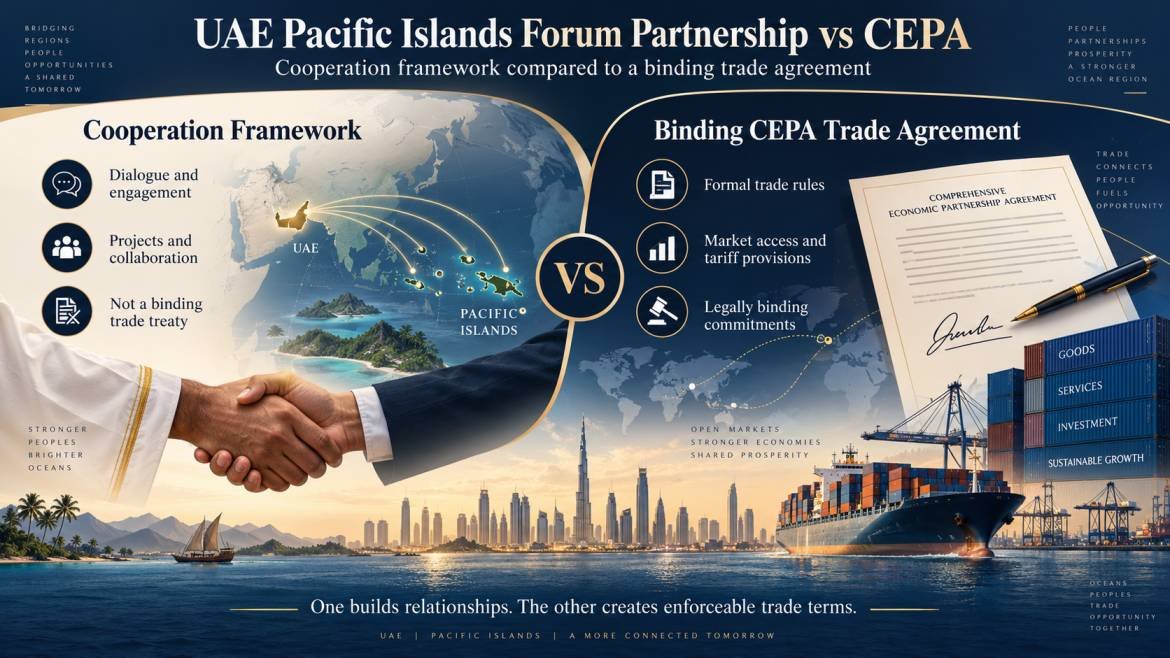
The UAE Pacific Islands Forum partnership is a different instrument entirely. It’s a cooperation framework between the UAE and a regional forum of 18 Pacific nations, not a bilateral agreement with binding trade terms. It signals where the UAE intends to deepen ties, in the sectors named (renewable energy, climate resilience, digital transformation, connectivity, education), but it does not, on its own, change a single tariff line, licensing requirement, or market access rule for a business trying to trade with or invest in the Pacific region today.
That distinction matters if you’re the kind of founder or investor who reads a headline like this and wonders whether it opens a new market overnight. It doesn’t, not yet. What it does is tell you where the UAE’s government is likely to put diplomatic and, eventually, trade infrastructure next.
Why the UAE Keeps Doing This
This announcement isn’t an isolated diplomatic gesture. It’s the latest instance of a pattern the UAE has run consistently for several years: use non-oil economic diplomacy, CEPA agreements, sovereign wealth deployment, and now forum-level partnerships, to build economic relationships with regions that were historically outside its trade focus.
The UAE’s CEPA program alone has gone from a handful of agreements to 37 concluded and 18 in force in under five years. Its sovereign wealth funds (ADIA, Mubadala, ADQ) manage close to USD 2.93 trillion in combined assets, the fourth largest pool of state-owned investment capital globally, and have been actively diversifying into new geographies and sectors. The UAE Pacific Islands Forum partnership fits the same logic: establish the relationship and the cooperation framework first, in sectors where the UAE already has real capability and capital, and let the trade and investment mechanisms follow once the relationship is established.
Read that way, this week’s news is less a standalone story and more a marker in a pattern that’s been building for years.
Compare the trajectory: the UAE’s first CEPA agreements were signed from 2021 onward, and by mid-2026 the program had grown to 37 concluded deals with 18 in force. If the Pacific Islands Forum partnership follows even a loosely similar trajectory, from cooperation framework to something with actual trade terms, that shift is more likely to be measured in years than in months. That is precisely why treating this as an early signal, not an immediate opportunity, is the more accurate read.
The Seven Named Sectors: What Each Could Mean for a UAE-Based Business
The official statements name seven areas of cooperation: renewable energy, climate resilience, education, sustainable development, energy transition, digital transformation and connectivity. None of them come with a budget, a timeline or a named program yet, but each maps onto capability the UAE has already built at home, so each is worth watching for a different reason depending on where your business sits.
Renewable energy and energy transition. The UAE has spent over a decade building solar and clean-energy capacity domestically and exporting that expertise through its sovereign wealth vehicles and state-linked energy companies. A cooperation framework naming this sector is a plausible early marker for where renewable-energy project financing, technology transfer or advisory work could eventually travel, though nothing announced so far commits capital to it.
Climate resilience and sustainable development. Pacific Island nations face some of the most direct climate exposure of any region in the world, and the UAE has positioned itself, particularly since hosting COP28, as a climate-finance and adaptation partner to vulnerable states. Businesses in climate-adaptation infrastructure, resilient construction or sustainability consulting sit closest to this thread if it develops further.
Education. UAE-based education exporters, from higher-education partnerships to vocational and technical training providers, are the most direct beneficiaries if this sector turns into anything concrete. It is also, realistically, the sector most likely to move fastest, since education partnerships rarely require the regulatory machinery a binding trade agreement does.
Sustainable development, on its own. Separate from climate resilience specifically, sustainable development as a named sector is broader: economic diversification, resilient infrastructure, job creation and non-oil growth. It is the closest match to the UAE’s own domestic diversification playbook of the last decade, and the sector where UAE free zones have the most existing capacity to absorb new partnerships without building anything new first. Businesses in urban planning, infrastructure advisory, or diversification-linked consulting are the ones best placed to notice if this sector moves from a named intention to an actual program.
Digital transformation and connectivity. UAE free zones have been actively licensing fintech, digital-infrastructure and telecom-adjacent businesses for years, and digital economy diplomacy has been a standing UAE government priority well beyond this announcement. Connectivity in particular is the vaguest of the seven named sectors, spanning everything from undersea cable and telecom infrastructure to logistics and market-access facilitation, which makes it the one worth the closest reading once, or if, a formal work plan is published.
The same caveat applies across all seven: a cooperation framework naming a sector is not the same as a funded program in that sector. But if your business already sits in one of these seven, watching this partnership is a lower-cost way to track UAE-Pacific developments early than waiting for a CEPA-style agreement that, based on the UAE’s own track record, could take one to two years to materialize, if it materializes at all.
What This Actually Means If You’re Building or Expanding a Business
Here’s where most coverage of this story stops short, and where the honest answer has to include a caveat rather than a promise.
What it doesn’t mean, yet. No new tariff reduction, no new market access right, no new visa or licensing pathway specific to Pacific Island trade exists today because of this announcement. If your business needs an actual binding trade mechanism to justify an expansion decision, this isn’t one, a CEPA is.
What it does mean. It’s a reliable early signal of where UAE government attention, and eventually capital and trade infrastructure, is likely to go next. The sectors named, renewable energy, climate resilience, digital transformation and connectivity, are the same sectors the UAE has been building out domestically (its free zones increasingly license precisely this kind of activity). A business already positioned in one of those sectors, and structured to trade internationally from a UAE base, is better placed to benefit if and when this cooperation framework produces actual trade mechanisms than a business that waits to react after the fact.
The realistic timeline. CEPA agreements typically take one to two years from initial framework to signed agreement. There’s no published timeline for whether or how the UAE Pacific Islands Forum partnership will formalize into anything with binding trade terms, and it may not. Treat this as a signal worth watching, not a market that’s open for business today.
My Approach: Reading Diplomatic Signals as Business Decisions, Not Headlines
Most business setup consultants help you register a company. I help you make informed business decisions before you invest.
A headline like this one gets forwarded around WhatsApp groups and LinkedIn within hours of publishing, usually stripped of the distinction between a cooperation framework and an actual trade mechanism. The question that actually matters for your business isn’t whether the UAE joined a forum, it’s whether your structure, sector, and market strategy are positioned to benefit if this relationship develops into something with real trade terms, the way CEPA agreements have. My advisory process focuses on helping you reduce uncertainty and make confident decisions, not just complete documentation.
What you can expect:
- A clear read on whether a piece of UAE economic or trade news is a binding change or a directional signal, before you act on it
- Sector positioning guidance if your business sits in renewable energy, digital transformation, connectivity, or another sector the UAE is actively building diplomatic and trade relationships around
- A structured comparison of which UAE trade mechanisms (CEPA, free zone licensing, forum partnerships) actually apply to your specific expansion target
- Market research and competitor analysis before you commit to a jurisdiction or a new trade corridor
- Business plan and financial feasibility work grounded in verified data, not recycled headline claims
- Structure and licensing recommendations that match your actual business model, not the fastest authority to process
- Investor and visa planning aligned to your growth strategy
- Banking strategy that accounts for the market you’re actually trying to reach
- Risk assessment specific to your industry and target region
- Independent research, cross-checked against primary sources, not resold formation-agent talking points
- A second opinion before you commit capital, not after
- Ongoing advisory as UAE trade and diplomatic relationships actually develop into binding terms
The objective is simple: help you start and grow your business with clarity, confidence and a long-term strategy that holds up as UAE trade relationships and diplomatic partnerships continue to evolve.
If you’re evaluating how a shifting UAE trade and diplomatic landscape fits into your own market expansion strategy, or you’re still deciding on your broader business setup approach, that’s exactly the groundwork worth doing before you react to the next headline like this one.
Is This Worth Acting On Right Now?
Worth watching closely if:
- Your business is in renewable energy, climate resilience, digital transformation, or connectivity infrastructure
- You’re already structured to trade internationally from a UAE base and are evaluating new markets
- You track UAE economic diplomacy as a leading indicator for where trade infrastructure gets built next (the way CEPA expansion has been a useful indicator historically)
- You’re structured to trade internationally from a UAE base already and want a low-cost way to monitor early signals before competitors do
Not yet actionable if:
- You need a binding trade mechanism (tariff reduction, market access right) to justify a specific expansion decision today
- Your business model depends on a defined trade corridor or licensing pathway to the Pacific region existing right now, it doesn’t yet
Frequently Asked Questions
Does the UAE Pacific Islands Forum partnership create a new trade agreement?
No. It’s a cooperation framework, not a binding trade agreement. It doesn’t change tariffs, market access, or licensing rules on its own. A CEPA is the UAE’s actual trade agreement mechanism, and this is a different instrument.
Who else has Strategic Partner status with the Pacific Islands Forum?
Twelve others: China, the United States, France, Germany, the United Kingdom, Canada, Japan, India, Indonesia, Singapore, South Korea and the European Union. The UAE is the newest addition as of September 2026.
What sectors does the UAE-PIF partnership actually cover?
Renewable energy, climate resilience, education, sustainable development, energy transition, digital transformation and connectivity, based on the official statements from Minister of State Noura Al Kaabi and envoy Omar Shehadeh.
Is this related to the UAE’s CEPA trade agreements?
Not directly. It follows the same broader UAE strategy of expanding economic diplomacy into new regions, but CEPA agreements are binding bilateral trade deals (37 concluded, 18 in force as of July 2026). PIF partnership status is a cooperation framework with no comparable binding trade terms.
Should this change my UAE market entry or expansion plans right now?
Not on its own. Treat it as a signal of where UAE trade infrastructure may develop next, particularly if your business sits in one of the named sectors, rather than as an opening of a new market today.
If you want a second opinion on whether a specific UAE trade or diplomatic development changes your own expansion timeline, that’s the kind of question worth a direct conversation rather than a generic answer, since the right call depends on your sector, structure and target market.
Where can I read the UAE’s own statement on this?
The Ministry of Foreign Affairs published its statement on mofa.gov.ae, and the Emirates News Agency (WAM) carried the official release on wam.ae.
Has the UAE approached other regions this way before?
Yes. CEPA negotiations also tend to start as smaller framework-level conversations before becoming binding agreements, so a cooperation framework preceding a possible trade mechanism is consistent with how the UAE has approached economic diplomacy in other regions. That is not a guarantee the Pacific Islands Forum partnership follows the same path, only that it would not be unprecedented if it did.
Sources & References
- Emirates News Agency (WAM), official UAE government news wire
- UAE Ministry of Foreign Affairs (mofa.gov.ae), official statement
- The National
- Khaleej Times
- Gulf News