Quick Answer: A gold tokenization business in Dubai needs a VARA Category 1 ARVA (Asset Referenced Virtual Asset) authorisation, AED 1.5 million in paid-up capital, and fully allocated gold custody. Most founders route through DMCC, the free zone that already runs Dubai’s physical gold trade, before applying to VARA. Realistic timeline is 8 to 12 months, and licensing is only the second decision, not the first.
In this guide
What Gold Tokenization Actually Means
Gold tokenization is the process of issuing a blockchain-based digital token that represents a claim on physical gold. Each token is backed by an identifiable quantity of gold held in custody, and the token itself trades and settles on a blockchain rather than through a bullion dealer’s ledger.
This is a narrower business than tokenization in general. My earlier guide on tokenization in the UAE covers real estate, funds and other real-world assets. Gold has its own regulatory path, because Dubai’s Virtual Assets Regulatory Authority (VARA) classifies a gold token as an Asset Referenced Virtual Asset (ARVA) the moment it represents ownership of, or entitlement to the value of, an underlying commodity. The label a project gives itself does not matter. What matters is the structure: if the token references gold’s value, VARA treats it as an ARVA and the full Category 1 licensing regime applies.
Why Dubai, and Why DMCC Specifically
Dubai is not a natural entrant into gold tokenization. It is the market gold tokenization is trying to digitise.
The emirate handles roughly 15% of world gold trade, and the majority of that volume moves through the Dubai Multi Commodities Centre (DMCC), the free zone built around Almas Tower in Jumeirah Lakes Towers. DMCC operates precious metals vaults, a refinery grid and jewellery manufacturing facilities, and its members trade on the Dubai Gold and Commodities Exchange (DGCX), which reported 5.4 million contracts worth USD 115.3 billion in 2023, a 78% year-on-year increase in gold contract volume.
This is the gap most gold tokenization content misses. Coverage of the regulatory side treats VARA as the whole story and stops there. DMCC is not a footnote. It is the free zone that already runs the physical gold infrastructure a token issuer needs: allocated vaulting through operators like Brink’s, the UAE Good Delivery (UAEGD) standard for responsible sourcing, and DMCC Tradeflow, its existing platform for commodity registration and collateral management. DMCC also piloted gold-backed crypto assets through its Tradeflow platform, and in June 2026 signed a non-binding memorandum of understanding with Tether covering commodity tokenization, blockchain advisory and digital payments infrastructure. That MoU does not grant any company a licence. It signals where DMCC intends its ecosystem to go.
The practical route most founders take for a gold tokenization business in Dubai is DMCC company registration and trading licence first, VARA Category 1 ARVA application second. The free zone gives you the physical gold relationship and the corporate base. VARA gives you the right to issue the token.
DMCC vs DIFC vs ADGM: Choosing Your Base
DMCC is not the only base available to a gold tokenization business. DIFC and ADGM both host virtual asset activity under their own regulators, and the right choice depends on your model, not on which zone is best known.
| Free Zone | Regulator | Best Fit |
|---|---|---|
| DMCC | VARA (Dubai) | Physical gold custody, vaulting relationships, commodity trading ties, retail-facing gold tokens |
| DIFC | DFSA | Institutional structures, funds wrapping gold exposure, cross-border financial instruments |
| ADGM | FSRA | Fund vehicles, Abu Dhabi-based institutional capital, entities wanting an alternative to Dubai’s virtual asset regime |
A gold tokenization business built around DMCC’s existing vault relationships and DGCX-adjacent trading activity has little reason to structure through DIFC or ADGM instead. A gold-backed fund aimed at institutional investors may find DFSA’s regime a better fit. This decision belongs at the start of structuring, not after a DMCC company is already registered.
Market Opportunity: Why Now
Tokenized gold is still a small market relative to physical gold, and that gap is exactly the opportunity. On-chain tokenized gold totalled roughly USD 5.1 billion as of mid-September 2026, against a physical gold market worth an estimated USD 30.1 trillion. That is under 0.02% of the physical market represented on-chain. Two tokens, Tether Gold (XAUt) and Pax Gold (PAXG), account for between 89% and 98% of all tokenized gold supply between them, which leaves the category concentrated and, for a well-structured new entrant, genuinely open.
The growth trajectory is the more interesting number. Tokenized gold’s total market cap was below USD 1.5 billion in late 2024. By Q1 2026, first-quarter spot trading volume alone reached approximately USD 90.7 billion, more than the entire USD 84.64 billion traded across all of 2025. That is roughly 18 times the total market cap changing hands in a single quarter, evidence of real trading activity rather than a static holding market.
Three demand drivers sit behind that growth, and none of them are specific to any one token issuer. Physical gold’s spot price crossed USD 5,000 per ounce in January 2026, pulling investor attention toward gold generally. Central banks purchased an estimated 1,200 tonnes of gold in 2025, with a majority of surveyed institutions planning to increase holdings further. And institutional inflows into regulated gold token products are now measured in the hundreds of millions per month, not experimental pilot sums. None of this guarantees success for a new gold tokenization business in Dubai. It does mean the underlying demand for gold exposure is real and growing, which is a more useful starting point than assuming demand exists because the technology is available.
The VARA Licensing Framework
VARA regulates virtual assets in Dubai outside DIFC, and a gold-backed token issuer needs its Category 1 Virtual Asset Issuance authorisation before any token goes to market, including before any pre-sale.
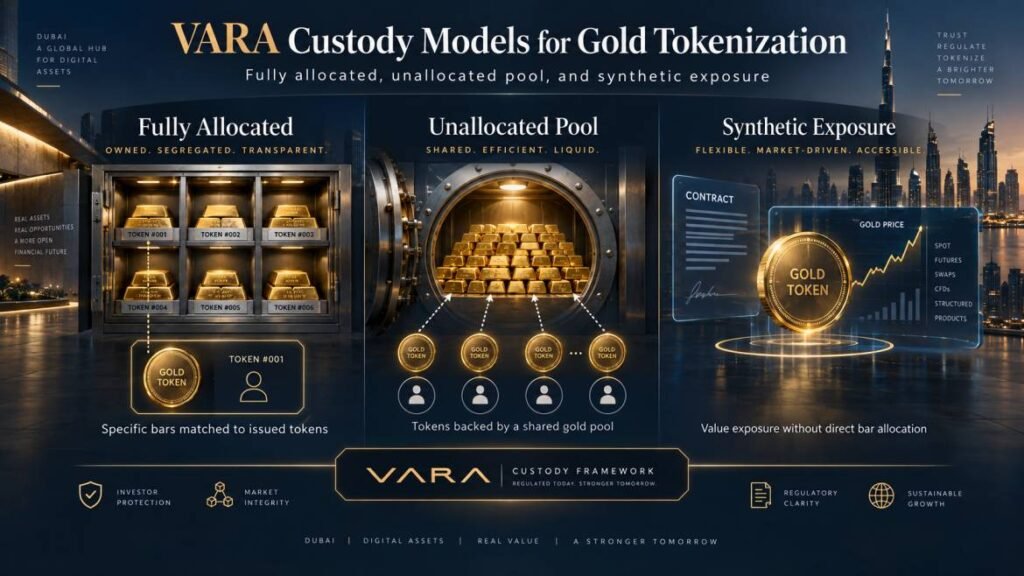
Custody comes first, structurally. VARA’s framework distinguishes three custody models, and the choice shapes everything downstream in the application.
- Fully allocated custody. Each token maps to individually identified, segregated gold bars. This is VARA’s preferred model and the one that draws the least regulatory friction.
- Unallocated pool custody. Token holders have a proportionate claim on a shared pool of gold rather than specific bars. This carries materially higher regulatory scrutiny.
- Synthetic or derivative exposure. The token tracks gold’s price without physical backing. VARA treats this as the highest-risk structure, and it invites the most questions during review.
Fully allocated custody is not just the safer choice ethically. It is the structure that moves through VARA review with the fewest follow-up queries, and it is the model behind both of the market’s dominant tokens today.
Whitepaper requirements are substantive, not procedural. VARA expects the offering whitepaper to disclose issuer identity, exact gold specifications and purity, the storage location, the custodian’s identity, the valuation methodology, redemption terms, and what happens to token holders’ claims in an insolvency scenario. A whitepaper written to sound reassuring rather than to answer these questions directly is the single most common reason applications stall.
Licensing Costs and Capital Requirements
| Requirement | Amount |
|---|---|
| VARA Category 1 application fee | AED 100,000 |
| VARA annual supervision fee | AED 200,000 |
| Minimum paid-up capital | AED 1,500,000 |
| Net liquid assets requirement | 1.2x monthly operating expenses |
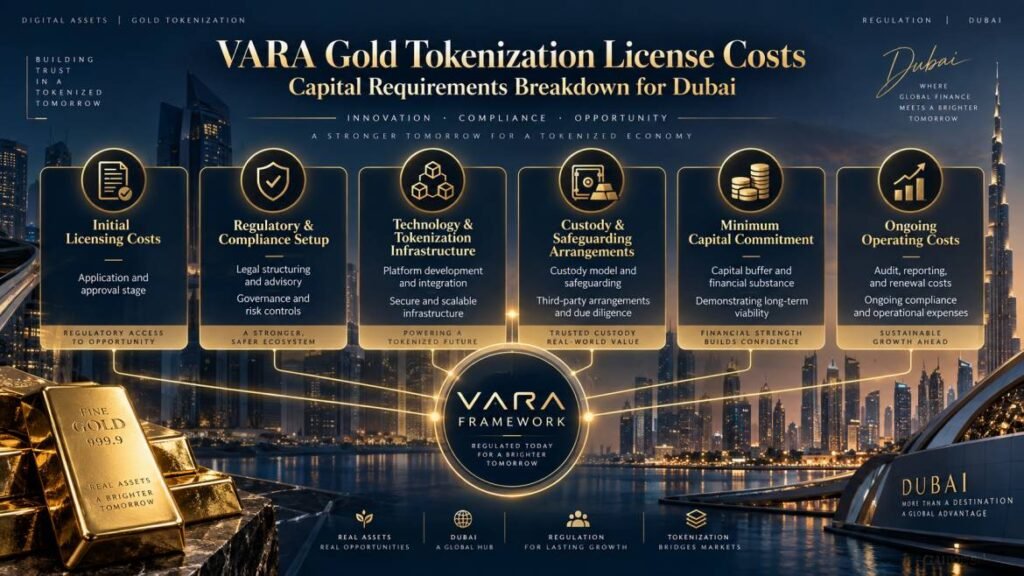
These figures cover the VARA licence only. They do not include DMCC company registration and trading licence fees, legal drafting for the whitepaper and custody agreements, custodian fees for allocated vaulting, or the blockchain infrastructure and smart contract development itself. Any article that quotes a single headline number for the cost of a gold tokenization licence is quoting one line item out of five. Get each of those five costed separately before you commit capital, because the VARA fees are the smallest line on the list for most projects once custody, legal and technology spend are added.
Governance appointments are also mandatory before approval, not optional hires for later: two Responsible Individuals who are UAE residents, a Compliance Officer, a Money Laundering Reporting Officer (MLRO), and someone accountable for information security and data protection. VARA also expects daily reconciliation between tokens in circulation and gold in custody, with bi-annual audits strongly advised even where not strictly mandated. This is where a financial reporting and auditing relationship needs to be in place before launch, not arranged after the first reconciliation query.
Secondary Market and Trading
Getting a token licensed is not the same as getting it traded. This is where most gold tokenization coverage stops, and where a real business plan needs to keep going.
A licensed token needs somewhere to trade. That means either listing on a VARA-licensed virtual asset exchange, which carries its own approval process separate from the issuance authorisation, or building direct redemption and over-the-counter arrangements with your investor base. Market-making matters more than most first-time issuers expect: a token nobody can sell easily is a token nobody wants to buy first. The two tokens dominating today’s tokenized gold market got there partly through deep exchange listings and DeFi integrations that gave holders confidence they could exit a position when they wanted to, not just buy in. A gold tokenization business in Dubai that treats secondary market access as an afterthought is building a product few investors will hold for long.
Seven Mistakes That Stall Applications
Regulatory counsel who work these applications regularly point to the same failure patterns.
- Pre-selling tokens before licensing is granted. This is the fastest way to draw enforcement attention rather than approval.
- Choosing unallocated or synthetic custody to save on vaulting costs, then trying to explain the risk profile to VARA after the structure is already built.
- Allowing rehypothecation rights on the underlying gold, which undermines the entire premise of a backed token.
- Underestimating capital planning, treating the AED 1.5 million as the ceiling rather than the floor once operating buffers are added.
- Writing the whitepaper as a marketing document instead of the disclosure document VARA requires it to be.
- Promising redemption terms that are not operationally tested. If physical redemption is offered, the delivery jurisdiction, minimum threshold, fees and timing all have to work in practice, not just on paper.
- Ignoring cross-border securities exposure. A gold token marketed to investors outside the UAE can trigger securities regulation in their home jurisdiction, independent of anything VARA requires.
Every one of these is a structuring decision, made before the VARA application is filed. That is the point in the process where a founder needs an outside, unhurried read on the plan, not partway through review when a query comes back.
Realistic Timeline
| Phase | Duration |
|---|---|
| Structuring and jurisdiction mapping | 2 to 4 weeks |
| Documentation (whitepaper, custody agreements, legal opinions) | 6 to 10 weeks |
| VARA review | 4 to 8 months |
| Conditions closure | 1 to 2 months |
| Total | 8 to 12 months |
Complex structures involving exchange or broker-dealer permissions on top of the base issuance authorisation run longer. Nobody planning to launch a gold tokenization business in Dubai inside a single quarter is planning against the real timeline. Factor the same runway into your tax registration and filing setup, since a DMCC entity has corporate tax obligations from incorporation, independent of when the VARA licence is granted.
My Approach
Most consultants writing about gold tokenization approach it as a licensing checklist: apply here, pay this fee, wait this long. I start earlier than that, before you have decided this is the right structure for your business at all.
The questions I work through with a founder before we get anywhere near a VARA application: What is the actual demand for a gold-backed token versus buying allocated gold directly? Who is the target investor, retail or institutional, onshore UAE or cross-border, and what does that do to your securities exposure in their jurisdiction? Does your team’s realistic capital position support AED 1.5 million in paid-up capital plus a working liquidity buffer, or does the plan need a different structure entirely? Is DMCC the right free zone base for your specific model, or does the token’s design point toward DIFC or ADGM instead?
This is not paperwork I file for you. I am not a lawyer, and I do not draft your VARA whitepaper or your custody agreements. What I do is the work before that: mapping your business model against the UAE’s actual regulatory and free zone landscape, so that when you do engage licensing counsel, you are instructing them on a structure you have already stress-tested, not asking them to tell you if the idea works.
If you are evaluating whether a gold tokenization business fits your goals, or whether DMCC, DIFC or ADGM is the right base for it, get in touch and we will work through the decision before either of us touches a licensing form.
Frequently Asked Questions
Is gold tokenization legal in the UAE?
Yes. VARA regulates gold-backed token issuance under its Category 1 Virtual Asset Issuance framework, and DMCC provides the physical gold infrastructure many issuers build on. The activity is legal when properly licensed. Issuing or selling tokens without VARA authorisation is not.
What licence do I need to start a gold tokenization business in Dubai?
A VARA Category 1 ARVA (Asset Referenced Virtual Asset) issuance authorisation, typically built on top of a DMCC company registration and trading licence. Additional VARA permissions (broker-dealer, custody, exchange) apply if your business model includes those activities.
How much capital do I need for a gold tokenization licence?
AED 1.5 million in minimum paid-up capital, plus net liquid assets equal to 1.2 times your monthly operating expenses. This is separate from DMCC registration costs, legal fees, custody fees and technology development.
What is the difference between allocated and unallocated gold custody?
Allocated custody means each token maps to specific, segregated gold bars you can identify. Unallocated custody means token holders share a proportionate claim on a pooled holding. VARA prefers allocated custody and reviews unallocated structures with significantly more scrutiny.
How long does it take to launch a gold tokenization business in Dubai?
8 to 12 months from structuring through VARA approval, assuming a straightforward Category 1 issuance. Add time if your model requires exchange or broker-dealer permissions alongside the base issuance authorisation.
Does DMCC issue its own gold tokenization licence?
DMCC provides the free zone company registration, trading licence and physical gold infrastructure (vaulting, the UAE Good Delivery standard, Tradeflow). The token issuance authorisation itself comes from VARA, not DMCC. Most founders register with DMCC first and apply to VARA second.
Is gold tokenization the same as buying digital gold?
No. Digital gold platforms typically sell you a direct, often unlicensed claim on gold without the token structure or secondary trading VARA regulates. A tokenized gold offering under VARA’s framework is a regulated security-adjacent product with disclosure, custody and redemption obligations a simple digital gold purchase does not carry.
Getting Started the Right Way
A gold tokenization business in Dubai is not a project you back into by registering a company and figuring out the rest along the way. The sequence matters. Decide your custody model first, since fully allocated gold is what most of the market’s successful tokens are built on. Confirm which free zone actually fits your structure, DMCC for a business built around physical gold trading relationships, DIFC or ADGM if your model leans institutional. Only then does the VARA Category 1 ARVA application become the right next step, backed by a whitepaper that answers the regulator’s questions rather than one written to sound reassuring.
A gold tokenization business in Dubai that gets this sequence right spends its first year building trading volume and investor confidence. One that gets it wrong spends its first year re-explaining its custody structure to a regulator, or worse, to investors after launch. The AED 1.5 million capital requirement, the 8 to 12 month timeline and the governance appointments are all manageable when the structure underneath them is sound. They become expensive when the structure was never right for the business in the first place.
Related Reading
- Tokenization Revolution in the UAE
- Free Zone Company Formation
- Banking & Financial Services
- Tax Registration & Filing
- Mainland vs Free Zone vs Offshore UAE
Sources: Gold & Commodity Tokenisation in UAE, Cryptoverse Lawyers; DMCC Gold Ecosystem; DMCC-Tether MoU coverage; CryptoBriefing, tokenized gold market data; bex.co, Q1 2026 tokenized gold report. This article is general commentary, not legal or investment advice. Licensing fees, capital requirements and timelines are set by VARA and DMCC and may change; verify current requirements before acting.