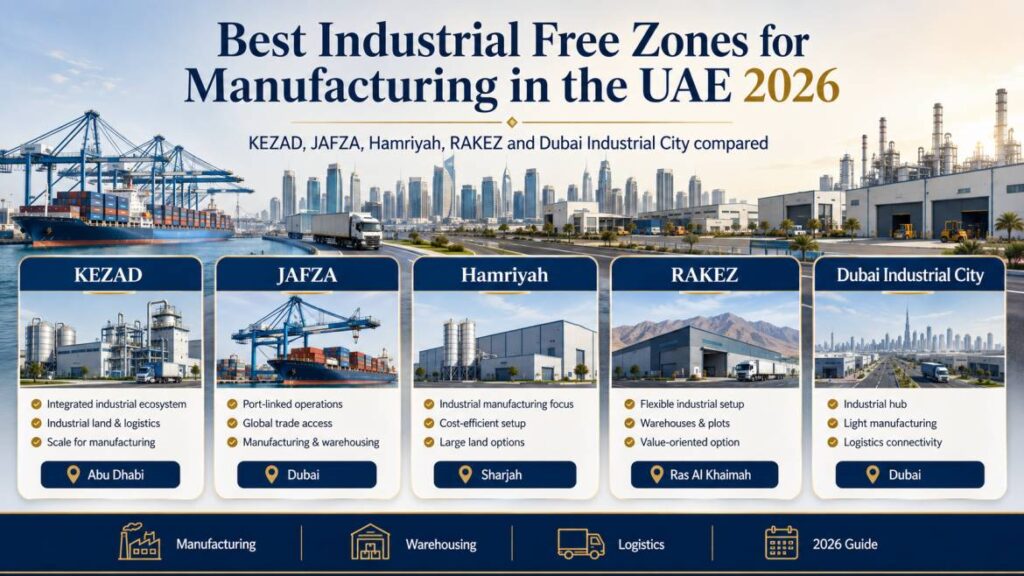
Search for the best industrial free zones for manufacturing in the UAE and one of the five names you will see most often, KIZAD, has not been the zone’s legal name since 2022. That alone would be a minor footnote if it were the only thing competing guides got wrong. It is not. Cost transparency, visa quotas, facility costs and sector fit differ sharply between these five zones, and most comparisons treat “biggest” or “cheapest” as the whole answer. Here is what actually distinguishes KEZAD, JAFZA, Hamriyah, RAKEZ and Dubai Industrial City, and how to choose between them based on what your manufacturing operation actually needs.
Quick Navigation
Quick Answer
- KEZAD (formerly KIZAD, Khalifa Economic Zones Abu Dhabi) suits heavy industry and processing with direct Khalifa Port access, government backing, and the region’s most transparent published pricing among these five zones.
- JAFZA suits manufacturers whose economics depend on Jebel Ali Port, the world’s ninth-busiest and the largest man-made port, and re-export-oriented production.
- Hamriyah Free Zone is the cost leader for chemicals, gas equipment and industrial steel, at a significant discount to Dubai and Abu Dhabi equivalents.
- RAKEZ is the value option for smaller manufacturers and exporters, but its base packages cap at just 4 visas, a genuine constraint for any operation beyond a workshop.
- Dubai Industrial City is purpose-planned around specific sectors, food and beverage, base metals, machinery, transport equipment, chemicals and minerals, and ran at roughly 94% occupancy through 2026.
- Facility cost, from around AED 50,000 for a small warehouse to AED 500,000 or more for a dedicated factory plot, sits on top of the licence fee in every one of these zones and is rarely disclosed in headline pricing.
KIZAD Is Not the Name Anymore, and the Confusion Is Older Than Most Guides Admit
Start here, because it is the fact that trips up the most search traffic on the best industrial free zones for manufacturing in the UAE, and the one competing guides handle least consistently.
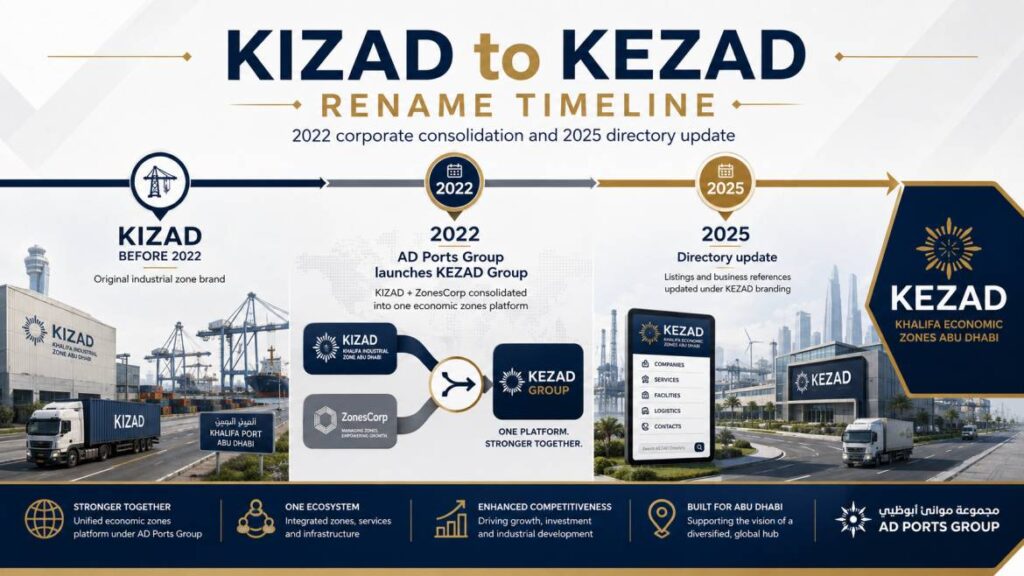
Khalifa Industrial Zone Abu Dhabi, KIZAD, was consolidated with ZonesCorp in September 2022 to form KEZAD Group, Khalifa Economic Zones Abu Dhabi. That was a genuine legal and organisational rename, not a rebranding exercise layered on top of an unchanged entity. Today KEZAD Group spans 12 economic zones across Abu Dhabi, Al Ain and Al Dhafra, roughly 550 to 570 square kilometres in total, and includes the original industrial area adjacent to Khalifa Port that most people mean when they say KIZAD.
What makes this genuinely confusing, rather than a simple correction to make once, is that KIZAD kept being used as the practical, working name for that specific industrial area for years afterward. At least one source dates a formal free-zone-directory update, replacing the KIZAD listing with KEZAD, to September 2025, three years after the underlying corporate rename. And even now, a guide dated as recently as June 2026 opens with “KIZAD, now officially Khalifa Economic Zones Abu Dhabi (KEZAD)” and then continues using KIZAD throughout the rest of the piece, because that remains the term most businesses actually search.
The practical answer: the zone’s correct current name is KEZAD, the search term most people still use is KIZAD, and both refer to the same physical location and authority. If a guide you are reading treats this as a settled, single-date rename, it has simplified a messier and more recent transition than actually occurred.
The Cost Transparency Gap Between These Five Industrial Free Zones
This is the comparison criterion missing from almost every ranking guide to the best industrial free zones for manufacturing, and it changes how much you should trust any headline number you are quoted.
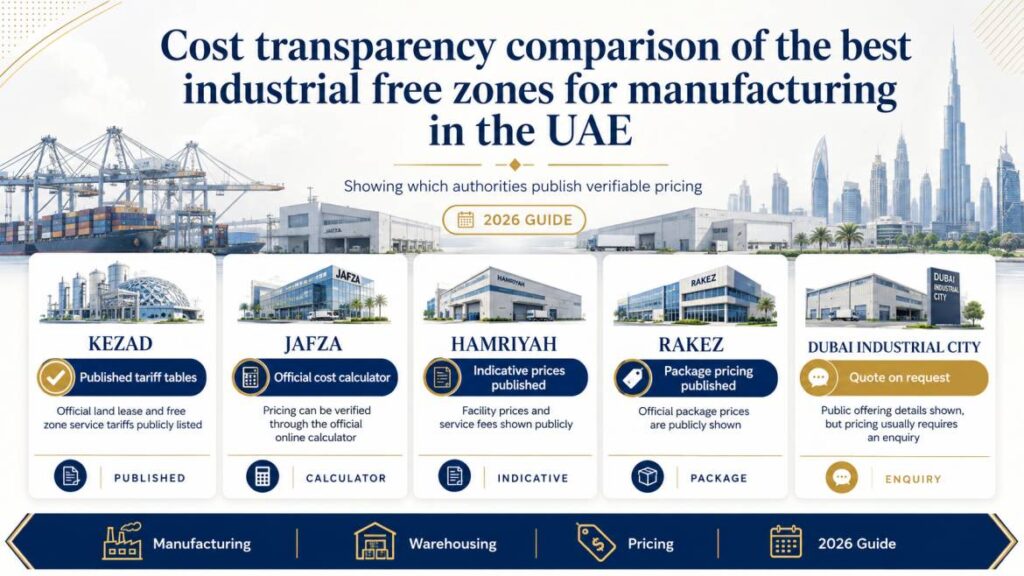
Several UAE free zones, including JAFZA, RAKEZ, SHAMS and Meydan, publish only a headline licence figure, with no itemised fee schedule available directly from the authority. That is precisely why published cost tables for these zones vary so widely between different consultancies and blogs: everyone is estimating from the same incomplete public information.
KEZAD is a documented exception. One source citing verified 2026 figures puts a KEZAD licence, including one visa, at approximately AED 9,450 all-in, a specific, checkable number rather than a headline figure with an undisclosed breakdown behind it.
This does not mean KEZAD is necessarily the cheapest option once facility costs, which are separate from licence costs everywhere, are added in. It means that if predictable, verifiable budgeting matters to you before you engage an agent, KEZAD is currently the only one of these five zones where you can do that from public information alone. For the other four, treat any quoted total as an estimate until you have it in writing from the authority or a licensed agent.
Best Industrial Free Zones for Manufacturing: KEZAD, for Government Backing and Transparent Pricing
KEZAD, formerly KIZAD, sits in southwest Abu Dhabi, adjacent to Khalifa Port, described as the most technically advanced port in the Middle East, semi-automated with a capacity of 14.5 million TEUs. The zone is wholly owned by the Abu Dhabi Government, which gives it institutional weight and access to government supply chains that privately operated free zones cannot match.
At roughly 417 square kilometres for the industrial free zone area specifically, KEZAD is designed to rival Dubai South and JAFZA in scale. It already anchors serious heavy industry: Emirates Global Aluminium operates a major aluminium smelter here, with downstream aluminium product companies co-located nearby, and the zone’s sector focus runs across metals and minerals processing, petrochemicals and energy-adjacent manufacturing.
Bonded cargo can move between KEZAD facilities and Khalifa Port without customs clearance at that stage, a genuine logistics cost saving for import-heavy or export-heavy manufacturing. Combined with the transparent pricing covered above, KEZAD is the strongest option in this comparison for heavy industry and processing operations where government-backed infrastructure and predictable setup cost both matter.
JAFZA: The Port Justifies the Premium, If You Need the Port
Among the best industrial free zones for manufacturing, Jebel Ali Free Zone spans more than 57 square kilometres and hosts over 9,500 companies from more than 100 countries, including Nestlé, Samsung, LG, Nissan and FedEx. Its defining asset is direct adjacency to Jebel Ali Port, the world’s largest man-made harbour and its ninth busiest, handling roughly 15 million TEUs a year.
JAFZA’s economics make the most sense for manufacturers whose margin genuinely depends on container flow, customs handling and port proximity, meaning import-heavy, export-heavy or re-export-oriented production. Finished goods can move from factory floor to shipping container without leaving the zone, which is a real operational advantage if that describes your business.
The trade-off is equally real. JAFZA sits in the same pricing disclosure category discussed above, headline figures only, and its occupancy costs only make commercial sense when cargo movement is genuinely central to your business. For a manufacturer selling primarily into the UAE domestic market rather than exporting through the port, the premium JAFZA commands over Hamriyah or RAKEZ is harder to justify.
Hamriyah Free Zone: The Cost Leader for Heavy and Regulated Industry
Hamriyah Free Zone, in Sharjah, is the honest cost leader among the best industrial free zones for manufacturing for businesses that specifically need physical industrial space, port access and heavy or regulated industrial infrastructure, at a cost significantly below Dubai or Abu Dhabi equivalents.
Where Hamriyah earns its position is regulated materials: chemicals, gas equipment and industrial steel are named specifically as activities where Hamriyah is the natural choice, distinct from Sharjah’s other free zones. SAIF Zone, in the same emirate, serves trading SMEs and companies that move goods primarily by road or air rather than sea freight, and the two should not be treated as interchangeable despite sitting in the same emirate.
The honest verdict from one detailed comparison: Hamriyah wins on cost and is the right choice if your primary markets are the Northern Emirates, the Indian subcontinent or East Africa, and you do not specifically need the Dubai brand or Abu Dhabi government contract access that JAFZA and KEZAD respectively provide.
RAKEZ: Value Pricing, and the Visa Cap That Catches People Out
Ras Al Khaimah Economic Zone, RAKEZ, is genuinely one of the UAE’s most affordable of the best industrial free zones for manufacturing, and it explicitly covers manufacturing, industrial, trading and consultancy activities, positioning itself as the value alternative to JAFZA for industrial businesses.
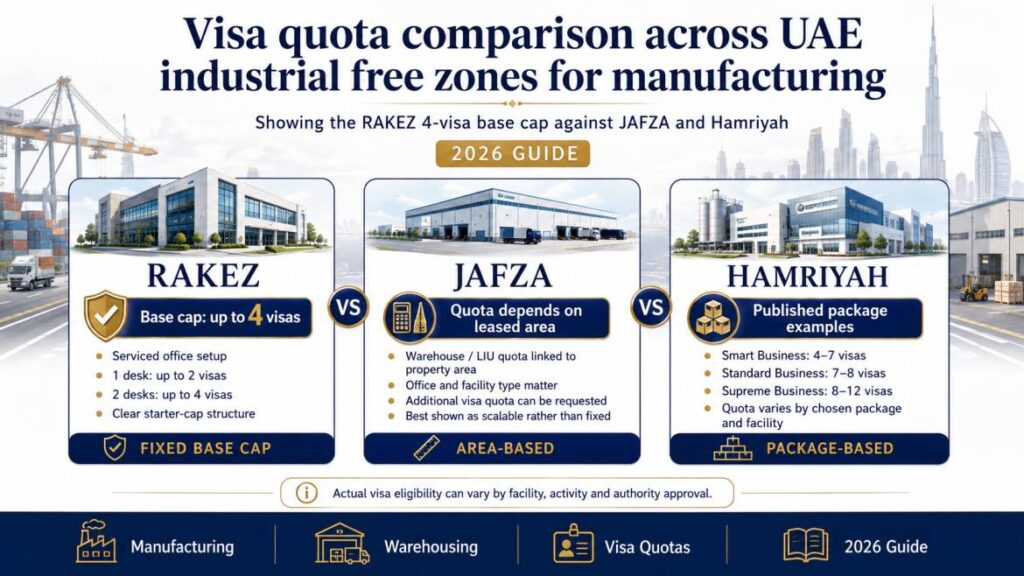
Here is the constraint most guides bury in an FAQ section rather than flagging upfront: RAKEZ base packages cap at 4 visas. JAFZA and Hamriyah support 50 or more. For a manufacturing operation that genuinely needs a factory workforce rather than a small workshop, that 4-visa ceiling forces an upgrade to a premium package almost immediately, which changes the cost comparison against the other four zones significantly. RAK is also roughly 100 kilometres from Dubai and 200 kilometres from Abu Dhabi, meaning raw materials arriving at Jebel Ali need trucking to a RAKEZ facility, a real logistics cost for operations dependent on port-adjacent supply chains.
RAK’s own building materials and ceramics industry does give the emirate a genuine manufacturing identity beyond simply cheap land, which is a point in its favour for businesses in those specific sectors. But treat the base package pricing as a starting point that will very likely need revising once real visa needs are factored in.
Dubai Industrial City: Sector-Planned, and Running Near Full
Among the best industrial free zones for manufacturing, Dubai Industrial City is structurally different from the other four zones in this comparison: it is purpose-built around specific manufacturing sectors rather than general industrial or trading activity. TECOM Group’s own description names food and beverage, base metals, machinery, transport equipment, chemicals and minerals as the sectors the district is planned around.
Two 2026 data points are worth having. Roughly 6.6 million square feet of new industrial and warehousing space was expected to enter the wider Dubai market during 2026, yet Dubai Industrial City continued to record occupancy levels around 94% through the same period, close behind Dubai South’s approximately 96%. That is a tight-supply signal: mid-sized facilities, particularly in the 10,000 to 50,000 square foot range, are in real demand, and manufacturers weighing this zone should expect to move on suitable space relatively quickly rather than assume ample availability.
The practical read: if your product sits inside one of Dubai Industrial City’s planned sectors, the infrastructure is genuinely built for your operation rather than adapted to it. If it does not, the sector planning that makes this zone strong for its target industries offers you little advantage over a more general-purpose zone.
Facility Cost Is Separate from Licence Cost, Every Time
A detail that belongs in every comparison of the best industrial free zones for manufacturing and rarely gets stated plainly enough: for an actual manufacturing operation, you will need industrial space, whether a warehouse, a factory unit or a land plot, and this cost sits entirely outside the licence package in all five of the best industrial free zones for manufacturing covered here.
Most authorities issue a manufacturing licence against a flexi-desk to begin the process, which lets you start licensing while securing facilities separately. Realistic facility costs range from roughly AED 50,000 for a small warehouse to AED 500,000 or more for a dedicated factory plot, and this range applies regardless of which zone you choose. KEZAD, JAFZA and Hamriyah all offer purpose-built industrial units directly; RAKEZ provides industrial warehouses through its own inventory.
Any comparison that leads with a low licence fee and does not immediately attach this facility range is presenting an incomplete number. Ask specifically for the facility cost alongside the licence quote before treating any single figure as your total year-one cost.
The Mainland-Selling Question These Zones Don’t Answer for You
A structural point that applies across all five of the best industrial free zones for manufacturing and is worth raising before you commit rather than after.
Free zone companies generally cannot invoice UAE mainland customers directly without a distributor, a branch, a service agent or a dual licence. For a manufacturer whose target market is genuinely export or re-export, this rarely matters. For a manufacturer selling into UAE consumers or businesses directly, it is a real structural decision, not a formality to handle later.
Several of these zones now offer dual licensing that covers both free zone and mainland operations in a single application, RAKEZ among them, though eligibility and process depend on activity and emirate. The underlying legal comparison between mainland and free zone structures, including this exact restriction, is set out in mainland vs free zone vs offshore in the UAE and the difference between mainland and free zone companies. For export-focused manufacturers, particularly those shipping into markets like India, the trade infrastructure question is covered separately in how Bharat Mart Dubai is reshaping trade for Indian exporters.
My Approach: Choosing the Best Industrial Free Zones for Manufacturing Starts With the Product
Most business setup consultants help you register a company. I help you make informed business decisions before you invest, which for the best industrial free zones for manufacturing means starting with the product rather than the brochure.
The manufacturers I see struggle are rarely the ones who chose an obviously wrong zone. They are the ones who chose a genuinely good zone, on a fair reading of the headline comparison, without first pinning down three things: how many workers they will actually need at scale, whether their target market is export or UAE domestic, and what physical facility their production actually requires. Get those three answers first, and the zone choice among KEZAD, JAFZA, Hamriyah, RAKEZ and Dubai Industrial City usually becomes straightforward. Skip them, and even the right-sounding zone can turn into an expensive mismatch six months in.
My advisory process focuses on helping you reduce uncertainty and make confident decisions, not just complete documentation. In practice:
- Product and sector fit assessed against each zone’s actual planning, not against brand recognition or headline cost alone.
- Realistic workforce and visa forecasting before a package is chosen, specifically to avoid the RAKEZ-style visa ceiling surprise.
- Full cost modelling that separates licence fees from facility costs from the start, rather than presenting one number as the total.
- Mainland-selling assessment upfront if any part of your target market is UAE domestic, not treated as a later structural fix.
- Structure and jurisdiction guidance matched to whether export, domestic sale, or both, drives your revenue.
- Business setup and licensing execution once the zone and structure decision is sound.
- Corporate tax registration and filing planning appropriate to a manufacturing activity from the outset.
- Banking setup coordinated with equipment financing and trade finance needs specific to industrial operations.
The objective is simple: help you start your business with clarity, confidence and a long-term strategy, choosing the zone that fits your product rather than the one that ranks highest in a generic comparison.
If you are weighing the best industrial free zones for manufacturing for a genuine operation, get in touch before you commit to a package.
Frequently Asked Questions
Is KIZAD still called KIZAD?
No, not officially. Khalifa Industrial Zone Abu Dhabi (KIZAD) was consolidated with ZonesCorp in September 2022 to form KEZAD Group, Khalifa Economic Zones Abu Dhabi. “KIZAD” remains the term most people search and many guides still use, but the zone’s correct current name is KEZAD, and a formal directory update replacing the older listing is dated to around September 2025 by at least one source.
Which UAE industrial free zone has the most transparent pricing?
Among these five, KEZAD is the clearest example of published, verifiable pricing, cited at approximately AED 9,450 including one visa. JAFZA, RAKEZ, SHAMS and Meydan generally publish headline figures only, without an itemised fee schedule from the authority itself, which is why published cost estimates for those zones vary between sources.
How many visas can I get for a manufacturing operation in RAKEZ?
RAKEZ base packages cap at 4 visas. JAFZA and Hamriyah Free Zone support 50 or more, sufficient for full factory operations. For any manufacturing business beyond a small workshop, the RAKEZ base package will very likely need an upgrade, which changes the overall cost comparison.
Does the licence fee include the cost of a factory or warehouse?
No. Facility cost sits separately from the licence package in every UAE industrial free zone. Realistic figures range from roughly AED 50,000 for a small warehouse to AED 500,000 or more for a dedicated factory plot. Most authorities let you begin licensing against a flexi-desk while facilities are secured separately.
Which zone is best for a manufacturer selling to UAE domestic customers rather than exporting?
None of these five zones grants direct mainland-selling rights by default. A manufacturer targeting UAE consumers or businesses needs a distributor, branch, service agent or dual licence. Several zones, including RAKEZ, now offer dual licensing covering both free zone and mainland operations, though eligibility varies by activity.
Is Dubai Industrial City better than JAFZA for manufacturing?
It depends on the product. Dubai Industrial City is purpose-planned around specific sectors, food and beverage, base metals, machinery, transport equipment, chemicals and minerals. JAFZA is fundamentally a trade and re-export zone with strong manufacturing support. If your product sits inside Dubai Industrial City’s planned sectors, its infrastructure is built specifically for you. If your business depends on port-linked import and export volume, JAFZA’s advantage is harder to replicate.
What is the cheapest UAE free zone for heavy or regulated industrial manufacturing?
Hamriyah Free Zone in Sharjah is generally the cost leader for chemicals, gas equipment and industrial steel, at a significant discount to Dubai and Abu Dhabi equivalents. It suits businesses whose primary markets are the Northern Emirates, the Indian subcontinent or East Africa.
Sources & References
- KEZAD Group
- Abu Dhabi Media Office – KEZAD Group
- Jebel Ali Free Zone Authority (JAFZA)
- Hamriyah Free Zone Authority
- RAKEZ – Ras Al Khaimah Economic Zone
- Dubai Industrial City / TECOM Group
Picking among the best industrial free zones for manufacturing in the UAE means matching your process, logistics and export profile to the zone, not chasing the most familiar name. That is what actually decides the best industrial free zones for manufacturing question in 2026.