
PhonePe UAE became real news on 9 September 2026, when the company announced it has secured a licence from the Central Bank of the UAE, its first move into any market outside India. That is the confirmed news. What isn’t yet confirmed: a launch date, pricing, or whether the UAE service connects directly to India’s UPI system. For an Indian founder weighing expansion to Dubai, PhonePe UAE is worth watching closely, and worth understanding honestly, what’s real right now and what’s still an open question.
Quick Navigation
Quick Answer
- The new licence refers to two approvals from the Central Bank of the UAE, announced 9 September 2026 at the Global Fintech Fest in Mumbai: a Stored Value Facility licence for a digital wallet, and a Retail Payment Services and Card Schemes licence for merchant acquiring, PhonePe’s first overseas market.
- No launch date, fees, or service details have been announced as of this writing. Treat any “PhonePe is live in the UAE” claim as premature until confirmed.
- This is separate from UPI’s existing UAE acceptance, which has worked since 2024 through NPCI International’s partnership with Mashreq’s NEOPAY platform, connected to the UAE’s domestic Aani rail.
- The announced scope, remittances and merchant acquiring specifically, is the part most directly relevant to Indian businesses operating in or expanding to Dubai.
- The practical move for now is to watch for the launch announcement, not to plan around unconfirmed features.
What’s Actually Confirmed About PhonePe UAE
Start with the facts, since the coverage of this announcement varies in how carefully it separates confirmed detail from speculation.
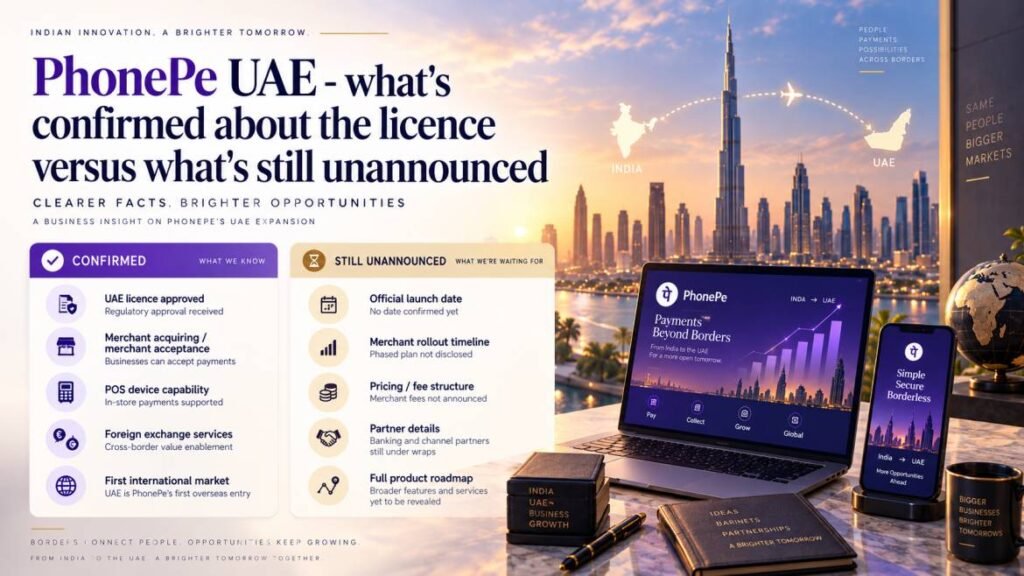
PhonePe CEO Sameer Nigam announced at the Global Fintech Fest in Mumbai on 9 September 2026 that the company has received two licences from the Central Bank of the UAE, its first overseas market, after a decade focused entirely on India. The first, a Stored Value Facility licence, covers a PhonePe-branded digital wallet and gift cards. The second, a Retail Payment Services and Card Schemes licence, covers local merchant acquiring, meaning UAE-based merchants would be able to accept payments through PhonePe’s infrastructure at physical points of sale. Nigam also said the UAE business is expected to enable remittances between the UAE and India.
What has not been announced: a launch date for any of these services, pricing or fees, named UAE banking or acquiring partners, and whether the UAE wallet will connect directly to India’s UPI rails or operate as a separate, UAE-domestic product. PhonePe currently reports more than 71.5 crore registered users in India and an acceptance network exceeding 5 crore merchants, context for the scale of the company behind this move, not confirmation of anything about the UAE rollout specifically.
How PhonePe UAE Differs From UPI Already Working in the UAE
Worth separating clearly, since some current coverage blends the two.
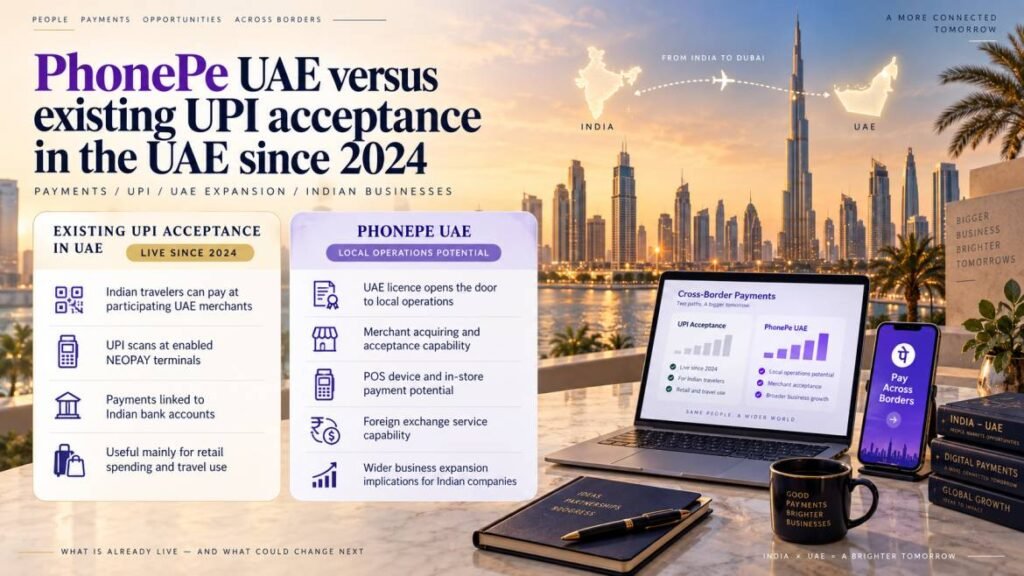
UPI, India’s underlying payment system, has already been accepted in the UAE since 2024, through NPCI International’s partnership with Mashreq’s NEOPAY platform, following a February 2024 launch event in Abu Dhabi, and connects into the UAE’s own domestic payment rail, known as Aani. That existing acceptance lets Indian travellers pay UAE merchants using UPI-linked apps, PhonePe among them, at merchants that support the NEOPAY integration.
PhonePe UAE, the newly announced licence, is a different thing: a UAE-based, UAE-regulated product from the same company, not simply UPI acceptance extending further. Whether the new UAE wallet will connect to the existing UPI-NEOPAY acceptance network, operate independently, or eventually merge the two is one of the specific details not yet announced. Treat “PhonePe already works in the UAE via UPI” and “the company is launching a UAE-licensed wallet and merchant service” as two related but distinct facts.
Seven Ways PhonePe UAE Could Help Indian Businesses, If It Launches as Scoped
The following are reasoned implications of this announced service scope, not confirmed features. Each is flagged with how confident that inference is.
- Simpler remittances between an Indian founder’s home accounts and a new UAE operation. The announced remittance service is explicitly aimed at the Indian diaspora, a natural fit for a founder moving funds between India and a new Dubai entity. Reasonably confident, since remittances are explicitly named in the licence scope.
- A familiar payment brand for UAE merchant acquiring. If merchant acquiring launches as scoped, an Indian-run business in the UAE could accept payments through infrastructure built on a brand its founders and Indian customers already trust. Reasonably confident, since merchant acquiring is explicitly named.
- Potentially lower switching friction for Indian customers visiting or relocating to the UAE. A wallet already familiar to Indian users could reduce onboarding friction for Indian residents and frequent visitors. Plausible, not confirmed, since consumer adoption patterns aren’t something a licence announcement can predict.
- A possible future bridge to India-linked payment acceptance for UAE-based Indian businesses, if UPI connectivity is eventually confirmed. This is the most speculative item on this list, since UPI connectivity for the new wallet is explicitly unconfirmed in every source reviewed.
- Gift card infrastructure for businesses serving the Indian diaspora specifically. If launched as scoped, this could suit retail or hospitality businesses targeting Indian residents and tourists. Plausible, directly named in scope, timing unknown.
- Increased competitive pressure on existing UAE payment and remittance providers, which can be a genuine positive for businesses as a customer, since more competition in payments infrastructure generally pushes fees down over time. Reasonably confident as a market dynamic, though the scale of the effect depends entirely on adoption after launch.
- A signal, not yet a service: continued deepening of India-UAE financial infrastructure ties, consistent with the broader UPI-UAE integration trend since 2024. This is the safest, most confirmable item on the list, since it describes a trend already underway rather than a specific new capability.
What to Actually Do About PhonePe UAE While It’s Still Unconfirmed
Given how much of this launch remains unannounced, the practical advice is straightforward: don’t plan your Dubai expansion timeline around it specifically, since no launch date exists yet. Continue with established UAE banking, payment gateway and remittance options for your actual setup, and treat this news as a development worth watching rather than infrastructure to build around today. If merchant acquiring does launch as scoped, it would be one additional option among the several UAE payment providers already available, not a replacement for setting up proper UAE banking, covered in our banking services guidance.
For the broader context of India-UAE trade infrastructure this sits within, see Bharat Mart, Dubai and the new RBI rules for Indian exporters, and for UAE fintech licensing generally, starting a fintech business in the UAE.

My Approach: Setting Up in Dubai Regardless of How PhonePe UAE Unfolds
Most business setup consultants help you register a company. I help you make informed business decisions before you invest.
News like this is genuinely useful context, and it’s also easy to over-plan around before any of the specifics are confirmed. An Indian founder’s actual UAE setup, banking, licensing, tax registration, doesn’t need to wait for a launch date to move forward properly, and shouldn’t be built around features that haven’t been announced yet.
My advisory process focuses on helping you reduce uncertainty and make confident decisions, not just complete documentation. In practice:
- Current, confirmed UAE banking and payment options for your business, not speculative future ones.
- Business setup and licensing execution that doesn’t depend on any single payment provider’s roadmap.
- Corporate tax registration and filing planning appropriate to an Indian-owned UAE business specifically.
- Ongoing awareness of India-UAE financial infrastructure developments, this launch included, factored into your plans once details are actually confirmed, not before.
The objective is simple: help you expand to Dubai on solid, current ground, while keeping an informed eye on developments like this one as they actually materialise.
If you’re an Indian founder planning a move to Dubai and want your setup built on what’s actually confirmed today, get in touch.
The Broader India-UAE Payments Corridor
It helps to see this announcement inside the wider trend rather than as an isolated headline. The UAE and India have been steadily deepening financial ties over the past several years: a bilateral trade agreement, growing rupee-dirham settlement arrangements, and a fast-expanding population of Indian founders, freelancers and remittance senders based in Dubai and Abu Dhabi. UPI acceptance through NPCI International’s Aani-linked partnership was one visible step in that direction, letting Indian travellers and residents pay at a growing number of UAE merchants using their home banking apps. A separately licensed, UAE-regulated wallet and merchant product would be a further step, not a replacement for what already exists.
For a founder relocating from India to Dubai, the useful question is rarely “which app will I use” but “what does my business actually need on day one”. That usually means a UAE corporate bank account, a way to accept card and local bank-transfer payments from customers, and a compliant way to move money between India and the UAE for salaries, supplier payments or profit repatriation. None of that depends on any single consumer fintech product launching on schedule. Banks, payment gateways and money-transfer operators already licensed and operating in the UAE can cover those needs today, and a new entrant, however well-funded, takes time to build out merchant acceptance, compliance processes and customer trust before it becomes something a business can build a plan around.
What Founders Should Actually Track
Rather than waiting on a single announcement, founders planning a Dubai move are better served by tracking three things directly. First, whether merchant acquiring actually goes live and which payment gateways or point-of-sale providers integrate it, since that determines whether a UAE business could accept payments through it at all. Second, whether any cross-border settlement link to UPI or existing rails is confirmed, since that would matter far more for remittance-heavy businesses than a standalone wallet would. Third, the regulatory scope of the Stored Value Facility licence itself, since Central Bank of the UAE licences of this type typically come with limits on transaction size, permitted use cases and reporting obligations that shape what a business can realistically rely on it for.
None of that is reason to delay a UAE company formation. Mainland and free zone licensing timelines, corporate bank account opening, visa processing and the rest of the setup process run on their own track, using banking and payment infrastructure that is already live and well understood. Founders who want a genuinely informed view can keep a short watch-list of the specific milestones above and revisit their payment stack decisions once, not if, those milestones are confirmed, rather than building early assumptions into a business plan around a product that has not yet opened for customers.
A useful comparison is how similar fintech announcements have played out in the UAE before. Several international payment and wallet brands have announced regional ambitions that took considerably longer than expected to reach full public availability, often because licensing, banking-partner integration and merchant onboarding move at a different pace than a press release does. That is not a criticism of any particular company; it reflects how financial-services regulation in the UAE is deliberately thorough. The practical takeaway stays the same regardless of which fintech brand is involved: treat announced licences as a signal worth monitoring, not as infrastructure to plan a business around before it is operational.
Reading Fintech Announcements Like a Founder, Not a Headline
A licence announcement, a funding round or a regional expansion story is genuinely useful information, but it is easy to over-read into it before the operational details exist. A licence from the Central Bank of the UAE confirms that a company can legally operate a defined set of services once it meets ongoing supervisory requirements; it does not confirm a launch date, pricing, which merchants will accept it, or whether it will work the way an equivalent product does in another market. Distinguishing between what has been formally confirmed and what is reasonable speculation is the habit worth building, and it applies well beyond this one story to almost any fintech or infrastructure news relevant to a Dubai business.
The practical version of that habit is simple: read the regulator’s own confirmation where one exists, note the specific scope of what was approved, and treat everything else, however plausible, as unconfirmed until a company states it directly. Applied here, that means the Central Bank of the UAE’s two licences are the confirmed fact, and the rest, including timing, integration with existing UPI rails, and pricing, remains open. Founders who build that habit generally make steadier, better-informed decisions about their own UAE setup than those who plan around the most optimistic reading of a single headline.
If you are actively planning a move from India to Dubai and want a clear picture of what banking, payment and remittance infrastructure is actually available to your business today, that is a more productive starting point than waiting on any single fintech announcement to mature. A short conversation about your specific setup, sector and payment needs will usually surface options you can act on immediately, rather than a roadmap built around a product still working through its own regulatory and operational rollout.
Frequently Asked Questions
Has PhonePe UAE actually launched yet?
No. As of this writing, PhonePe has announced it received two licences from the Central Bank of the UAE, its first overseas market, but no launch date, fees, or service details have been confirmed.
What services will PhonePe UAE offer?
The announced scope includes a digital wallet and gift cards under a Stored Value Facility licence, plus local merchant acquiring under a Retail Payment Services and Card Schemes licence, with remittances between the UAE and India also expected. None have a confirmed launch date yet.
Is PhonePe UAE the same as UPI working in the UAE?
No. UPI acceptance in the UAE has existed since 2024 through NPCI International’s partnership with Mashreq’s NEOPAY platform, connected to the UAE’s Aani rail. PhonePe UAE is a separate, newly licensed product, and whether it will connect to existing UPI acceptance is not yet confirmed.
Will PhonePe UAE help Indian businesses accept payments in Dubai?
Possibly, if merchant acquiring launches as scoped in the licence. This isn’t confirmed with a launch date yet, so it shouldn’t be planned around for a current UAE business setup.
Should I wait for PhonePe UAE before setting up my business in Dubai?
No. Established UAE banking and payment options are available now and don’t require waiting on an unconfirmed launch date. Treat PhonePe UAE as a development to watch, not infrastructure to plan around yet.