None of this is something a founder needs to personally audit before choosing a provider. A short, direct question, where are your primary and backup facilities, and what happens to my service if one goes offline, is usually enough to separate a vendor who has actually engineered for redundancy from one that has not. Asking it before signing a contract costs nothing and can save a great deal of disruption later.
Redundancy is also not a one-time build. Facilities age, demand patterns shift, and new failure modes show up as systems scale, so the UAE’s approach has been to keep adding capacity and diversity rather than treating an initial build-out as finished. For a founder comparing hosting or cloud options today, that ongoing investment is a better signal than a single facility announcement, because it suggests the redundancy is being maintained rather than declared once and left alone.
For a founder setting up in the UAE today, this redundancy build-out is one more reason the country is a credible base for a digitally dependent business, not just a tax or visa decision. Reliable underlying infrastructure is easy to take for granted until it is missing, and the UAE’s current investment in that layer is worth factoring into a genuinely informed comparison against other regional hubs.
None of this is something a founder needs to personally audit before choosing a provider. A short, direct question, where are your primary and backup facilities, and what happens to my service if one goes offline, is usually enough to separate a vendor who has actually engineered for redundancy from one that has not. Asking it before signing a contract costs nothing and can save a great deal of disruption later.
Redundancy is also not a one-time build. Facilities age, demand patterns shift, and new failure modes show up as systems scale, so the UAE’s approach has been to keep adding capacity and diversity rather than treating an initial build-out as finished. For a founder comparing hosting or cloud options today, that ongoing investment is a better signal than a single facility announcement, because it suggests the redundancy is being maintained rather than declared once and left alone.
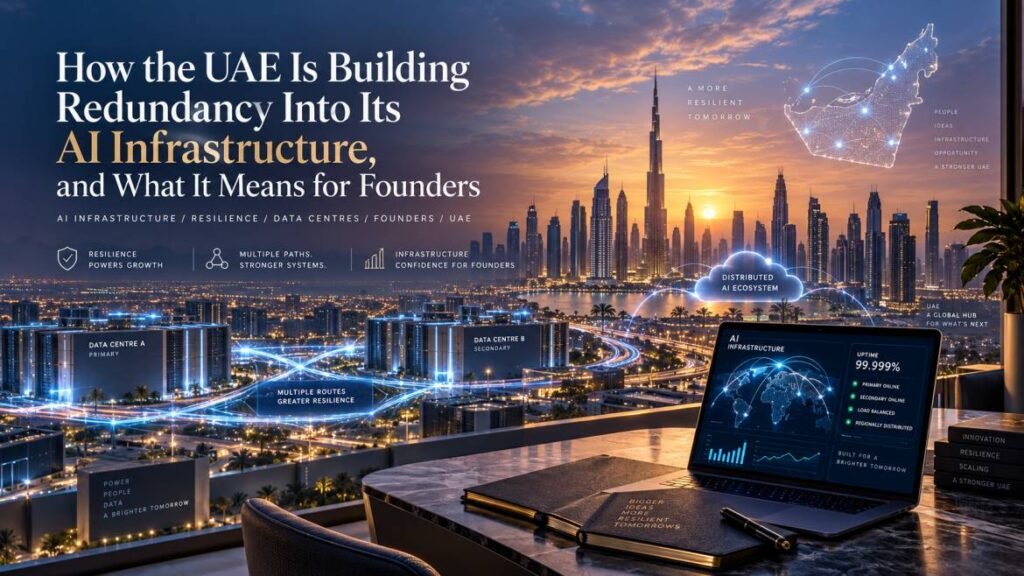
UAE AI infrastructure redundancy is the unglamorous engineering principle behind every reliable data network in the world: don’t put everything in one place, and build so that one facility going offline doesn’t take the whole system with it. The UAE’s AI and cloud infrastructure is being built around exactly that principle, spreading capacity across availability zones and, increasingly, across emirates. Dubai and Abu Dhabi still hold the overwhelming majority of current capacity, but Ras Al Khaimah and Fujairah are now part of that redundancy picture too, for ordinary, well-understood commercial reasons: land cost, submarine cable access, and power pricing. Here’s how UAE AI infrastructure redundancy actually works, and what it means for founders building here.
Quick Navigation
Quick Answer
- UAE AI infrastructure redundancy relies on availability zones, physically separate facilities designed so that one site going offline doesn’t take a service down, the same model AWS uses across its three UAE Availability Zones in Abu Dhabi and Dubai.
- Geographic spread across emirates is becoming part of this redundancy picture: Ras Al Khaimah and Fujairah are attracting real data center investment for concrete commercial reasons, land cost, submarine cable access, and power pricing.
- Fujairah’s Arabian Sea coastline offers alternate submarine cable landing options that bypass Strait of Hormuz routing, relevant specifically for latency-sensitive and financial workloads.
- Ras Al Khaimah’s power cost advantage is tied to preferential electricity tariffs linked to quarry byproduct power projects, a genuinely distinctive, location-specific driver.
- For founders, this points toward two things: genuine confidence in UAE infrastructure reliability, and a real, specific opportunity in data hosting, cybersecurity, and digital infrastructure businesses based in the northern emirates.
What UAE AI Infrastructure Redundancy Actually Means
Redundancy, in data infrastructure terms, is a specific engineering principle: build multiple physically separate facilities, far enough apart that a disaster affecting one won’t affect the others, and connect them with high-bandwidth, low-latency networks so workloads can shift between them if needed. AWS’s Middle East (UAE) Region operates on exactly this model, with three separate Availability Zones across Abu Dhabi and Dubai, each isolated enough that one going offline doesn’t take the whole region down.
This is the practical core of UAE AI infrastructure redundancy, and it matters beyond any single provider. As UAE cloud and AI infrastructure keeps growing, spreading physical capacity across more locations, not concentrating it in one place, is the standard, sensible way to build resilience against any kind of disruption, from a power outage to a fiber cut to routine hardware failure. Geographic diversification across emirates, including the growth in Ras Al Khaimah and Fujairah covered below, is a natural extension of the same redundancy logic operating at a national rather than single-region scale.
Why Ras Al Khaimah and Fujairah Are Now Part of UAE AI Infrastructure Redundancy
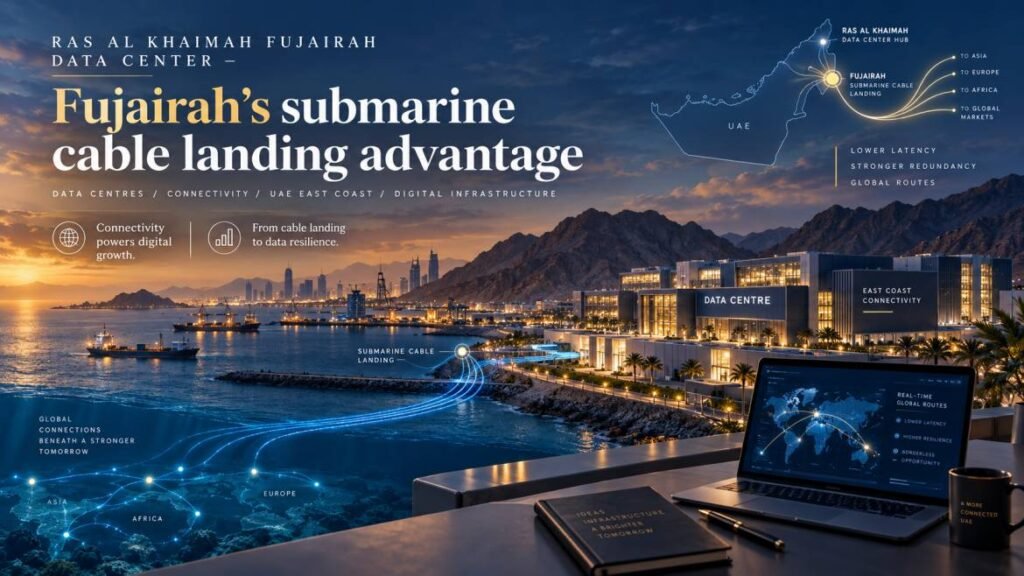
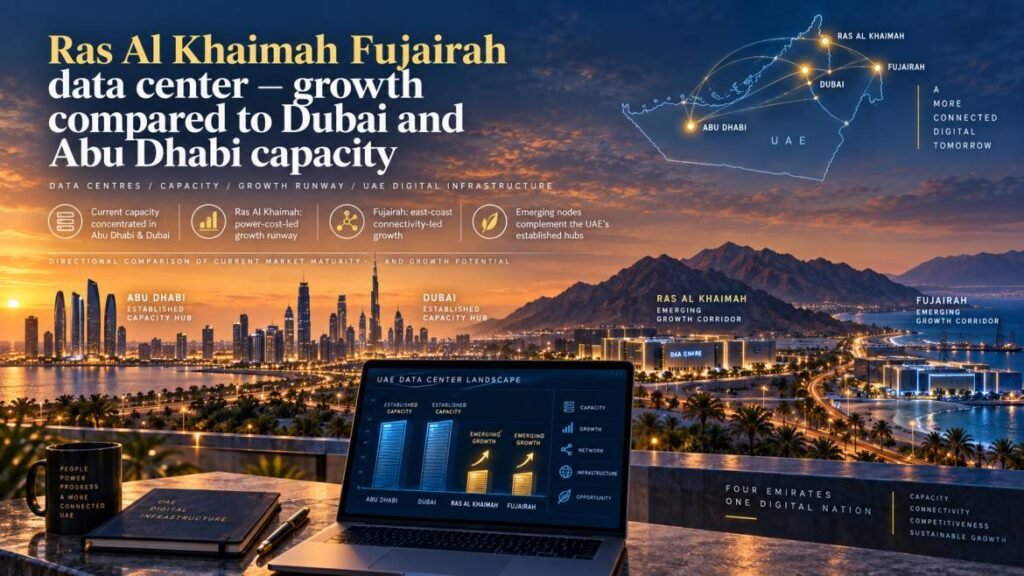
Dubai currently accounts for close to 80% of the UAE’s planned upcoming data center capacity, and the largest operators, Khazna Data Centers among them, remain concentrated in Dubai, Abu Dhabi and Ajman. Against that backdrop, Ras Al Khaimah and Fujairah data center activity is a smaller, emerging segment, one more location added to the country’s overall redundancy picture, rather than a shift in where the industry’s center of gravity sits.
What’s driving it is straightforward: land cost arbitrage. As Dubai and Abu Dhabi’s established data center corridors face rising land and grid-capacity pressure, operators looking for lower-cost sites with room to scale, and a genuinely different physical location for redundancy purposes, are looking further afield. Ras Al Khaimah and Fujairah offer that, alongside two more specific, location-particular advantages covered below.
Fujairah’s Submarine Cable Advantage
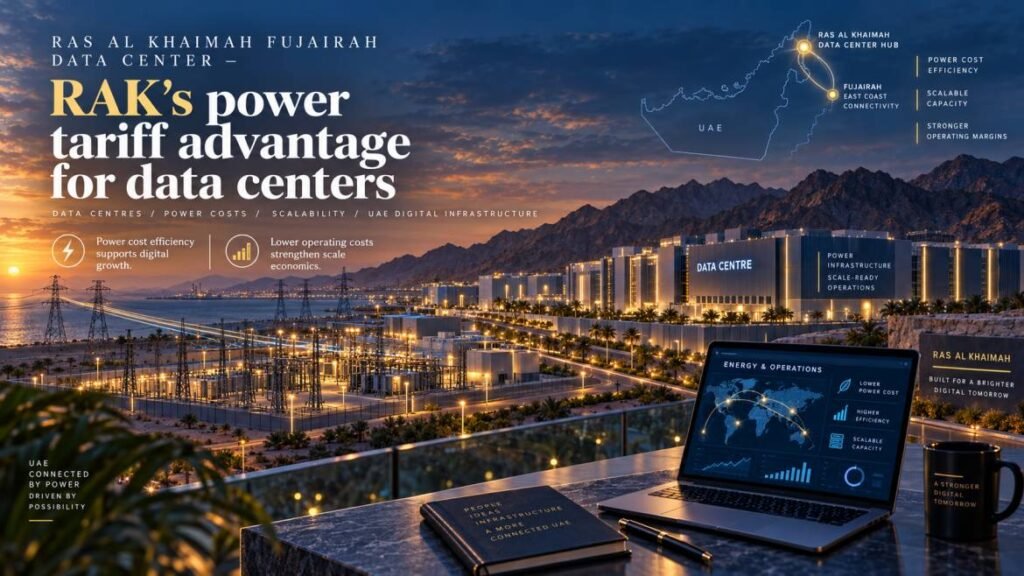
Fujairah’s position on the UAE’s Arabian Sea coastline gives it a genuine, specific advantage: proximity for submarine cable landing stations that don’t route through the Strait of Hormuz. For data center operators serving latency-sensitive workloads, particularly financial services applications where microseconds matter, an alternate cable landing point is a real technical benefit, not a marketing line, and a genuine contribution to the wider redundancy picture.
This connects to the same geography behind Fujairah’s established position in UAE logistics and trading more broadly. The full picture of why Fujairah’s Gulf of Oman coastline matters for business more generally, including the honest, conditional version of its “bypasses regional transit risk” positioning, is covered in why Fujairah free zones are a strong opportunity for trading in 2026.
Ras Al Khaimah’s Power Cost Advantage
Ras Al Khaimah’s specific draw is different: preferential electricity tariffs tied to quarry byproduct power projects, a genuinely distinctive, RAK-specific cost driver rather than a generic low-cost pitch. Power is one of the largest ongoing operating costs for any data center, so a location-specific tariff advantage is a real, quantifiable factor in site selection economics, not a soft incentive.
Reported regulatory uncertainty around this tariff structure means it’s worth confirming current terms directly rather than relying on older coverage, consistent with how quickly incentive structures can shift in this sector generally.
What UAE AI Infrastructure Redundancy Means If You’re Setting Up a Data or Tech Business
For a founder specifically building in data hosting, cybersecurity, colocation, or digital infrastructure, this emerging northern growth segment is worth genuine consideration alongside the more established Dubai and Abu Dhabi options, not as a replacement for them. And for any founder simply relying on UAE cloud infrastructure to run their business, the redundancy story matters directly: it’s a large part of why UAE-hosted services can offer genuine uptime confidence.
The broader AI and technology company setup picture, including which UAE free zones fit AI-classified activity generally, is covered in building an AI company in the UAE and the best UAE free zones for AI and technology companies. This post’s focus is narrower: how UAE AI infrastructure redundancy actually works, and the specific, concrete reasons RAK and Fujairah are now part of that picture.
My Approach: Matching Your Infrastructure Business to the Right Emirate
Most business setup consultants help you register a company. I help you make informed business decisions before you invest.
A data hosting or infrastructure business genuinely benefits from getting the location decision right the first time, since physical infrastructure is far more expensive to relocate than a services business. Understanding whether Fujairah’s cable access, Ras Al Khaimah’s power tariffs, or an established Dubai or Abu Dhabi location actually fits your specific workload and customer base, and how it fits into your own redundancy planning, is worth doing properly before committing capital.
My advisory process focuses on helping you reduce uncertainty and make confident decisions, not just complete documentation. In practice:
- Honest assessment of whether your specific infrastructure business genuinely benefits from a northern-emirate location, or whether an established hub fits better.
- Current confirmation of power tariff and incentive terms before you rely on them in your planning.
- Business setup and licensing execution across whichever emirate and free zone genuinely fits your infrastructure business.
- Corporate tax registration and filing planning appropriate to your specific structure.
The objective is simple: help you make this decision on genuine commercial fundamentals, not headlines.
If you’re building a data hosting, cybersecurity, or infrastructure business and want an honest read on where it fits, get in touch.
Frequently Asked Questions
What does UAE AI infrastructure redundancy actually mean?
It means building multiple physically separate facilities so that one site going offline, from a power outage, fiber cut, or hardware failure, doesn’t take a service down. AWS’s three UAE Availability Zones across Abu Dhabi and Dubai operate on this model.
Are Ras Al Khaimah and Fujairah replacing Dubai as the UAE’s main data center hub?
No. Dubai accounts for close to 80% of the UAE’s planned upcoming data center capacity. RAK and Fujairah represent a smaller, genuine growth segment that adds to the country’s overall redundancy picture, not a shift in the industry’s center of gravity.
Why is Fujairah attractive for data centers specifically?
Its Arabian Sea coastline offers submarine cable landing options that bypass Strait of Hormuz routing, a real advantage for latency-sensitive workloads, particularly financial services applications, and a genuine contribution to broader infrastructure redundancy.
What makes Ras Al Khaimah attractive for data centers?
Preferential electricity tariffs tied to quarry byproduct power projects, a genuinely distinctive, location-specific cost advantage, though reported regulatory uncertainty means current terms should be confirmed directly.
Is this growth driven by anything other than commercial and redundancy factors?
This post covers the standard commercial and redundancy drivers, land cost, cable access, power pricing, and geographic diversification, that shape data center site selection anywhere. It does not cover other reported factors tied to regional security considerations, which are outside the scope of this business-setup analysis.
What does redundancy actually mean for a founder relying on UAE cloud infrastructure?
It means your provider’s service is designed to keep running even if one physical facility has a problem, since workloads and data can shift to another availability zone or location. For a founder, this translates into fewer outages and more confidence in uptime, without needing to build that resilience yourself.
Sources & References
- Mordor Intelligence – UAE Data Center Market report
- MarkWide Research – UAE Data Center Construction Market
- Research and Markets – UAE Existing and Upcoming Data Center Portfolio
- Evernex – Why data center disaster recovery is critical in the UAE
- Blackridge Research – Top data center companies in the UAE, including AWS’s UAE Availability Zone architecture
UAE AI infrastructure redundancy matters to founders well beyond the data-centre operators building it, because it directly affects the reliability of whatever cloud or AI service your own business depends on. Understanding how UAE AI infrastructure redundancy is actually engineered helps you evaluate a vendor’s claims with more confidence.
For a founder setting up in the UAE today, this redundancy build-out is one more reason the country is a credible base for a digitally dependent business, not just a tax or visa decision. Reliable underlying infrastructure is easy to take for granted until it is missing, and the UAE’s current investment in that layer is worth factoring into a genuinely informed comparison against other regional hubs.
None of this is something a founder needs to personally audit before choosing a provider. A short, direct question, where are your primary and backup facilities, and what happens to my service if one goes offline, is usually enough to separate a vendor who has actually engineered for redundancy from one that has not. Asking it before signing a contract costs nothing and can save a great deal of disruption later.
Redundancy is also not a one-time build. Facilities age, demand patterns shift, and new failure modes show up as systems scale, so the UAE’s approach has been to keep adding capacity and diversity rather than treating an initial build-out as finished. For a founder comparing hosting or cloud options today, that ongoing investment is a better signal than a single facility announcement, because it suggests the redundancy is being maintained rather than declared once and left alone.