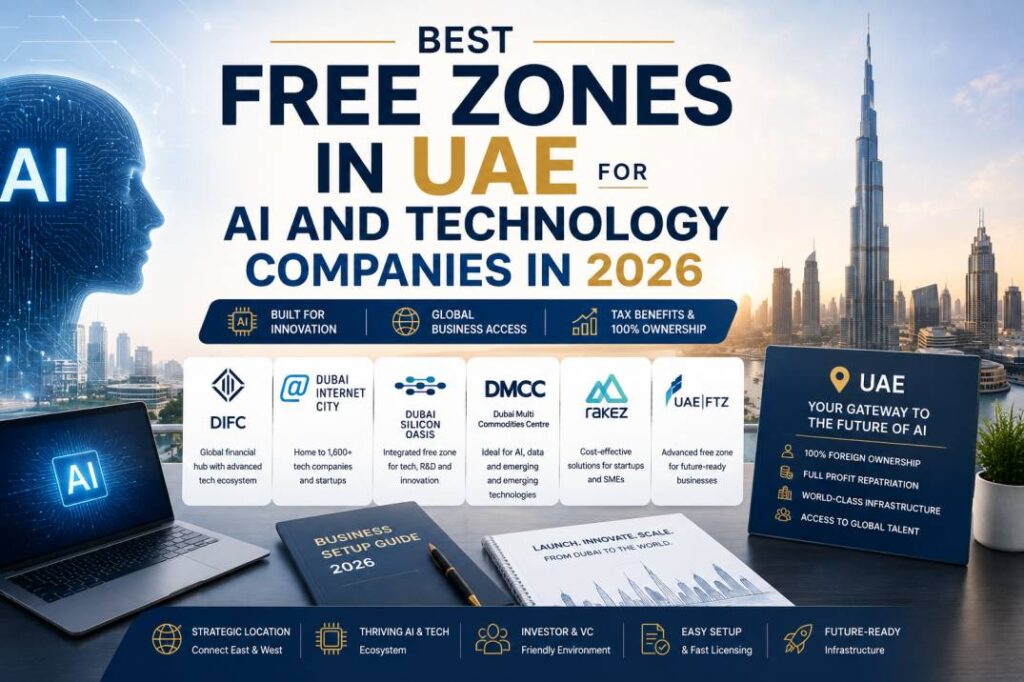
Most guides to UAE free zones treat “AI and technology” as one category and rank zones by which markets loudest about innovation. That is the wrong lens. An AI company doing model training needs power-dense data center infrastructure. A SaaS company doing enterprise sales needs a Common Law jurisdiction investors trust. A bootstrapped tools company needs the lowest defensible cost. This is the actual comparison of the best free zones in UAE for AI and technology companies in 2026, sorted by what each one is actually built to support, not by which one markets itself loudest. It also covers the question none of those guides answer: whether the income your AI company earns is eligible for the 0% rate at all.
Quick Navigation
Quick Answer
- Software development, SaaS and AI services are not among the 13 Qualifying Activities listed in Ministerial Decision No. 229 of 2025, so a free zone AI company does not automatically pay 0% corporate tax.
- Copyrighted software does count as Qualifying Intellectual Property under Cabinet Decision No. 100 of 2023, so a company that owns the code it earns from has a route to 0% that a services company does not.
- DIFC fits an AI or Web3 company chasing institutional VC, through its AI and Web3 licence, subsidized 90% for early-stage founders, though it excludes financial services and crypto exchange activity.
- ADGM, paired with the Hub71 accelerator, fits an AI startup that wants Common Law protection plus real capital: Hub71+ AI offers up to AED 750,000 in cash and in-kind support, with access to MBZUAI and 42 Abu Dhabi.
- Masdar City Free Zone fits a compute-heavy AI company, with AI business packages starting around AED 12,000 a year and a 50% discount for MBZUAI students and faculty in their first two years.
- SRTIP in Sharjah is the lower-cost research and technology park option, with packages starting near AED 5,500 for a zero-visa setup.
- RAKEZ is the cost floor for a bootstrapped tech or IT company that does not need Common Law, institutional investor access, or a specialized AI ecosystem.
Why It Depends on What Your Company Actually Does
Every list ranking UAE free zones for tech companies uses the same shortcut: pick the zones with the most press coverage and rank them by name recognition. That approach breaks the moment you ask what your company actually needs.
An AI company training or fine-tuning models needs power-dense, cooling-ready infrastructure, which most standard office-based free zones were never built for. A company raising a Series A from an institutional VC needs a jurisdiction that can issue preferred shares and enforce a shareholder agreement, which most standard UAE free zones running on civil law cannot do. A two-person SaaS tools company bootstrapping its first year needs the lowest defensible annual cost, not a Common Law framework it will never use. These are three different companies, and they belong in three different free zones.
For the legal mechanics behind why company structure matters this much before you raise capital, see best Dubai free zones for tech startups chasing venture capital funding, and for the infrastructure story behind why “AI-friendly” has become a specific, buildable claim in the UAE rather than a marketing phrase, see what it actually takes to build an AI company in the UAE.
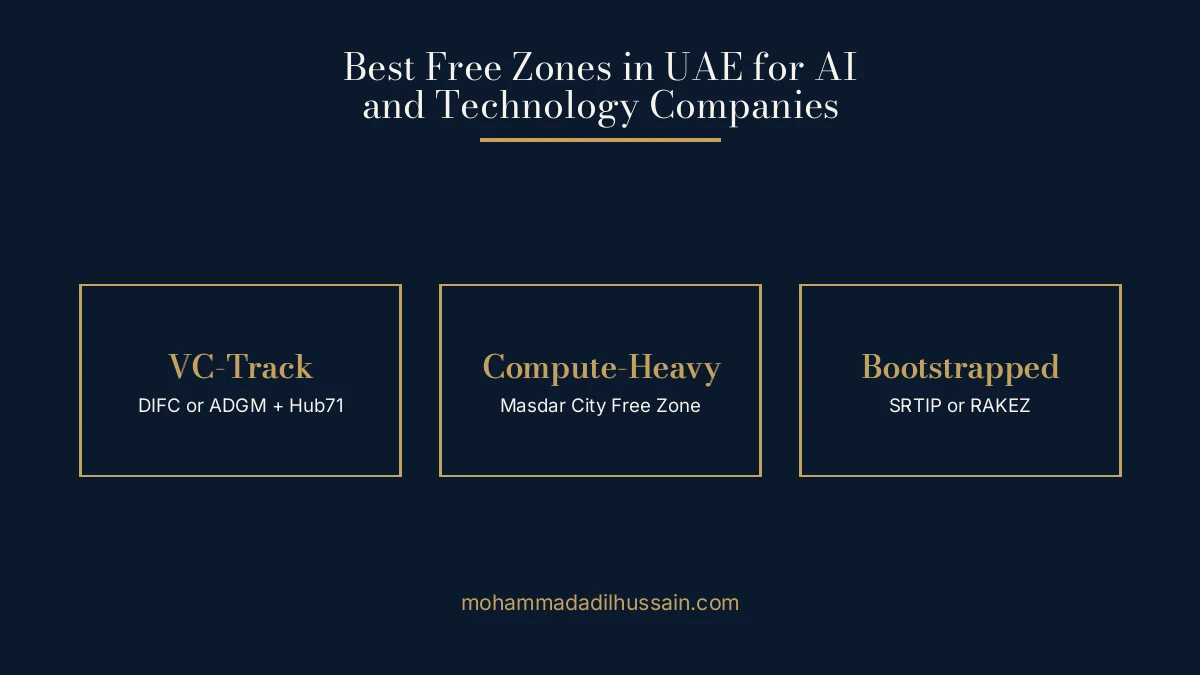
The Corporate Tax Question Every Free Zone Comparison Skips
Read ten rankings of the best free zones in UAE for AI and technology companies and you will see the same three claims in all ten: 100% foreign ownership, full repatriation of profits, 0% corporate tax. The first two are accurate. The third is a conditional statement being presented as a feature.
A free zone company pays 0% only if it is a Qualifying Free Zone Person, and only on the portion of its income that counts as Qualifying Income. Everything else is taxed at 9%. Those conditions sit in Federal Decree-Law No. 47 of 2022, Cabinet Decision No. 100 of 2023 and Ministerial Decision No. 229 of 2025, which replaced the earlier Ministerial Decision No. 265 of 2023 retroactively from 1 June 2023.
Ministerial Decision No. 229 of 2025 lists 13 Qualifying Activities in full: manufacturing of goods or materials, processing of goods or materials, trading of qualifying commodities, holding shares and securities for investment, ownership and operation of ships, reinsurance services, fund management services, wealth and investment management services, headquarter services to related parties, treasury and financing services, financing and leasing of aircraft, distribution of goods from a designated zone, and logistics services.
Software development is not on that list. Neither is SaaS, AI model development, data annotation, IT consulting, cloud services or systems integration. That catches most applied AI businesses, including anyone building AI agents for clients in Dubai. That has three consequences that change which zone is the right answer for you.
Selling to a UAE mainland customer is taxable. A mainland company is a Non-Free Zone Person. Under Article 3 of Cabinet Decision No. 100 of 2023, income from a Non-Free Zone Person qualifies only when it comes from a Qualifying Activity. Your AI licensing revenue from a Dubai mainland bank is 9% income.
Selling to individuals is worse. Article 2(2)(a) of Ministerial Decision No. 229 of 2025 makes any transaction with a natural person an Excluded Activity, with narrow exceptions for shipping, fund management, wealth management and aircraft leasing. A consumer AI app charging individual subscribers produces non-qualifying revenue on every transaction.
Exporting does not automatically fix it. A company in London or Singapore is also a Non-Free Zone Person. Foreign revenue from AI development services is not qualifying income simply because it came from abroad. This is the single most common misunderstanding I correct in first conversations.
Income from another free zone company, where that company is the beneficial recipient of the service, does qualify. So a business-to-business AI company selling into DIFC, DMCC and JAFZA tenants sits in a materially different tax position from one selling to mainland enterprises, and neither company would learn that from a free zone comparison table.
The exception that changes the arithmetic
Cabinet Decision No. 100 of 2023 defines Qualifying Intellectual Property as patents, copyrighted software, and rights functionally equivalent to a patent. Marketing assets such as trademarks are specifically excluded.
So a company that owns the software it earns from has a route to 0% that a company selling development hours does not. The qualifying portion is calculated on a nexus formula: qualifying research and development expenditure, plus a 30% uplift, divided by overall expenditure including acquisition costs, applied to overall income. If you built the model in-house, most of your income can qualify. If you licensed or acquired the core technology, much less of it will.
There is a second detail worth knowing. Core income-generating activities normally have to happen inside the free zone. Article 8(3) of Cabinet Decision No. 100 of 2023 carves out an exception for Qualifying Intellectual Property: that work can be outsourced to any person in the UAE, and to any non-related party outside the UAE, provided you supervise it adequately. For an AI company with a distributed engineering team, that exception is often the difference between a workable structure and an unworkable one.
The practical read: build and own, or accept 9%. For how these rules interact with recent enforcement changes, see my breakdown of the new UAE anti-evasion tax laws.
DIFC: Institutional Capital and the AI and Web3 Licence
Dubai International Financial Centre runs under English Common Law with its own commercial court system, the framework that makes preferred shares, vesting schedules and enforceable IP protection possible in a way most standard free zones cannot match. Its AI and Web3 licence, run out of the DIFC Innovation One campus, is a commercial licence subsidized at 90% for early-stage founders, targeting more than 500 startups and 3,000 jobs by 2028.
It is not a tax exemption, and it specifically excludes financial services and crypto exchange activity, so it fits a machine learning or applications company far better than a fintech-adjacent one.
The compliance cost nobody prices in
DIFC also has Regulation 10 of its Data Protection Regulations, the first data protection regulation anywhere to name autonomous and semi-autonomous systems as a distinct category. It has been in force since 1 September 2023 and moved to full enforcement on 1 January 2026.
If your company deploys or operates AI systems that process personal data in DIFC, you carry documented impact assessment, transparency and record-keeping obligations. High-risk processing requires certification before deployment and the appointment of an Autonomous Systems Officer, a role broadly equivalent to a Data Protection Officer.
That is a genuine advantage if you sell to regulated enterprise buyers, because certification is something you can point at during procurement. It is a genuine cost if you are two people shipping a product. Both are true, and a comparison that only calls DIFC “AI-friendly” has told you half the story.
One pricing note while you are here. Several setup agents publish DIFC AI licence costs of USD 12,500 and upwards. That figure reflects the standard DIFC commercial licence, not the subsidised AI programme rate. Ask any consultant quoting you a DIFC number which of the two they are quoting, and what happens to the subsidy from year three, when it typically becomes tied to headcount.
Best fit: an AI or Web3 company planning to raise institutional VC or a Series A round, where the legal structure has to survive investor due diligence.
ADGM and Hub71: Abu Dhabi’s Accelerator-Backed Option
Abu Dhabi Global Market also operates under English Common Law, and since 1 January 2025 its Tech Startup licence category costs USD 1,500 for registration and annual renewal, plus a USD 300 data protection fee, a meaningful reduction from the USD 1,000 to USD 1,500 range that applied before.
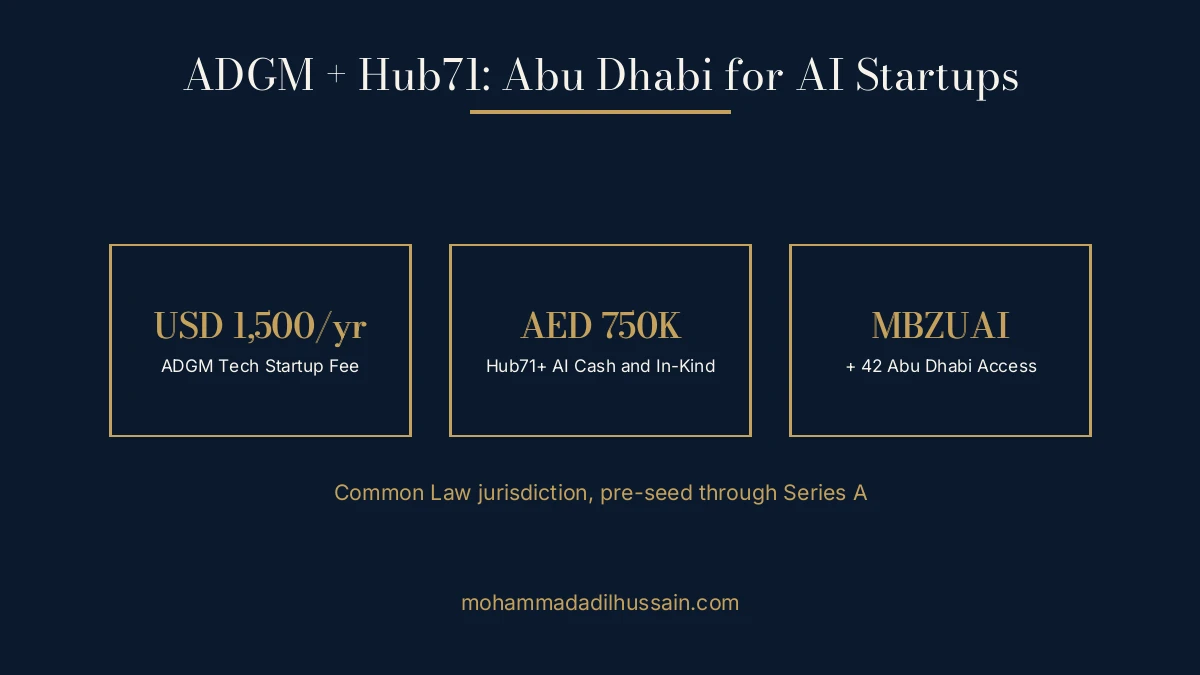
What separates ADGM from a purely legal comparison to DIFC is Hub71, Abu Dhabi’s startup ecosystem, which operates its startups under ADGM’s jurisdiction. Hub71+ AI, its dedicated program for AI-driven companies from pre-seed through Series A, offers AED 250,000 in cash through a SAFE note, AED 250,000 in in-kind service credits, and a further AED 250,000 top-up for startups that commit long-term to Abu Dhabi. Accepted companies get advanced compute access, connections to AWS, Nvidia, Google and Hewlett Packard, and access to Mohamed bin Zayed University of Artificial Intelligence (MBZUAI) and 42 Abu Dhabi.
The one binding condition: at least one founder has to relocate to Abu Dhabi long-term. Cohort 20 applications close 21 August 2026. Best fit: an AI startup that wants Common Law protection and is willing to trade Dubai’s visibility for real, structured capital and an accelerator relationship rather than a self-directed setup.
Masdar City Free Zone: Built for Compute-Heavy AI
Masdar City Free Zone, also in Abu Dhabi, is the one option on this list actually built around energy-intensive infrastructure rather than adapted to it. Its buildings are LEED Platinum-certified with cooling systems designed for AI and data center workloads, and its licensing covers Clean Tech and ICT, service providers, and renewable energy categories, with AI business packages, licensing plus office space, starting around AED 12,000 a year.
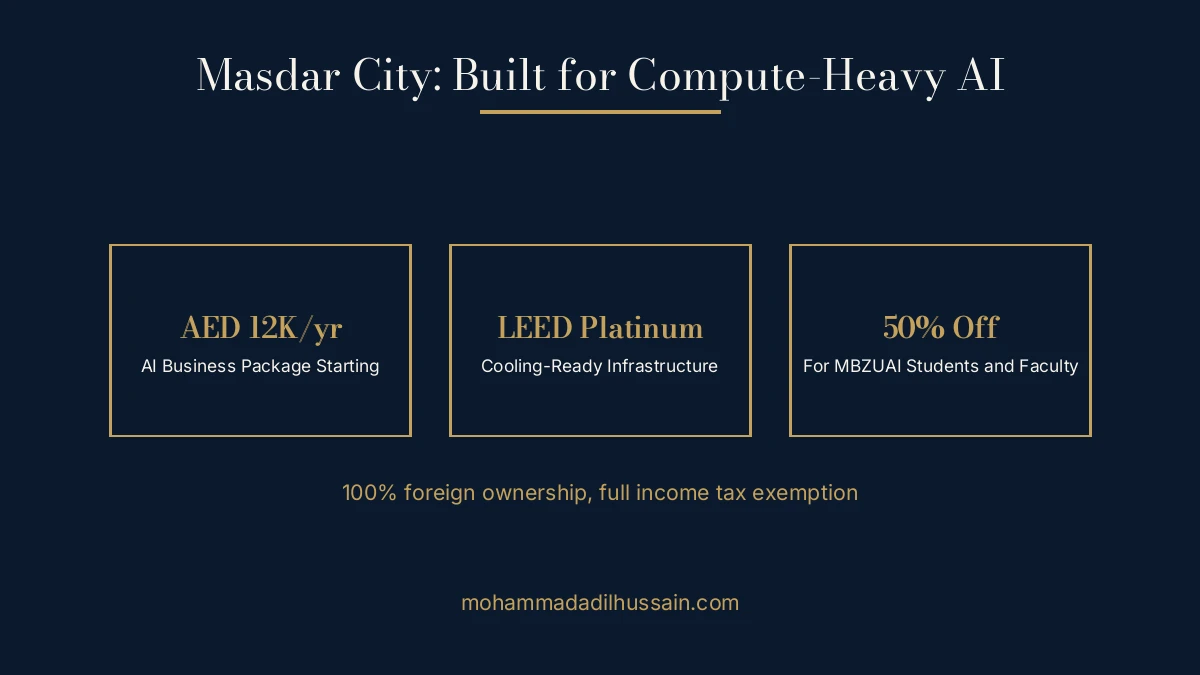
The zone offers 100% foreign ownership and full income tax exemption, and it runs a specific discount tied to the UAE’s AI talent pipeline: students and faculty at MBZUAI, based nearby, get 50% off registration, licensing and leasing fees for their first two years. That is a narrow but real signal of how deliberately Abu Dhabi is trying to convert its AI research talent into AI companies.
Best fit: an AI company whose actual workload, model training, inference at scale, data center operations, needs infrastructure built for it, not just a licence that permits it.
SRTIP: Sharjah’s Lower-Cost Research and Technology Park
Sharjah Research Technology and Innovation Park positions itself around research and innovation broadly, covering technology and IT services alongside manufacturing, logistics and R&D, rather than AI specifically. Authorized setup packages start near AED 5,500 for a zero-visa licence, rising to roughly AED 12,500 with one visa and AED 17,795 with two, considerably below Dubai or Abu Dhabi pricing for a comparable setup.
It is also, notably, where Unbound, the company behind the Yalla Commerce e-commerce summit, is based, a real example of a tech-adjacent company choosing Sharjah over Dubai or Abu Dhabi for its home base. SRTIP won’t hand an AI startup the accelerator capital Hub71 does or the Common Law framework DIFC and ADGM offer, but for a technology company prioritizing cost and government-backed setup support over either of those, it is a genuine option most comparisons skip entirely.
Best fit: a technology company, not necessarily AI-specific, that wants a lower-cost, government-backed setup without needing institutional investor infrastructure.
Dubai Internet City: The Established Tech Hub
Dubai Internet City, part of Dubai’s TECOM free zone group, is the oldest and most recognized tech-specific free zone in the UAE, historically home to the regional operations of Microsoft, Google and other global technology companies. Costs vary widely by activity and provider, and licence packages for a straightforward IT or SaaS company typically start in the AED 15,000 to AED 30,000 range depending on visa allocation and office type.
Its advantage is ecosystem density and brand recognition rather than a specific legal or capital mechanism. If your company’s plan already runs through the Dubai VC funding logic covered in best Dubai free zones for tech startups chasing venture capital funding, Dubai Internet City and Dtec are the two zones that piece already covers in depth, and the funding-stage logic there applies here too.
RAKEZ: The Cost Floor
Ras Al Khaimah Economic Zone is the free zone to consider when the honest answer is that your technology company does not need Common Law, an accelerator relationship, or a specialized AI ecosystem yet, and the actual priority is minimizing burn during an early, self-funded stage. A licence-only setup runs from around AED 6,000, with residence visa packages adding roughly AED 4,000 each on top of that base, putting RAKEZ meaningfully below Dubai or Abu Dhabi pricing for a comparable company.
The tradeoff is real and worth stating plainly: RAKEZ runs on standard civil law, not Common Law, so a company planning to raise from an institutional VC later will likely need to restructure. That is a reasonable decision for a two-person SaaS company self-funding its first eighteen months. It is a poor one for a company that already knows it is raising a priced round in the next year.
The Best Free Zones in UAE for AI and Technology Companies, Compared
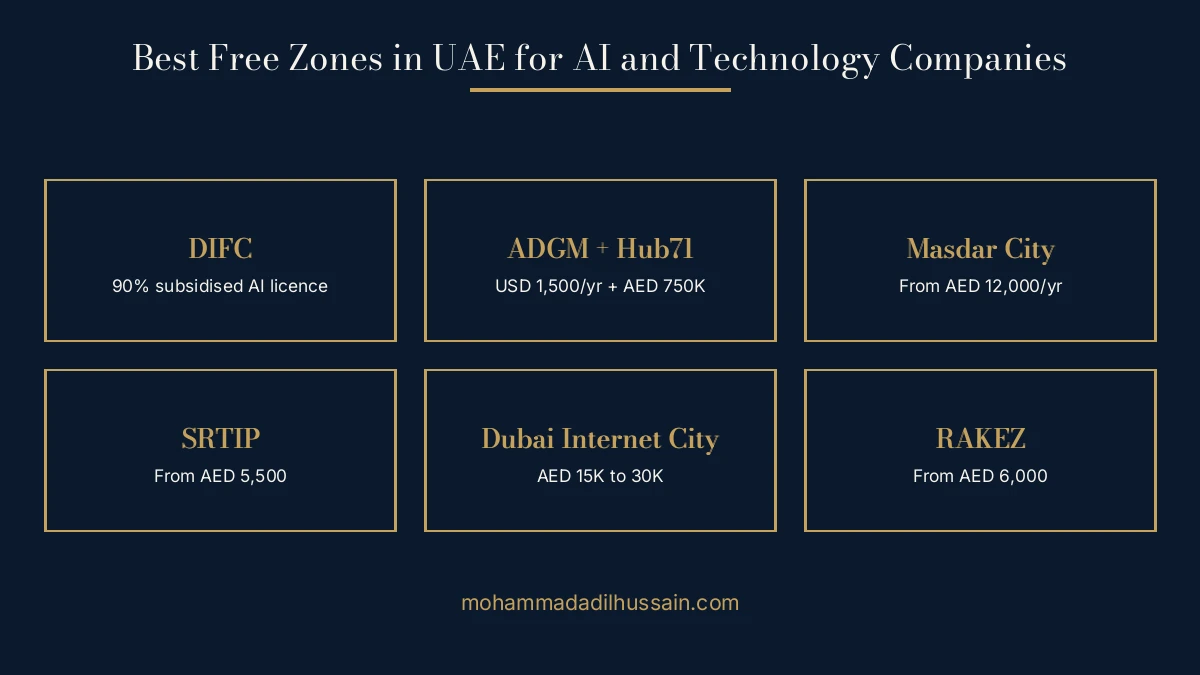
| Free zone | Emirate | Starting cost | Best fit |
|---|---|---|---|
| DIFC | Dubai | Licence subsidized 90% under the AI and Web3 programme | AI or Web3 company chasing institutional VC |
| ADGM + Hub71 | Abu Dhabi | USD 1,500/year tech startup fee plus Hub71 capital | AI startup wanting Common Law and structured accelerator funding |
| Masdar City Free Zone | Abu Dhabi | From AED 12,000/year | Compute-heavy AI companies needing built-for-purpose infrastructure |
| SRTIP | Sharjah | From AED 5,500 (zero visa) | Lower-cost technology company, government-backed setup |
| Dubai Internet City | Dubai | Roughly AED 15,000 to 30,000 | Established tech company wanting ecosystem density |
| RAKEZ | Ras Al Khaimah | From AED 6,000 | Cost-sensitive, self-funded technology company |
Substance, Audits and the Five-Year Lockout
Three compliance realities that belong in the setup decision, not in a conversation eighteen months later. They apply across every one of the best free zones in UAE for AI and technology companies, not only the low-cost ones.
Substance is a staffing question. Article 8 of Cabinet Decision No. 100 of 2023 requires a Qualifying Free Zone Person to conduct its core income-generating activities in the free zone, with adequate assets, adequate qualified full-time employees and adequate operating expenditure. For an AI company whose engineers work remotely from three countries, that is a design constraint, subject to the intellectual property carve-out described earlier.
Audited accounts are mandatory. Ministerial Decision No. 84 of 2025 requires audited financial statements for every Qualifying Free Zone Person, regardless of revenue. Budget for it from year one.
The de minimis threshold is tighter than it sounds. Non-qualifying revenue must stay under 5% of total revenue or AED 5,000,000, whichever is lower. On AED 2 million of revenue, that ceiling is AED 100,000. One mainland enterprise contract can breach it.
Failure is not a one-year problem. Under Article 5(2) of Ministerial Decision No. 229 of 2025, a company that fails any condition ceases to be a Qualifying Free Zone Person from the start of that tax period and for the following four tax periods. Five years at 9%, triggered by one contract nobody flagged.
There is a practical fallback that suits most early-stage AI companies better than chasing Qualifying Free Zone Person status at all. Small Business Relief gives businesses under AED 3 million in revenue an effective 0% position, and it has now been extended to 2029. For a pre-revenue or early-revenue AI company, electing that relief is usually simpler, cheaper and considerably less fragile than engineering a qualifying income structure you will breach on your first enterprise deal.
Common Mistakes Founders Make Choosing an AI or Tech Free Zone
Reading “0% corporate tax” as a property of the free zone rather than a property of the income. It is a conditional rate applied to Qualifying Income earned by a Qualifying Free Zone Person. An AI company selling development services to mainland clients pays 9% across all of the best free zones in UAE for AI and technology companies listed here.
Structuring as a services company when the same work could be structured around owned software. Copyrighted software is Qualifying Intellectual Property. Development hours are not. The difference between billing for a licence and billing for a person’s time can be the difference between 0% and 9% on identical revenue.
Picking the zone with the most media coverage instead of the one that matches the company’s actual stage. DIFC and ADGM get written about constantly; that has nothing to do with whether a bootstrapped SaaS company needs Common Law protection it will never use.
Assuming every AI-branded free zone package includes infrastructure suited to the workload. A licensing category called “AI business package” is not the same as a facility built for the cooling and power demands of actual model training, which is specifically what Masdar City’s infrastructure, not its licence type alone, is built to handle.
Applying to an accelerator program like Hub71+ AI without confirming the relocation requirement first. At least one founder has to commit to living in Abu Dhabi long-term, which is a real constraint some teams discover only after investing time in the application.
Choosing the cheapest zone for a company that already knows it is raising an institutional round. RAKEZ and SRTIP are genuinely good options for the right company, but restructuring out of civil law jurisdiction after a term sheet arrives is slower and more expensive than choosing correctly the first time.
My Approach: Matching the Zone to What You’re Actually Building
Most business setup consultants help you register a company. I help you make informed business decisions before you invest.
An AI or technology company’s free zone decision is not primarily a comparison of licence fees. It is a question of who your customers are, whether you own the code you earn from, and whether your engineering team can sit where the substance rules require. A free zone AI company selling to mainland banks, one selling to other free zone tenants, and one licensing its own copyrighted model to overseas customers face three different tax outcomes on identical revenue. I don’t open a conversation with a free zone name. I open it with your revenue mix, because that is what decides the answer.
My advisory process focuses on helping you reduce uncertainty and make confident decisions, not just complete documentation. Here is what that looks like in practice.
- Idea validation against what your specific AI or technology product actually requires, not a generic UAE tech free zone overview.
- Market research specific to your sector and the free zones that actually serve it.
- Competitor analysis, including who else is building in the same space across DIFC, ADGM, Masdar City, SRTIP and Dubai Internet City.
- A business plan built for the investor conversations, or the bootstrapped runway plan, you’re actually working with.
- Startup cost estimation, license fees, compliance costs and infrastructure costs, disclosed together rather than one number at a time.
- Revenue mix mapping, so you know before formation what share of your income will be qualifying and what share will not.
- Corporate tax registration and filing planning, including whether Small Business Relief beats a qualifying income structure for you.
- Financial feasibility modeling before you commit to a jurisdiction.
- A structure recommendation matched to your product and stage, not the free zone that is fastest to set up.
- License selection that accounts for what your specific technology or AI application is actually permitted to do.
- Investor and employment visa planning, including for specialized technical talent you may need to bring in.
- Banking strategy, since technology companies handling data and payments face closer scrutiny than a standard services business.
- Risk assessment covering data residency, IP protection and jurisdiction-specific compliance.
- Expansion planning for scaling past your first free zone as the company grows.
The objective is simple: help you start your business with clarity, confidence and a long-term strategy. If you want to talk through which zone actually fits your product, you can review business setup services, look at what growth and market expansion involves once you’re past formation, or get in touch directly.
Frequently Asked Questions
Do AI and software companies in UAE free zones pay 0% corporate tax?
Not automatically. Software development and AI services are not among the 13 Qualifying Activities in Ministerial Decision No. 229 of 2025. Income from those activities is taxed at 9% unless it comes from another free zone company, or qualifies as income from copyrighted software treated as Qualifying Intellectual Property.
Is a SaaS company selling to UAE mainland customers still tax-free in a free zone?
No. A mainland company is a Non-Free Zone Person. Income from a Non-Free Zone Person qualifies for 0% only when it comes from a Qualifying Activity, and software services are not one. That revenue is taxed at 9%.
What happens if I lose Qualifying Free Zone Person status?
Under Article 5(2) of Ministerial Decision No. 229 of 2025, you cease to be a Qualifying Free Zone Person from the beginning of that tax period and for the following four tax periods. That is five years of 9% corporate tax from a single breach.
What is the best free zone in the UAE for an AI company in 2026?
There is no single best free zone, because the right one depends on whether you need Common Law protection for institutional investors, compute-heavy infrastructure, accelerator capital, or the lowest possible setup cost. DIFC and ADGM fit VC-track companies, Masdar City fits infrastructure-heavy AI workloads, and SRTIP or RAKEZ fit cost-sensitive setups.
Can I get funding as part of setting up in a UAE free zone?
Yes, through Hub71+ AI specifically, which pairs an ADGM tech startup licence with up to AED 750,000 in cash and in-kind support for AI-driven companies from pre-seed through Series A, conditional on at least one founder relocating to Abu Dhabi long-term.
Does DIFC’s AI and Web3 licence work for a fintech company?
No. It specifically excludes financial services and crypto exchange activity, so a fintech or crypto-adjacent company needs a different DIFC licence category or a different free zone entirely.
Is Masdar City only for clean energy companies?
No. It licenses Clean Tech and ICT, service providers, and renewable energy categories, and it has built AI business packages and infrastructure specifically for AI and data center workloads, not only sustainability-focused businesses.
Is RAKEZ or SRTIP a bad choice if I plan to raise venture capital eventually?
Not necessarily, but plan for it honestly. Both run on standard civil law rather than the Common Law frameworks DIFC and ADGM use, so a company that later raises an institutional round from those jurisdictions will likely need to restructure, which is more expensive done under investor time pressure than decided upfront.
Related reading: best Dubai free zones for tech startups chasing venture capital funding.
The same logic extends past legal structure. A free zone’s actual infrastructure, whether it was built for office-based services or for power-dense compute, matters just as much as its legal framework once you know what your product actually runs on. That is exactly why AI and general technology companies increasingly need a different comparison than the one built for VC-track startups alone.
Sources & References
- Ministry of Finance – Ministerial Decision No. 229 of 2025 on Qualifying Activities and Excluded Activities
- Ministry of Finance – Cabinet Decision No. 100 of 2023 on Determining Qualifying Income for the Qualifying Free Zone Person
- DIFC – Regulation 10 on Personal Data Processed Through Autonomous and Semi-Autonomous Systems
- ADGM – Reduces Commercial Licence Fees From January 2025
- Hub71 – Hub71+ AI Program
- Hub71 – How a Startup Ecosystem Is Thriving Thanks to a Smart Approach to Regulation
- Masdar City Free Zone – Set Up Your AI or Data Center in Abu Dhabi
- Zawya – Masdar City Free Zone Introduces Specialized AI Business Package
- SRTIP Accelerator – Business Setup in SRTIP