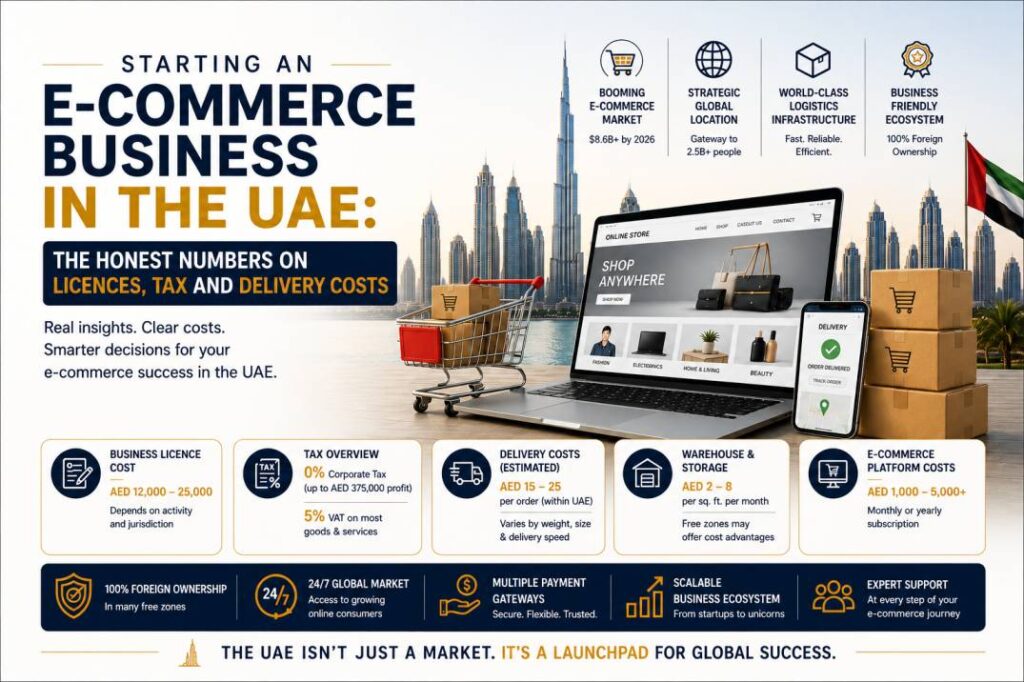
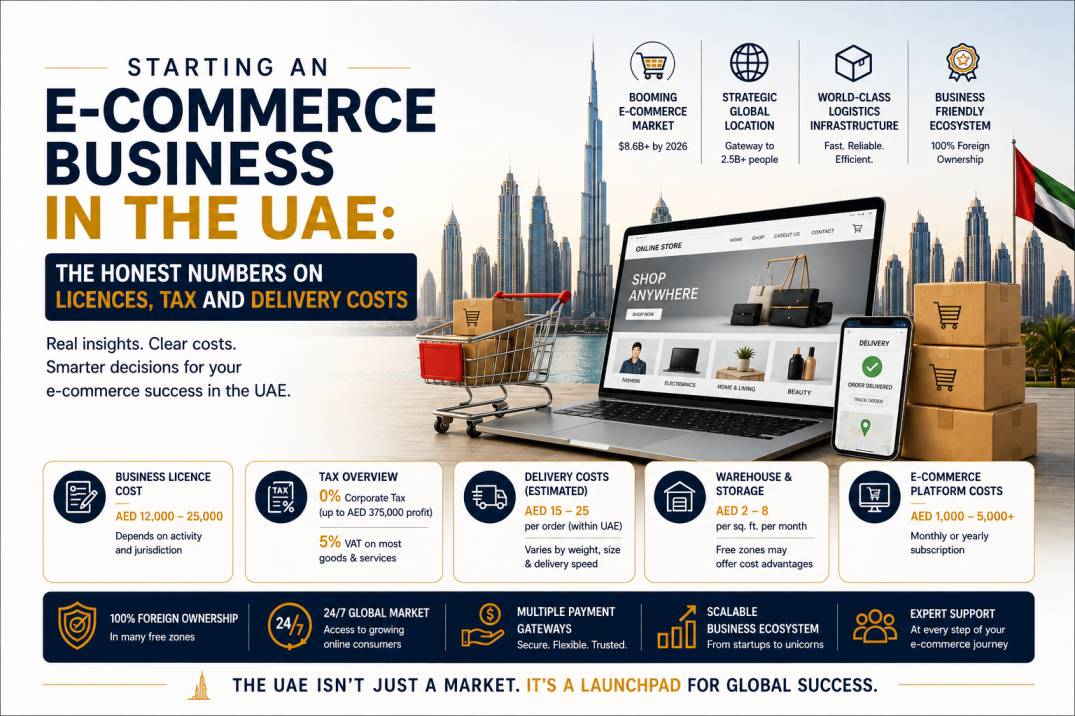
 The UAE e-commerce market is projected to roughly double between 2026 and 2031. The growth is real, the infrastructure genuinely leads the region, and the opportunity for new entrants is significant. But the headline number deserves scrutiny before you build a business plan on it – because reputable research houses disagree about the size of this market by a factor of six.
In this guide
Quick Answer
- The UAE e-commerce market reached USD 12.30 billion in 2026 and is forecast to hit USD 21.01 billion by 2031 – an 11.29% CAGR. That figure comes from Mordor Intelligence.
- Read that attribution carefully. Other established research firms put the same market at USD 79.94 billion in 2024. The definitions differ, and anyone quoting a single number as settled fact has not checked.
- What is not in dispute: smartphones handled 78.67% of transactions in 2025, digital wallets took 43.92% of payment share, and UAE Pass passed 11 million users processing 2.6 billion transactions across 322 services.
- Fashion and apparel led at 21.59% share in 2025; food and beverage is the fastest-growing category at a 13.16% CAGR, driven by 15-minute quick commerce.
- The constraint that decides profitability: last-mile delivery at AED 35–50 per parcel, against average order values that often cannot carry it.
1. The number, and why the attribution matters
Start with the figure your competitors are quoting.
Mordor Intelligence puts the UAE e-commerce market at USD 12.30 billion in 2026, rising to USD 21.01 billion by 2031 at an 11.29% compound annual growth rate. Mordor’s own note states these are generated using its proprietary estimation framework, updated as of January 2026.
That is a credible, well-constructed estimate. It is not the only one.
| Source | Market size | Year |
|---|---|---|
| Mordor Intelligence | USD 12.30 billion | 2026 |
| Research and Markets | USD 12.28 billion | 2025 |
| Verified Market Research | USD 79.94 billion | 2024 |
| Dubai Chamber (Euromonitor) | USD 9.2 billion forecast | 2026 |
Those are not small discrepancies. Verified Market Research’s figure is more than six times Mordor’s for a period two years earlier.
The gap comes from definitions, and the USD 516 billion trade corridor figure behind the UAE’s first global e-commerce summit counts a wider basket again. Some estimates count only retail goods sold online. Others include travel bookings, digital services, ride-hailing, food delivery and B2B transactions. “E-commerce” is not a standardised category, and each research house draws the boundary differently.
Why this matters commercially: if you build a business plan around “a USD 12 billion market” and your investor is working from a USD 80 billion figure, one of you will look uninformed in the meeting. Cite the source and the definition, every time.
For your own planning, the growth rate is more useful than the level. An 11–12% CAGR is consistent across the credible estimates, and a compounding rate is what determines whether a market can absorb a new entrant.
2. What is genuinely not in dispute
Whatever the exact figure, the UAE e-commerce market fundamentals are not seriously disputed. Behind the market-sizing noise, the structural picture is consistent across every source – and it is the strongest in the region.
Mobile has already won. Smartphones accounted for 78.67% of e-commerce transactions in 2025, growing at an estimated 16.24% CAGR through 2031. Nearly four in five orders. If your storefront is not built mobile-first, you are not competing for the majority of the market.
Payment friction has collapsed. Digital wallets held 43.92% of payment share in 2025. Buy Now, Pay Later – Tabby, Tamara and others – is projected to grow at 13.27% CAGR through 2031. The Aani instant-payment rail continues reducing cash-on-delivery dependence, which has historically been the single largest margin drain in Gulf e-commerce.
Digital identity is the underrated advantage. UAE Pass surpassed 11 million users by early 2025, processing 2.6 billion transactions across 322 public and private services. Reported first-time conversion uplift from single sign-on at checkout runs as high as 40%. Very few markets anywhere have a government-issued identity layer this deeply integrated into private commerce.
Connectivity is effectively universal. Over 96% internet penetration, and one of the highest smartphone usage rates globally.
Taken together: a mobile-first, wallet-paying, digitally identified consumer base with near-total connectivity. That is an unusually clean set of conditions to launch into.
3. Where the demand actually sits
| Vertical | 2025 position | What drives it |
|---|---|---|
| Fashion and apparel | 21.59% share – largest | Regional players like Namshi plus international fast-fashion |
| Food and beverage | Fastest growing, 13.16% CAGR | 15-minute quick commerce and dark-store density |
| Consumer electronics | High average order value | Replacement cycles, premium smart-home adoption |
| B2B and procurement | Reported ~19.5% CAGR to 2030 | Digitisation of wholesale and industrial purchasing |
Two observations worth more than the table.
Fashion leads on share, but that is where competition is heaviest. Namshi, Amazon.ae, Noon and every international fast-fashion brand are contesting the same customer. A new entrant needs a genuine niche – modest fashion, technical apparel, local designers, resale – rather than a general offering.
The fastest growth is in categories with the hardest economics. Food and beverage at 13.16% CAGR is the standout number, but 15-minute delivery is also the least forgiving business model in retail. High order frequency, thin baskets, punishing labour and delivery costs. Growth and profitability are not the same thing.
The quieter opportunity sits in B2B and underserved verticals. Industrial procurement, subscription models, re-commerce, pet care, EdTech and speciality categories remain structurally under-served online relative to consumer retail – where a smaller operator can build a defensible position without outspending Amazon.
4. The constraint that decides whether you make money
This is the constraint that separates profitable operators in the UAE e-commerce market from the rest.
If you take one operational point from this article, take this one.
Last-mile delivery in the UAE costs approximately AED 35–50 per parcel.
Now run the arithmetic. On a AED 150 order at a 30% gross margin, you have AED 45 of gross profit – and delivery alone can consume all of it. Before payment processing, returns, customer acquisition, packaging or platform fees.
This is why so many well-funded UAE e-commerce ventures have struggled despite genuine demand. The market is real. The unit economics are unforgiving.
Three structural responses are visible in the market:
Micro-fulfilment density. Operators are establishing dark stores within roughly a 3 km radius of dense urban catchments, shortening delivery distance rather than accepting the cost.
AI-assisted discovery and conversion. Around 51% of shoppers report using conversational AI tools to discover products. Higher conversion on the same traffic improves the margin available to absorb delivery cost.
Fulfilment infrastructure at scale. Investments such as Noon’s fulfilment hubs in KEZAD are pushing per-order handling costs down through volume.
There are also two frictions worth planning around: delivery lag in the less populated northern emirates, and compliance costs under the Personal Data Protection Law, which apply from your first customer, not your thousandth.
And competition is not only local. Forecasts suggest roughly 32% of transactions will flow through foreign platforms – meaning you compete with cross-border sellers who may have structurally lower cost bases.
5. What this means for setting up
Setting up inside the UAE e-commerce market means treating the licensing decision as strategic, not administrative. E-commerce is one of the few sectors where the licensing decision is genuinely strategic rather than administrative, because it determines who you can legally sell to.
Free zone or mainland – the question is your customer
A free zone company suits cross-border selling, marketplace-only models and international B2B. Several zones – DMCC, Dubai CommerCity, Meydan, Sharjah’s SPC – run dedicated e-commerce licence categories.
A mainland licence is generally the stronger position if you are selling directly to UAE consumers, holding local stock, operating your own delivery, or opening physical retail alongside the online channel. Most consumer-facing e-commerce businesses end up here.
A branch or subsidiary is often cleanest for an established overseas retailer extending into the market, with an offshore holding structure sometimes sitting above the operating entity. I have compared the routes in detail in Mainland vs Free Zone vs Offshore.
The tax point that changes your model
You will see “0% corporate tax” attached to every free zone e-commerce package. That is not how the regime works.
The UAE applies 9% corporate tax on profits above AED 375,000. A Qualifying Free Zone Person accesses 0% on qualifying income only, subject to substance and activity conditions. For distribution specifically, qualifying treatment generally requires the activity to be carried out in or from a Designated Zone, with the buyer being a reseller or processor – sales to end consumers are taxed at 9%.
Read that last clause again if you are planning direct-to-consumer. Most e-commerce is, by definition, selling to end users. See Tax Registration & Filing and Financial Reporting & Auditing.
VAT also applies at 5% on domestic supplies, with registration mandatory above AED 375,000 in taxable turnover – a threshold a growing store crosses quickly.
Customs, if you import
Goods held in a bonded free zone are not subject to import duty. Duty becomes payable at 5% CIF when goods enter the UAE domestic market – which, for a direct-to-consumer store selling locally, is every order. Free zone status defers duty for re-export; it does not remove it for domestic sale.
If you are importing stock, the Dubai South logistics corridor and the UAE’s CEPA network are both relevant – noting that CEPA tariff preference follows the origin of your goods, not your company’s licence.
The operational layer
Corporate banking – e-commerce businesses face extended compliance review, and payment gateway approval typically depends on having the account first. Sequencing matters. Add residency visas and PRO support for your team.
If you are still testing whether the model works – whether your average order value can carry AED 35–50 of delivery cost – that belongs in pre-launch feasibility work and market expansion planning before you register anything.
6. My Approach: Strategy Before the Licence
Most business setup consultants help you register a company. I help you make informed business decisions before you invest.
E-commerce numbers like these look straightforward until you price in delivery, returns and payment gateway costs against your actual margin. Before recommending a licence and structure for an e-commerce business, I run the full cost picture against your specific product category and delivery model, not just the headline licence fee.
My advisory process focuses on helping you reduce uncertainty and make confident decisions, not just complete documentation.
What You Can Expect
- Business idea validation
- Market research
- Competitor analysis
- Business plan development
- Startup cost estimation
- Financial feasibility analysis
- Business structure recommendations
- Licence selection guidance
- Investor and employment visa planning
- Business bank account strategy
- Risk assessment
- Business expansion planning
The objective is simple: help you start your business with clarity, confidence and a long-term strategy.
7. Is the UAE the right choice for your business?
If you are planning to launch a new venture, expand internationally, or relocate your business to the UAE, do not base the decision solely on promotional offers or the lowest licence price – and do not build an e-commerce plan on a market size figure without checking which definition produced it.
Build your business on research, planning and informed decision-making. The right strategy today can save you thousands in cost and position your business for sustainable growth tomorrow.
The UAE has assembled something genuinely rare: near-universal connectivity, a mobile-first consumer base, a government digital identity layer integrated into private checkouts, mature payment infrastructure, and logistics capability that most markets its size cannot match. A market compounding at 11–12% a year is one that can still absorb new entrants.
The operators who succeed will be the ones who picked a defensible niche rather than competing with Amazon on breadth, and who proved their unit economics could carry AED 35–50 of delivery cost before they scaled.
Ready to build your business with confidence?
If you are considering setting up a business in the UAE, let’s start with strategy – not paperwork. Together we will evaluate your goals, analyse the market, identify the right setup options, and create a roadmap tailored to your vision.
Because successful businesses aren’t built by chance – they’re built on informed decisions.
Book a free consultation or message me directly on WhatsApp.
Frequently asked questions
How big is the UAE e-commerce market?
Mordor Intelligence puts it at USD 12.30 billion in 2026, rising to USD 21.01 billion by 2031 at an 11.29% CAGR. Other research houses publish materially different figures – Verified Market Research estimated USD 79.94 billion in 2024 – because definitions of what counts as e-commerce vary. Always cite the source and its definition.
Do I need a mainland or free zone licence for e-commerce in the UAE?
It depends on your customer. Free zone suits cross-border and marketplace-only models; mainland is generally stronger if you sell directly to UAE consumers, hold local stock, run your own delivery or plan physical retail alongside online.
Do free zone e-commerce companies pay 0% corporate tax?
Only on qualifying income. Distribution generally qualifies only when carried out in or from a Designated Zone with the buyer being a reseller or processor. Sales to end consumers are taxed at 9% above AED 375,000 – which affects most direct-to-consumer stores.
What is the biggest cost risk in UAE e-commerce?
Last-mile delivery, at roughly AED 35–50 per parcel. On a AED 150 order at 30% gross margin, delivery alone can consume the entire gross profit before any other cost. Average order value and delivery density decide profitability.
Which e-commerce category is growing fastest in the UAE?
Food and beverage, at a projected 13.16% CAGR through 2031, driven by 15-minute quick commerce. Fashion and apparel remains the largest by share at 21.59% in 2025.
What do most first-time sellers get wrong?
The most common mistake is underestimating last-mile delivery cost relative to product margin before launch, rather than after. A seller who prices a product to compete on the marketplace, without first modelling the actual delivery cost per order at realistic volumes, often discovers the true margin only after several months of trading, by which point pricing has already been communicated to customers and is harder to adjust. Building a delivery cost model before setting prices, not after, is the single change that would fix the most common early losses in this sector.
The second common mistake is licensing for general trading when the actual activity is retail e-commerce, which can create friction with payment gateway providers and marketplaces that expect the licence to match the declared business activity precisely.
Fixing both of these before launch, rather than after the first few months of trading, is what separates a durable e-commerce business from one quietly losing money on every order.
A single extra sentence on delivery cost, checked before the first sale, is worth more to your margin than an entire quarter of marketing spend.
Sources
- Mordor Intelligence – UAE E-commerce Market report
- Research and Markets – UAE E-Commerce market analysis
- Verified Market Research – alternative market sizing
- Gulf News – Dubai Chamber / Euromonitor forecast
- Statista – E-commerce in the UAE, statistics and facts
This article is general commentary, not legal, tax or investment advice. Market size estimates vary significantly by research methodology and definition. Verify current licensing, tax and customs requirements with the relevant authority before acting.
Related reading: Dubai’s 161,000 new residents in 2026 and what it means for founders.
Related reading: the top-performing businesses in Dubai 2026 and their startup costs.