
Quick Answer
Yes, an HR consultancy business setup in UAE is worth starting, but only if you license the right activity for the work you actually do. The modeled UAE HR-services market is about US$546 million in 2026, rising to roughly US$770 million by 2030, inside a wider GCC market modeled at US$1.86 billion growing to US$2.62 billion over the same period. Demand is strongest from SMEs and mid-market companies that have no senior HR function, and from international founders entering the UAE who need to employ people correctly from day one.
In the base case I use in this guide, a lean UAE HR consultancy reaches AED 2.4 million in Year 1 revenue, turns EBITDA-positive inside the first year, and crosses operational break-even around month 10 to 12, which points to AED 1.0 to 1.2 million of starting liquidity. A free zone advisory licence such as SPARK, starting from around AED 5,500, is the realistic way to launch and prove the model, since genuine HR advisory work does not need a MOHRE recruitment licence. A mainland LLC becomes the stronger choice once you are targeting enterprise or government clients, or once you are ready to add regulated recruitment and staffing. This covers demand, competition, setup costs, break-even and licensing strategy in that order.
Table of Contents
HR Consultancy Business Setup in UAE: Is the Market Good?
No single official source publishes one consistent “HR consultancy market” figure across the GCC, so I built this estimate the honest way: starting from a published number and stating the method rather than presenting false precision. One commercial estimate puts the UAE HR outsourcing market at US$421.2 million in 2023, forecasting roughly 9% annual growth to about US$800.2 million by 2032. Separately, the broader Middle East and Africa HR-management software and services market was estimated at US$2.52 billion in 2024, growing 14.2% a year from 2025 to 2030. The wider GCC consulting industry grew 13.2% in 2023, well ahead of mature Western consulting markets, with Saudi Arabia’s diversification programme a major driver.
Compounding that UAE outsourcing figure forward gives a 2026 reference point of roughly US$546 million, rising to about US$770 million by 2030. Scaling the rest of the GCC against labour-force size and spend intensity gives a modeled GCC total of approximately US$1.86 billion in 2026, climbing to US$2.62 billion by 2030, with Saudi Arabia the largest single market and the UAE second.
| Country | Modeled 2026 market (US$m) | Planning CAGR 2026 to 30 | Modeled 2030 (US$m) | Confidence |
|---|---|---|---|---|
| Saudi Arabia | 855 | 10.0% | 1,252 | Medium |
| UAE | 546 | 9.0% | 770 | Medium-high |
| Qatar | 170 | 7.5% | 227 | Medium-low |
| Kuwait | 130 | 6.5% | 167 | Low-medium |
| Oman | 95 | 7.0% | 125 | Low-medium |
| Bahrain | 60 | 7.2% | 79 | Low-medium |
The UAE figure carries the highest confidence because it is anchored directly to a published outsourcing estimate. The other five are planning values, built from labour-force scale and country-specific growth assumptions, and I would treat them as directional rather than exact. What matters more than any single total is where the demand actually sits, which is the next question.

Who Actually Needs an HR Consultancy in the UAE
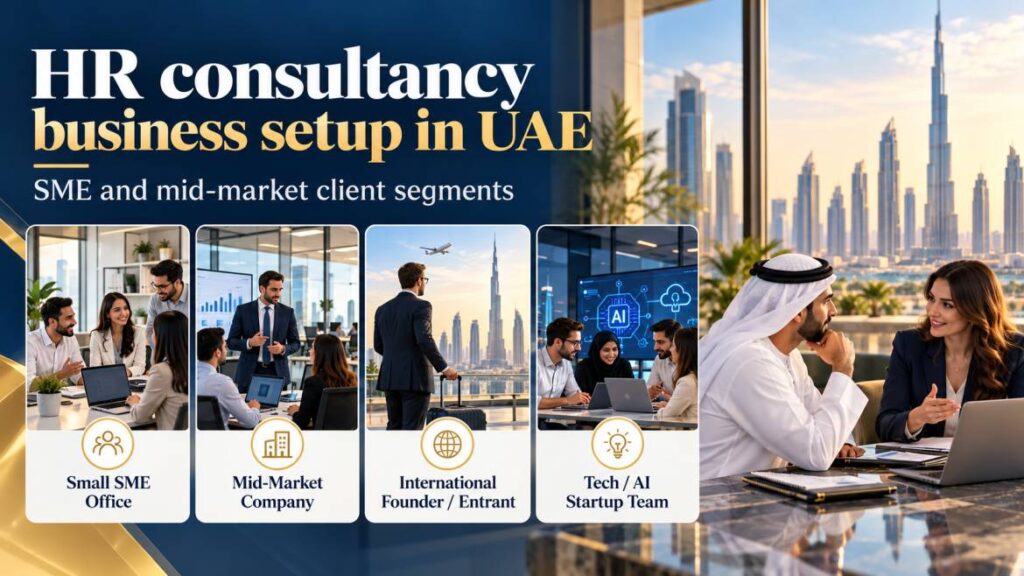
Demand is not evenly spread. Some client segments have an urgent, recurring HR problem. Others are high-value but slow to close. I would not build a launch plan around the slow ones.
| Client segment | Typical HR pain point | Commercial attractiveness |
|---|---|---|
| SMEs, 20 to 250 employees | No senior HR function, policies and payroll fragmented | Very high |
| Mid-market, 250 to 1,000 employees | HR exists but lacks specialist capacity | Very high |
| International market entrants | Need to employ quickly and understand UAE employment practice | Very high |
| Technology, AI and cybersecurity firms | Scarce specialists, fast team building | Very high |
| Startups and scale-ups | Rapid hiring on limited infrastructure | High |
| Healthcare | Licensed-professional shortages, credentialing | High |
| Energy and industrial | Scarce technical talent, nationalisation compliance | High |
| Government and semi-government | Workforce modernisation, national talent | High value, long procurement cycle |
I would build the first twelve months of a new HR consultancy almost entirely around the top three rows. SMEs, mid-market companies and international founders entering the UAE all convert faster than government or enterprise accounts, and all three are exactly the audience a founder reading a business setup website is already part of. This is also where a foreign company opening a branch in the UAE or setting up in Abu Dhabi usually realises it has no local HR infrastructure at all.
The Line Most Guides Skip: Advisory Versus Regulated Recruitment
Most articles about starting an HR consultancy in the UAE describe a single licensing path and stop there. That is not accurate, and treating it as accurate is the single biggest risk in this business. “HR consultancy” covers two legally different activities. One is unregulated advisory work: strategy, policy design, compensation frameworks, HR audits and payroll coordination. The other is regulated: mediating employment, recruiting workers as an agency, sponsoring and placing staff, or supplying temporary personnel. The UAE Ministry of Human Resources and Emiratisation, MOHRE, licenses that second category separately, under its own agency framework.
The cost difference is not small. MOHRE’s published service lists an AED 50,000 fee for a new temporary-employment and mediation agency licence, and renewal guidance requires those agencies to maintain a bank guarantee of at least AED 1 million. A boutique consultancy taking on that capital and compliance burden on day one, before it has a single client, is solving a problem it does not have yet. Getting an HR consultancy business setup in UAE right starts with separating advisory work from this regulated category, not with picking a jurisdiction first.
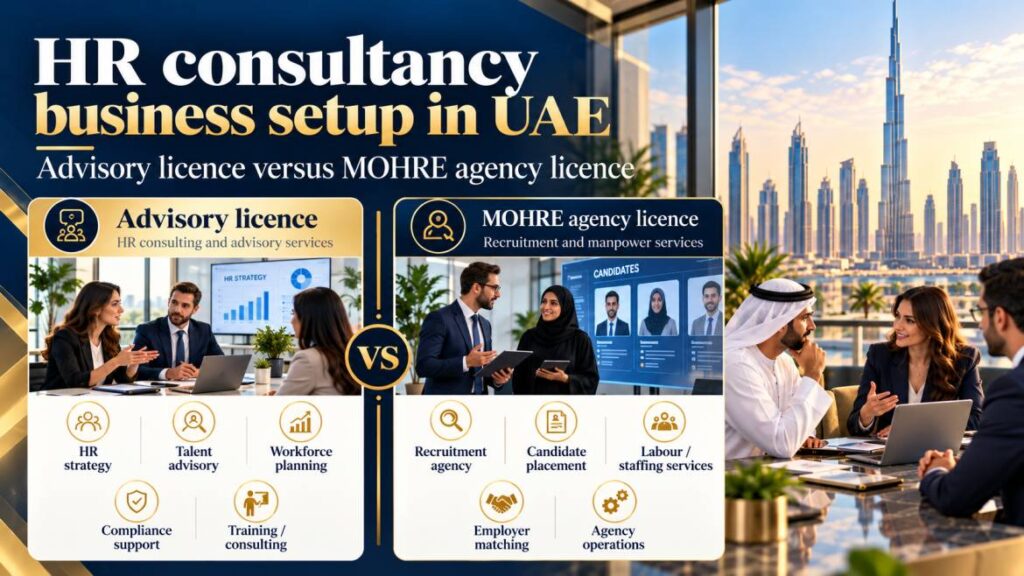
What this means in practice: your licence should cover HR strategy, policy, compliance audits, payroll administration coordination, HRIS implementation and workforce planning from the start. It should not describe your company as an employment mediator, a staffing agency or an employer of record until you hold the MOHRE agency licence. If an early client needs temporary staffing, sponsorship or an employer-of-record arrangement, the correct move is to refer or subcontract that piece through a properly licensed partner, not to provide it yourself on an advisory licence. Get the activity wording wrong at formation and you are either blocked from the services you actually want to sell, or exposed to a licensing-perimeter breach you did not know you had.
Competition: Where a Boutique HR Consultancy Actually Fits
There is no audited market-share table for UAE HR consultancies, so treat any “top 10” list, including this one, as a view of who is strategically relevant, not a revenue ranking. The honest picture is a market with global staffing platforms at one end and global strategy and HR transformation firms at the other, and very little in between.
| Competitor type | Core services | Who they serve |
|---|---|---|
| TASC Outsourcing, Adecco UAE | Recruitment, staffing, PEO/EOR, payroll, Emiratisation | Enterprise, high-growth entrants, regulated industries |
| Hays Middle East, Michael Page, Robert Walters | Specialist and executive recruitment, contract staffing, salary intelligence | Professional, technology and corporate functions |
| NADIA Global, MBR Recruitment, Salt | Recruitment, training, Emiratisation and nationalisation support | SMEs through large regional businesses |
| Korn Ferry, Mercer, PwC Middle East, KPMG UAE | Organisation strategy, rewards benchmarking, HR transformation | Large corporates, boards, government |
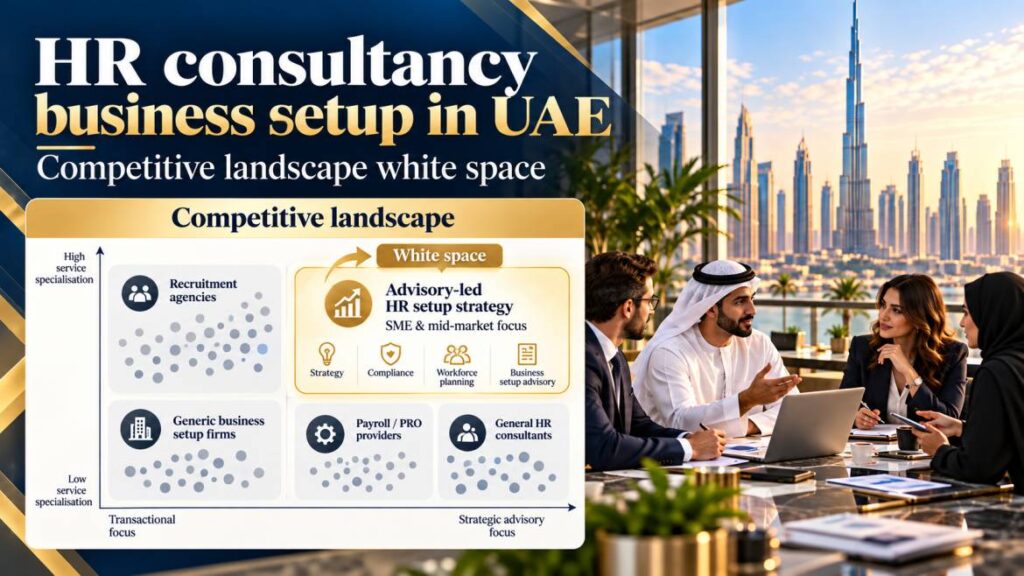
The white space sits between the recruitment boutiques and the global strategy firms: a mid-priced consultancy that becomes the outsourced “people office” for a growing SME or mid-market company, combining compliance, payroll coordination, HR systems and recruitment under one accountable relationship, rather than competing on CV volume or trying to out-brand Mercer. That is a defensible position for a new entrant, and it is the one this guide is written around.
What an HR Consultancy Actually Sells, and the Going Rate
These are 2026 planning ranges for designing your own service menu, not advertised industry tariffs. Most serious providers quote client by client based on volume, seniority and contract complexity, so validate prices through your own conversations before you put them in a proposal.
| Service | Pricing mechanism | Indicative UAE range |
|---|---|---|
| Permanent recruitment | Success fee | 15% to 25% of annual base salary |
| Executive or retained search | Staged retainer | 25% to 33% of annual cash compensation |
| Outsourced or fractional HR | Monthly retainer | AED 5,000 to 25,000 per month, SME scope |
| Payroll administration | Per employee, with a minimum | AED 50 to 150 per employee a month, AED 3,000 to 8,000 monthly minimum |
| HR compliance audit or handbook | Fixed project | AED 10,000 to 75,000 |
| HR operating model or organisation project | Fixed project or day rate | AED 30,000 to 250,000+ |
| HRIS selection and implementation | Fixed implementation | AED 20,000 to 150,000 SME; AED 150,000 to 1 million+ enterprise |
| RPO | Monthly retainer plus per-hire fee | AED 15,000 to 60,000 a month, plus AED 3,000 to 10,000 per hire |
A boutique that relies only on success-fee recruitment is building a volatile business, since that revenue disappears the moment hiring slows. The products that create monthly client dependence, fractional HR, payroll administration, RPO retainers and compliance retainers, are the ones worth prioritising, because recruitment then benefits from privileged access to a client’s hiring plans instead of competing cold against every agency in the market.
HR Consultancy Business Setup in UAE: What It Actually Costs
The licence fee is the smallest number in this business, the same pattern I see in almost every service-based setup. For an advisory-only Dubai mainland LLC, plan for AED 45,000 to 90,000 for the entity itself, licence, basic premises and initial immigration and admin. A wider, realistic pre-launch budget, including website, brand, CRM or applicant-tracking software, equipment and initial marketing, sits closer to AED 250,000 to 450,000. The UAE Ministry of Economy is explicit that your chosen activity, not your company name, determines your legal form and licensing requirements, which is exactly why the activity wording matters more than the jurisdiction you pick.
| Cost item | Planning range (AED) |
|---|---|
| Economic licence, incorporation, government processing | 15,000 to 30,000 |
| Serviced office, lease, deposits | 15,000 to 35,000 |
| Establishment, immigration and initial visas | 8,000 to 20,000 |
| Legal documents, accounting and tax setup, insurance | 8,000 to 20,000 |
| Website, brand, CRM or ATS setup | 20,000 to 60,000 |
| Equipment | 15,000 to 35,000 |
| Initial marketing, events, database subscriptions | 30,000 to 75,000 |
Technology and sourcing tools add a running cost most founders underbudget. Plan for AED 8,000 to 25,000 a month initially, rising toward AED 25,000 to 60,000 as recruiter seats, candidate databases and payroll processing expand. None of these figures include the recurring-revenue runway you need before the business supports itself, which is the next section.
Break-Even Potential: Three Scenarios
These are modeled planning scenarios, not a guarantee. The model treats net consultancy and service revenue as revenue, not the full payroll of outsourced workers, which is the honest way to view an advisory-led business rather than inflating turnover with pass-through costs.
| Scenario | Year 1 revenue (AED) | Year 3 revenue (AED) | Year 3 EBITDA (AED) | Operational break-even |
|---|---|---|---|---|
| Conservative | 1.20 million | 3.20 million | 0.28 million | Month 28 to 32 |
| Base | 2.40 million | 7.00 million | 1.67 million | Month 10 to 12 |
| Aggressive | 3.60 million | 12.50 million | 3.53 million | Month 6 to 8 |
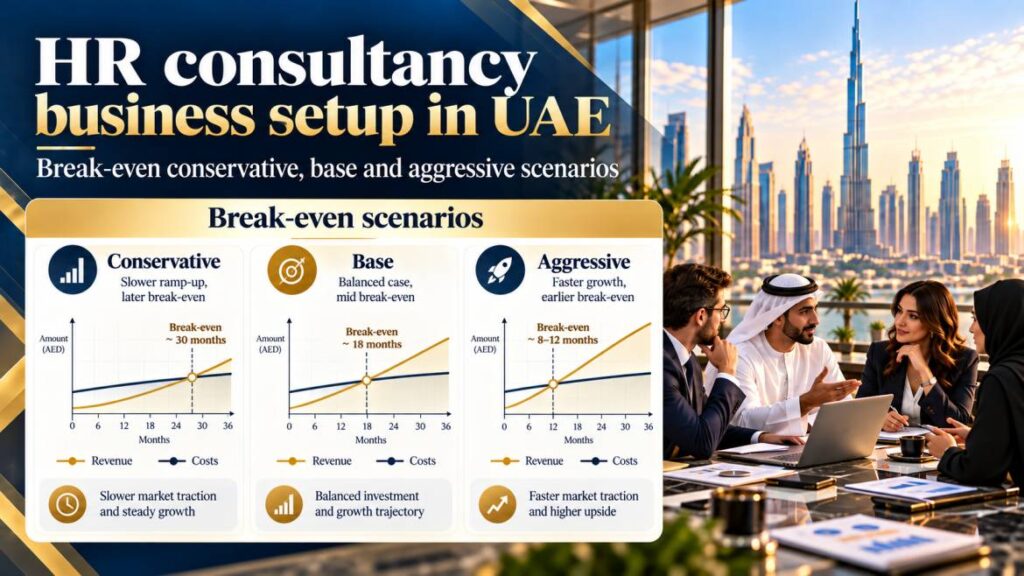
The base case is the rational planning case. It does not depend on landing a major staffing contract on day one, it does not assume unrealistic recruiter productivity, and it still reaches a Year 3 EBITDA margin of roughly 24%. It also needs AED 1.0 to 1.2 million of starting liquidity, since receivables and working capital create a cash trough even once the business is profitable on paper. One detail catches most founders off guard: the aggressive scenario consumes almost as much early cash as the base case, because rapid growth creates recruiter payroll and project-delivery costs before clients pay. Billing terms and days sales outstanding are strategic numbers here, not back-office metrics.
A realistic Year 3 revenue mix in the base case looks like 35% permanent recruitment, 20% advisory and compliance, 18% payroll and fractional HR, 12% RPO, 8% HRIS projects and 7% training. The improvement worth making early is shifting part of the advisory work into monthly retainers, so that 35% to 45% of annual revenue is contracted or highly repeatable by Year 3, rather than depending on one-off project wins.
These EBITDA figures are not the same as taxable profit. The UAE’s official corporate tax guidance sets the general rate at 0% on taxable income up to AED 375,000 and 9% above that, so your actual tax bill will differ from accounting EBITDA once depreciation and other adjustments are applied.
Licensing Strategy: Where to Start, and When to Move to Mainland
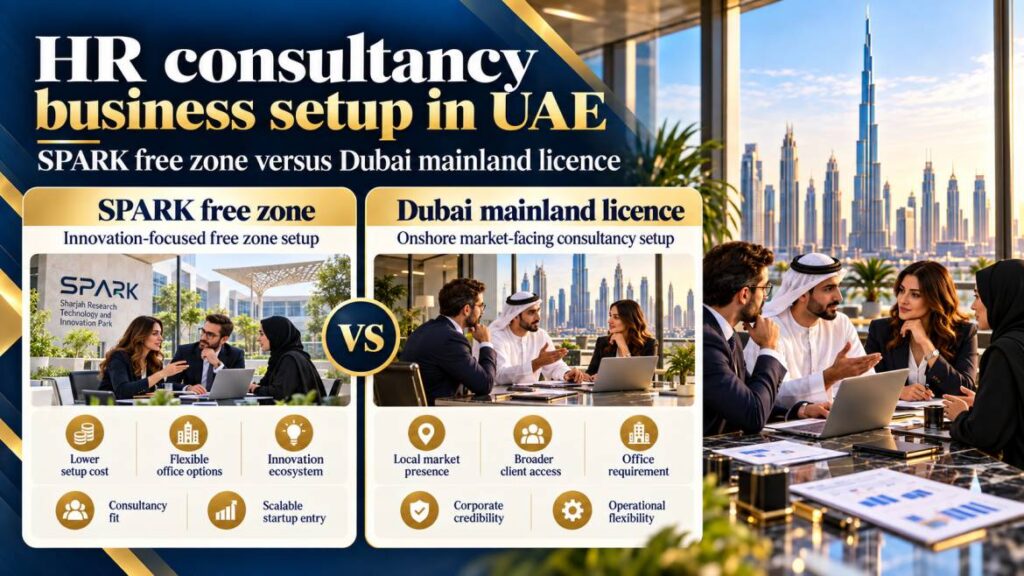
A Dubai mainland LLC is the stronger strategic default once you are selling to large corporates, government-related entities or international companies that expect vendor continuity and a mainland footprint, and it keeps the door open to a future MOHRE agency licence if you later move into regulated recruitment. That is the right structure for a consultancy that already has anchor enterprise clients lined up.
Most new HR consultancies do not start there, because most new HR consultancies start as one person selling advisory work to SMEs, not an enterprise vendor with a signed government contract. For that stage, a free zone advisory company is a genuine, viable route, provided the business stays inside consulting and serves clients contractually from the free zone. SPARK, the free zone most people still search for under its former name, SRTIP, already licenses HR advisory as one of its named consultancy activities, alongside management, marketing, IT and strategy consulting, under one bundled licence rather than charging per activity. I cover exactly how that works in why SPARK is a smart UAE base for consultants.
On cost, SPARK’s packages start from around AED 5,500 for a zero-visa package, with one-visa packages close to AED 13,990 and two-visa packages around AED 17,795, based on the most consistent published figures. That is a fraction of the AED 45,000 to 90,000 mainland entity budget, which is exactly why I treat it as the sensible way to launch and prove an HR advisory model before committing to a larger structure. I break down what sits behind the headline number, the visa cost, office cost and the fees most quotes leave out, in the full SPARK free zone cost guide, and the actual application steps in the SPARK setup process.
The honest caveat: SPARK is built around research, technology and innovation-classified activity, so it is not the right base for every business model, and I have set out where it genuinely does not fit in who should not choose SPARK free zone. For an HR advisory practice specifically, that caveat does not disqualify you, since consultancy is a named, licensable activity there, but it does mean you should confirm your exact activity list before you commit, the same discipline I apply to every licence recommendation on this site. A SPARK licence also will not, on its own, let you run regulated recruitment or staffing, so once your pipeline includes that work, a mainland LLC paired with the correct MOHRE agency licence is the honest next step, not an optional upgrade.
Timelines follow the same pattern. A free zone advisory setup or a straightforward mainland advisory-only LLC can often be completed in two to four weeks once documents and premises are ready, while a regulated recruitment or temporary-employment agency should be budgeted at six to twelve weeks or more, because external MOHRE approval, qualifying management, premises and the bank guarantee all add steps a pure advisory licence never touches.
My Approach: The Right Licence for the Services You Actually Sell
Most business setup consultants help you register a company. I help you make informed business decisions before you invest.
For an HR consultancy, that means I start with your actual service list before I touch a licence application. Advisory, compliance audits, payroll coordination and HRIS work can start today on a lean advisory licence. Recruitment and staffing sit on top of that once volume justifies it, and anything that touches employment mediation, sponsorship or temporary staffing needs a separate conversation about MOHRE’s agency licence and the bank guarantee that comes with it, not a workaround. Getting that activity wording wrong at formation is the single most common, and most avoidable, mistake I see in this category.
My advisory process focuses on helping you reduce uncertainty and make confident decisions, not just complete documentation.
What you can expect when you work with me:
- A review of your actual service mix before any licence or jurisdiction is proposed
- A clear line drawn between advisory activity and MOHRE-regulated recruitment or staffing
- A realistic comparison of free zone and mainland costs for your specific case
- Activity wording that will not block you from the services you plan to add later
- A first-year budget that includes technology, marketing and working capital, not just the licence fee
- Guidance on structuring recurring revenue, payroll, fractional HR, RPO, rather than relying only on one-off placements
- Bank account guidance appropriate to a free zone or mainland consultancy
- Golden Visa advisory once your consultancy is established
- A clear view of when to graduate from free zone to mainland
- Honest flagging of the point at which you will need a MOHRE agency licence
- Introductions to the specialist partners, legal, payroll, licensed staffing, your model will eventually need
- A total cost picture disclosed up front, including what renews annually
The objective is simple: help you start your business with clarity, confidence and a long-term strategy.
Is an HR Consultancy the Right Business for You?
This fits you if you have real HR, recruitment or organisational experience and want to sell it as advisory, compliance or fractional HR work to SMEs and mid-market companies, starting lean and adding recruitment as a cross-sell rather than the whole business. It does not fit if your plan is to launch as a volume recruitment agency competing purely on price against TASC, Adecco or the specialist recruiters, since that lane already has global scale and database advantages a new entrant cannot match on day one. It also does not fit if your real intention is staffing, sponsorship or employer-of-record work, because that is a different, more capital-intensive licence from the start, not something to back into later.
Frequently Asked Questions
Is an HR consultancy business setup in UAE a good idea?
Yes, for a founder with real HR or organisational experience. The modeled UAE HR-services market is roughly US$546 million in 2026, and demand is strongest from SMEs, mid-market companies and international founders entering the UAE, all of which convert faster than government or large enterprise accounts.
How much does it cost to set up an HR consultancy business in the UAE?
A free zone advisory licence such as SPARK starts from around AED 5,500. A Dubai mainland LLC needs roughly AED 45,000 to 90,000 for the entity alone, and a realistic pre-launch budget including website, brand and initial marketing sits closer to AED 250,000 to 450,000.
Do I need a special licence for recruitment or just HR consulting?
HR advisory, compliance, payroll coordination and HRIS work can run on a standard consultancy licence. Recruiting, sponsoring or supplying staff as an agency is separately regulated by MOHRE, which currently lists a AED 50,000 fee for a new temporary-employment and mediation agency licence, plus a bank guarantee of at least AED 1 million on renewal.
Should I choose a free zone or mainland for an HR consultancy?
A free zone such as SPARK suits a lean, advisory-first launch, since consultancy is a named licensable activity there and the cost is a fraction of a mainland entity. Mainland is the stronger choice once you are targeting enterprise or government clients, or once you are ready to add a MOHRE-regulated recruitment licence.
How long does an HR consultancy take to break even in the UAE?
In the base-case model, operational break-even arrives around month 10 to 12, with Year 3 EBITDA margin near 24%. A conservative scenario pushes break-even to month 28 to 32, while an aggressive growth scenario can reach it in 6 to 8 months, at the cost of more early working capital.
How much should I charge for HR consulting or recruitment services in the UAE?
Permanent recruitment typically runs 15% to 25% of annual base salary as a success fee. Outsourced or fractional HR is usually a monthly retainer of AED 5,000 to 25,000 for SME scope, and payroll administration is commonly AED 50 to 150 per employee a month with a monthly minimum.
Can I run staffing or employer-of-record services from day one?
Not without the correct MOHRE agency licence. Until you hold it, the honest route is to refer or subcontract staffing, sponsorship or EOR needs to a properly licensed partner, rather than provide them yourself on an advisory licence.
Is SRTIP, now SPARK, a good free zone for an HR consultancy?
Yes, for advisory work. HR consultancy is a named activity SPARK licenses alongside management, marketing, IT and strategy consulting, bundled under one licence. It is not a route to a MOHRE recruitment or staffing licence, so plan the mainland move separately once that work is ready to launch.
What is the biggest mistake founders make when setting up an HR consultancy in the UAE?
Treating “HR consultancy” as one licence rather than two different activities. Advisory work and MOHRE-regulated recruitment or staffing have different licensing requirements, different costs and different capital demands, and getting the activity wording wrong at formation either blocks services you plan to sell or exposes you to a licensing-perimeter breach.
Related Reading
- SRTIP Isn’t Just for Tech Startups: Why SPARK Is a Smart UAE Base for Consultants
- SPARK Free Zone Cost 2026: Licence, Visa, Office and Hidden Setup Costs Explained
- SPARK Free Zone Company Setup Process: From Licence Application to Bank Account
- SRTIP SPARK Accelerator: What It Offers Founders
- Who Should Not Choose SPARK Free Zone? 7 Business Models That May Fit Better Elsewhere
- Mainland vs Free Zone vs Offshore: Which UAE Structure Is Right for Your Business
- How to Set Up a Branch of a Foreign Company in the UAE
- The Golden Visa Rule Half the Guides Still Get Wrong