Quick Answer
An SRTIP healthcare licence, issued through Sharjah’s SPARK programme, is worth serious consideration if you’re building a medical device business, an AI-driven healthcare product, hospital technology, or an insurtech company. SRTIP names healthcare explicitly as one of its core target sectors, alongside advanced manufacturing, sustainability tech, and mobility. The multi-activity licence structure means a healthtech company doing both software and device distribution doesn’t need two separate licences. The real decision isn’t whether SRTIP can licence a healthcare business, it can, it’s whether the free zone licence actually clears you to operate, or whether a separate regulatory approval from a health authority still sits on top of it, which for most healthcare sub-sectors, it does.
Table of Contents
What SRTIP Means by “Healthcare,” and Why It’s Four Different Businesses
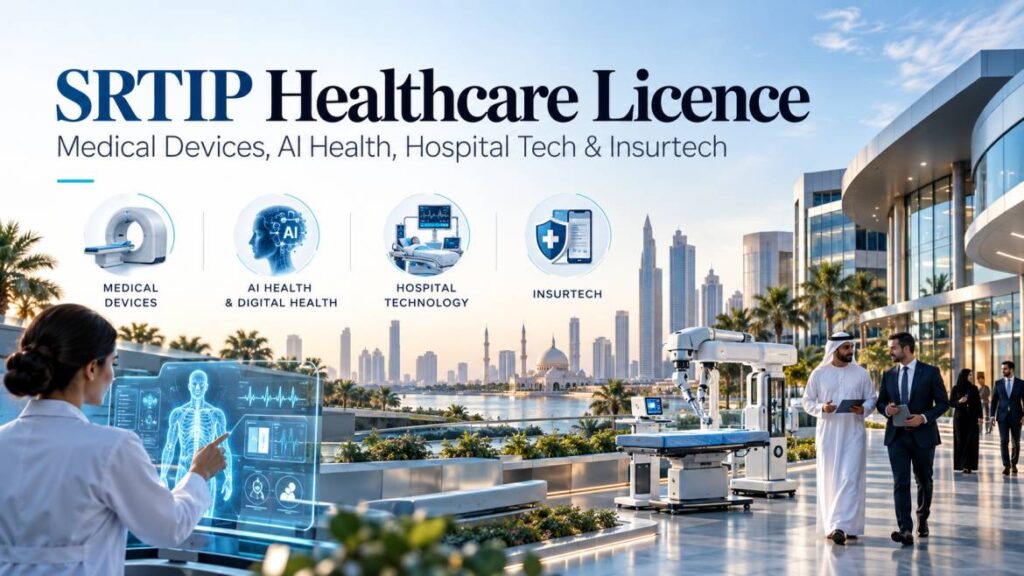
SRTIP’s healthcare sector isn’t one activity, it’s a bracket covering at least four distinct business models: medical device companies (manufacturing, importing, or distributing physical devices), AI-driven healthcare solutions (diagnostic software, clinical decision tools, health data platforms), hospital technology (systems and equipment vendors serving hospitals and clinics directly), and insurtech (technology built for health insurance underwriting, claims, or distribution). An SRTIP healthcare licence can cover any of these, but each one carries a different regulatory reality once the free zone licence is issued, and treating them as one category is where most generic guides stop short.
Matching the Licence Category to Your Healthcare Sub-Sector
SPARK’s standard licence categories, Commercial, Trading, Services, E-Commerce, and Consultancy, aren’t healthcare-specific, so the right one depends on what you’re actually doing:
- Medical device companies distributing or importing physical products typically need a Trading or Commercial licence with the correct device-related activity codes attached, since this is what determines whether you can legally hold and move regulated stock.
- AI-driven healthcare software (diagnostic tools, clinical software, health data platforms) usually fits a Services or Consultancy licence, since the deliverable is software and advisory work rather than a physical product.
- Hospital technology vendors selling systems or equipment directly to hospitals often need a blend, Trading for hardware, Services for implementation and support, which is exactly the kind of multi-activity case SRTIP’s single-licence structure is built to handle.
- Insurtech companies building software for insurers usually fit under Services or Consultancy, but the activity a free zone licence can cover stops well short of what regulated insurance activity itself requires, covered below.
The Regulatory Layer an SRTIP Healthcare Licence Doesn’t Replace
This is the part most SRTIP overview pages skip entirely, and it’s the part that actually determines whether the business can operate. A free zone licence authorises the company to exist and conduct the listed activities, it doesn’t automatically clear healthcare-specific regulatory requirements:
- Medical devices sold or distributed in the UAE generally require registration with the Ministry of Health and Prevention’s medical device registration system, or with Dubai Health Authority or the Department of Health Abu Dhabi depending on where the device is actually placed, regardless of which free zone issued your SRTIP healthcare trading licence.
- AI health software that makes diagnostic or clinical claims can fall under medical device regulation depending on its function, a distinction worth confirming with the relevant health authority before assuming pure-software status exempts it.
- Insurtech platforms that touch actual insurance underwriting, distribution, or claims handling operate in a space regulated by the UAE Central Bank’s insurance supervision function, separate entirely from free zone company licensing. A free zone licence lets the company exist, it doesn’t authorise regulated insurance activity on its own.
None of this makes an SRTIP healthcare licence the wrong choice, it means the free zone licence is one part of a two-part approval, not the whole picture, and the second part depends entirely on which of the four healthcare sub-sectors above the business actually falls into.
What an SRTIP Healthcare Licence Actually Costs
SRTIP’s packages are generally structured around visa count rather than sector, a Zero Visa package for founders not taking a residency visa, and One or Two Visa packages layered on top. Package pricing and inclusions change periodically, so confirm the current figures and exactly which activities are bundled directly with SRTIP or an authorised formation agent before committing, rather than relying on a number quoted in any single guide, this one included.
The Tax Point for Healthcare Businesses, Without Oversimplifying It
A free zone company doesn’t automatically pay 0% corporate tax, only a Qualifying Free Zone Person receives 0% on Qualifying Income, covered in full in UAE Corporate Tax Registration & VAT Filing. For a healthcare business this matters in a specific way: a medical device company selling into the UAE mainland market, or an insurtech company earning revenue tied to regulated insurance activity, needs its Qualifying Income position assessed against its actual revenue mix, not assumed from the free zone name alone.
Opening a Business Bank Account as an SRTIP Healthcare Company
No provider or free zone can guarantee bank account approval, that decision sits entirely with the bank’s own compliance process, covered further in Banking & Financial Services. Healthcare and insurtech businesses in particular should expect closer compliance scrutiny than a generic trading company, banks tend to ask more detailed questions about regulatory status, device certifications, or insurance authority approvals where relevant, so having that documentation ready before applying speeds the process considerably.
My Approach: Beyond Company Formation
Most SRTIP guides stop at the licence. For a healthcare business, the licence is the easier half of the question, the harder half is mapping which health authority or regulatory body actually governs the specific product or service before the company is formed, not after. I work through the full picture with founders: which of the four healthcare sub-sectors the business actually falls into, what the free zone licence covers and what it doesn’t, what the realistic Qualifying Income position looks like, and what documentation the eventual bank account application will need.
This is the same sector-specific approach I’ve applied across SRTIP’s other target industries: for consultancy businesses in SRTIP for consultancy licensing, for advanced manufacturing in SRTIP for aerospace and automotive, and for digital and IT companies in SPARK for software and IT companies. The fuller case for working this way is in why founders choose to work with me.
If you’re building a medical device, health-AI, hospital tech, or insurtech business and want a straight read on whether SRTIP fits and what regulatory layer sits on top, get in touch.
Frequently Asked Questions
Does an SRTIP healthcare licence let me sell medical devices immediately?
The licence authorises the company to conduct trading or distribution activity. Actually selling a medical device in the UAE generally also requires registration with the relevant health authority (MOHAP, DHA, or DOH depending on emirate), which sits separately from the free zone licence.
Can one SRTIP licence cover both software and medical device distribution?
Often yes, SPARK’s multi-activity structure is built for exactly this kind of blended healthtech business, though the specific activity combination should be confirmed against your actual business model before formation.
Is AI-driven health software regulated the same as a physical medical device?
Not automatically, but software that makes diagnostic or clinical decisions can fall under medical device regulation depending on its specific function. This is worth confirming with the relevant health authority rather than assumed either way.
Does SRTIP licensing cover insurance underwriting activity for an insurtech company?
No. A free zone licence lets the company exist and conduct its listed activities, but regulated insurance underwriting, distribution, or claims handling falls under the UAE Central Bank’s insurance supervision, a separate approval entirely.
Is SRTIP the only Sharjah free zone that fits healthcare businesses?
Not necessarily. A full comparison of Sharjah’s free zone options is in five Sharjah free zones, one confusing choice, useful if healthcare isn’t a clean fit for SRTIP’s specific structure.
Do I need a UAE-based health authority approval before I form the company, or after?
It depends on the sub-sector and activity, but mapping this out before formation avoids licensing a company for an activity it then can’t actually operate without a second approval.
What’s the biggest mistake healthcare founders make with SRTIP?
Treating the free zone licence as the complete authorisation. It’s the company-formation half of a two-part approval process, the regulatory half depends entirely on which of the four healthcare sub-sectors the business actually falls into.