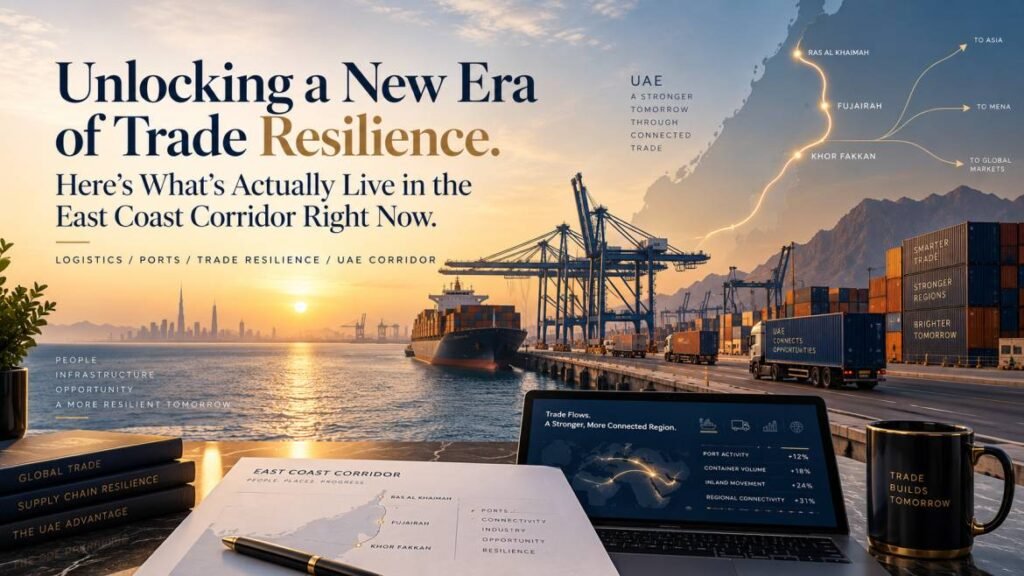
“Unlocking a new era of trade resilience” is how the pitch for the Sharjah Fujairah East Coast Corridor describes pairing the two emirates as a single, rail-connected logistics hub bypassing the Strait of Hormuz. Part of that is genuinely true. Part of it is ahead of where things actually stand. Fujairah’s Etihad Rail connection is real: freight since 2016, national network since 2023, passenger service since June 2026. Sharjah’s rail connection is the least finished leg of the entire network, with passenger service not scheduled until March 2027, and no confirmed dedicated freight spur to Khor Fakkan in current reporting. If you’re weighing the Sharjah Fujairah East Coast Corridor for a business setup, the gap between these two emirates’ current rail readiness is worth knowing before it factors into your jurisdiction decision.
Quick Navigation
Quick Answer
- The pitch treats both emirates as equally connected by Etihad Rail right now. They are not.
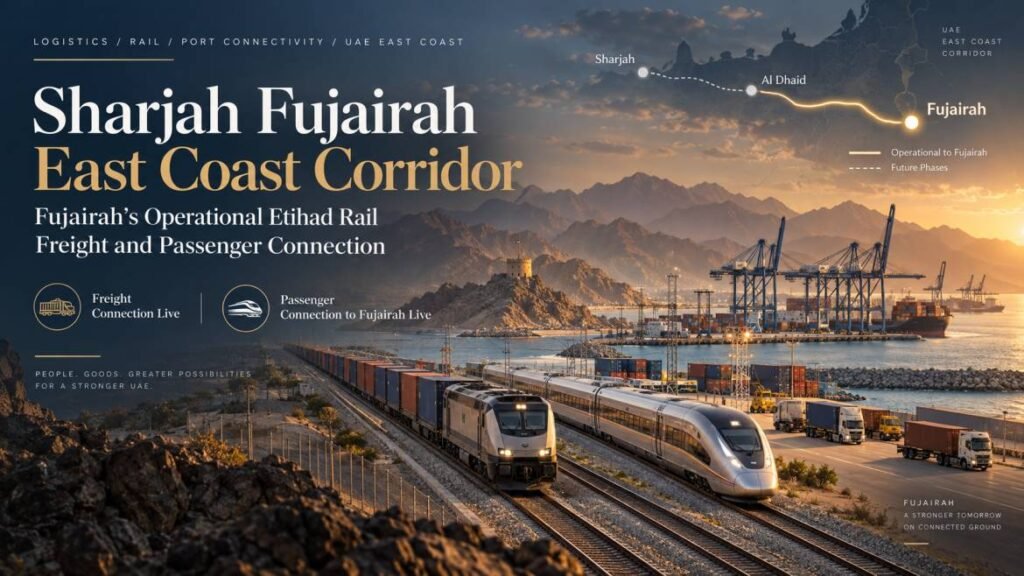
- Fujairah’s rail connection is operational: freight since 2016, national network complete since 2023, passenger service from Abu Dhabi since 30 June 2026.
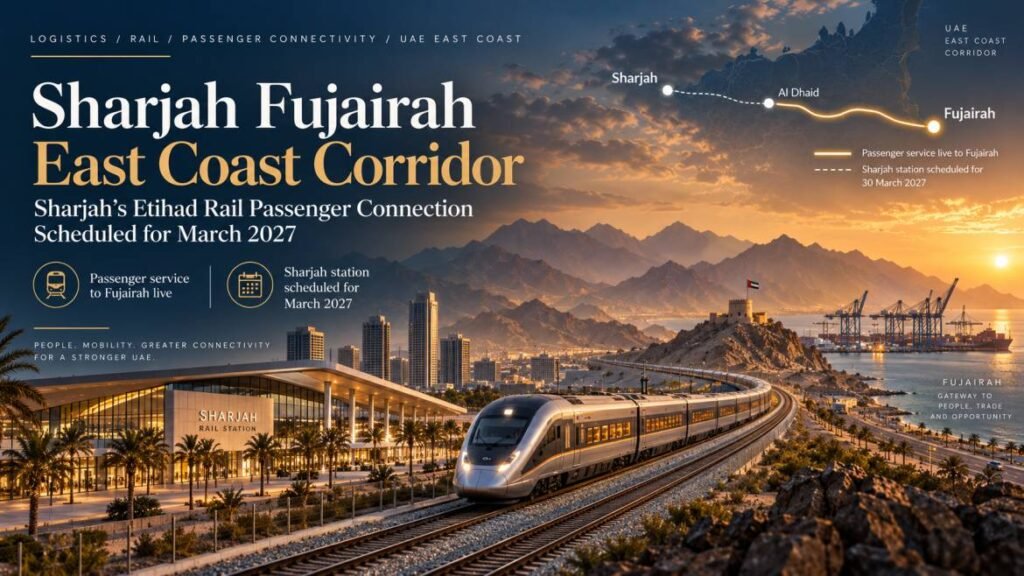
- Sharjah’s passenger rail connection isn’t scheduled until 30 March 2027, the last major leg of the network to open, and current reporting does not confirm a dedicated freight spur to Khor Fakkan specifically.
- Fujairah’s Gulf of Oman geography is real, but “bypassing the Strait of Hormuz” depends on cargo origin and destination, a nuance most promotional content skips.
- For a business model genuinely dependent on rail-connected logistics, Fujairah is usable today in a way Sharjah’s rail leg is not yet.
What the Sharjah Fujairah East Coast Corridor Pitch Actually Claims
The pitch, in its cleanest form, argues that Sharjah and Fujairah together form a single strategic logistics play: Fujairah’s deepwater Gulf of Oman port bypassing the Strait of Hormuz, Sharjah’s multi-modal access through Khor Fakkan and its own free zones, and Etihad Rail tying the two together into one integrated corridor connecting to Abu Dhabi and Dubai.
The individual pieces are mostly real. Fujairah’s geography is genuine. Sharjah’s port and free zone infrastructure is genuine and well-established. The part that overstates current reality is the framing that these two emirates are equally, currently integrated by rail into one finished corridor. They are not at the same stage, and the gap is specific and dateable.
Fujairah’s Rail Connection: Genuinely Operational
This part of the pitch holds up.
Etihad Rail’s freight operations began in 2016, and the national freight network, spanning from the Saudi border at Ghuweifat to Fujairah on the east coast, became fully operational in 2023, with capacity to move up to 50 million tonnes of cargo annually. Passenger service followed: an introductory phase connecting Abu Dhabi to Fujairah launched on 30 June 2026, with the full official passenger network launch on 30 September 2026 extending to Dubai and Al Dhaid.
A separate, specific development strengthens Fujairah’s logistics case further: a preliminary corridor agreement between Etihad Rail, Abu Dhabi Customs, Fujairah Customs, Abu Dhabi Ports Group, Fujairah Terminals and Noatum Logistics is intended to enable seamless goods movement between Khalifa Port and Fujairah Terminals, with priority customs clearance for rail-transported goods. This is real, current, and specific to Fujairah. The full setup detail for a Fujairah free zone company, including the trading activity restrictions and current cost figures, is covered in why Fujairah free zones are a strong opportunity for trading in 2026.
Sharjah’s Rail Connection: The Least Finished Leg of the Corridor
This is where the pitch gets ahead of the current facts.
Etihad Rail’s own confirmed passenger rollout sequence is staged: Abu Dhabi to Fujairah from 30 June 2026, extending to Dubai and Al Dhaid from 30 September 2026, Al Dhafra stations from 30 November or December 2026, and Sharjah not until 30 March 2027, roughly nine months after the Fujairah leg opened. The sequencing was reportedly based on population density, demand levels and connectivity priorities between emirates, meaning Sharjah’s later position is a deliberate scheduling decision, not an oversight, but it does mean the corridor is not currently unified.
On the freight side specifically, current reporting on Etihad Rail’s specific corridor agreements and customs partnerships names the Abu Dhabi-Fujairah route directly. No equivalent, specifically confirmed freight spur connecting Etihad Rail to Khor Fakkan port has appeared in current coverage reviewed for this piece. Sharjah’s own port, airport and free zone infrastructure, SAIF Zone and Hamriyah among them, remains genuinely strong on its own terms; it simply is not yet integrated into the same rail network the pitch describes as already complete. The full comparison across Sharjah’s free zones, including SAIF Zone’s logistics-specific positioning, is covered in business setup in Sharjah: SAIF Zone, SHAMS, SPARK and Hamriyah compared.
Sharjah Fujairah East Coast Corridor: The Strait of Hormuz Claim, Stated Carefully
For the Sharjah Fujairah East Coast Corridor specifically, Fujairah is genuinely the only emirate sitting entirely on the Gulf of Oman, outside the Strait of Hormuz. That geography is real and is a genuine structural advantage for shipping that would otherwise transit the Strait.
Whether this constitutes a full “bypass” of regional transit risk, as promotional content often states unconditionally, depends on where cargo actually originates and where it’s ultimately headed. For traffic genuinely routed to avoid Strait of Hormuz transit specifically, Fujairah’s position is a real advantage. For cargo that still needs to move through the Gulf for other legs of its journey, the practical risk reduction is more limited than “mitigates regional transit risks entirely” suggests. Treat the geography as real and the absolute framing as marketing language layered on top of it.
What This Timing Gap Means for East Coast Corridor Setup Sequencing
Within this corridor, if your business model genuinely depends on rail-connected logistics, not just port or airport access, this timing gap is a practical planning input, not a footnote.
A business setting up now specifically to leverage rail-connected freight movement between the east coast and the wider UAE network can operate on that basis in Fujairah today. The same business planning around a Sharjah rail connection specifically should build the actual confirmed timeline, March 2027 for passenger service, and unconfirmed for any dedicated freight spur to Khor Fakkan, into its own operational planning rather than assuming current integration.
This does not mean Sharjah is the wrong choice generally. Sharjah’s free zones remain strong for the activities they’re actually built for, covered in depth in the comparison linked above. It means the specific “rail-connected corridor” argument for Sharjah is ahead of where the infrastructure currently stands.
Sharjah Fujairah East Coast Corridor: Choosing by Actual Activity
Setting the rail timing question aside, the more fundamental decision here comes down to activity fit, the same principle that applies across every UAE free zone decision.
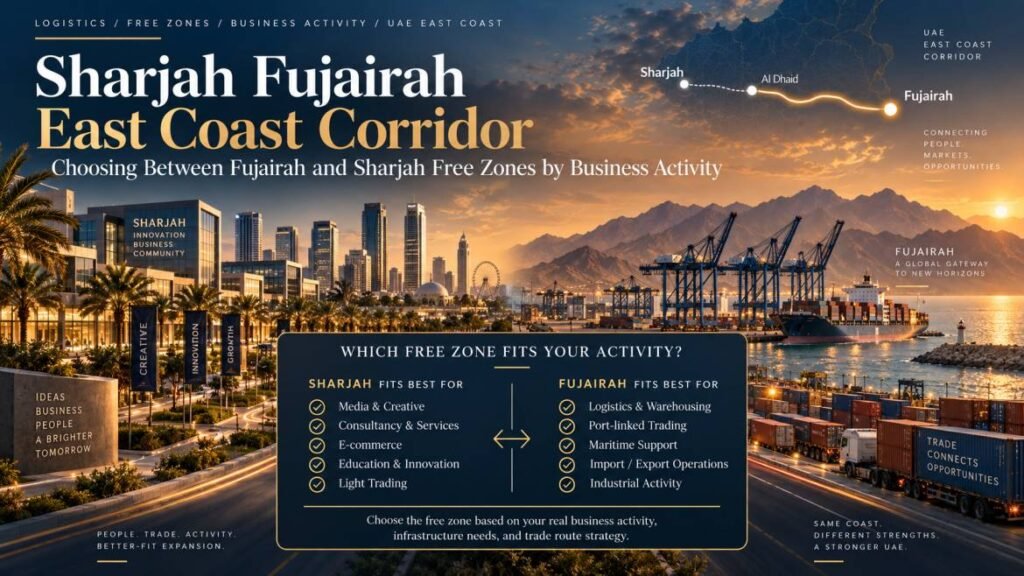
Fujairah suits heavy trading, maritime-adjacent, and energy-related activity, with genuine deepwater port access and a stated 0% corporate tax position that carries real conditions worth confirming directly. Sharjah’s zones split by activity: SAIF Zone for trading and logistics with physical facility needs, SHAMS for media, consultancy and freelance work with no facility requirement, and SPARK for technology and research-classified businesses. Neither emirate is universally “better”; the right one depends on what you’re actually building, not which one currently has the more compelling rail-corridor pitch.
My Approach: Sequencing the Real Infrastructure, Not the Pitch
Most business setup consultants help you register a company. I help you make informed business decisions before you invest.
Within this corridor specifically, the businesses that get this wrong are rarely the ones that chose a bad location. They’re the ones that structured a decision around a piece of promotional content describing infrastructure as complete when it’s still rolling out in phases, then found the actual timeline didn’t match what they’d planned around. Checking what’s genuinely operational today, not what a pitch deck describes as already unified, is what prevents that gap from becoming your problem.
My advisory process focuses on helping you reduce uncertainty and make confident decisions, not just complete documentation. In practice:
- Current infrastructure status confirmed directly, rail, port and customs corridor agreements included, before it factors into a jurisdiction decision.
- Honest activity-fit assessment across Fujairah and Sharjah’s free zones, rather than a location choice driven by a logistics narrative alone.
- Business setup and licensing execution across whichever east coast jurisdiction genuinely fits your activity and timeline.
- Corporate tax registration and filing planning appropriate to the specific free zone and activity you choose.
- Banking setup guidance suited to a trading, logistics or manufacturing business specifically.
The objective is simple: help you make this decision on what’s actually built and operational today, with a clear view of what’s still rolling out, rather than on a pitch that’s ahead of the infrastructure.
If you’re weighing Fujairah against Sharjah for a logistics-dependent business within the East Coast Corridor, get in touch for an honest assessment of what’s actually ready now.
Frequently Asked Questions
Are Sharjah and Fujairah equally connected by Etihad Rail right now?
No. Fujairah’s rail connection is operational: freight since 2016, national network since 2023, passenger service from Abu Dhabi since 30 June 2026. Sharjah’s passenger rail connection isn’t scheduled until 30 March 2027, and current reporting does not confirm a dedicated freight spur to Khor Fakkan.
Does Fujairah genuinely bypass the Strait of Hormuz?
Fujairah’s geography is real: it is the only emirate sitting entirely on the Gulf of Oman, outside the Strait of Hormuz. Whether this constitutes a full “bypass” depends on where cargo actually originates and where it’s headed. Treat the geography as a genuine advantage and “mitigates regional transit risks entirely” as marketing language layered on top of it.
When does Etihad Rail reach Sharjah?
Passenger service to Sharjah is scheduled to begin 30 March 2027, the last major leg of the currently announced East Coast Corridor rollout, roughly nine months after the Fujairah connection opened in June 2026.
Is there a direct freight rail link to Khor Fakkan port?
Current reporting reviewed for this piece does not confirm a specific, dedicated Etihad Rail freight spur to Khor Fakkan. Sharjah’s port infrastructure at Khor Fakkan is real and long-established independently of rail connectivity.
Should I choose Fujairah or Sharjah for a logistics business?
It depends on your activity and timeline. If your model depends on rail-connected freight movement specifically, Fujairah’s connection is operational today in a way Sharjah’s is not yet. Beyond rail specifically, the right choice depends on activity fit: Fujairah for heavy trading and maritime-adjacent business, Sharjah’s specific free zones for trading, media, consultancy or technology depending on which zone fits.
Is the East Coast Corridor a real, official designation?
It functions more as a descriptive framing used in business and logistics commentary than a single, formally unified administrative corridor. The individual infrastructure, Fujairah’s port, Sharjah’s port and free zones, and Etihad Rail’s expanding network, are all real; describing them as one already-finished corridor overstates the current integration between Sharjah and the rail network specifically.
What to verify before committing to either emirate
Infrastructure timelines in the UAE have a strong track record of eventually delivering on what is announced, but “eventually” is doing real work in that sentence. Before signing a lease or ordering equipment on the assumption that a specific rail link, road upgrade or port expansion will be operational by a stated date, get written confirmation of the current status directly from the relevant authority rather than relying on promotional material, which tends to describe the plan rather than the current build phase.
It is also worth distinguishing between infrastructure that is confirmed and funded, infrastructure that is announced but not yet under construction, and infrastructure that exists only as a feasibility study. All three get described in similar promotional language, but they carry very different levels of certainty for a business planning around them. A confirmed, funded project with a published construction timeline is a reasonable basis for a business decision. A feasibility study is not, however confidently it is presented.
For a business that genuinely depends on rail-connected freight movement today, rather than in a projected future state, Fujairah’s already-operational connection is the more defensible starting point. For a business with a longer runway, where the decision can be revisited once Sharjah’s passenger and eventual freight connections mature, factoring in the corridor’s future state is reasonable, provided the current gap is priced into the plan rather than assumed away.
The practical takeaway for a setup decision today
None of this argues against the corridor as a location. Both emirates offer genuine, structural advantages that a purely Dubai-centric setup does not, and the underlying economics of positioning close to both a functioning deep-water port and an expanding freight network are sound. The argument here is narrower: base the decision on what is confirmed and operational now, treat the pitch’s forward-looking claims as a bonus rather than a certainty, and revisit the plan as the infrastructure timeline firms up.
That distinction, between what is built and what is promised, is the one piece of due diligence most promotional coverage of this corridor skips entirely, and it is the one most likely to protect a founder from committing to a timeline the infrastructure has not yet caught up with.
Questions worth asking any consultant pitching this corridor
Given how often this corridor is presented as a single, unified opportunity, it is worth pressing any consultant recommending it on a few specific points before signing anything. Ask which emirate’s infrastructure the recommendation actually depends on, and whether that infrastructure is operational today or scheduled for a future date. Ask for the source of any timeline they quote, since a construction update from the operating authority carries more weight than a projection repeated across marketing content.
It is also reasonable to ask what happens to the business case if a quoted completion date slips, which is common across large infrastructure projects everywhere, not only in the UAE. A consultant who has genuinely thought through your specific activity, rather than reusing a generic corridor pitch, should be able to answer that question directly instead of falling back on general enthusiasm about the region’s growth.
A well-prepared answer to that question, rather than a deflection, is usually the clearest signal of whether a consultant has done the underlying homework or is simply repeating the promotional pitch back to you with your business name attached.
Whichever emirate ends up fitting your business, basing that choice on what is operational today rather than what is promised for tomorrow remains the safer starting point.
That one check is worth more than any amount of promotional enthusiasm about the corridor’s long-term potential.