Every guide to opening a UAE business bank account leads with the same reassurance: the country left the FATF grey list in February 2024, so banking has become easier. That is accurate and it is also two years out of date as a description of what you will actually experience. On 16 April 2026 the Central Bank issued its most significant overhaul of KYC and AML guidance since the grey-list exit, shifting from a one-time onboarding check to continuous, real-time monitoring, and it lands months before the UAE’s next FATF mutual evaluation cycle begins in June 2026. Here is what that actually involves now: the documents, the realistic timelines for mainland and free zone companies, and the specific reasons roughly four in ten first applications get delayed.
Quick Navigation
Quick Answer
- To do this you need a valid trade licence, disclosed beneficial ownership (UBO), complete KYC documentation, and evidence of real business activity and source of funds.
- The FATF removed the UAE from its grey list in February 2024, but this did not reduce banking scrutiny. The CBUAE issued major new continuous-monitoring KYC guidance on 16 April 2026, ahead of the UAE’s FATF mutual evaluation cycle beginning June 2026.
- Realistic timelines range from 3 to 7 working days with a digital bank like Wio, to 4 to 8 weeks with a traditional bank, depending on documentation completeness and ownership complexity.
- Roughly 4 in 10 first-time applications face delay or rejection, most commonly due to incomplete or inconsistent documentation rather than genuine ineligibility.
- Free zone companies, particularly broad professional service activities such as IT and consulting, generally face more intensive review than mainland companies with the same documentation quality.
How to Open a UAE Business Bank Account: The Story Everyone Tells, and the Update Almost Nobody Has Read
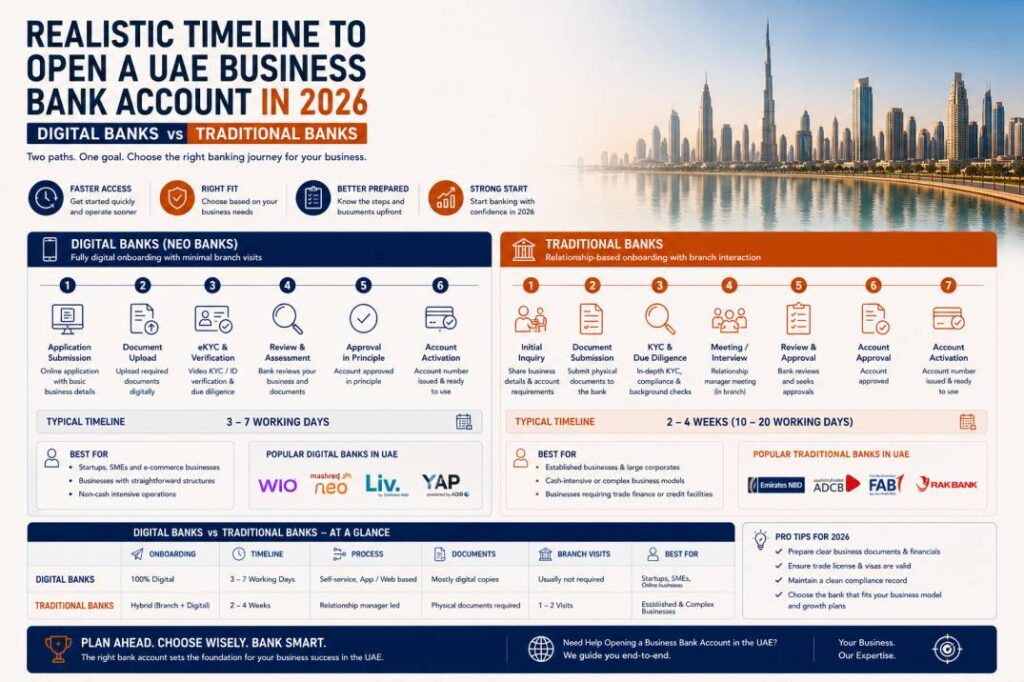
The FATF removed the UAE from its list of jurisdictions under increased monitoring on 23 February 2024. The EU aligned its own high-risk list with that decision in June 2025. Both are real and both are widely reported as reasons UAE banking has become more straightforward.
What is missing from nearly every guide on this topic is what happened next. On 16 April 2026, the Central Bank of the UAE issued updated anti-money laundering guidance for licensed financial institutions, described as the most substantial revision to UAE KYC obligations since the grey-list exit. It formally shifts identity verification from a point-in-time onboarding check to a continuous, risk-based compliance obligation, and it explicitly lands ahead of the UAE’s upcoming FATF mutual evaluation cycle, which begins in June 2026.
Three practical consequences follow, and none of them are covered in most currently ranking guides.
Verification does not stop at account opening. Banks are now expected to conduct periodic document refresh and ongoing screening rather than a single check at onboarding. A business that opened an account cleanly in 2023 may still be asked to re-submit documentation now.
Real-time screening is the baseline, not a discretionary extra. The CBUAE expects real-time screening against sanctions lists, politically exposed persons databases and adverse media sources as part of a technology-enabled compliance stack, for every customer, not only high-risk ones.
The timing is not a coincidence. One compliance analysis notes plainly that removal from the FATF grey list does not guarantee complete normalisation, and that some counterparties continue enhanced due diligence regardless of formal delisting. With the UAE’s own mutual evaluation approaching in mid-2026, banks have every institutional incentive to demonstrate rigour now, not to relax it.
The honest summary for a founder applying today: you are not applying into a system that has been getting steadily easier since 2024. You are applying into a system that has just been told, formally and recently, to watch more closely, not less.
What You Actually Need to Open a UAE Business Bank Account
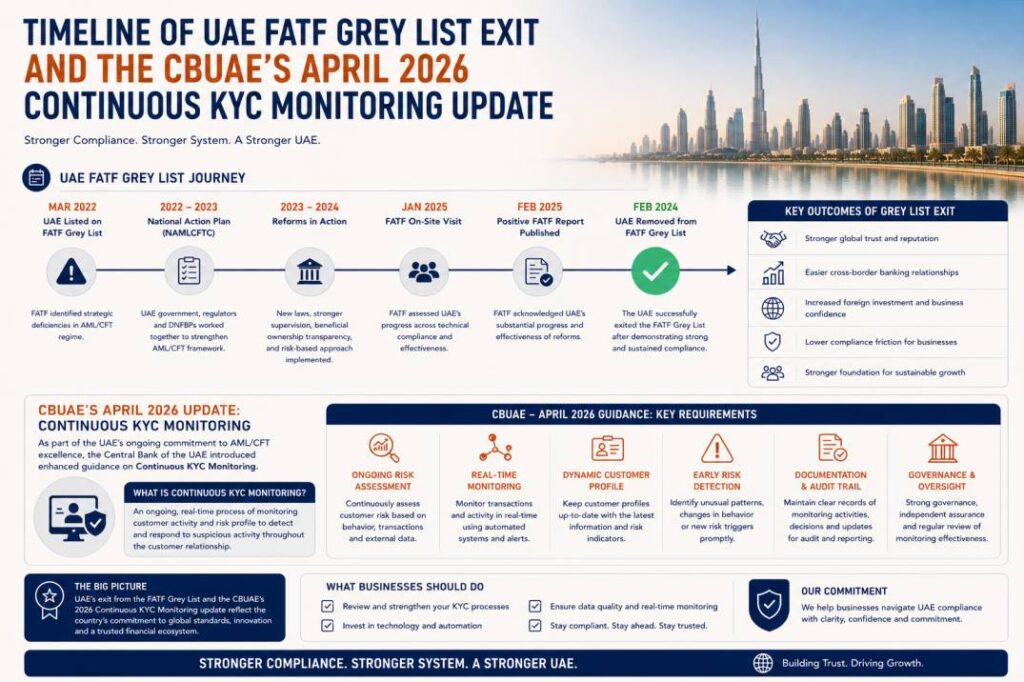
The document list itself has not changed much, but the standard of consistency banks now expect has tightened under the April 2026 guidance.
Corporate documents. Valid trade licence, certificate of incorporation, memorandum and articles of association, and a board resolution specifically authorising the account opening and naming signatories.
Ownership disclosure. Full UBO (Ultimate Beneficial Owner) disclosure for every individual with meaningful ownership or control, not just the named shareholders on the licence. This is the single document category most likely to trigger delay if your ownership structure spans multiple jurisdictions or holding entities.
Proof of address. For Dubai mainland companies, an Ejari certificate or valid tenancy contract. For free zone companies, a free zone lease agreement, flexi-desk contract, or free zone tenancy certificate. Requirements vary by bank and emirate, so confirm the accepted form before applying rather than assuming.
Individual KYC for every signatory and shareholder. Passport copies, Emirates ID where applicable, proof of residential address, and a CV or professional background where the bank requests one.
Business substance evidence. Increasingly requested rather than optional: sample client contracts, invoices, a business plan with realistic projected turnover, and a clear explanation of source of funds for initial capital.
Resident signatory, where possible. Not always mandatory, but having at least one UAE-resident shareholder or authorised signatory measurably improves approval chances and often shortens the review.
Realistic Timelines to Open a UAE Business Bank Account, and Why They Vary So Much
The range quoted across guides is wide because it is genuinely wide in practice, and the variable that matters most is documentation quality and ownership complexity, not which bank you approach.
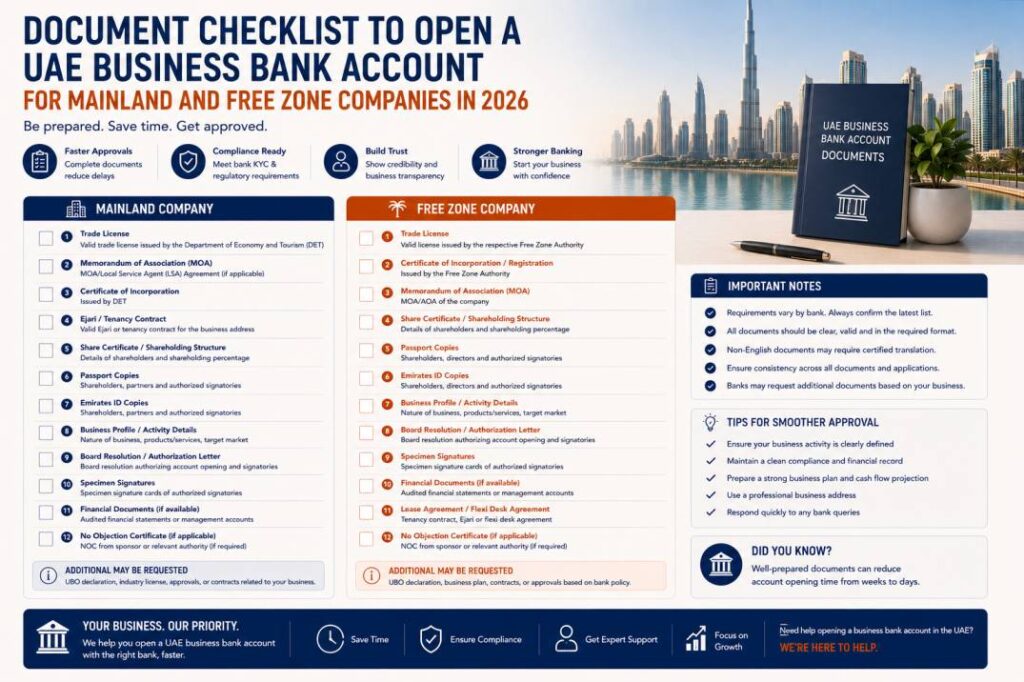
Fast track: 3 to 7 working days. Achievable with a digital bank such as Wio, for a straightforward single-jurisdiction ownership structure with complete documentation and a low-risk activity.
Standard: 3 to 6 weeks. The typical range for a traditional bank with clear documentation, resident signatories and an established business model.
Extended: 4 to 8 weeks or more. Where ownership structures span multiple jurisdictions, the business activity is classified as higher risk, or documentation arrives incomplete and requires multiple rounds of clarification.
Multi-jurisdiction ownership is named specifically as the single biggest timeline risk in 2026. If your structure has a holding company in one jurisdiction, an operating company in another, and individual shareholders in a third, that complexity itself is what a compliance officer has to unwind before approval, regardless of how legitimate the underlying business is.
Why Four in Ten Applications to Open a UAE Business Bank Account Get Delayed
One figure deserves far more attention than it currently gets in published guidance: roughly 4 in 10 first-time applications face delay or rejection, and the stated cause is incomplete or inconsistent documentation, not genuine ineligibility of the business itself.
Read that carefully. Most delays are not the bank deciding the business is unbankable. They are the bank pausing because something in the file does not match something else in the file.
The pattern I see most often: the business activity described in the bank application does not match the activity on the trade licence precisely enough for a reviewer to reconcile the two without asking. Or the UBO chain disclosed to the bank does not exactly match the ownership structure disclosed at incorporation. Or the projected turnover in the business plan bears no visible relationship to the paid-up capital or the contracts provided as evidence.
None of these are compliance failures in the sense of wrongdoing. They are inconsistencies that force a human reviewer to stop and ask, and every question asked adds a week or more to the timeline. Under the April 2026 guidance, with real-time and continuous screening now the expectation, a compliance officer has less discretion to wave through a file that does not fully reconcile, not more.
The fix is almost entirely within the applicant’s control: make sure the trade licence activity, the bank application description, the UBO disclosure and the business plan tell the same story, in the same words, before submission.
Free Zone Versus Mainland: Why the Scrutiny Differs When You Open a UAE Business Bank Account
Multiple guides note, correctly, that free zone companies generally face more intensive bank review than mainland companies, particularly for broad professional service activities such as IT services, consulting and advisory. Almost none explain why, which matters, because the reason points directly at the fix.
A mainland company with a specific trade licence activity, a physical office under Ejari, and UAE-based operations is comparatively easy for a compliance officer to verify against real economic substance. A free zone company describing itself broadly as IT consulting or general trading from a flexi-desk address, with no visible local client base, is harder to distinguish from a shell used purely for the tax or ownership benefits of the jurisdiction, even when the underlying business is entirely legitimate.
This is not a reason to avoid free zones. It is a reason to make your substance visible before the bank asks for it: a narrower, more specific activity description, real client contracts, evidence of actual operations rather than a licence sitting dormant, and where relevant, an upgrade from a flexi-desk to a dedicated office once the business justifies it. The structural trade-offs between mainland and free zone are covered fully in mainland vs free zone vs offshore in the UAE and the difference between mainland and free zone companies.
Digital Bank or Traditional Bank to Open Your UAE Business Bank Account
The speed difference between a digital bank and a traditional one is real, but it is a trade-off, not a free upgrade.
Digital banks (such as Wio) compress account opening to as little as 3 to 7 working days, with a fully online application process. The trade-off: typically narrower service ranges, lower transaction or trade finance ceilings, and in some cases, less institutional credibility with large corporate counterparties or government tenders that expect a recognised traditional banking relationship.
Traditional banks take longer, commonly 3 to 8 weeks, but offer the full range of corporate services: trade finance, multi-currency accounts, payroll infrastructure, and the kind of relationship banking that matters once a business scales past its first year.
The right choice depends on what you need on day one versus what you will need in eighteen months. A services business invoicing a handful of clients may never need trade finance and gains nothing from the wait. A trading company planning to use letters of credit within its first year should not optimise for a three-day account opening only to open a second, traditional relationship six months later anyway.
If You Have Not Incorporated Yet, Structure to Open a UAE Business Bank Account More Easily Now
Every competing guide assumes a company already exists and walks through opening its account from there. If you have not yet incorporated, you have an option nobody writing these guides addresses: you can choose your structure specifically to make banking easier, before it becomes a problem.
Simplify ownership before you incorporate, not after. If a multi-jurisdiction holding structure is not required for a genuine commercial reason, a simpler direct ownership chain removes the single biggest timeline risk, before a bank ever sees the file.
Choose an activity description a compliance officer can verify at a glance. A precise, narrow activity classification that matches what you actually do is easier to bank than a broad one chosen for flexibility. Flexibility on the licence becomes friction at the bank.
Weigh mainland against free zone with banking in mind, not only tax. If your business model depends on visible local substance, mainland or a well-established free zone with real infrastructure will bank more easily than a flexi-desk arrangement in a professional services category banks already treat cautiously.
Plan the UBO disclosure at incorporation, not as a document to produce later. Knowing exactly who the ultimate beneficial owners are, and being able to state it identically across your licence, your bank application and your corporate tax registration, avoids the single most common source of reconciliation delay. Corporate governance and UBO structuring support is covered on the corporate support services page.
My Approach: Getting the Account Before the Runway Runs Out
Most business setup consultants help you register a company. I help you make informed business decisions before you invest.
The mistake I see most often is treating company formation and bank account opening as two separate projects, done in sequence, with the second one starting only once the first is complete. By the time the account application is filed, the ownership structure, the activity description and the licence are already fixed, and any mismatch between them and what the bank expects has to be explained rather than avoided.
My advisory process focuses on helping you reduce uncertainty and make confident decisions, not just complete documentation. In practice:
- Structure and ownership review before incorporation, specifically to avoid the multi-jurisdiction complexity that most commonly delays bank applications.
- Activity description alignment across your trade licence, your business plan and your bank application, so nothing needs reconciling later.
- Realistic timeline planning built around your actual documentation and ownership complexity, not a generic a few weeks estimate.
- Digital versus traditional bank guidance matched to what your business actually needs in year one, not only how fast you want the account.
- UBO and corporate governance structuring planned at formation, not discovered as a gap during the bank application.
- Direct support through the banking setup process once your structure and documentation are ready.
- Corporate tax registration and filing coordinated with your banking timeline, since the two interact more than founders expect.
The objective is simple: help you start your business with clarity, confidence and a long-term strategy, with a bank account that opens on the first attempt rather than the third.
If you are setting up now and want your structure reviewed with the bank application in mind before you incorporate, get in touch.
Frequently Asked Questions
What documents do I need to open a UAE business bank account?
A valid trade licence, certificate of incorporation, memorandum and articles of association, a board resolution authorising the account and naming signatories, full UBO disclosure, proof of address (Ejari for mainland, a free zone lease for free zone companies), individual KYC for shareholders and signatories, and evidence of business substance such as contracts or a business plan.
Did UAE banking get easier after the FATF grey list removal?
Partly, and the picture is more current than most guides suggest. The February 2024 grey-list exit reduced international friction on cross-border transactions, but the Central Bank issued major new continuous-monitoring KYC guidance on 16 April 2026, ahead of the UAE’s FATF mutual evaluation cycle beginning June 2026. Scrutiny at account opening has not eased since 2024, it has been formalised and in places tightened.
How long does it take to open a UAE business bank account in 2026?
Digital banks such as Wio can open an account in 3 to 7 working days for straightforward, single-jurisdiction applications. Traditional banks typically take 3 to 8 weeks, extending further where ownership structures are complex or documentation is incomplete.
Why do so many bank account applications get delayed?
Roughly 4 in 10 first-time applications face delay or rejection, most commonly because information is inconsistent across documents rather than because the business is ineligible. The most frequent cause is a mismatch between the activity described on the trade licence, the bank application, and the UBO disclosure.
Do free zone companies face more scrutiny than mainland companies?
Generally yes, particularly for broad professional service activities such as IT consulting. This is because free zone companies with generic activity descriptions and flexi-desk addresses are harder for a compliance officer to verify against real economic substance than a mainland company with a specific activity and a physical office.
Should I use a digital bank or a traditional bank?
It depends on what your business needs in its first 18 months, not only how fast you want the account. Digital banks are faster to open but offer narrower services and lower transaction ceilings. Traditional banks take longer but provide trade finance, multi-currency accounts and the relationship banking many businesses need as they scale.
Can I make banking easier by how I structure my company before incorporating?
Yes, and this is the step most guides skip. Simplifying ownership before incorporation, choosing a precise rather than broad activity description, and planning UBO disclosure consistently across your licence and bank application all reduce the risk of delay, and are far easier to address before you incorporate than after.
Sources & References
- Central Bank of the UAE
- FATF – Increased Monitoring, February 2024
- Norton Rose Fulbright – UAE removed from the FATF grey list
- Herbert Smith Freehills Kramer – EU removes UAE from High-Risk AML List following FATF Grey List exit
- Shufti Pro – KYC in the UAE: CBUAE, FATF, and Digital Identity Regulations for 2026