Search for how to register this kind of structure in Sharjah and several of the results, including ones dated for 2026, will tell you to appoint a Local Service Agent. That requirement was abolished across the whole UAE in July 2024. Branch registration is a federal process before it is a Sharjah one, so what changed nationally changed here too, and a meaningful share of the guidance circulating for this specific emirate has not caught up. Here is what actually applies, how the SEDD side of the process works, what it costs, and when a branch is the right structure for Sharjah specifically.
Quick Navigation
Quick Answer
- This structure does not require a Local Service Agent or a AED 50,000 bank guarantee. Both were abolished nationally under Ministerial Resolution No. 138 of 2024, and the abolition applies in Sharjah exactly as it does everywhere else in the UAE.
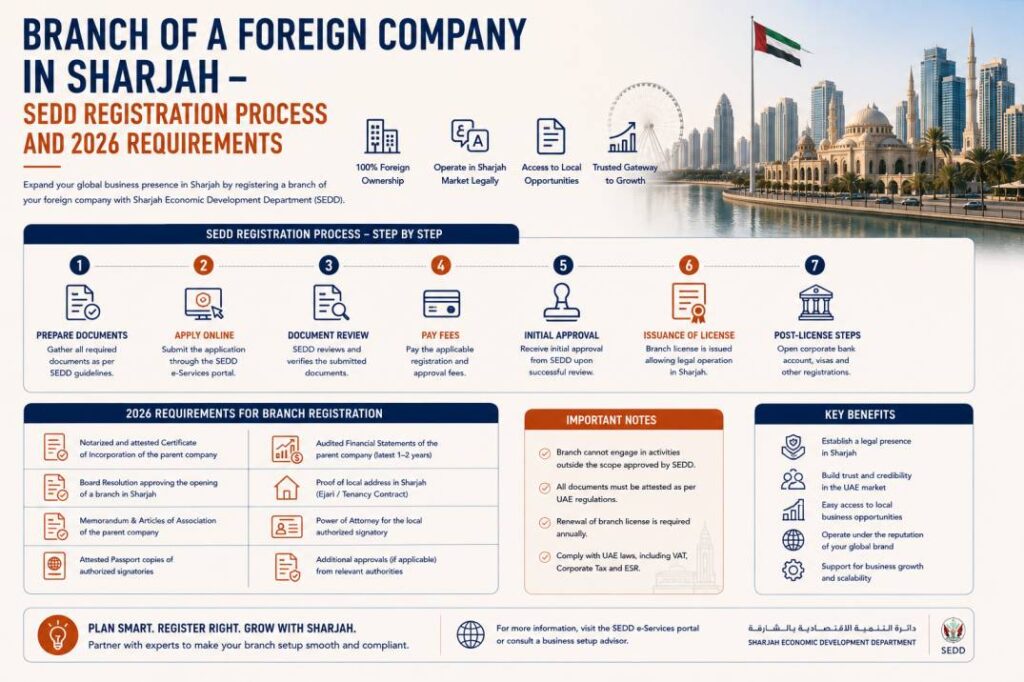
- Registration runs in two stages: initial approval from the federal Ministry of Economy and Tourism, then a trade licence from the Sharjah Economic Development Department (SEDD).
- A branch is not the same as a Sharjah free zone company. SHAMS, SAIF Zone and Hamriyah Free Zone are separate structures under separate authorities, and confusing the two is one of the most common mistakes in Sharjah setup guidance.
- SEDD reported 84,443 economic establishments and 18% growth in foreign ownership licences in 2025, alongside an Instant License service that issued over 1,100 licences in its first months.
- A branch must carry the parent company’s exact name and can only conduct the activities the parent is licensed for at home. The parent bears full liability.
Setting Up a Branch of a Foreign Company in Sharjah: The Requirement Guides Still List, and Why It Is Gone
Several pages ranking for branch of foreign company in Sharjah, some carrying a 2026 date, list a Local Service Agent (LSA) as a mandatory requirement: a UAE national or a wholly UAE-owned company appointed to sponsor the branch’s registration.
That requirement does not exist anymore. Ministerial Resolution No. 138 of 2024, issued by the federal Ministry of Economy and Tourism on 30 July 2024, abolished the Local Service Agent requirement for branches of foreign companies across the entire UAE. It replaced Ministerial Resolution No. 377 of 2010, under which the requirement had existed. The same resolution also removed the AED 50,000 bank guarantee that branches previously had to lodge.
This matters specifically for Sharjah because branch registration is not a Sharjah process with a Sharjah rulebook. It is a federal process administered by the Ministry, with SEDD issuing the local trade licence only after the Ministry has granted initial approval. A rule the Ministry abolished nationally is abolished in Sharjah on the same date it was abolished in Dubai or Abu Dhabi. There is no separate Sharjah carve-out that reinstates it.
One likely source of the confusion: SEDD’s own website still runs a Local Service Agent complaints process, because LSAs remain a real and current requirement for other structures, such as certain sole establishments and civil companies under the older ownership regime. That is a genuinely current SEDD service. It has nothing to do with branch registration, and at least one currently-ranking guide appears to have conflated the two.
If a consultant quotes you a fee for arranging a Local Service Agent for a Sharjah branch in 2026, that is either an outdated checklist or an unnecessary charge, and it is worth asking which.
How Branch Registration in Sharjah Actually Works
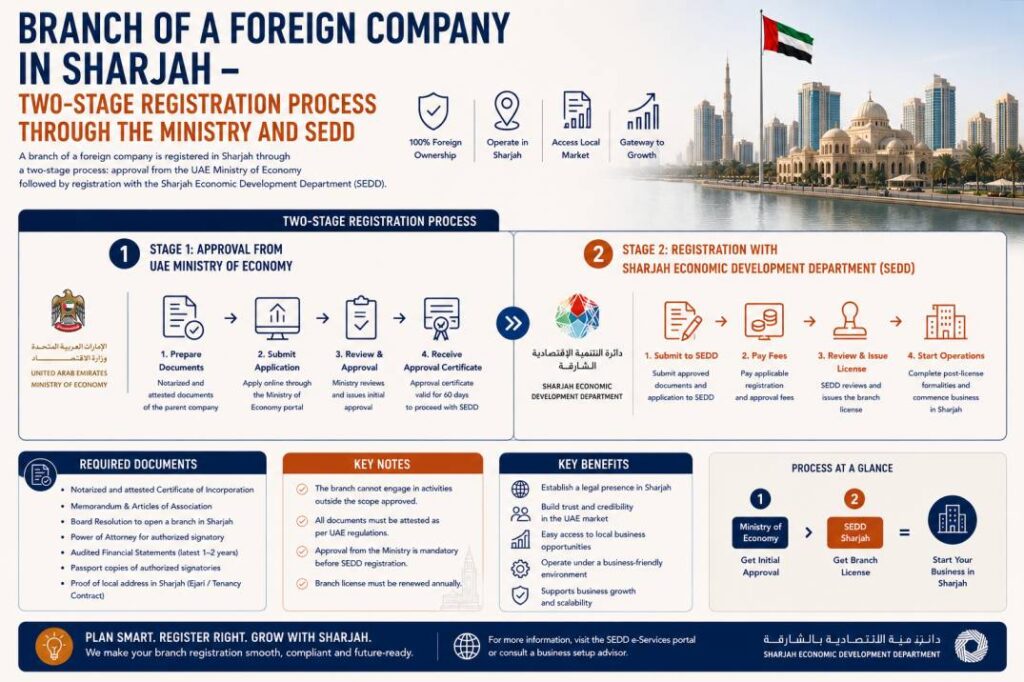
Registering it runs in two stages, exactly as it does in every other emirate under the federal framework.
Stage one: Ministry approval. The application is filed through the Ministry of Economy and Tourism’s online platform with the parent company’s attested corporate documents: certificate of incorporation, memorandum and articles of association, a board resolution authorising the Sharjah branch, and a power of attorney for the branch manager. This stage does not involve SEDD at all.
Stage two: SEDD licensing. Once the Ministry grants initial approval, the application moves to SEDD for the local trade licence. This is where Sharjah-specific requirements apply: trade name reservation consistent with the parent company’s name, a registered and attested lease, and SEDD’s own document review before the trade licence is issued.
Final registration with the Ministry must be completed within a set window of the local licence being issued, and the Ministry then issues a registration certificate that SEDD’s local licence sits alongside.
The document attestation chain for the parent company’s paperwork, which is usually the longest part of the whole process, is identical regardless of which emirate you choose. That full mechanism, including the five-stage attestation sequence, is set out in the complete guide to setting up a branch of a foreign company in the UAE.
A Branch of a Foreign Company in Sharjah Versus a Free Zone: Not the Same Decision
This is the second confusion I found repeated across ranking guides. Several list branch office as one option in a menu alongside SHAMS, SAIF Zone, Hamriyah Free Zone and Sharjah Publishing City, as though a founder were choosing between similar things. They are not comparable at all.
A branch under SEDD is a mainland structure. It gives the parent company direct access to Sharjah and UAE mainland customers, including government contracts, and it operates as the same legal entity as its parent, carrying the parent’s exact name and licensed activities.
A Sharjah free zone company is a separate legal entity, registered under a specific free zone authority rather than SEDD, typically suited to export, digital services, media, logistics or international trade rather than direct mainland sales. Sharjah’s free zones each set their own packages, visa quotas and activity lists, and none of them issue a branch in the sense this article covers.
The practical test is simple: if you need to invoice UAE mainland clients directly or bid for government work, you need a mainland presence, either a SEDD branch or a SEDD-licensed LLC. If your Sharjah presence exists to serve international or free-zone-to-free-zone clients, a free zone company usually fits better and costs less to run.
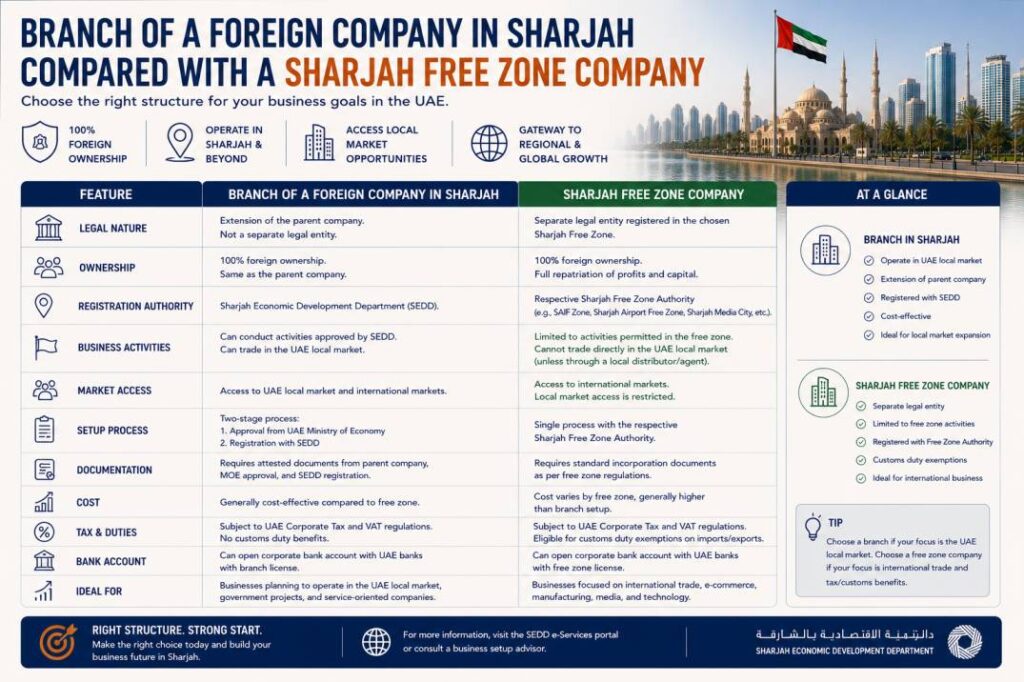
Do not let a comparison table flatten this into a single decision. They are different regulators, different market access, and different reasons to choose either one. The broader structural comparison across mainland, free zone and offshore is set out in mainland vs free zone vs offshore in the UAE.
What SEDD’s 2025 Numbers Actually Tell a Foreign Company
Before registering, it is worth knowing that SEDD reported 84,443 economic establishments in Sharjah for 2025, with foreign ownership licences growing 18% overall and newly issued foreign ownership licences up 25% year on year. An Instant License service launched in July 2025 issued over 1,100 licences in its first months of operation. SEDD also became one of the first entities in Sharjah, and in the UAE, to achieve ISO/IEC 42001:2023 certification for AI management systems.
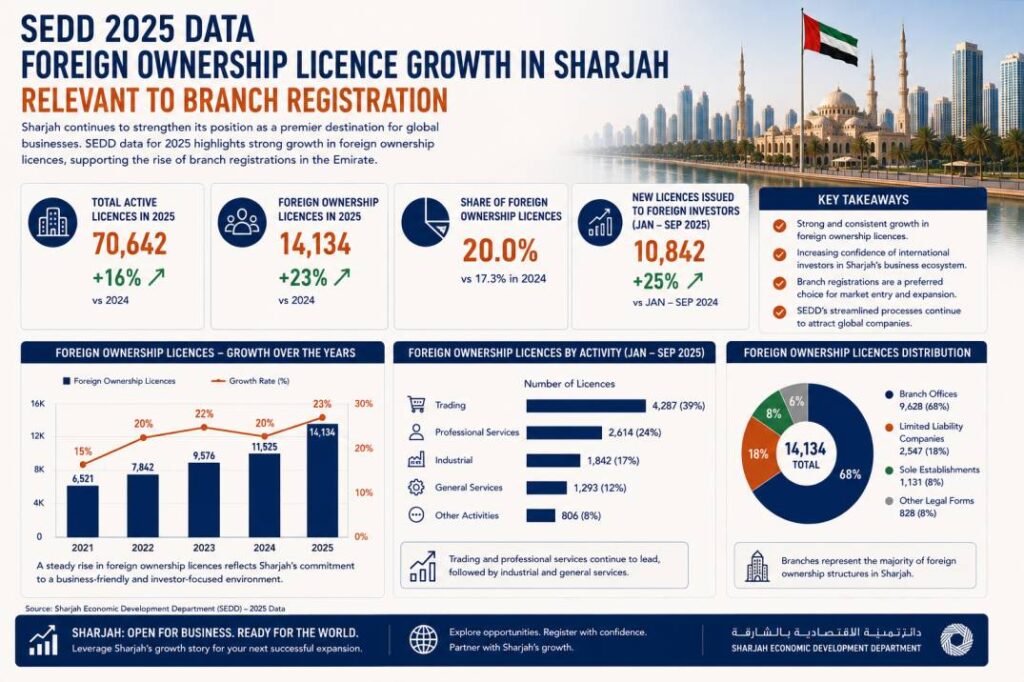
Read plainly, that data says three things relevant to a foreign company weighing Sharjah specifically. Foreign ownership activity is growing meaningfully faster than the base rate, which suggests the emirate is actively attracting international entrants rather than being a secondary choice behind Dubai. The Instant License service suggests SEDD has invested in processing speed for straightforward applications, though a branch, with its federal Ministry stage, will not move at Instant License speed regardless of SEDD’s own efficiency. And the AI management certification is a genuine institutional signal, though it says more about SEDD’s internal processes than about anything a founder experiences directly during branch registration.
None of this is a reason to choose Sharjah over another emirate by itself. It is context that the emirate’s mainland licensing environment is active and growing, which is different information from a generic claim that Sharjah is business-friendly.
Documents, Lease and Timeline
For this structure, the parent company documentation is the same regardless of emirate: certificate of incorporation, memorandum and articles of association, board resolution, power of attorney for the branch manager, and audited financial statements, each passing through the standard attestation chain.
Sharjah-specific requirements sit on the SEDD side. The lease must be for premises appropriate to the licensed activity, and it must be registered and attested through Sharjah’s municipal system before submission to SEDD. SEDD reviews the complete file, including the lease, before issuing the trade licence, and can request additional documents if anything is incomplete.
For timeline, treat the same eight-to-ten-week planning horizon that applies to any UAE branch as the working assumption, with the Ministry stage and the attestation chain as the parts most likely to determine your actual start date rather than the SEDD stage itself. The full attestation sequence and realistic weekly breakdown is covered in the UAE-wide branch guide.
What a Branch of a Foreign Company in Sharjah Costs
SEDD’s own guidance is explicit that licence cost depends on activity, legal form, lease value, location and approvals, and should not be treated as a single fixed figure. That is accurate, and it is also what makes a headline Sharjah branch cost number from a consultancy page close to meaningless without the specifics behind it.
What should appear in any quote you receive: the Ministry registration fee, the SEDD trade licence fee, lease cost for premises meeting the activity requirement, document attestation and legal translation, visa costs per person, and the annual renewal cost in year two. As with any UAE branch, an annual audit is a recurring obligation, not a one-off setup cost, and it belongs in the same conversation as the licence fee, not as a surprise afterward.
The one line that should not appear on a 2026 quote: a fee for arranging a Local Service Agent. If it does, ask why.
When a Branch of a Foreign Company in Sharjah Is the Right Structure
This structure suits a foreign company that already has an established name and licensed activity abroad, wants direct mainland market access including government contract eligibility, and is comfortable with the parent carrying full liability for the branch’s activities in the UAE.
It is a weaker fit when the UAE activity differs meaningfully from what the parent does at home, since a branch cannot exceed the parent’s licensed scope. It is also a weaker fit when the plan eventually involves a local partner or investor, since a branch has no shares to offer. In either case, a Sharjah mainland LLC or a free zone company is usually the better structure, and the comparison is worth doing properly before filing rather than after.
My Approach: The Question Before the SEDD Application
Most business setup consultants help you register a company. I help you make informed business decisions before you invest. For this structure specifically, that distinction matters more than usual.
For a Sharjah branch specifically, the question that matters is not whether you can register one. It is whether Sharjah, as a specific emirate with a specific customer base and a specific regulator, is where your UAE activity should actually sit, and whether a branch, rather than an LLC or a free zone company, is the right instrument for it. Getting the structure right before the SEDD application is filed saves months compared with discovering the mismatch afterward.
My advisory process focuses on helping you reduce uncertainty and make confident decisions, not just complete documentation. In practice:
- Structure assessment comparing a Sharjah branch against a mainland LLC and a Sharjah free zone company, based on your actual customers and activity.
- Emirate selection grounded in where your customers and operations genuinely sit, rather than assuming Sharjah by default.
- Activity mapping between your parent company’s home licence and Sharjah’s classification, checked before filing.
- Attestation planning started early, since it determines your realistic timeline more than the SEDD stage does.
- Full cost modelling including the Ministry fee, SEDD fee, lease, attestation, visas and the recurring annual audit.
- Structure and licensing execution through the Ministry and SEDD in the correct sequence.
- Corporate tax registration and filing planning from the outset.
- Banking setup for the branch, which is more document-intensive than for a standard company.
- Visa planning for the branch manager and the staff you bring in.
The objective is simple: help you start your business with clarity, confidence and a long-term strategy.
If you are weighing Sharjah against another emirate, or a branch against another structure, get in touch before you file.
Frequently Asked Questions
Do I need a Local Service Agent for a branch of a foreign company in Sharjah?
No. Ministerial Resolution No. 138 of 2024 abolished the Local Service Agent requirement for branches of foreign companies across the entire UAE, including Sharjah, from 30 July 2024. Several guides still list this requirement, describing the pre-2024 regime.
Which authority licenses a branch in Sharjah?
Two authorities in sequence. The federal Ministry of Economy and Tourism grants initial approval based on the parent company’s attested documents. The Sharjah Economic Development Department (SEDD) then issues the local trade licence once Ministry approval is in place.
Is a branch the same as a Sharjah free zone company?
No. A branch is a mainland structure under SEDD, carrying the same legal identity as its parent and giving direct access to UAE mainland and government customers. A free zone company, registered under an authority such as SHAMS, SAIF Zone or Hamriyah Free Zone, is a separate legal entity typically suited to international or export-focused activity.
What does a branch of a foreign company in Sharjah cost?
Cost depends on activity, legal form, lease value and approvals required, so a single fixed figure is not meaningful. A proper quote should itemise the Ministry registration fee, the SEDD licence fee, lease cost, attestation and translation, visa costs, and the annual renewal and audit obligations in year two.
Can a Sharjah branch serve clients outside Sharjah?
Yes. A mainland branch licensed through SEDD can operate across the UAE, not only within Sharjah, and remains eligible to bid for government contracts, subject to the activities the parent company is licensed for at home.
How long does it take to register a branch in Sharjah?
Plan for the same eight-to-ten-week horizon that applies to a UAE branch in any emirate. The document attestation chain for the parent company’s paperwork, not the SEDD stage itself, is usually what determines the realistic timeline.
Is Sharjah cheaper than Dubai or Abu Dhabi for a branch?
Not necessarily, and cost should not be the only factor. SEDD licence fees can be competitive, but the Ministry registration stage, attestation costs and visa costs are largely emirate-independent. The right emirate depends on where your customers and operations actually are.
Sources & References
- Sharjah Economic Development Department
- Ministry of Economy and Tourism – Registration of a Branch of a Foreign Company
- UAE Legislation Portal – Federal Decree-Law No. 32 of 2021 on Commercial Companies
- Gulf News – Digital drive powers Sharjah’s economic expansion in 2025
- Your own guide: How to set up a branch of a foreign company in the UAE