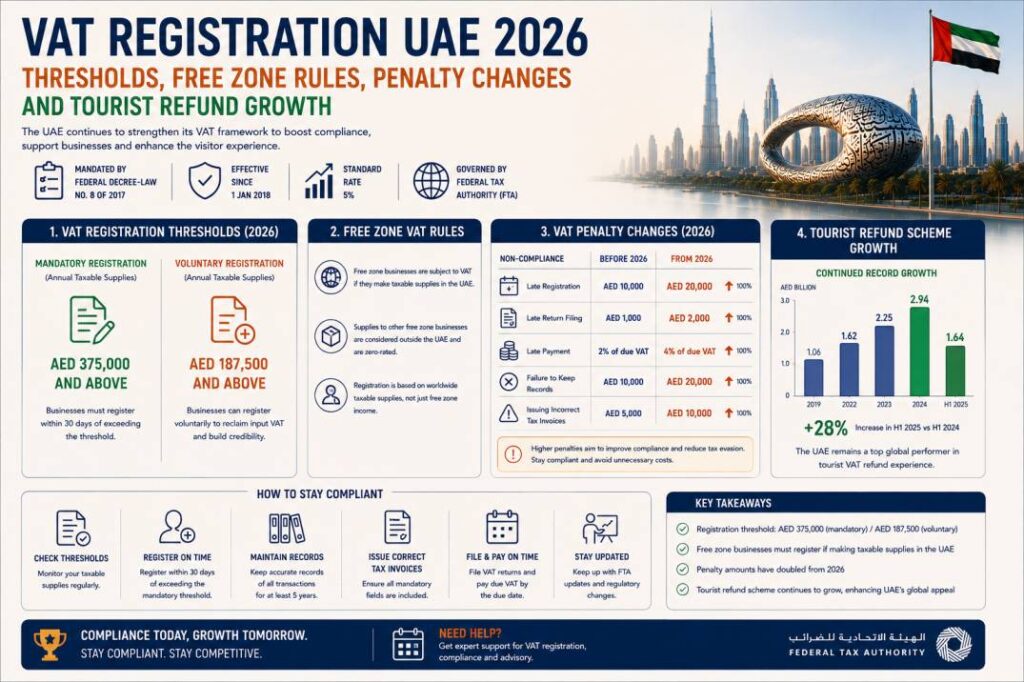
Every VAT registration UAE guide repeats the same two numbers: AED 375,000 mandatory, AED 187,500 voluntary. Both are correct and have been since 2018. What almost none of them mention is that the penalty framework sitting underneath those numbers, what happens when you register late, file wrong or pay late, was rewritten this year. Cabinet Decision No. 129 of 2025 took effect on 14 April 2026, and it changes the actual cost of a mistake more than anything published about VAT registration in years. Here is the full picture for a new UAE company: the thresholds, the reform, the free zone trap almost every new licensee falls into, and what the tourist refund system’s growth means if you are opening a retail business.
Quick Navigation
Quick Answer
- VAT registration UAE rules are mandatory once taxable supplies and imports exceed AED 375,000 in a rolling 12-month period, and optional above AED 187,500.
- The penalty framework changed on 14 April 2026 under Cabinet Decision No. 129 of 2025, replacing the 2021 rules with a flat 14% per annum late payment charge and reduced fixed penalties for procedural errors.
- A free zone is not automatically a designated zone. Only around 27 Cabinet-approved zones get special VAT treatment, and even then only for goods, never for services.
- The UAE’s Digital Tourist VAT Refund System grew 5.9% in H1 2026 to over 19,340 connected outlets, and the refund fee was cut from AED 4.80 to AED 3.6 per claim from 12 July 2026.
- The most expensive pitfall for new licensees is assuming free zone status means VAT relief, followed by treating services between designated zones as exempt when they are fully standard-rated.
VAT Registration UAE: The Thresholds Have Not Changed. What Happens When You Get Them Wrong Just Did
Start with what is genuinely stable, because it is stable for a reason.
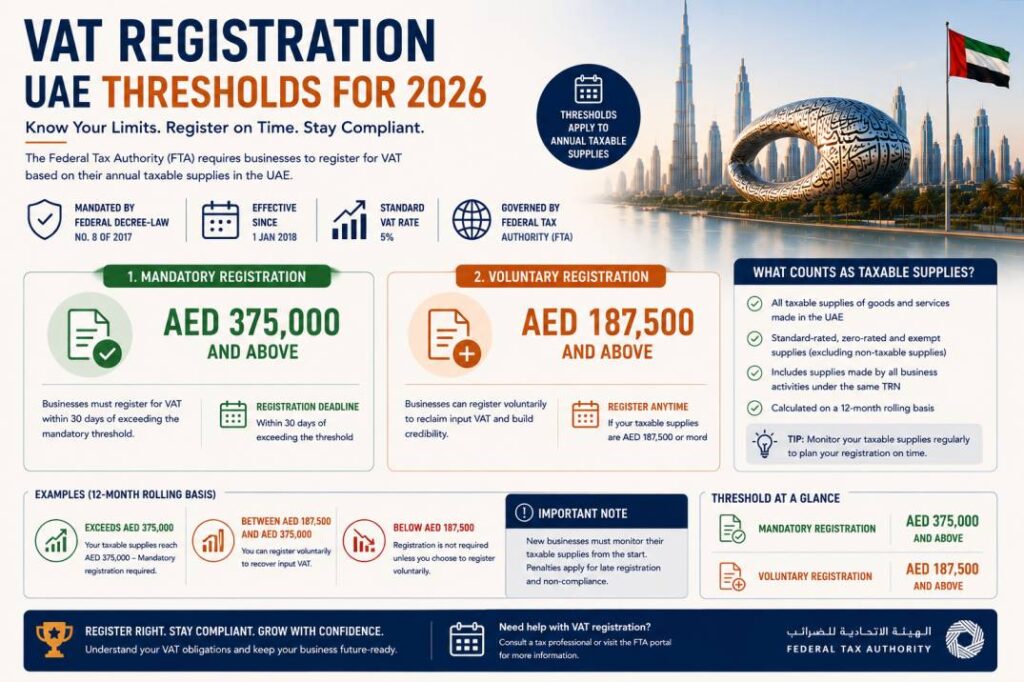
VAT registration UAE rules require mandatory registration once taxable supplies and imports exceed AED 375,000 over the previous 12 months, or are expected to exceed that figure in the next 30 days. Voluntary registration is available from AED 187,500, and most new companies with a genuine trajectory toward the mandatory threshold register voluntarily early, specifically to reclaim input VAT on setup costs, office fit-out and professional fees before revenue arrives.
Two calculation details catch new licensees more than the thresholds themselves. The count is based on taxable turnover, not profit, so a business with thin margins can cross the threshold on revenue while barely breaking even. And the 30-day forward test means a single large contract signed on day one of trading can trigger mandatory registration immediately, regardless of trailing revenue.
Once registered, VAT is charged at the standard 5% rate, returns are filed quarterly for most businesses and monthly for larger ones, and returns are due within 28 days of the period end.
None of that has moved since Federal Decree-Law No. 8 of 2017 came into force. What moved is what happens when a business gets any of it wrong.
The VAT Penalty Reform Almost Nobody Is Writing About
This is the section that separates a current VAT registration UAE guide from one written for 2021.
On 14 April 2026, Cabinet Decision No. 129 of 2025 came into force, replacing the previous administrative penalty framework under Cabinet Decision No. 108 of 2021. It was issued on 9 October 2025 and published on the FTA’s website on 11 November 2025, giving businesses roughly a six-month window to prepare before it took effect.
Three changes matter most for a new licensee.
Late payment moved to a flat rate. Unpaid tax now carries a flat 14% per annum late payment penalty, calculated monthly, replacing a compounding percentage structure that could escalate sharply the longer an amount went unpaid.
Voluntary disclosure got cheaper. Previously, correcting your own error through a voluntary disclosure carried stepped fixed penalties in bands from 5% to 40% of the tax difference, depending on how long the error had gone uncorrected. The reform reduces this burden and is explicitly designed to reward businesses that self-correct before the FTA finds the issue during an audit.
Fixed penalties for procedural errors dropped. Several administrative fines, including failing to keep records in Arabic and failing to notify the appointment of a legal representative, were reduced substantially, in some cases to a flat AED 1,000 for a first violation with a higher fee only on repetition within 24 months.
The policy shift is stated plainly across the professional commentary I reviewed: from a deterrence model to a proportionality model, and from punishing first-time errors harshly to focusing enforcement on repeated non-compliance within a defined window.
For a company registering for VAT today, this matters twice. It means the actual financial exposure for an honest mistake is now lower than most published guides suggest, since several are still describing the pre-April framework. And it means the FTA now expects self-correction. A business that spots and voluntarily discloses its own error is treated meaningfully better under the new rules than one that waits to be caught.
Free Zone Versus Designated Zone: The VAT Registration UAE Mistake That Costs New Licensees the Most
Here is the confusion I see most often in new company formation, and it is not unique to my clients. Several currently-ranking guides make the same error.
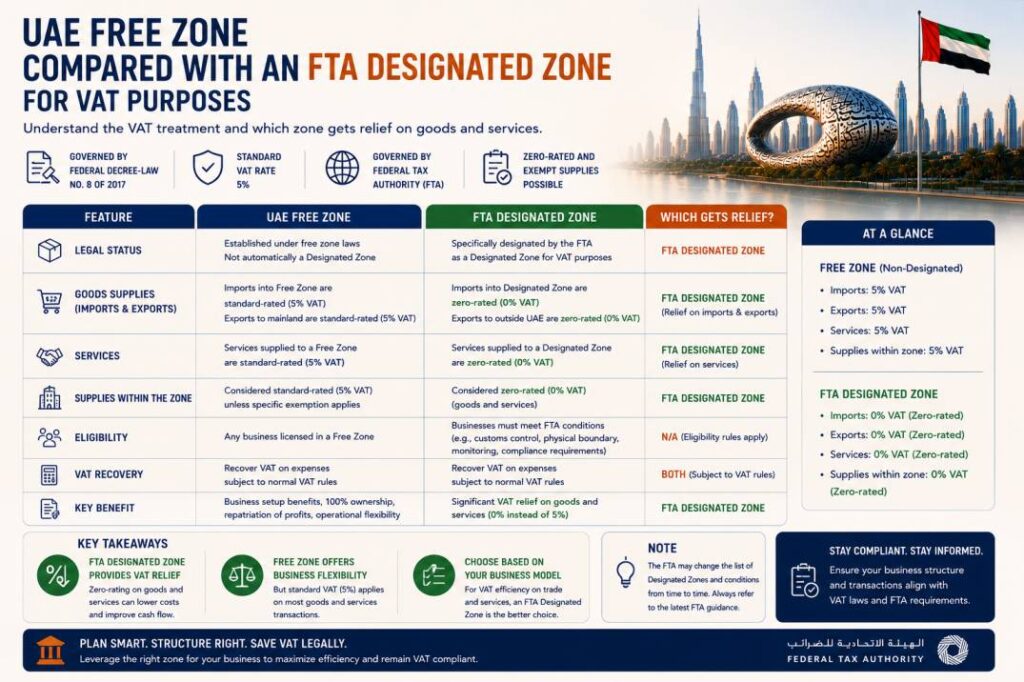
A UAE free zone and an FTA designated zone are not the same thing. A free zone is a licensing and ownership structure. A designated zone is a specific VAT status that a small subset of free zones hold under Cabinet Decision No. 59 of 2017.
To qualify as a designated zone, an area must be a fenced, physically secured location with controlled entry and exit points monitored by the FTA and customs, and the zone operator must run internal procedures for handling and storing goods. Roughly 27 zones across the UAE currently hold this status, concentrated in Dubai and Ras Al Khaimah, including JAFZA, DAFZA, Hamriyah Free Zone, Khalifa Industrial Zone and Sharjah Airport International Free Zone among others. The list has been amended multiple times since 2017 and should always be checked against the current FTA publication rather than assumed from memory.
If your free zone is not on that list, and most are not, it is a non-designated free zone, and VAT applies exactly as it would on the mainland. Dubai Media City and most DMCC operations fall into this category. Company formation in a prestigious free zone creates no VAT advantage by itself.
Even inside a genuine designated zone, the relief is narrower than most new licensees assume. The benefit applies specifically to the movement of goods that remain within the fenced, customs-controlled area. Import of goods directly into a designated zone from outside the UAE can be outside the scope of VAT. Movement of goods between two designated zones can also be outside scope, provided strict conditions are met.
Services get none of it. A management consultancy or IT company based in a designated zone supplying services to another company in a different designated zone, or to the mainland, is charged standard 5% VAT exactly as if neither party were in a zone at all. This is the specific mistake I see most often: a services business chooses a designated zone address expecting a VAT benefit that legally does not exist for what they sell.
And moving goods out is where audits happen. Goods moving from a designated zone like JAFZA into the UAE mainland trigger import VAT at 5% at that point. Businesses frequently miss this and either fail to charge VAT they should have, or reclaim VAT they were never entitled to.
If your business is a trading or logistics operation genuinely moving goods, a real designated zone is worth serious consideration, and the practical case for one specific zone is set out in why Fujairah free zones are a strong setup opportunity for trading. If your business sells services, the zone’s VAT designation is irrelevant to your tax position, and the decision should be made on cost, activity licence and location alone.
The Tourist VAT Refund System, and What Its Growth Means for VAT Registration UAE Retailers
This section is specific to anyone setting up a retail or e-commerce business, and the data here is more recent than almost anything published on the topic.
The UAE’s Digital Tourist VAT Refund System, operated in partnership with Planet, the FTA’s appointed system operator, grew to over 19,340 connected retail outlets by the end of the first half of 2026, up 5.9% from 18,260 a year earlier. Self-service refund kiosks reached 100 across malls, hotels and departure points. The top nationalities using the scheme in 2026 were tourists from India, Russia, Turkey, China and the United States.
Two developments in 2026 are worth knowing specifically because they are recent enough that most published guides have not caught up.
Noon joined the scheme. The FTA integrated the Noon e-commerce platform into the tourist refund system, described as the first initiative of its kind globally, allowing tourists to claim VAT refunds on eligible online purchases made while in the UAE. This signals the scheme is actively expanding into e-commerce, not just physical retail.
The refund fee dropped. Under FTA Decision No. 11 of 2026, effective 12 July 2026, the fixed fee deducted per refund claim fell from AED 4.80 to AED 3.6. The tourist still receives 87% of the VAT paid, unchanged, but the flat deduction on top of that is now smaller. Several refund guides published before July still quote the old AED 4.80 figure.
{{IMG4}}
For a new retail licensee deciding whether to join the scheme, two things worth knowing before registering with Planet. The minimum eligible purchase is AED 250 per transaction, and it cannot be reached by combining receipts from different retailers. And registration is not free of commitment: retailers must provide refundable collateral, either a security cheque or bank guarantee in favour of Planet Tax Free LLC, with the amount determined by Planet based on the retailer’s profile. That is a working capital decision, not just an admin form, and it belongs in your setup budget if tourist footfall is part of your business model.
The growth numbers suggest the scheme is a genuine and increasingly digital channel rather than a legacy programme, which strengthens the case for retail and e-commerce businesses to plan for it from the outset rather than treating it as an afterthought once trading has begun.
Common VAT Registration UAE Pitfalls for New Licensees
Beyond the designated zone confusion above, five mistakes I see repeatedly in new company setups.
Registering too late because turnover was miscounted. Businesses frequently exclude exempt supplies incorrectly or forget that the forward-looking 30-day test can trigger registration even with low trailing revenue.
Treating VAT registration as separate from corporate tax planning. The two regimes interact, and a business that registers for VAT without considering its corporate tax position, or vice versa, often ends up restructuring within the first year. The corporate tax side is covered in corporate tax registration and filing.
Assuming a free zone licence changes VAT obligations at all. Covered above, and worth repeating because it is the single most common and most expensive assumption new licensees make.
Not building VAT-compliant invoicing into the accounting system from day one. This now sits alongside a parallel obligation, since the UAE’s e-invoicing mandate is being phased in from 2026 for larger businesses, covered fully in the UAE e-invoicing rollout. Choosing accounting and ERP software at formation that handles both VAT and structured e-invoicing correctly avoids two separate retrofits later, a point also covered on the ERP systems page.
Discovering the penalty framework only after an error has already occurred. Understanding the April 2026 reform, and specifically the incentive to self-correct through voluntary disclosure, changes how a business should respond the moment it spots a mistake, not after the FTA has already flagged it.
VAT Registration UAE in Practice
The mechanical steps, briefly, since most guides cover this part adequately and it is not where the risk sits.
Register through the EmaraTax portal with your trade licence, Emirates ID, business activity details, and financial information showing turnover. The FTA reviews most applications within 20 business days and issues a 15-digit Tax Registration Number (TRN) on approval. That TRN must appear on every tax invoice, VAT return and communication with the FTA thereafter.
Once registered, output VAT is charged on taxable supplies at 5%, input VAT is reclaimed on eligible business expenses, and the net difference is remitted to the FTA on your filing schedule. Where input tax exceeds output tax in a period, a refund can be claimed. The system is designed to be neutral for the business itself, with the final cost falling on the end consumer, which is worth explaining to founders who assume VAT is a direct cost to their company.
My Approach: Getting VAT Registration UAE Right Before You File, Not After
Most business setup consultants help you register a company. I help you make informed business decisions before you invest.
VAT registration itself is a form. The decisions around it are not. Whether to register voluntarily before you hit the mandatory threshold, whether your chosen free zone actually carries designated status for what you sell, whether the tourist refund scheme’s collateral requirement belongs in your working capital plan, and how the April 2026 penalty reform changes your risk if something goes wrong: those are business decisions, and they are the ones that determine whether VAT compliance is a quiet background process or a recurring source of exposure.
My advisory process focuses on helping you reduce uncertainty and make confident decisions, not just complete documentation. In practice:
- Turnover forecasting against both VAT thresholds, so registration timing is a choice rather than a scramble.
- Free zone and designated zone analysis specific to your activity, since the VAT benefit depends entirely on whether you move goods or sell services.
- VAT and corporate tax planning handled together rather than as separate projects, through corporate tax registration and filing.
- Retail and e-commerce businesses assessed on the tourist refund scheme’s collateral and eligibility requirements before commitment, not after.
- Accounting and ERP selection at formation that handles VAT compliance and the incoming e-invoicing mandate together.
- Structure and jurisdiction guidance, since the right structure depends on your activity, not on which zone markets itself loudest.
- Business setup and licensing sequenced so your VAT position is understood before the licence is issued.
- Banking setup coordinated with your VAT and reporting obligations.
The objective is simple: help you start your business with clarity, confidence and a long-term strategy, with VAT compliance built in correctly from the start rather than corrected under FTA scrutiny later.
If you are setting up now and want your VAT position assessed properly before you register, get in touch.
Frequently Asked Questions
What is the VAT registration threshold in the UAE?
Mandatory registration applies once taxable supplies and imports exceed AED 375,000 over a rolling 12-month period, or are expected to exceed that in the next 30 days. Voluntary registration is available from AED 187,500, commonly chosen by new businesses to reclaim input VAT on setup costs.
Did UAE VAT penalties change in 2026?
Yes. Cabinet Decision No. 129 of 2025 took effect on 14 April 2026, replacing the 2021 penalty framework. Late payment now carries a flat 14% per annum penalty calculated monthly rather than a compounding structure, and voluntary disclosure of errors is penalised more leniently than under the previous rules.
Does setting up in a free zone mean I do not pay VAT?
No. VAT and free zone status are separate questions. Only around 27 Cabinet-approved designated zones carry special VAT treatment, and even within those zones, relief applies only to the movement of goods that stay inside the fenced, customs-controlled area. Services supplied from a designated zone are charged standard 5% VAT exactly as on the mainland.
What is the difference between a free zone and a designated zone for VAT?
A free zone is a licensing and ownership jurisdiction. A designated zone is a specific VAT status under Cabinet Decision No. 59 of 2017, requiring a fenced, FTA-monitored area with customs controls. All designated zones are free zones, but most free zones are not designated zones, and the distinction only matters for goods, not services.
How does the UAE tourist VAT refund scheme work in 2026?
Tourists can claim a refund on eligible purchases of AED 250 or more from retailers registered with Planet, the FTA’s appointed operator. As of mid-2026, over 19,340 outlets were connected. Tourists receive 87% of the VAT paid, with a fixed AED 3.6 deduction per claim since 12 July 2026, reduced from AED 4.80.
What does a retailer need to join the tourist VAT refund scheme?
Registration with Planet requires a VAT registration certificate, trade licence, and refundable collateral in the form of a security cheque or bank guarantee in favour of Planet Tax Free LLC, with the amount set by Planet. This is a working capital commitment that should be planned for before registering.
What is the biggest VAT mistake new UAE companies make?
Assuming a free zone address automatically provides VAT relief. Most free zones are not designated zones, and even genuine designated zones only relieve the movement of goods, never services. A services business gains no VAT advantage from a designated zone location.
Sources & References
- Federal Tax Authority – Registration for VAT
- Federal Tax Authority – VAT Refund for Tourists
- The Official Platform of the UAE Government – VAT refund for tourists
- DLA Piper – Cabinet Decision amends administrative penalties for UAE tax law violations
- Habib Al Mulla and Partners – Administrative Penalties in the UAE: The 2025 Reform