
If you are researching a branch of a foreign company in the UAE, there is a good chance you have already been told you need a AED 50,000 bank guarantee and a UAE national service agent. Neither has been true since July 2024. Ministerial Resolution No. 138 of 2024 removed both, and a large share of the consultancy pages ranking for this topic have not been updated since. This is what the process actually involves in 2026, what it costs, how long it takes, and where a branch is the wrong answer.
Quick Navigation
Quick Answer
- Ministerial Resolution No. 138 of 2024, issued 30 July 2024, replaced Resolution No. 377 of 2010 and removed both the AED 50,000 bank guarantee and the local service agent requirement for branches of foreign companies.
- A mainland branch needs two approvals: registration with the Ministry, and a trade licence from the local authority (DET in Dubai, ADDED’s licensing authority ADRA in Abu Dhabi, or the emirate equivalent).
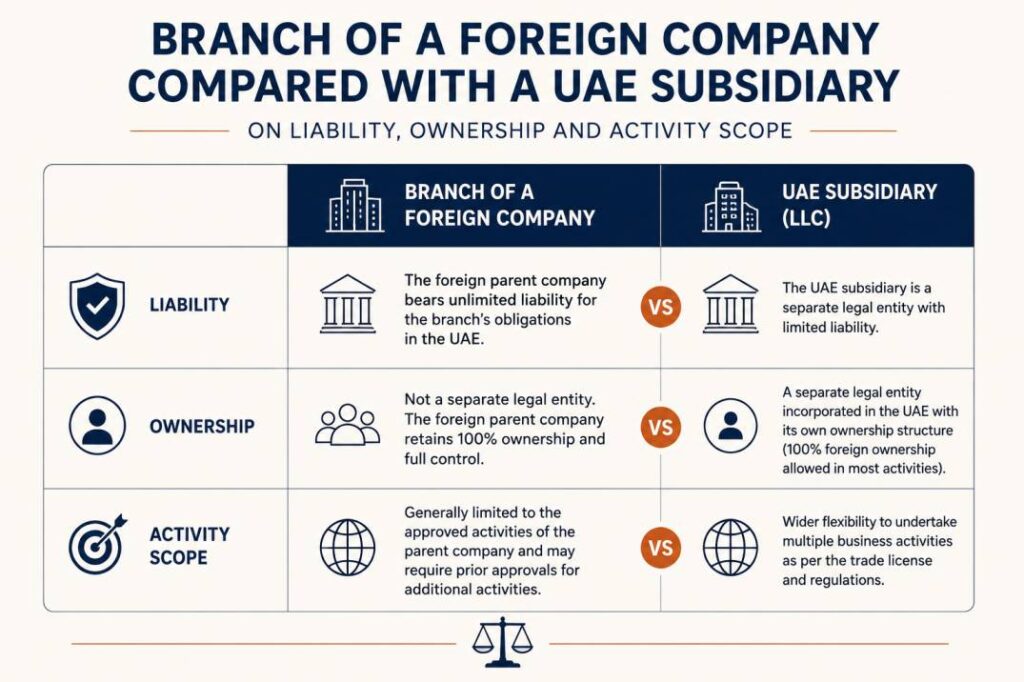
- A branch of a foreign company is not a separate legal entity. The foreign parent carries unlimited liability for its debts and obligations.
- A branch may only conduct the activities the parent is licensed for at home. A representative office may not trade at all.
- Branches must file annual audited financial statements with the Ministry. Representative offices are exempt, because they are prohibited from generating revenue.
What Is a Branch of a Foreign Company?
A branch of a foreign company is the same legal person as its parent company, registered to operate in the UAE. It is not a subsidiary. It has no shareholders, no share capital and no separate legal personality.
Three consequences follow, and they decide whether this structure suits you.
The parent carries unlimited liability. Every debt, contract and regulatory obligation of the UAE branch sits with the foreign parent company. There is no corporate veil between them. A subsidiary gives you that separation. A branch does not.
Activity is restricted to the parent’s licensed scope. A branch may only carry out activities the parent company is licensed to conduct in its home jurisdiction. If your UAE plan involves doing something the parent does not do at home, a branch will not accommodate it.
The brand carries over intact. You trade under the parent name, wholly owned, with no local shareholder. For a firm whose name is the asset, that continuity is the main reason to choose this route over incorporating something new.
That is the trade. Continuity and full ownership, paid for with liability exposure and a narrower activity scope.
What Changed in 2024, and What Most Pages Still Get Wrong
On 30 July 2024 the Ministry issued Ministerial Resolution No. 138 of 2024 on the controls and procedures for registering branches and representative offices of foreign companies. It abrogated and replaced Ministerial Resolution No. 377 of 2010.
Two requirements disappeared.
The AED 50,000 bank guarantee. Under the 2010 regime, a foreign entity or free zone entity establishing a mainland branch had to lodge a AED 50,000 bank guarantee issued by a UAE-licensed bank. That is no longer required.
The local service agent. A branch of a foreign company no longer needs a UAE national service agent on the mainland. Under the old regime this was a notarised contract filed with the licensing authority. The agent had no legal authority over branch operations but could, in practice, complicate visa issuance and licence renewals. That friction is gone.
A third change is procedural but worth knowing: all applications for registration, renewal, amendment, suspension, deletion or re-registration must now be filed through the Ministry’s online platform.
Read almost any consultancy page on this subject and you will still find the AED 50,000 guarantee listed as a live requirement, sometimes on pages dated this year. Several of the pages ranking highest for branch office searches go further and cite the Commercial Companies Act No. 8 of 1984 and Ministerial Decision No. 69 of 1989 as the governing law. Both were superseded long ago. The current commercial companies law is Federal Decree-Law No. 32 of 2021.
Some of those pages are published by firms that sell local service agent services, which is worth knowing when you read a page telling you that you need one.
The practical test: if a guide lists the AED 50,000 guarantee, or names a service agent as mandatory, or cites 1984 or 1989 legislation, treat everything else on that page as equally out of date.
If You Registered Before Mid-2024, Reclaim Your Guarantee
This section is for readers who already operate a branch of a foreign company in the UAE rather than those setting one up.
If your branch was registered under the old regime, you lodged a AED 50,000 bank guarantee. That guarantee is no longer required. Existing branches that submitted one should contact their bank to arrange cancellation and release the funds.
Nobody is going to tell you this proactively. The bank has no reason to, and the Ministry does not write to you about it. It is AED 50,000 of working capital sitting idle because a rule changed and nothing prompted a review.
The same applies to legacy service agent contracts. Existing branches still holding one should review whether it needs to continue, because it is now a cost without a legal basis.
If you have held a UAE branch since before 2024 and have not reviewed either of these, that is worth an hour of someone’s time this month.
Branch or Representative Office
These are two different registrations and people conflate them constantly.
A branch may conduct the parent’s licensed commercial activities in the UAE. It can contract, invoice, earn revenue and hire.
A representative office may not. Under Article 339 of Federal Decree-Law No. 32 of 2021 on Commercial Companies, a representative office is prohibited from undertaking business activity. It may study the market, identify opportunities and promote the parent’s products and services. It may not sell them.
Resolution 138 covers a wider set of these than most people realise: representative offices, regional liaison offices, management offices, and representative offices of foreign banks all fall within the same framework.
The difference that costs money: a branch must file annual audited financial statements with the Ministry. A representative office does not, because it generates no revenue to audit. Over a five-year horizon that is a meaningful gap in running cost.
Choose the representative office if the plan for the first year or two is genuinely market study and business development, with contracts signed by the parent abroad. Choose the branch the moment you need to invoice from inside the UAE.
The Two Approvals, in Sequence
Registering a branch of a foreign company on the mainland is not one application. It is two, and the order matters.
- Trade name reservation with the local licensing authority.
- Initial approval from the Ministry, filed through the online platform, with the parent’s attested corporate documents.
- Trade licence from the local authority (DET in Dubai, ADDED’s licensing authority ADRA in Abu Dhabi, or the emirate equivalent), which requires proof of premises. In Dubai that means an Ejari-registered tenancy.
- Final registration with the Ministry, which must be completed within one month of the local licence being issued. The Ministry then issues a registration certificate valid for one year, renewable annually.
Getting this out of order is the most common way a branch application stalls. The local authority will not issue a licence without the Ministry’s initial approval, and the Ministry will not complete registration without the local licence.
Free zone branches follow a different path entirely. Where the branch is established in a free zone, the process is governed by that zone’s authority rather than the Ministry, which is why free zone branch applications are typically faster and bundled into a single workflow.
Which Authority, by Emirate
Most guides on this topic say the UAE and describe Dubai. The licensing authority differs, and so do fees, office requirements and activity classifications.
| Emirate | Local licensing authority |
|---|---|
| Dubai | Department of Economy and Tourism (DET) |
| Abu Dhabi | Abu Dhabi Department of Economic Development (ADDED), through its Abu Dhabi Registration and Licensing Authority (ADRA) |
| Sharjah | Sharjah Economic Development Department (SEDD) |
| Other emirates | The relevant emirate’s economic development department |
Each sets its own fee schedule, minimum office size and activity list. A branch approved for a given activity in Dubai is not automatically approved for the same activity in Abu Dhabi, and the classification names do not always match between emirates.
Three Abu Dhabi differences worth knowing before you file
Abu Dhabi is the emirate people search for most on this topic, and it differs from Dubai in three ways that guides written about the UAE as a whole tend to miss.
Tawtheeq, not Ejari. Abu Dhabi registers tenancy contracts through Tawtheeq, administered by the Department of Municipalities and Transport and processed through the TAMM platform. Ejari is Dubai’s system and does not apply in Abu Dhabi. You cannot obtain the trade licence without a registered Tawtheeq certificate, and it must be updated whenever the lease is renewed or amended. In practice the landlord usually initiates it, so confirm who is responsible when you negotiate the lease rather than after.
Activity restrictions are tighter. Abu Dhabi is reported not to permit foreign branches to hold trading activities, meaning the buying and selling of goods, wholesale or retail. That makes the branch route better suited to services and manufacturing businesses. New foreign branches are also generally limited to activities that permit 100% foreign ownership. Confirm your specific activity with ADDED before you commit to the structure, because discovering this after attestation is expensive.
The general manager needs a UID first. If your proposed branch manager is not a UAE citizen or resident, they need a Unified Identification number issued at Immigration, which requires having entered the UAE. That step gates the start of the application, so build it into the timeline rather than treating it as paperwork to handle later.
For the fuller Abu Dhabi picture, including real cost ranges, the ADDED-versus-ADRA distinction, and a week-by-week timeline specific to this emirate, see how to open a foreign company branch in Abu Dhabi.
The Attestation Chain, Which Is the Real Bottleneck
Every substantive delay in a branch of a foreign company application traces back to documents.
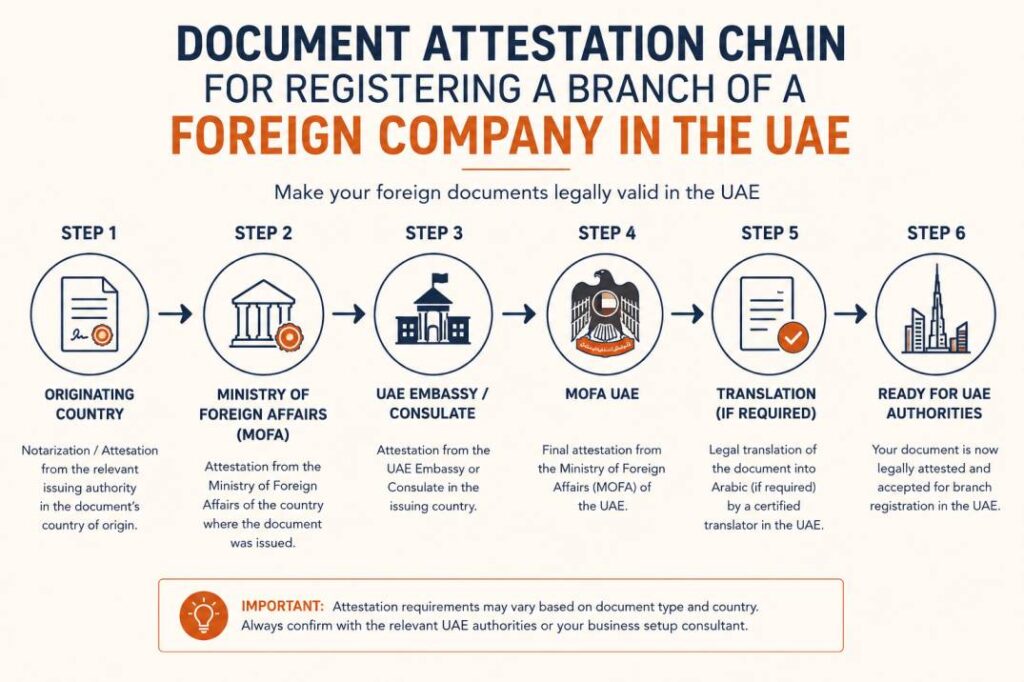
The parent’s certificate of incorporation, memorandum and articles of association, board resolution authorising the UAE branch, power of attorney for the branch manager, and audited financial statements each need to pass through a chain:
- Notarisation in the home country
- Certification by the home country’s foreign ministry or apostille authority
- Attestation by the UAE embassy in the home country
- Attestation by UAE MOFA on arrival
- Translation into Arabic by a UAE Ministry of Justice-licensed legal translator
Every document. Every stage. A single missing certification at stage two surfaces at stage four, weeks later, and the document goes back to the start.
The practical advice: start the attestation chain before you have finalised anything else. It is the only part of this process you cannot compress by paying more or knowing the right people, and it determines your realistic start date more than any other factor.
Timeline and Cost
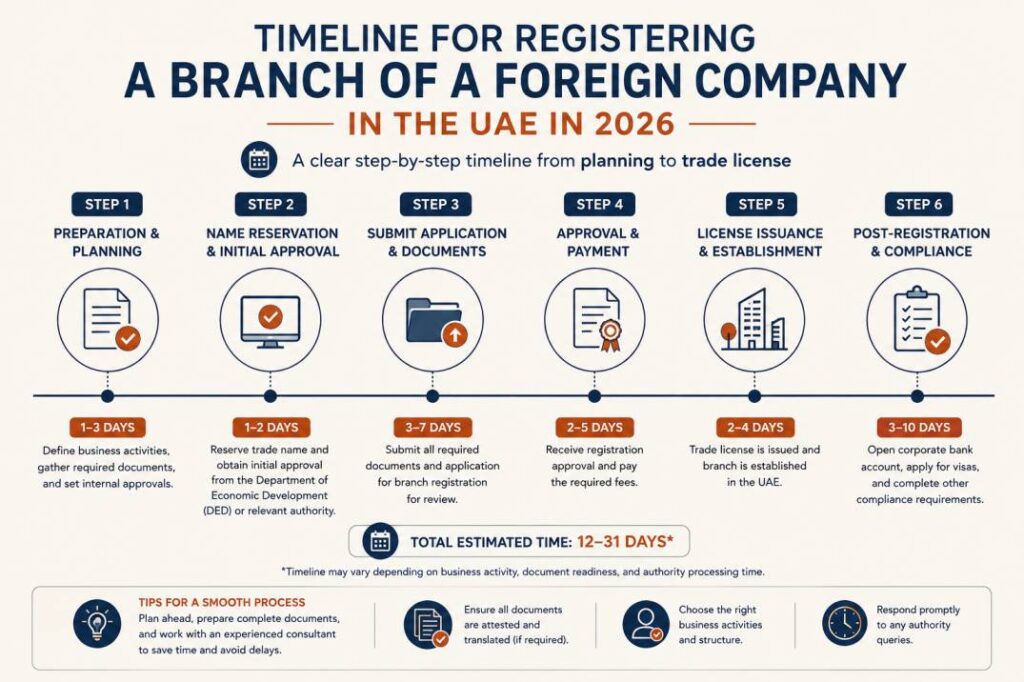
Timeline. Plan for eight to ten weeks end to end for a mainland branch with documents in good order. Roughly: document preparation and home-country attestation in weeks one and two, UAE attestation and translation in week three, Ministry and local authority approvals in week four, premises and licence issuance in weeks five and six, then visa file and bank account opening through weeks six to eight.
Once documents are attested and submitted, the licensing step itself typically runs 7 to 21 business days on the mainland. Free zone authorities are usually faster, often 3 to 10 business days, because the licence and visa quota come bundled.
Cost. Published figures vary too widely by emirate, activity and office requirement to quote a single number honestly. What I would insist on before signing with any consultant is an itemised quote covering: Ministry registration fee, local authority licence fee, attestation and legal translation, office or Ejari cost, visa cost per person including medical and Emirates ID, annual renewal in year two, and the annual audit.
The audit is the line most quotes leave out, and it recurs every year.
The one cost you should no longer see: the AED 50,000 guarantee. If a quote includes it, the consultant is working from an outdated checklist, which tells you something about the rest of the quote.
Tax and Ongoing Compliance
A branch of a foreign company is within scope of UAE corporate tax on its UAE-sourced business income, at 0% up to AED 375,000 of taxable income and 9% above it. VAT registration follows the standard thresholds based on taxable supplies.
Three recurring obligations to budget for:
Annual audited financial statements filed with the Ministry. This is a branch obligation and it is not optional.
Annual renewal of both the Ministry registration certificate and the local trade licence.
Economic substance and other filings depending on the activity your branch conducts.
One obligation people forget entirely: if the branch is no longer needed, it must be formally liquidated and removed from the register. Simply letting the licence lapse accrues fines, and the tax filing obligations continue to run against the parent until the registration is properly cancelled. Closing a branch is a process, not an omission.
If you are weighing a branch against a free zone entity, note that the corporate tax treatment of free zone income depends on whether it qualifies, which is a separate and more complicated question. I have set that out in best free zones in UAE for AI and technology companies, and the registration mechanics are on my corporate tax registration and filing page.
When a Branch of a Foreign Company Is the Wrong Structure
A branch of a foreign company suits most expansion cases, but not all. Four situations where I would steer a client elsewhere.
When liability matters. The parent carries unlimited liability for the branch. If the UAE activity carries real operational or contractual risk, a subsidiary with its own legal personality is the safer structure even though it costs more to establish.
When the UAE activity differs from the parent’s. A branch cannot exceed the parent’s licensed scope. If the UAE plan involves a different business, you need a new entity, not an extension of an old one.
When you want local investment later. A branch has no shares. If there is any prospect of bringing in a local partner, a co-investor or an eventual buyer for the UAE operation, you need something with a cap table.
When the parent’s documents are difficult. If the parent sits in a jurisdiction with slow or unreliable attestation, the eight to ten week timeline can stretch considerably, and incorporating fresh in the UAE is sometimes genuinely faster.
The comparison against the alternatives is set out in mainland vs free zone vs offshore in the UAE and the difference between mainland and free zone companies.
My Approach: The Question I Ask Before the Paperwork
Most business setup consultants help you register a company. I help you make informed business decisions before you invest.
For a branch of a foreign company, the question that comes before any paperwork is simple: what is the UAE entity actually for? If the answer is invoicing existing clients under an established name, a branch is usually right and the job is executing the attestation chain cleanly. If the answer involves new activities, local partners, or exposure the parent should not carry, the branch is the wrong instrument and no amount of efficient processing fixes that.
My advisory process focuses on helping you reduce uncertainty and make confident decisions, not just complete documentation. In practice:
- Structure assessment first, comparing a branch against a subsidiary and a free zone entity on liability, activity scope and exit options.
- Activity mapping between the parent’s home licence and the UAE classification, before filing, because a mismatch here is discovered late and expensively.
- Emirate selection based on where your customers and staff will be, with the fee and premises differences set out side by side.
- Attestation planning, started early, since it is the part of the timeline nobody can compress.
- Full cost modelling including annual audit and renewal, not just the setup fee.
- Structure and licensing execution through the Ministry and the local authority in the correct sequence.
- Corporate tax registration and filing planning from the start rather than at the first return.
- Banking setup, which for branches is more document-heavy than for a standard company.
- Visa planning for the branch manager and staff you intend to bring in.
Clients are told the standard authority timeline up front, not the best case. If it can be done faster, that should be a pleasant surprise rather than a promise you are relying on.
The objective is simple: help you start your business with clarity, confidence and a long-term strategy.
Frequently Asked Questions
Can a foreign company open a branch in the UAE?
Yes. A foreign company can register a branch on the UAE mainland under Ministerial Resolution No. 138 of 2024. The branch is not a separate legal entity: it trades in the parent’s name, may only carry out activities the parent is licensed for, and the parent carries unlimited liability. It needs Ministry of Economy registration and a licence from the emirate.
How do I set up a branch of a foreign company in Sharjah?
Register with the UAE Ministry of Economy, then obtain the branch licence from the Sharjah Economic Development Department (SEDD). You need the parent’s attested incorporation documents, a board resolution approving the branch, a power of attorney for the branch manager and a registered office lease in Sharjah. SEDD sets its own fees and activity list, so confirm your activity first.
Do I still need a AED 50,000 bank guarantee to open a UAE branch?
No. Ministerial Resolution No. 138 of 2024, issued on 30 July 2024, removed the requirement. It replaced Ministerial Resolution No. 377 of 2010, under which the guarantee was mandatory. Existing branches that lodged one should contact their bank about cancelling it.
Do I need a local service agent for a mainland branch?
No. The same resolution removed the requirement for a UAE national service agent for branches of foreign companies. Guides still describing this requirement are describing the pre-2024 regime.
What is the difference between a branch and a representative office?
A branch may conduct the parent company’s licensed activities, contract and earn revenue in the UAE. A representative office may not trade at all. Under Article 339 of Federal Decree-Law No. 32 of 2021 it is limited to market study and promoting the parent’s products and services.
How long does it take to register a branch of a foreign company in the UAE?
Plan for eight to ten weeks end to end for a mainland branch with documents in order. Most of that is the document attestation chain. Once documents are submitted, mainland licensing typically runs 7 to 21 business days and free zone branches often 3 to 10.
Can a branch do something the parent company does not do?
No. A branch may only carry out activities the parent is licensed to conduct in its home jurisdiction. If your UAE plan involves a different business, you need a separate entity rather than a branch.
Which authority licenses a branch in Abu Dhabi?
The Abu Dhabi Registration and Licensing Authority (ADRA), which the Abu Dhabi Department of Economic Development (ADDED) set up in January 2025 to handle business licensing, after the Ministry issues initial approval. In Dubai it is the Department of Economy and Tourism, and in Sharjah the Sharjah Economic Development Department. Each sets its own fees and activity classifications.
Is setting up a branch in Abu Dhabi different from Dubai?
Yes, in three ways. Abu Dhabi registers tenancies through Tawtheeq rather than Dubai’s Ejari system. Abu Dhabi is reported not to permit foreign branches to hold trading activities, which makes the route better suited to services and manufacturing. And a non-resident general manager needs a Unified Identification number from Immigration before the application can start.
Does a UAE branch have to file audited accounts?
Yes. A branch of a foreign company must file annual audited financial statements with the Ministry. A representative office does not, because it is prohibited from generating revenue and therefore has nothing to audit.
Sources & References
- Ministry of Economy and Tourism – Registration of a Branch of a Foreign Company
- Ministry of Economy and Tourism – Licensing a Branch of a Foreign Company
- UAE Legislation Portal – Federal Decree-Law No. 32 of 2021 on Commercial Companies
- Dubai Department of Economy and Tourism
- Abu Dhabi Department of Economic Development
Setting up a branch of a foreign company in the UAE is more straightforward today than most guides suggest, provided you work from the current rules rather than outdated ones. A properly structured branch of a foreign company gives you a genuine UAE presence without incorporating a fresh entity.
Further reading: Once your branch is licensed, you will need to employ people correctly; I covered whether an HR consultancy business setup in UAE makes sense.