Free zone selection sounds like paperwork. For a startup planning to raise venture capital, it is a legal decision that can decide whether an investor is even able to write you a check. Not every one of Dubai’s 40+ free zones can hold the share structure a VC term sheet actually asks for.
Choosing where to register your company in Dubai is usually treated as an administrative step, something to get through before the real work starts. If your roadmap includes raising pre-seed, seed, or venture capital funding, it isn’t administrative at all. Structure the company in the wrong jurisdiction and an institutional investor may be legally unable to invest, no matter how strong your metrics are.
I work with founders before they register anything, and this is one of the few decisions that genuinely cannot be fixed later without cost. Here is how to think about the best Dubai free zones for tech startups depending on the round you’re actually trying to close, not the one you hope to close eventually.
Quick Navigation
Quick Answer
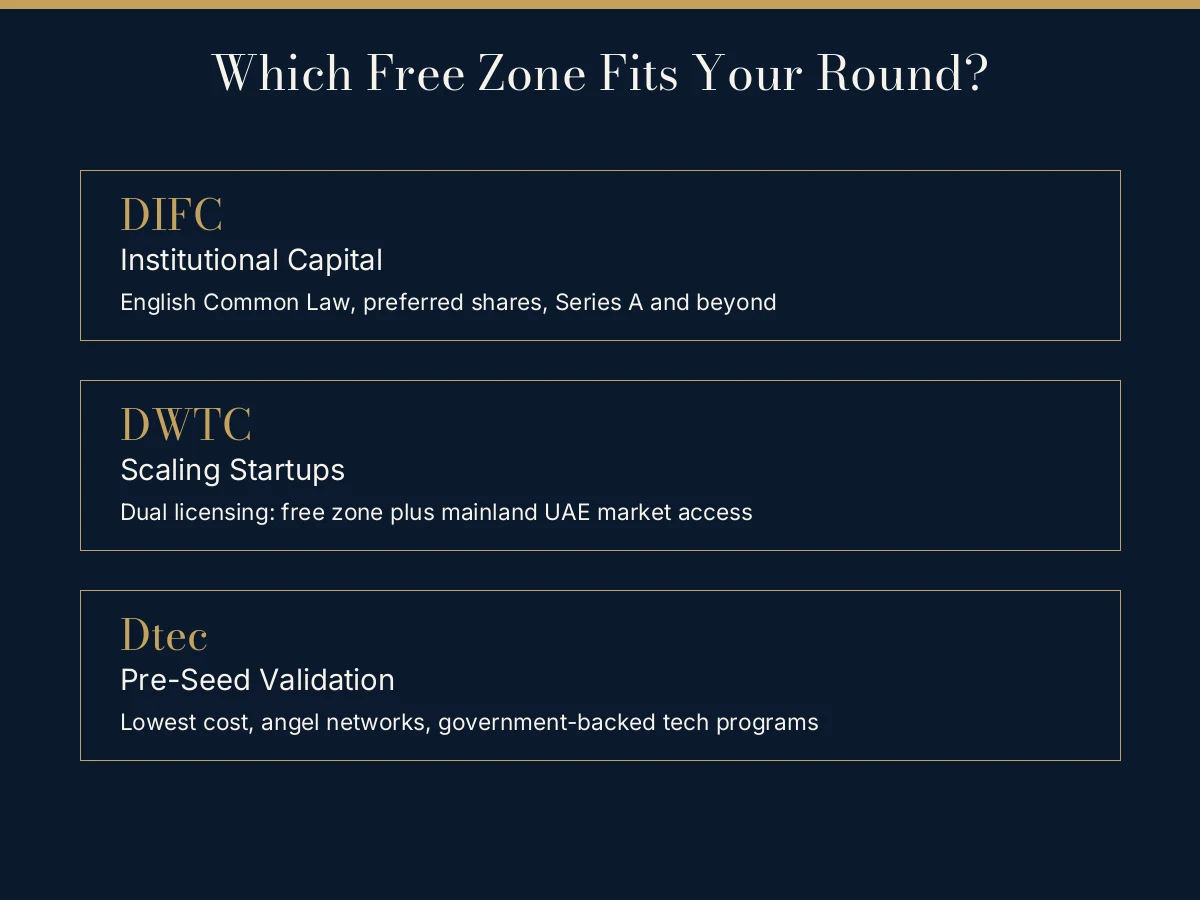
- DIFC is the strongest of the best Dubai free zones for tech startups targeting institutional VC, sovereign wealth funds, or a Series A round, because it runs under English Common Law with its own courts and supports preferred shares, vesting schedules, and convertible notes.
- DWTC suits scale-ups that need dual licensing: a free zone license alongside a mainland permit to trade directly in the local UAE market.
- Dtec is the lowest-cost option for pre-seed founders still validating a product, with direct access to government-backed tech programs and angel networks.
- Most standard UAE free zones run on local civil law and do not natively support the share structures institutional VCs require. That is the actual legal risk behind picking the wrong one.
- A hybrid DIFC HoldCo structure lets a startup take VC investment under English Common Law protection while keeping day-to-day operating costs in a cheaper free zone.
Why Your Free Zone Choice Matters to Venture Capitalists
When an institutional VC evaluates an early-stage startup, they are underwriting two things at once: the growth numbers and the legal risk of the deal itself.
Most standard free zones in the UAE operate under local civil law. Civil law, by default, does not include mechanisms venture investors treat as standard: vesting schedules, drag-along and tag-along rights, or separate share classes such as preferred stock sitting above common stock. If a VC cannot hold preferred shares with contractual protections, the deal usually does not happen. That is not a negotiating point, it is a structural block.
Put concretely: a civil-law free zone company typically issues one class of ordinary shares, split by ownership percentage, with no built-in mechanism for a four-year vesting schedule or a liquidation preference. A common-law structure can build all of that into the constitutional documents from day one. That difference sounds technical until a term sheet actually asks for it.
This is the actual mechanism behind “the wrong free zone can cost you funding.” It has nothing to do with which free zone sounds more prestigious. It comes down to which one lets a lawyer draft the share class the investor is asking for. It’s also why the best Dubai free zones for tech startups are not the same list as the cheapest ones, or the fastest ones to set up.
Related reading: mainland vs free zone: what actually matters in 2026, for the fundamentals before you get to fundraising structure specifically.
DIFC: The Choice for Institutional Capital
If the plan is to raise from institutional VCs, sovereign wealth funds, or international investors, the Dubai International Financial Centre is the jurisdiction built for that conversation.
DIFC operates as an independent financial jurisdiction under English Common Law, with its own commercial court system separate from onshore Dubai courts. That framework, set out under DIFC Law No. 5 of 2018 (the Companies Law), is what makes sophisticated shareholder agreements, convertible notes, and enforceable IP protection possible in the first place. It’s also a jurisdiction that keeps growing: DIFC passed 10,018 active registered companies in H1 2026, up 30% in twelve months, with AI, fintech and innovation firms among the fastest-growing segments.
DIFC also offers structuring options built specifically for holding and investment vehicles, including Prescribed Company status for special purpose vehicles and a Variable Capital Company regime for fund-style structures. Most operating tech startups won’t need either at the outset, but they’re part of why institutional investors treat DIFC as a jurisdiction built for their paperwork, not just tolerant of it.
Best fit: FinTech, enterprise SaaS, and any startup expecting to raise a Series A or later.
The tradeoff: setup costs and annual compliance run higher here than in a lifestyle free zone. DIFC also runs an Innovation Licence aimed specifically at early-stage tech founders, priced below its standard commercial licence, so it’s worth checking against your actual stage before ruling DIFC out on cost alone.
Related reading: what Blackstone’s move into DIFC signals about where institutional capital is heading.
DWTC: The Choice for Scaling Startups
Dubai World Trade Centre has become a common choice for regional tech startups because of one specific feature: dual licensing. A DWTC company can hold a free zone license and obtain a mainland permit at the same time, which means operating directly in the local UAE market without registering a second legal entity.
DWTC’s free zone sits inside one of Dubai’s most established commercial districts, which matters operationally as much as legally: investors and enterprise clients meeting in person, banking relationships built on a physical Dubai address, and a licensing authority that’s used to processing scale-up-stage companies rather than only first-time formations. For a startup that has already found product-market fit in the UAE and needs to sign local enterprise contracts, that operational maturity often matters as much as the legal structure itself.
Best fit: general tech platforms, marketplace apps, and startups that need a physical presence near Dubai’s core business districts rather than an offshore-style structure.
Dtec: The Choice for Pre-Seed Validation
Dtec, the free zone built around Dubai Silicon Oasis, is designed for founders who are still proving the product works, not yet structuring a cap table for institutional money.
The cost is lower, which matters more at this stage than legal sophistication, because the actual constraint at pre-seed is runway, not shareholder rights. Dtec is a dedicated technology free zone, so registering here also puts you inside its government-backed venture programs, sandbox environments, and angel networks, rather than outside looking in.
Because Dtec sits inside Dubai Silicon Oasis, founders based there are also physically close to a working tech ecosystem: coworking space built for early teams, a community of other pre-seed and seed-stage founders, and a free zone authority that has seen enough first-time tech formations to move quickly on standard paperwork.
Best fit: pre-seed founders, hardware and software teams, and AI startups still validating product-market fit.
The DIFC HoldCo Strategy
Some founders combine two of the options above instead of choosing one. A DIFC Holding Company owns 100% of an operating company (OpCo) registered somewhere cheaper, in a free zone like Dtec or even overseas.
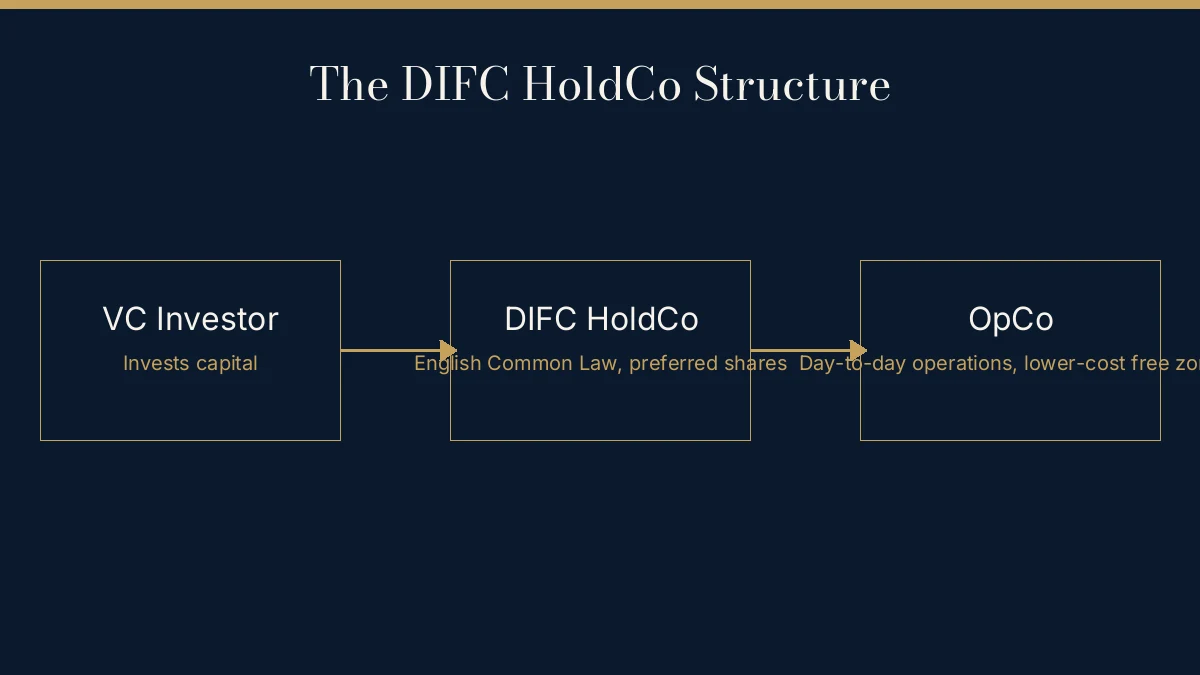
The VC invests directly into the DIFC HoldCo, under English Common Law protection, with preferred shares and a proper shareholder agreement. The OpCo keeps running day-to-day operations at whatever cost level makes sense for the business, without carrying DIFC’s higher compliance overhead on the operating side.
This is not the right structure for every startup. It adds a second entity, a second set of accounts, and a second point of compliance. It earns its complexity specifically when the round size, and the investor’s own legal requirements, call for it. That is a judgment call, not a default.
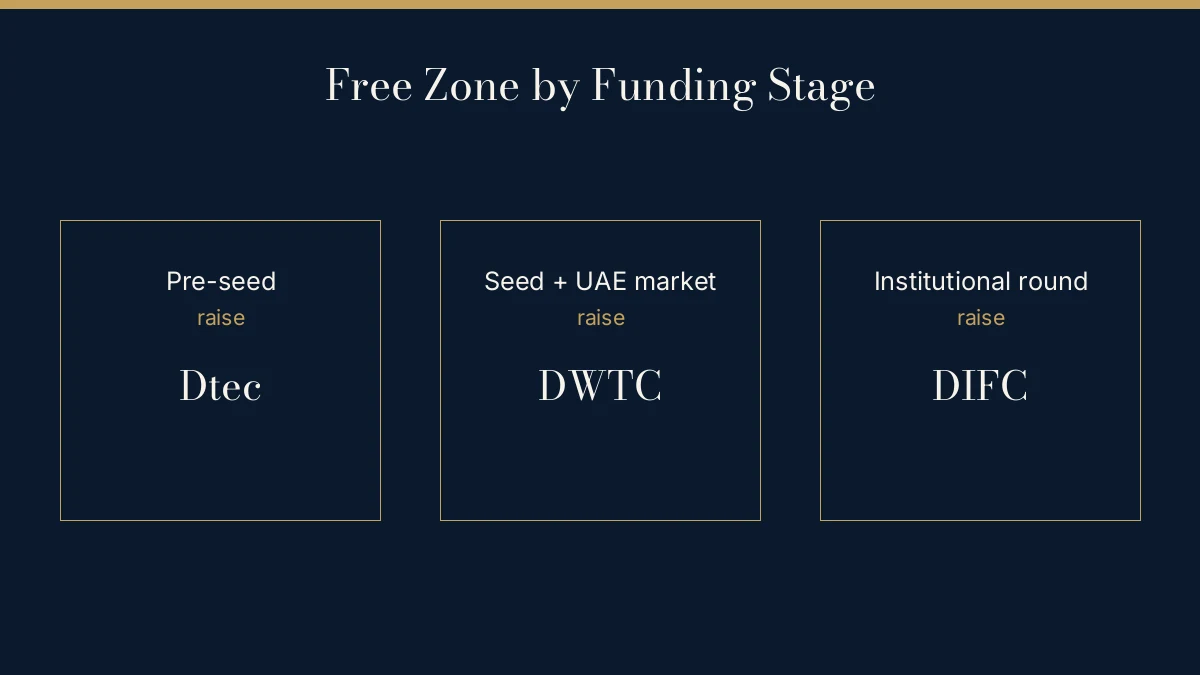
Best Dubai Free Zones for Tech Startups by Funding Stage
The honest answer depends on where you actually are, not where you expect to be in two years. Working through the best Dubai free zones for tech startups only helps if you’re matching the jurisdiction to your real, current stage, not your ambition.
| Your situation | Free zone to consider | Why |
|---|---|---|
| Pre-seed, self-funded, still validating the idea | Dtec | DIFC-level compliance costs before there’s a product to protect is money better spent on runway |
| Raising a priced seed round, mainland UAE market part of the plan | DWTC | Dual licensing solves an operational problem most tech founders don’t think about until they hit it |
| Closing, or about to close, an institutional VC round with a term sheet specifying preferred shares | DIFC, or a DIFC HoldCo above a cheaper OpCo | Makes the deal actually executable, not just agreed to in principle |
Common Mistakes Founders Make When Picking a Free Zone for VC Funding
Four patterns show up repeatedly among the best Dubai free zones for tech startups conversations I have with founders before they’ve raised anything.
- Registering in the cheapest free zone first and planning to restructure later. Restructuring after a term sheet exists is slower, more expensive, and happens under time pressure from the investor, not on the founder’s own schedule.
- Assuming any free zone with “tech” or “digital” in its name supports institutional share structures. Plenty of free zones market themselves to tech founders without operating under a legal system that recognizes preferred shares or vesting schedules the way a VC’s lawyers will expect.
- Treating the DIFC HoldCo structure as automatically necessary. It solves a specific problem, getting institutional capital into a common-law entity while keeping operating costs low, and it’s the wrong amount of complexity for a startup that hasn’t started fundraising conversations yet.
- Not asking the investor’s own lawyers what they need before choosing a jurisdiction. The fastest way to find out whether a structure will work is to ask the fund’s counsel directly, before formation, not after they’ve reviewed your cap table and come back with problems.
- Picking DIFC by default because it sounds the most prestigious. DIFC is the right jurisdiction when the deal terms actually call for it, not because it’s the best-known name among the best Dubai free zones for tech startups. A pre-seed company with no term sheet in hand is usually better served by Dtec’s lower cost structure, with DIFC or a HoldCo held in reserve for when an investor’s counsel actually asks for it.
Each of these is a formation-stage decision, not a fundraising-stage fix. That’s the whole argument for treating free zone selection as a business decision rather than a paperwork step, and it’s why this list of the best Dubai free zones for tech startups keeps coming back to the same question: what does your actual round require, not what looks most impressive on a company profile.
My Approach: Structuring for the Round You’re Actually Raising
Most business setup consultants help you register a company. I help you make informed business decisions before you invest.
Free zone selection for a VC-track startup is exactly the kind of decision that has to be made before formation, not fixed after. I don’t open with a license type. I open with the business: what you’re building, who you’re selling to, what round you’re actually trying to close, and what your investor’s own legal requirements will demand from the jurisdiction you register in. That’s what a pre-formation business intelligence session is built to answer, so the free zone recommendation that follows is driven by your actual funding trajectory, not by whichever license is fastest to process.
My advisory process focuses on helping you reduce uncertainty and make confident, data-based decisions, not just complete documentation. Here’s what that looks like in practice:
- A pre-formation business intelligence session before any free zone or license type is discussed: business model, target investor profile, funding stage, and cap table plans.
- A jurisdiction recommendation matched to the round you’re actually trying to close (DIFC, DWTC, Dtec, or a HoldCo structure), not the free zone that’s quickest to set up.
- Full disclosure of setup cost and ongoing annual compliance cost for every jurisdiction under consideration, in the same conversation, with nothing left for you to discover later.
- A straight answer on whether a DIFC HoldCo structure is worth its added complexity for your specific round size, or whether it isn’t yet.
- Documentation support, business plan, market research, competitor analysis, feasibility study, when your round needs more than a license to move forward.
The objective is simple: help you start your business with clarity, confidence and a long-term strategy. If you want to talk through your specific stage and round, you can review business setup services, look at what growth and market expansion involves once you’re past formation, or get in touch directly and we’ll go through your numbers.
Frequently Asked Questions
Can a Dtec-registered startup still raise institutional VC funding later?
Yes, but the shares held by that Dtec entity are governed by Dtec’s own legal framework, not English Common Law. Many founders who start at Dtec restructure into a DIFC entity, or a DIFC HoldCo above the existing Dtec OpCo, once a term sheet is actually on the table.
Does DIFC allow preferred shares and vesting schedules?
Yes. DIFC operates under English Common Law with its own commercial court system, which is what makes preferred share classes, vesting schedules, and drag-along and tag-along rights enforceable in the first place. This is the main reason institutional VCs prefer it among the Dubai free zones for tech startups raising a priced round.
What does dual licensing at DWTC actually mean?
It means one DWTC company can hold both a free zone license and a mainland permit, so the business can operate directly in the local UAE market without registering a second legal entity.
Is DIFC too expensive for a pre-seed startup?
DIFC’s standard commercial licence costs more than a free zone like Dtec, but DIFC also runs an Innovation Licence built specifically for early-stage tech founders at a lower entry point. Whether it makes sense depends on how close you are to an institutional raise, not just your current stage.
What is a DIFC HoldCo and do I need one?
A DIFC HoldCo is a holding company that owns your operating entity, which can sit in a cheaper jurisdiction. VCs invest into the HoldCo under English Common Law protection while your day-to-day costs stay in the cheaper entity. It earns the added complexity once the round size and the investor’s own requirements call for it, not before.
Related reading: mainland vs free zone vs offshore: which UAE structure is right for your business.
Sources & References
- DIFC – Establish a Business
- DIFC – Innovation Licence
- DIFC Companies Law, DIFC Law No. 5 of 2018
- Dubai World Trade Centre – Free Zone
- Dtec – Dubai Technology Entrepreneur Campus
Choosing among the best Dubai free zones for tech startups chasing venture capital funding is a decision worth making deliberately rather than defaulting to the first name you hear. The right free zone for a startup raising capital looks different from the right free zone for a services business.