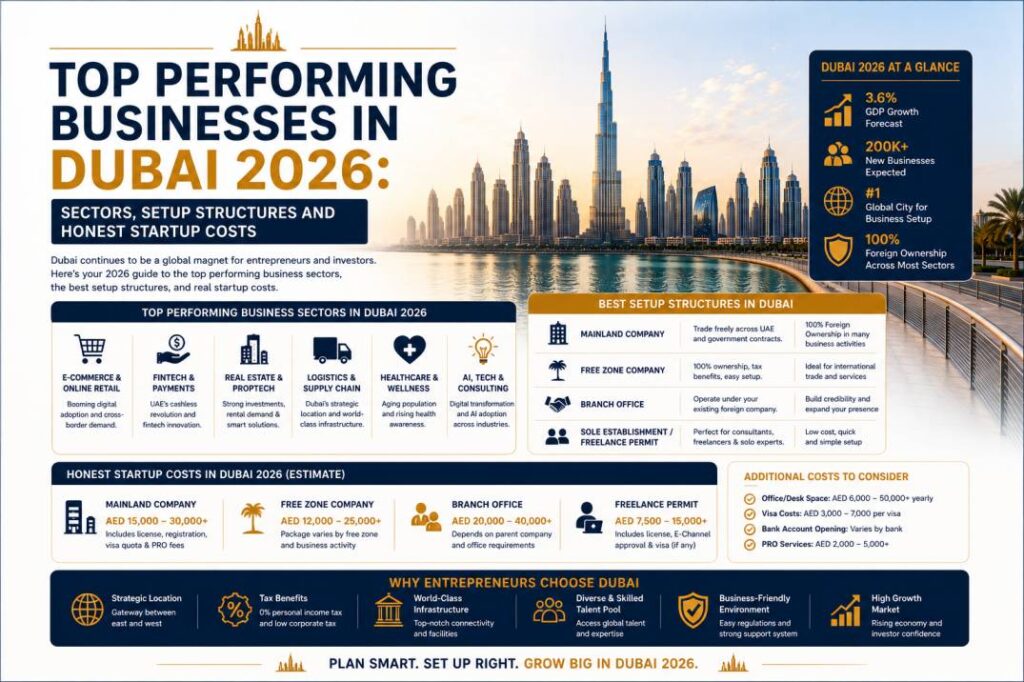
The top businesses in Dubai 2026 are not the obvious ones. This guide breaks down which sectors are performing, what structures they use, and what honest startup costs look like.
Quick Answer
- Five sectors are genuinely performing in Dubai in 2026: real estate and PropTech, e-commerce and last-mile logistics, AI, fintech and B2B tech services, cloud kitchens and delivery-first F&B, and corporate tax, compliance and financial advisory.
- The right business structure decision sits behind performance in every one of these sectors, not just formation cost.
- Startup costs vary significantly by sector and structure, and headline licence prices rarely reflect the full realistic launch cost.
- Sector performance does not guarantee any individual business succeeds in it; the structure and execution decisions still matter more than the sector choice alone.
In this guide
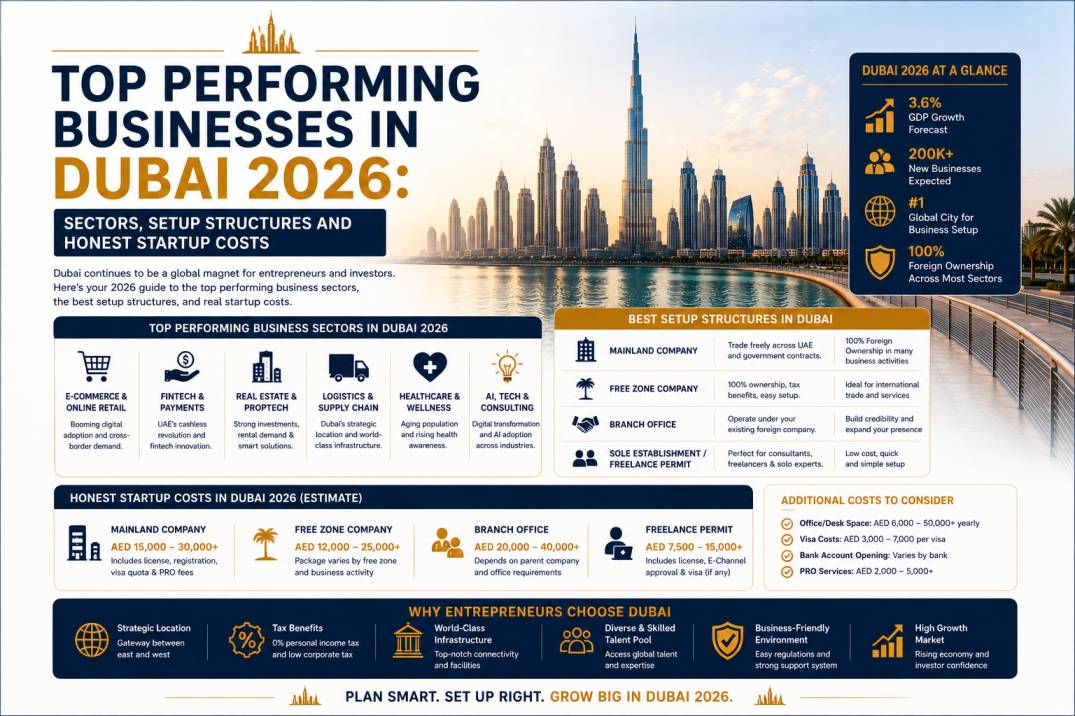 Dubai is not a market you stumble into and figure out as you go. The businesses that do well here – the ones that hit profitability in year one rather than year three – tend to share one quality: they chose the right sector and the right structure before they spent a single dirham on setup.
This guide covers both. Five sectors are performing strongly in Dubai in 2026, backed by verified market data. For each one, I have included the setup structure that actually makes sense, the honest startup cost range, and the real operational considerations that most business opportunity articles leave out. If you are evaluating where to invest your time and capital, start here before you start comparing licence packages.
1. Real Estate Services and PropTech
Real estate remains one of the clearest entries among the top businesses in Dubai 2026. Dubai’s property market recorded 79,281 residential sales transactions worth AED 221.4 billion in H1 2026, according to Engel & Völkers. Q1 alone saw AED 176.7 billion in total sales value – a 23.4% jump year-on-year, with January 2026 recording the highest single month in Dubai real estate history at AED 72.4 billion. Average price per square foot rose 12.5% year-on-year to AED 1,759.
Rental yields remain among the strongest in global prime markets: apartments average 6.93% gross in H1 2026, with mid-market communities like Jumeirah Village Circle reaching 8.5%. These returns compare with 3–4% in London and 2–3% in Singapore.
The activity creating genuine business opportunity is not property speculation – it is the services layer around it. Real estate brokerage agencies working with international investors on off-plan developments are generating record transaction volumes. Short-term holiday home management in high-demand communities (Dubai Marina, Downtown, Palm Jumeirah) is producing strong yields for professional operators who can manage occupancy, pricing, and guest experience at scale. PropTech businesses helping buyers, sellers, and investors navigate the market with better data and faster processes are attracting institutional attention.
Structure: A real estate brokerage requires a mainland DED licence issued by RERA (Real Estate Regulatory Agency). Holiday home management requires DTCM (Department of Tourism and Commerce Marketing) registration and a mainland commercial activity. You cannot run a licensed brokerage or holiday home management company from a free zone without a mainland presence. Budget AED 30,000–60,000 for first-year setup including RERA certification, DED licence, and initial operational costs.
The real constraint: the property pipeline. The market is active, but 72% of units scheduled for completion are currently overdue. Off-plan inventory is plentiful; ready-to-manage stock is selective. Your ability to source quality properties matters more than your marketing.
2. E-Commerce and Last-Mile Logistics
E-commerce is a second consistent entry on any honest list of the top businesses in Dubai 2026. The UAE e-commerce market reached USD 12.3 billion in 2026 and is projected to grow at 11.29% CAGR to USD 21 billion by 2031, according to Mordor Intelligence. Electronics lead by revenue (34% share), fashion and apparel lead by transaction volume (21.59% of retail e-commerce), and food and beverage is the fastest-growing vertical at 13.16% CAGR. Digital wallets now account for over 53% of all e-commerce transactions. The UAE Pass, with 11 million users processing 2.6 billion transactions, has significantly reduced checkout friction and increased first-time conversion.
The logistics layer is equally active. Last-mile delivery demand is growing alongside order volumes, and smart fulfilment – warehousing closer to the customer, faster dispatch, technology-driven route optimisation – is where operators are differentiating.
Structure: This is the sector where the setup decision carries the most hidden tax risk, and it is worth spending time on before you commit. Free zone company formation is commonly recommended for e-commerce because of the lower setup cost. But free zone distribution qualifies for 0% corporate tax only when carried out from a Designated Zone and the buyer is a reseller or processor – not an end consumer. If you are selling directly to UAE consumers, that revenue is non-qualifying income taxed at 9% with no AED 375,000 exemption band. For most e-commerce businesses targeting UAE retail customers, a mainland structure gives you simpler tax treatment and direct market access without a distributor. The full breakdown is in our guide to the UAE e-commerce market and business setup.
The real constraint: last-mile delivery costs run AED 35–50 per parcel. On a typical AED 150 order at 30% margin, that is the entire gross profit before you account for platform fees, packaging, and returns. Your unit economics need to work before you scale, not after.
3. AI Integration, Fintech, and B2B Technology Services
The UAE fintech market reached USD 52 billion in 2026 and is growing at 11.58% CAGR, with Dubai accounting for 59.68% of market activity. DIFC crossed 10,000 active registered companies for the first time in H1 2026 – a 30% increase in 12 months. AI and fintech firms in DIFC grew 39% year-on-year. The centre aims to become the world’s first AI-native financial centre, with projected economic value of AED 12.9 billion and 25,000 jobs from that initiative alone.
The demand is real and measurable. Companies across financial services, healthcare, real estate, logistics, and retail are actively seeking partners who can help them automate workflows, integrate AI into existing systems, and build or deploy licensed digital financial products. B2B technology consulting is not a crowded market at the quality end – Dubai hosts over 300 consulting firms, but niche operators with genuine AI and regulatory expertise are in short supply.
Structure: For AI consultants and B2B technology service firms whose clients are primarily international or regional (outside UAE mainland), a free zone company in DMCC, DIFC, or DTEC (Dubai Technology Entrepreneur Campus) is the standard route. DIFC is appropriate if your clients are primarily financial institutions. For firms serving UAE mainland corporates directly, a mainland licence gives you simpler market access without managing the QFZP de minimis threshold. Expect first-year setup costs of AED 20,000–50,000 depending on zone and visa requirements.
The real constraint: regulated fintech (digital payments, neo-banking, blockchain-based financial services) requires a licence from the Central Bank, DFSA (DIFC), FSRA (ADGM), or VARA depending on the activity. Licences in these categories take 3–12 months and require minimum capital, compliance infrastructure, and in some cases a physical UAE presence. Budget the time and regulatory cost before you budget the product build.
4. Cloud Kitchens and Delivery-First F&B
The UAE online food delivery market is projected to surpass USD 2.8 billion in 2026, with 5.5 million active delivery service users. Food delivery accounted for 87% of all online purchases in Dubai during peak winter season, according to the Dubai Gastronomy Industry Report. Dubai’s expatriate population – approximately 90% of the total – creates persistent, diverse demand across hundreds of cuisines. The city’s delivery infrastructure (Talabat, Deliveroo, Careem, UberEats) is mature, well-funded, and increasingly integrated with platform-level analytics that operators can use to optimise menus in near-real time.
Cloud kitchens – delivery-only commercial kitchen spaces with no front-of-house cost – allow operators to test and scale food concepts significantly faster and at lower capital risk than traditional restaurant openings. Over 400 cloud kitchens now operate across approximately 80 locations in the UAE, the majority in Dubai. The model’s core advantage is the ability to run multiple virtual brands from a single kitchen, spreading fixed costs across more revenue streams.
Structure: Cloud kitchens require a mainland DED licence for food and beverage trading, plus Dubai Municipality food safety approval and HACCP compliance. This is not a free zone activity – the food safety approvals and the requirement to operate a physical kitchen that meets municipality standards tie you to a mainland structure. Shared commercial kitchen hubs (where you rent kitchen space rather than lease your own) reduce the capital entry point significantly. Budget AED 50,000–150,000 for first-year setup depending on whether you lease your own space or operate from a shared hub. Our startup and pre-launch consulting service covers feasibility analysis for this model including kitchen sourcing, brand development, and platform launch strategy.
The real constraint: platform dependency. Talabat and Deliveroo charge commission rates of 25–35% of order value. On a delivery-only business with no dine-in revenue to cross-subsidise, that commission is a structural cost that must be built into pricing from the start. Operators who scale profitably either build enough volume to negotiate better terms, develop direct-order channels, or run multiple brands to spread kitchen overhead across higher aggregate revenue.
5. Corporate Tax, Compliance, and Financial Advisory
Among the top businesses in Dubai 2026, this sector is the least glamorous and the most necessary. The UAE introduced a 9% federal corporate tax under Federal Decree-Law No. 47 of 2022, effective for financial years starting on or after 1 June 2023. The first full-year tax returns for calendar-year businesses were due by 30 September 2025. As of 2026, every UAE-registered business – mainland and free zone – is navigating either standard corporate tax filing, Small Business Relief elections, or Qualifying Free Zone Person (QFZP) compliance. Most are doing at least one of these for the first time.
The demand for qualified tax and compliance advisory is not a trend – it is structural. The UAE’s corporate tax framework is new, complex, and actively evolving. FTA Decision No. 6 of 2026 introduced new audit requirements for free zone companies claiming distribution activity. Ministerial Decision No. 84 of 2025 changed audited accounts requirements for QFZP electors. Transfer pricing documentation requirements apply to related-party transactions above specific thresholds. Businesses across every sector need guidance, and many are discovering that their accountant, PRO service provider, or free zone setup agent does not have the specialist corporate tax knowledge to help them.
Structure: A tax and compliance advisory practice serving UAE mainland clients requires a mainland licence under a professional services category (management consultancy, financial consultancy, or accounting – the last requiring relevant professional certification). Serving international clients from a UAE base can be done from a free zone. Setup costs are among the lowest of the five sectors covered here: AED 15,000–30,000 for a mainland licence with a shared office arrangement. For corporate tax registration and compliance support for your own business, the same principle applies – get the right specialist early, before the filing deadline, not after.
The real constraint: credibility and accreditation. The UAE does not require a specific corporate tax licence to provide advice, but clients are increasingly asking for demonstrated expertise – ACCA, CPA, CA qualification, or demonstrated FTA engagement history. The market is large enough that entry is possible, but differentiation requires genuine technical depth, not just a UAE business setup.
The Structure Decision Sits Behind Every Sector
Look across the five sectors that make up the top businesses in Dubai 2026 and a pattern emerges. Real estate brokerage: mainland. Cloud kitchens: mainland. Tax and compliance serving local clients: mainland. E-commerce selling to UAE consumers: mainland. International consulting, B2B tech, cross-border trade: free zone. The source of your revenue – who your customers are and where they are – drives the structure, not the other way around.
This is the comparison that matters in 2026, and it has changed meaningfully since the UAE corporate tax introduction and the 2021 ownership reforms. The classic free zone advantages – 100% foreign ownership, faster setup – no longer differentiate as sharply as they did. What differentiates now is the tax treatment of your specific revenue mix, your banking profile, your visa headcount plan, and your client geography.
For a full breakdown of how mainland and free zone structures compare across ownership, market access, tax, visas, and banking, see the complete guide: Difference Between Mainland and Free Zone Company in the UAE. And for the three-way comparison that includes offshore structures, see: Mainland vs Free Zone vs Offshore UAE: The Complete 2026 Guide.
My Approach: Strategy Before Paperwork
Most business setup consultants help you register a company. My work on the top businesses in Dubai 2026 starts before that, before the licence, not after.
When someone comes to me evaluating a sector or a business idea, the first conversation is not about which licence to buy. It is about whether the business model actually works in this market, at what capital level, with what realistic path to profitability. That means market research, competitor analysis, a realistic startup cost estimate, financial feasibility modelling, and a structure recommendation that fits the revenue mix – not the promotional offer of the week.
Over 200 company formations across mainland, free zone, and offshore structures have taught me that the businesses which struggle are rarely the ones that picked the wrong sector. They are the ones that picked the right sector and the wrong structure, or launched without modelling the unit economics first. Both are fixable before you start. Neither is easy to fix after.
Every piece of content I publish follows the same process: regulatory research cross-referenced against current UAE legislation and FTA decisions, reviewed against real client scenarios, written for people who want to make informed decisions before they invest – not after.
If you are evaluating one of these sectors, or a different opportunity in the UAE, and want to work through the business model, structure, and setup cost before committing – book a strategy consultation. You will leave with a clear picture of whether the opportunity fits your goals, what it will cost to execute properly, and which structure gives you the best operating and tax position from day one.
Have a question about which sector suits your background and capital, or whether your chosen business model fits a mainland or free zone structure? Drop it in the comments or reach out directly.
Related reading: Dubai’s 161,000 new residents in 2026 and what it means for founders.
One thread runs through all five sectors: none of them reward a licence bought in isolation from a plan. The businesses that struggle in Dubai’s fastest-growing sectors are usually not undercapitalised, they are unstructured, having chosen a jurisdiction or activity code before working out who the customer actually is and how they will be billed. Get that sequence right and the sector-specific numbers above become a genuine tailwind rather than a marketing headline.
One thread runs through all five sectors: none of them reward a licence bought without a plan behind it, and every founder who has struggled in one of these sectors traces the problem back to that missing first step.