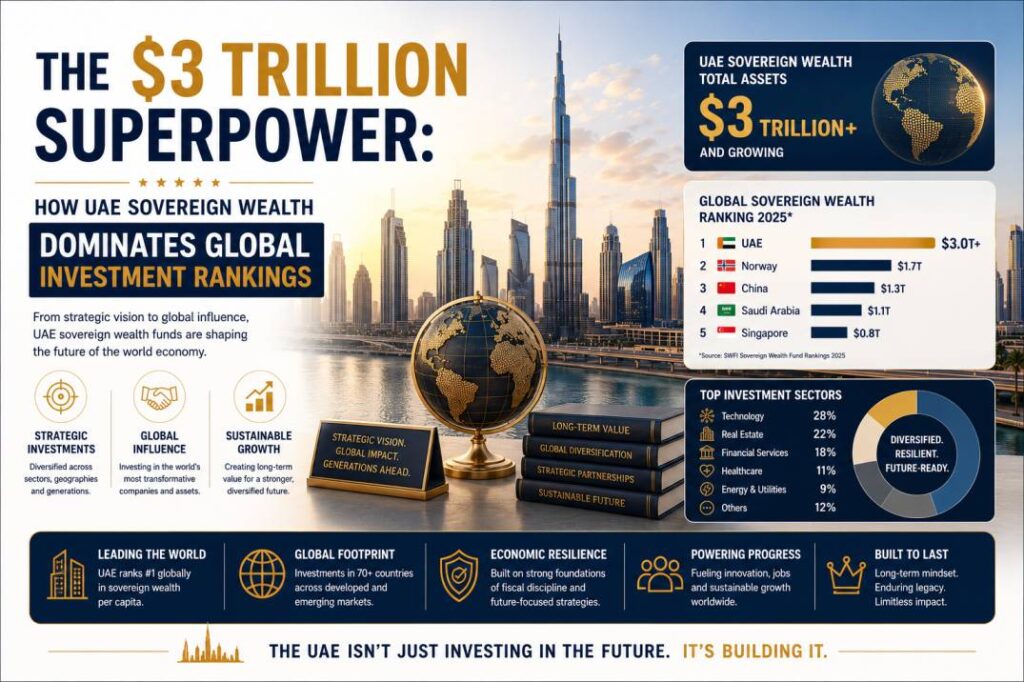
UAE sovereign wealth funds now rank the country as the world fourth-largest state investor, with roughly USD 2.93 trillion under state control – and for founders this is not just a geopolitical fact, it is a market signal. Understanding UAE sovereign wealth is quickly becoming a prerequisite for reading where regional capital moves next.
In this guide
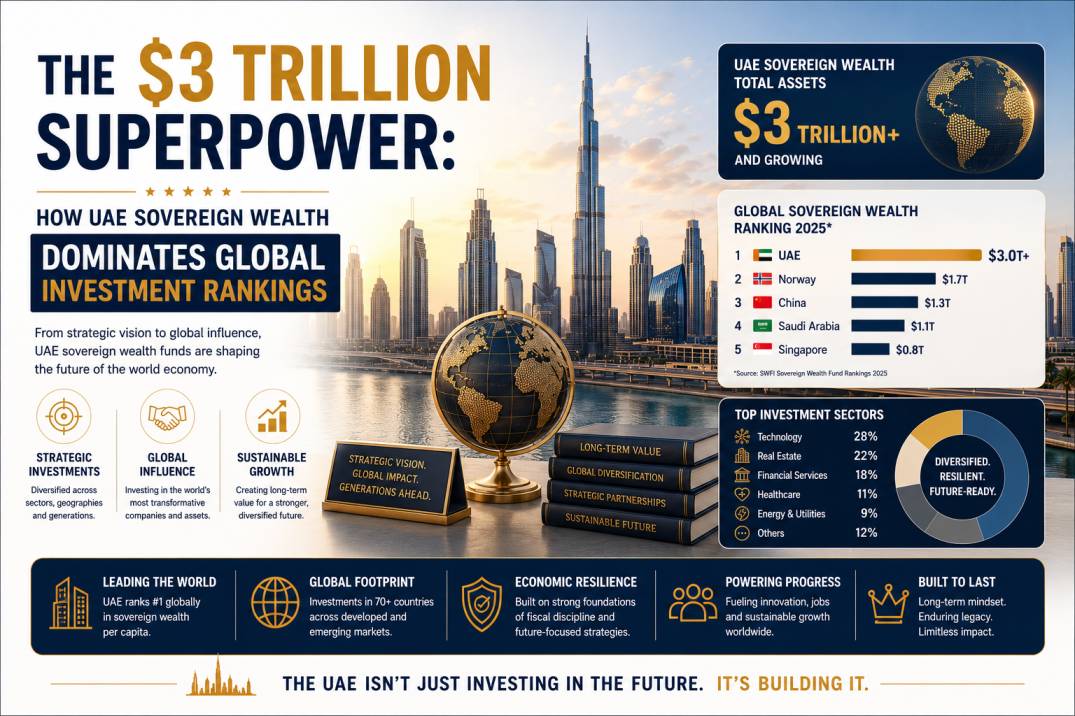 The UAE now ranks as the world’s fourth-largest state investor, with roughly USD 2.93 trillion under state control. The figure is genuinely extraordinary – and it is also the most misquoted number in Gulf finance, because “sovereign wealth” means at least three different things depending on who is counting.
Quick Answer
- The UAE’s total state-owned investment assets reached approximately AED 10.75 trillion (USD 2.93 trillion), making it the world’s fourth-largest state investor on Global SWF’s ranking.
- That headline number counts sovereign wealth funds, public pension funds and central bank reserves together. The UAE’s seven largest state-owned institutions alone control close to USD 2.5 trillion.
- Narrow it further to the top three sovereign wealth funds – ADIA, ICD and Mubadala – and the figure is USD 1.974 trillion, forecast to reach USD 2.767 trillion by 2030.
- ADIA alone holds around USD 1.18 trillion, the fourth-largest single sovereign fund on earth. Abu Dhabi is the world’s richest city by sovereign capital managed.
- The commercial point: almost nobody reading this will receive sovereign investment. The opportunity is in the ecosystem that USD 3 trillion of patient capital builds around itself – portfolio company supply chains, co-investment, and the sectors this money is deliberately creating.
1. What the USD 3 trillion actually counts
Start with precision, because this number is quoted three different ways and the differences run into hundreds of billions.
Global SWF’s data puts UAE state-owned institutions at roughly AED 10.75 trillion – about USD 2.93 trillion – placing the country fourth globally among state investors. That total includes sovereign wealth funds, public pension funds and central bank reserves.
Narrow the definition and the number moves:
| Measure | Figure |
|---|---|
| Total UAE state-owned investor assets | ~USD 2.93 trillion |
| Seven largest state-owned institutions | ~USD 2.5 trillion |
| Top three SWFs (ADIA, ICD, Mubadala), 2025 | USD 1.974 trillion |
| Same three, forecast for 2030 | USD 2.767 trillion |
| Abu Dhabi’s sovereign funds alone | ~USD 1.808 trillion |
All of these are accurate. They measure different things.
Why this matters commercially: if you cite “USD 3 trillion in UAE sovereign wealth funds” in a pitch and the person across the table knows the SWF-only figure is closer to USD 2 trillion, you have handed them a reason to doubt everything else you said. Say “state investor assets” when you mean the larger number, and “sovereign wealth funds” when you mean the smaller one.
There is a second caution. Most of these funds do not publish full audited asset figures. ADIA in particular publishes strategic allocation ranges rather than a balance sheet. Estimates for ADIA circulate between roughly USD 870 billion and USD 1.18 trillion depending on the source and method. Global SWF’s USD 1.18 trillion is the most widely cited. It remains an estimate.
2. The funds, and what each one actually does
The UAE does not operate one sovereign fund. It operates a portfolio of them, with genuinely different mandates – which matters if you are trying to work out which door to knock on.
| Institution | Assets | Character |
|---|---|---|
| ADIA (Abu Dhabi Investment Authority) | ~USD 1.18 trillion | Passive, diversified, global. 60+ countries |
| ICD (Investment Corporation of Dubai) | ~USD 429 billion | Dubai’s holding vehicle – Emirates, ENBD, DP World |
| Mubadala | ~USD 358 billion | Active and strategic – technology, aerospace, semiconductors, healthcare |
| ADQ | ~USD 251 billion | Regional infrastructure, food security, utilities. Fastest-growing |
| EIA (Emirates Investment Authority) | ~USD 116 billion | The only federal-level fund |
| Dubai Investment Fund | ~USD 80 billion | – |
| Dubai Holding | ~USD 72 billion | Dubai real estate, hospitality, telecoms |
Three distinctions worth internalising.
ADIA is a financial investor, not a strategic one. Founded in 1976, it allocates globally across developed and emerging equities, fixed income, private equity, real estate, infrastructure and hedge funds. It is institutional client number one or two in most major fundraising cycles worldwide. It is not looking for operating partners in Dubai.
Mubadala is the one building things. Aerospace, semiconductors, renewables, healthcare, technology – capital-intensive sectors where it takes strategic positions and builds operating companies. If sovereign capital is going to reshape a sector you work in, Mubadala is usually why.
ADQ stays close to home. More than a third of its roughly 280 deals over five years involved UAE-based companies, and its assets have more than doubled in four years. For a domestic business, ADQ’s portfolio is the most relevant of the three – because its portfolio companies are your potential customers.
3. Where the UAE actually ranks
Here is where I would push back gently on how this story is usually told.
The UAE is the fourth-largest state investor globally. That is a remarkable position for a country of roughly 11 million people. It is not first.
For context, global sovereign wealth funds collectively passed USD 15 trillion for the first time in December 2025. Together with public pension funds and central banks, state investors now manage around USD 60 trillion.
Where the UAE genuinely leads is concentration. Abu Dhabi is the world’s richest city by sovereign capital managed – ahead of Oslo, Beijing, Singapore, Riyadh and Hong Kong. With roughly 1.5 million citizens and around USD 1.7–1.8 trillion in sovereign fund assets, Abu Dhabi holds more managed capital per citizen than any comparable entity on earth.
That per-capita concentration is the real story, and it is more defensible than a claim to global dominance.
4. Why this matters if you are not a fund manager
This is the section most coverage of sovereign wealth never gets to.
You will not receive a cheque from ADIA. Neither will almost anyone reading this. Sovereign funds of that scale write cheques in the hundreds of millions and above, and their gatekeeping is severe.
The opportunity is in the ecosystem that patient capital at this scale creates around itself.
Portfolio company supply chains. ADQ, Mubadala and ICD own or control hundreds of operating businesses – utilities, airlines, ports, healthcare groups, food companies, banks, telecoms. Every one of them procures. Becoming a supplier to a sovereign-owned operating company is a realistic commercial goal in a way that receiving sovereign investment is not.
The sectors this money is deliberately building. Sovereign capital does not follow markets here; it creates them. Semiconductors and AI infrastructure, renewables and hydrogen, advanced manufacturing, healthcare and life sciences, food security and agritech, logistics. If your capability sits in one of those, you are entering a sector with a state-backed anchor investor already committed.
Co-investment and fund structures. At the smaller end, family offices and private funds routinely co-invest alongside sovereign vehicles. The DIFC’s rapid growth in fund managers and family entities exists partly because sovereign capital concentrates deal flow.
Professional services around the capital. Legal, audit, fund administration, compliance, technical due diligence, ESG assurance, recruitment. Capital at this density creates sustained professional services demand.
And the second-order economy. Every fund, portfolio company and adviser employs people who need housing, schooling, healthcare and services. That connects directly to the demand picture I set out in the 2026 UAE real estate analysis.
If you are working out which of these your capability actually fits, that is a market-entry question before it is a licensing question – the ground covered in Growth & Market Expansion Services and, for earlier-stage ventures, Startup / Pre-Launch Consulting.
5. Where the capital is actually going
Two flows are worth understanding because they tell you what the next decade looks like.
Outward, into the United States. The UAE has committed to roughly USD 1.4 trillion of US investment over ten years – one of the largest projected foreign capital flows into the American economy this decade. ADIA holds substantial US real estate, infrastructure and private equity.
Inward, into domestic transformation. ADQ’s concentration in UAE-based deals, Mubadala’s semiconductor and AI positions, and the capital behind the AI infrastructure build-out I covered in the US–UAE AI chip deal analysis all point the same direction: sovereign capital is being used to construct the post-oil economy rather than simply to store oil wealth abroad.
Notably, the funds maintained investment pace through the regional conflict that began in February 2026 – consistent with the institutional confidence visible in DIFC’s registration figures over the same period.
6. The constraints worth pricing in
I would be doing you a disservice if I presented USD 3 trillion as an opportunity you can simply walk into.
Access is genuinely difficult. These are sophisticated institutions with established counterparties. There is no application form. Relationships are built over years, usually through existing networks or by being an established supplier elsewhere first.
The figures are estimates. Most of these funds do not publish audited totals. Building a business case on a specific AUM number is unwise; the direction and scale are what matter.
Sovereign-linked procurement is competitive and slow. Portfolio companies of state-owned funds run rigorous procurement with long cycles. That is a working capital question as much as a sales one.
Concentration cuts both ways. An economy anchored by a handful of large state investors is stable in most conditions, but it also means their strategic priorities shape which sectors get capital and which do not. Being outside the priority list is a real disadvantage.
And proximity is not a strategy. Registering a company in Abu Dhabi does not connect you to ADIA. What connects you to this ecosystem is a capability someone in it actually needs.
7. Structuring an entry
If the ecosystem is what draws you, the structure question follows – and it is decided by who your customers are.
Selling to UAE government entities or state-owned operating companies? A mainland licence is generally the stronger position, and often a practical requirement for public-sector contracting.
Financial services, fund management or advisory? DIFC or ADGM, under independent common-law frameworks with their own regulators and courts. Premium cost, and the right home if your clients are the funds themselves.
International services or trading from a UAE base? A free zone company is typically more efficient – noting that free zone status delivers 0% corporate tax on qualifying income only, with 9% applying above AED 375,000 otherwise. See Tax Registration & Filing and Financial Reporting & Auditing.
An established overseas firm extending in? Foreign company setup via branch or subsidiary, sometimes with an offshore holding structure above it.
I have compared these routes in detail in Mainland vs Free Zone vs Offshore. For lower-cost trading alternatives, see Fujairah free zones, and for logistics-led entry, the Dubai South corridor.
Around the licence sit the operational realities: corporate banking, where investment-adjacent businesses face extended compliance review; and residency visas with PRO support for the team you will need.
8. My Approach: Finding Your Place in the Capital
Most business setup consultants help you register a company. I help you make informed business decisions before you invest.
Numbers at this scale can make the UAE feel automatically attractive for almost any business, but sovereign wealth flowing into a sector does not mean every entry point into that sector works for a smaller company. Before recommending a structure, I look at where your business specifically sits relative to where that capital is actually landing, and whether there is room for you in it.
My advisory process focuses on helping you reduce uncertainty and make confident decisions, not just complete documentation.
What You Can Expect
- Business idea validation
- Market research
- Competitor analysis
- Business plan development
- Startup cost estimation
- Financial feasibility analysis
- Business structure recommendations
- Licence selection guidance
- Investor and employment visa planning
- Business bank account strategy
- Risk assessment
- Business expansion planning
The objective is simple: help you start your business with clarity, confidence and a long-term strategy.
9. Is the UAE the right choice for your business?
If you are planning to launch a new venture, expand internationally, or relocate your business to the UAE, do not base the decision solely on promotional offers or the lowest licence price – and do not assume that proximity to sovereign capital is the same as access to it.
Build your business on research, planning and informed decision-making. The right strategy today can save you thousands in cost and position your business for sustainable growth tomorrow.
What USD 3 trillion of state capital actually means for a normal business is this: the UAE is not waiting for market forces to build its next economy. It is funding that economy directly, deliberately, and over decades. Semiconductors, AI infrastructure, renewables, healthcare, food security, logistics – these sectors have an anchor investor with a thirty-year horizon.
That is a rare thing to build alongside. The businesses that benefit will be the ones that identified precisely where their capability meets that programme.
Ready to build your business with confidence?
If you are considering setting up a business in the UAE, let’s start with strategy – not paperwork. Together we will evaluate your goals, analyse the market, identify the right setup options, and create a roadmap tailored to your vision.
Because successful businesses aren’t built by chance – they’re built on informed decisions.
Book a free consultation or message me directly on WhatsApp.
Frequently asked questions
How much sovereign wealth does the UAE have?
Approximately USD 2.93 trillion in total state-owned investor assets, making the UAE the world’s fourth-largest state investor. That figure includes sovereign wealth funds, public pension funds and central bank reserves. The top three sovereign wealth funds alone held USD 1.974 trillion in 2025, forecast to reach USD 2.767 trillion by 2030.
Which is the largest UAE sovereign wealth fund?
The Abu Dhabi Investment Authority, at approximately USD 1.18 trillion – the fourth-largest single sovereign wealth fund globally. Estimates vary between sources because ADIA does not publish a full audited asset figure.
Does the UAE have the world’s largest sovereign wealth fund?
No. Norway’s Government Pension Fund Global is larger as a single fund, and the UAE ranks fourth among state investors overall. Where the UAE leads is concentration – Abu Dhabi is the world’s richest city by sovereign capital managed, and holds more managed capital per citizen than any comparable entity.
Can a small business receive sovereign wealth fund investment?
Realistically, no. These funds deploy at scale with established counterparties and no application process. The practical opportunity lies in supplying their portfolio operating companies, or in operating within the sectors sovereign capital is deliberately building.
What sectors is UAE sovereign capital targeting?
Publicly visible priorities include semiconductors and AI infrastructure, renewables and hydrogen, advanced manufacturing, healthcare and life sciences, food security and agritech, and logistics. Mubadala focuses on strategic technology and capital-intensive sectors, while ADQ concentrates on regional infrastructure, utilities and food security.
Sources
- Khaleej Times – UAE becomes world’s 4th largest state investor
- Khaleej Times – top three SWF assets to 2030 (Global SWF data)
- Aletihad – Abu Dhabi sovereign funds manage over USD 1.8 trillion
- Global SWF – Abu Dhabi Inc. report
- Bloomberg – analysis of ADIA, Mubadala and ADQ deal activity
This article is general commentary, not legal, tax or investment advice. Sovereign fund asset figures are estimates – most of these institutions do not publish full audited balance sheets. Verify current figures and requirements before relying on them.
Related reading: how tokenisation is reshaping UAE digital assets in 2026.
Related reading: the UAE defence industry’s AED-scale economic footprint.
Related reading: why Blackstone returned to DIFC and what it signals.
Related reading: UAE GDP Q1 2026 growth and the 17.3% finance-sector spike.
UAE sovereign wealth continuing to grow is a signal worth paying attention to if you are deciding where to base a business that wants proximity to serious capital. The scale of UAE sovereign wealth is not going unnoticed by global investors, and it should not go unnoticed by founders either.