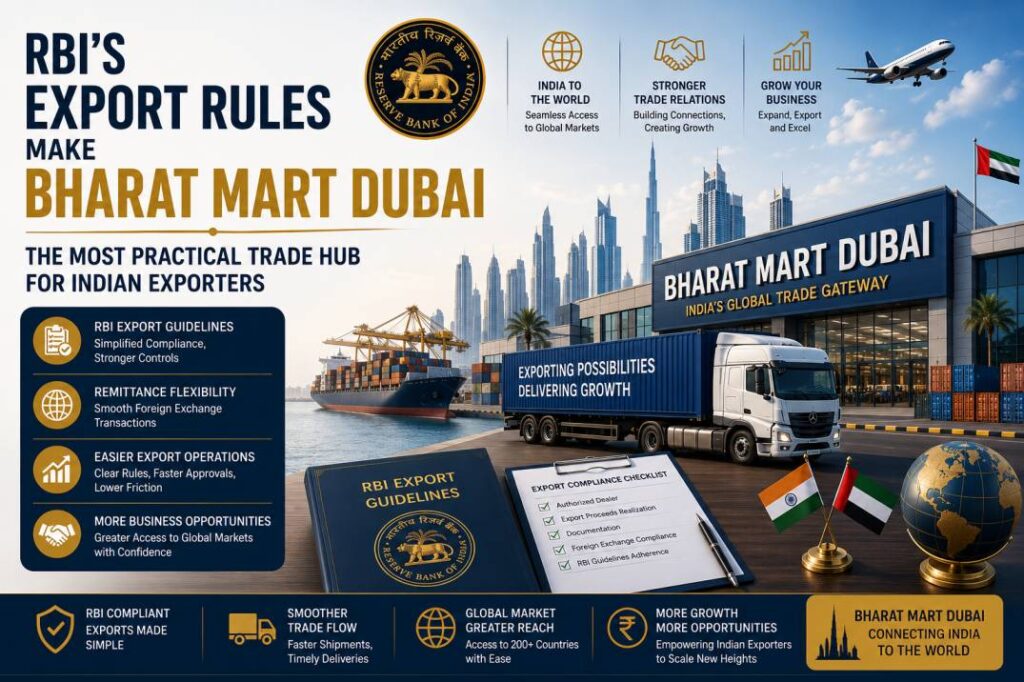
Bharat Mart Dubai is a government-backed trade hub concept that, combined with the RBI rule change in April 2025, has created the most credible window Indian exporters have had in a decade. Understanding Bharat Mart Dubai properly is what separates a working export plan from an expensive guess.
In this guide
In April 2025 the Reserve Bank of India issued a short circular that removed the single biggest obstacle facing small Indian exporters wanting to hold stock abroad. Bharat Mart, DP World’s 2.7 million sq ft trade platform in Jebel Ali, is the only address it applies to. Understanding exactly what the concession does – and what it does not do – is the difference between a working export model and an expensive assumption for anyone structuring a Bharat Mart Dubai entry this year.
Quick Answer
- RBI circular RBI/2025-26/30, dated 23 April 2025, allows AD Category-I banks to let Indian exporters realise and repatriate the full export value of goods sent to Bharat Mart within nine months from the date of sale from the warehouse.
- Banks may also approve, without pre-conditions, the opening or hiring of a warehouse in Bharat Mart by any Indian exporter holding a valid Importer Exporter Code, plus remittances for setup and recurring operating expenses.
- The real concession is the clock start, not the duration. Normally the repatriation clock runs from the date of export. For Bharat Mart it runs from the date of sale – so unsold stock sitting in a Dubai warehouse is not running down a compliance deadline.
- Bharat Mart is being developed by DP World in JAFZA, roughly 11 km from Jebel Ali Port and 15 km from Al Maktoum International Airport, with 1,500+ showroom and warehouse units planned.
- An important caveat: the general FEMA realisation period has itself been extended from nine months to fifteen, and new consolidated export-import regulations take effect on 1 October 2026. Confirm how the Bharat Mart concession sits within the new framework before you build a model on it.
1. What the RBI circular actually says
This circular is the legal basis for the whole Bharat Mart Dubai story. The circular is brief, which is part of why it gets misreported. In substance it permits Authorised Dealer Category-I banks to do three things.
First, allow exporters to realise and repatriate the full export value of goods exported to Bharat Mart within nine months from the date of sale of those goods from the warehouse.
Second, allow the opening or hiring of a warehouse in Bharat Mart by an Indian exporter with a valid Importer Exporter Code, without pre-conditions, after verifying the reasonableness of the arrangement.
Third, allow remittances by that exporter for both initial and recurring expenses of setting up and running the operation.
The instructions took effect immediately and were issued under FEMA, 1999.
Read those three together and the intent is clear. The RBI is not simply giving exporters more time. It is removing the specific friction that made consignment stocking abroad impractical for anyone without a large compliance department.
2. The detail almost every summary gets wrong
Most coverage of Bharat Mart Dubai skips this detail entirely. You will see the nine-month window described as a dramatic extension of the normal deadline. That framing is out of date, and it misidentifies the benefit.
The standard FEMA realisation period is no longer nine months. Under the 2025 amendment it was extended from nine months to fifteen, and the advance-payment shipment window went from one year to three. The consolidated Foreign Exchange Management (Export and Import of Goods and Services) Regulations, 2026 – effective 1 October 2026 – carry a general limit of around fifteen months, with eighteen where the transaction is invoiced or settled in rupees.
So nine months is not a longer window than standard. On duration alone it is shorter.
The concession is in when the clock starts.
Ordinarily, the realisation period runs from the date of export. Ship goods to a warehouse abroad and the deadline begins immediately, whether or not anyone has bought them. Stock that sits unsold is stock burning through a compliance deadline – which is precisely why holding inventory overseas was a large-company activity.
For Bharat Mart, the clock runs from the date of sale from the warehouse. Goods can be positioned in Dubai, displayed to buyers, and held until a genuine order arrives. Only then does the nine-month period begin.
That is a structural change to what an Indian MSME can do abroad, and it is a far more interesting concession than a simple extension would have been.
3. What this unlocks commercially
Commercially, Bharat Mart Dubai changes what is practical to sell and how.
Consignment and ready-stock selling. Buyers across the Gulf, Africa and CIS markets increasingly expect to see, inspect and take delivery quickly. An Indian supplier quoting a six-week lead time from Mumbai loses to a competitor with stock on the ground. Bharat Mart makes ready stock viable without the FEMA exposure that previously made it reckless.
Credit terms that match the market. If you can hold stock and only start the clock on sale, you can offer buyers competitive payment terms rather than demanding advance payment.
Sampling and showroom selling. The 1,500+ planned units are designed for display – textiles, pharmaceuticals, engineering goods, electronics, handicrafts, food products. For categories where buyers want to handle the product, physical presence converts far better than a catalogue.
Re-export reach. Positioned in JAFZA, roughly 11 km from Jebel Ali Port and 15 km from Al Maktoum International Airport, goods can move onward into the Middle East, Africa, Europe and CIS markets quickly. The wider Dubai Logistics Corridor places port, free zone and airport inside a single customs bond, which is why sea-to-air transfer in the zone runs in about an hour.
4. What the concession does not do
This is where I would slow down, because promotional coverage of Bharat Mart has been enthusiastic and imprecise.
It is not a tax exemption. The RBI circular is an exchange-control relaxation. It says nothing about UAE corporate tax, Indian income tax, or GST treatment. A JAFZA entity is subject to the UAE corporate tax regime like any other – and free zone status delivers 0% on qualifying income only, with 9% applying above AED 375,000 otherwise. For distribution specifically, qualifying treatment generally requires the activity to be carried out in or from a Designated Zone with the buyer being a reseller or processor. See Tax Registration & Filing.
It does not give you free access to the UAE domestic market. You will see claims of “dual market authorisation” allowing fluid trade across both free zone and UAE mainland. Treat that carefully. A free zone entity selling into the mainland ordinarily does so through a mainland importer or distributor, with customs duty becoming payable when goods leave the bonded zone – the GCC common external tariff of 5% CIF. Free zone status defers duty for re-export; it does not remove it for domestic sale. If your target customer is the UAE domestic market, look at mainland company formation alongside the free zone structure.
It does not create tariff preference. Under the India–UAE CEPA, preference follows the origin of the goods, not the location of the company. Indian-origin goods qualify on their own merits with a valid certificate of origin. But warehousing third-country goods in Dubai and re-exporting them unchanged does not create UAE origin and will not attract preference. I have covered this in detail in the UAE’s CEPA network.
It does not remove your obligations. Nine months is still a deadline. Failure to repatriate remains a civil contravention under FEMA with meaningful penalties. The concession changes the start date; it does not change the seriousness of the requirement.
And the regulatory ground is moving. With the general realisation period now at fifteen months and consolidated regulations arriving on 1 October 2026, verify the current position with your AD bank before committing. A circular issued in April 2025 sits inside a framework that has changed since.
5. Setting up properly
Setting up Bharat Mart Dubai correctly starts with separating the unit from the company. A Bharat Mart unit is a warehouse and showroom. It is not, by itself, a corporate structure – and the structure you choose determines your tax position, your ability to invoice, and who you can sell to.
Free zone entity. The natural fit for a JAFZA presence focused on re-export, consignment stocking and international B2B sales. See Free Zone Company Formation.
Mainland entity. Necessary if you intend to sell directly into the UAE domestic market or contract with government buyers. See Mainland Company Formation. Many Indian exporters end up running both structures for different customer sets.
Branch or subsidiary of your Indian company. Often the cleanest route where the Indian entity is the exporter of record and you want a direct corporate link rather than a separate shareholder structure. See Foreign Company Setup.
Holding structure. Where multiple entities or investors are involved, an offshore holding company may sit above the operating entity.
I have compared these routes in detail in Mainland vs Free Zone vs Offshore. And for the wider logistics context that makes JAFZA work, see the Dubai South logistics corridor.
Around the entity sit the practical requirements: corporate banking, where India-linked trading businesses face extended compliance review and where account opening should be sequenced against licensing; residency visas and PRO support for the staff who will run the showroom; and audit and financial reporting.
If you are still testing whether the model works at all – whether your product margin survives warehousing cost, whether Gulf demand justifies stock – that belongs in pre-launch feasibility work and market expansion planning before any lease is signed.
6. Who this genuinely suits
Bharat Mart Dubai is not right for every Indian exporter, and the honest filter is simple.
It works well for manufacturers with consistent product lines, reasonable margins and buyers who value speed – textiles and garments, pharmaceuticals and nutraceuticals, engineering and auto components, building materials, processed food, handicrafts. Anyone currently losing orders on lead time is the core case.
It works poorly for thin-margin commodity trading where warehousing cost eats the spread, for made-to-order capital goods that never sit as stock, and for businesses without the working capital to fund inventory sitting abroad for months.
That last point deserves emphasis. The RBI concession removes a compliance obstacle. It does not fund your inventory. Stock sitting in Dubai is still your capital, and the nine-month clock still starts the moment it sells.
7. My Approach: Using the RBI Concession Correctly
Most business setup consultants help you register a company. I help you make informed business decisions before you invest.
The RBI relaxation genuinely changes what is possible for Indian exporters, but it only helps if your UAE structure is set up to use it correctly, the warehouse arrangement, the entity type, and the compliance around repatriation all matter. Before recommending a setup for exporters looking at Bharat Mart, I check whether your specific product and volume actually benefit from this route, or whether a simpler structure serves you better.
My advisory process focuses on helping you reduce uncertainty and make confident decisions, not just complete documentation.
What You Can Expect
- Business idea validation
- Market research
- Competitor analysis
- Business plan development
- Startup cost estimation
- Financial feasibility analysis
- Business structure recommendations
- Licence selection guidance
- Investor and employment visa planning
- Business bank account strategy
- Risk assessment
- Business expansion planning
The objective is simple: help you start your business with clarity, confidence and a long-term strategy.
8. Is the UAE the right choice for your business?
Whether Bharat Mart Dubai suits your business depends on your product and your margins.
If you are planning to launch a new venture, expand internationally, or relocate your business to the UAE, do not base the decision solely on promotional offers or the lowest licence price – and do not commit to a warehouse lease on the strength of a regulatory headline you have not read in full.
Build your business on research, planning and informed decision-making. The right strategy today can save you thousands in cost and position your business for sustainable growth tomorrow.
The RBI concession is real, specific and genuinely useful. It takes a capability that belonged to large exporters – holding stock abroad and selling on credit terms – and makes it accessible to an MSME with an IEC and a bank willing to process it. Combined with DP World’s infrastructure and Dubai’s re-export reach, that is a meaningful opening for Indian manufacturers.
It rewards the exporters who read the circular properly, model the working capital honestly, and build the right structure underneath it.
Ready to build your business with confidence?
If you are considering setting up a business in the UAE, let’s start with strategy – not paperwork. Together we will evaluate your goals, analyse the market, identify the right setup options, and create a roadmap tailored to your vision.
Because successful businesses aren’t built by chance – they’re built on informed decisions.
Book a free consultation or message me directly on WhatsApp.
Frequently asked questions
What exactly did the RBI change for Bharat Mart?
For Bharat Mart Dubai specifically, Circular RBI/2025-26/30 dated 23 April 2025 permits AD Category-I banks to allow exporters to realise and repatriate the full export value of goods sent to Bharat Mart within nine months from the date of sale from the warehouse, and to approve warehouse opening or hiring and related remittances without pre-conditions for exporters holding a valid Importer Exporter Code.
Is nine months longer than the normal export realisation period?
No. The general FEMA realisation period was extended from nine months to fifteen, with new consolidated regulations effective 1 October 2026. The Bharat Mart benefit is not the duration but the starting point – the clock runs from the date of sale from the warehouse rather than the date of export, so unsold stock is not running down a deadline.
Do I need a UAE company to use Bharat Mart?
A Bharat Mart unit is a warehouse and showroom, not a corporate structure. You will need an appropriate UAE entity – typically a JAFZA free zone company, or a branch or subsidiary of your Indian company – to hold the licence, invoice customers and open banking.
Can I sell into the UAE domestic market from Bharat Mart?
Not freely. A free zone entity ordinarily sells into the UAE mainland through a mainland importer or distributor, with customs duty of 5% CIF becoming payable when goods leave the bonded zone. Free zone status defers duty for re-export; it does not remove it for domestic sale.
Does Bharat Mart give me India–UAE CEPA tariff benefits?
CEPA preference follows the origin of the goods, not the location of your company. Indian-origin goods qualify with a valid certificate of origin. Warehousing third-country goods in Dubai and re-exporting them unchanged does not create UAE origin and will not attract preference.
Sources
- TaxGuru – text of RBI circular RBI/2025-26/30 on Bharat Mart
- Business Standard – RBI export relaxations for Bharat Mart
- Taxmann – repatriation within nine months of sale from warehouse
- CAPEXIL – export promotion council summary
- On the general FEMA realisation period moving from nine to fifteen months
- World Trade Scanner – FEMA Export and Import Regulations 2026, effective 1 October 2026
This article is general commentary, not legal, tax or exchange-control advice. FEMA regulations, RBI circulars and UAE tax rules change frequently – verify the current position with your Authorised Dealer bank and a qualified adviser before acting.