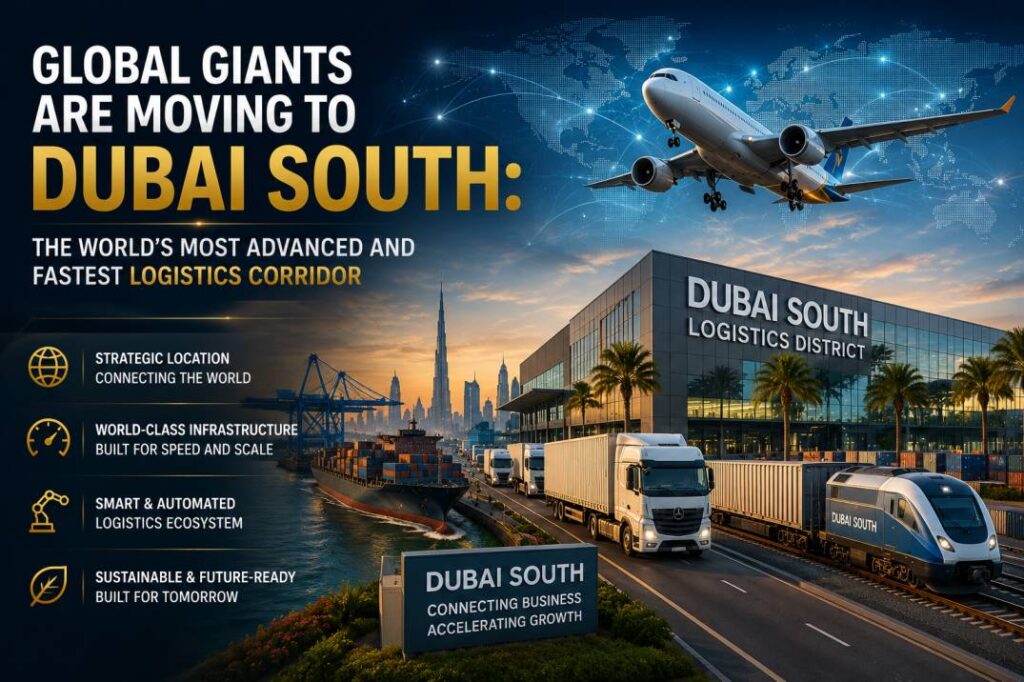
Dubai South is a 145-square-kilometre master-planned city built around an airport rather than beside one. The headline figures are genuinely extraordinary. Some of them are also years from delivery – and knowing which is which is the difference between a well-timed entry and a misjudged one.
In this guide
Quick Answer
- It spans 145 km², with an 18 km² Logistics District, a 7 km² aerospace hub (MBRAH), and a Business Park already housing over 4,000 companies.
- The Dubai Logistics Corridor links Jebel Ali Port, JAFZA and Al Maktoum International Airport under a single customs bond across roughly 200 km². It cut sea-to-air transfer times from four hours to under one – a quadrupling of throughput efficiency.
- EZDubai, a 920,000 m² e-commerce hub inside the Logistics District, supports operators including Amazon, Noon and DHL.
- Al Maktoum International (DWC) is operational for cargo today. The AED 128 billion expansion targeting 260 million passengers and 12 million tonnes of annual cargo is a phased build, with the first major operational phase targeted around 2032.
- One correction worth making up front: free zone status does not mean 0% tax on everything. It means 0% on qualifying income, with 9% applying otherwise. That distinction decides whether your logistics model actually delivers the margin you modelled.
1. What Dubai South actually is
Most logistics hubs are retrofitted. A city grows, a port gets busy, an airport fills up, and infrastructure is squeezed into whatever space remains. Congestion is structural, not accidental.
This location inverted that sequence. The land was designated first, the airport placed at the centre, and districts arranged around it by function.
| District | Size | Purpose |
|---|---|---|
| Logistics District | 18 km² | Warehousing, freight, bonded storage, distribution |
| EZDubai | 920,000 m² | Dedicated e-commerce fulfilment hub |
| MBRAH (aerospace hub) | 7 km² | MRO, aviation services, flight training, business aviation |
| Business Park | – | 4,000+ companies, offices, flexible licensing |
| Residential & Expo City | – | Housing, retail, community infrastructure |
| Total master plan | 145 km² |
That last figure deserves a moment. 145 km² is roughly the size of Liechtenstein, purpose-built around a single airport.
One practical point that trips people up: the Logistics District is not itself the licensing authority. Businesses incorporate through the Business Hub Free Zone to access free zone status within the corridor. Licences reportedly start from around AED 12,500, though you should confirm current pricing directly, as free zone fee schedules change annually.
2. The corridor – and the number your competitors are quoting wrong
This is the genuine competitive advantage, and it is routinely misreported.
The Dubai Logistics Corridor spans approximately 200 km² and places Jebel Ali Port, Jebel Ali Free Zone and Al Maktoum International Airport inside a single customs-bonded area. Cargo moving between them does not exit and re-enter customs jurisdiction. There is no repeated clearance, no re-documentation, no handover friction.
You will frequently see this described as enabling “sea-to-air transfer in under four hours”.
That figure is wrong, and it understates the achievement. Four hours was the time before the corridor existed. With the corridor, DP World and JAFZA both state the transfer time is under one hour – described officially as a quadrupling of Dubai’s logistics efficiency.
For a freight forwarder, that means container shipments arriving at Jebel Ali can be airfreighted out of DWC within the same business day. For a pharmaceutical cold-chain operator, temperature-sensitive cargo can land at DWC, move into bonded storage in the Logistics District, and distribute across the GCC without leaving a single integrated zone.
The supporting connectivity is equally strong:
- Sea – Jebel Ali Port handles over 14 million TEUs annually, serving around 150 shipping lines.
- Air – DWC operating today, expanding toward the largest cargo capacity in the world.
- Land – direct highway links into Saudi Arabia, Oman and the northern emirates.
- Rail – Etihad Rail freight connection confirmed, linking Dubai South toward Abu Dhabi and the Saudi border.
Very few places on earth combine all four inside one bonded footprint.
3. Separating what exists from what is coming
Here is where I would urge caution, because promotional content on this subject blurs the two badly.
Operational now: DWC as a working cargo airport, the Logistics District, EZDubai, MBRAH, the Business Park with 4,000-plus companies, the bonded corridor, Jebel Ali at full throughput, and the Etihad Rail connection.
Announced and phased: The AED 128 billion DWC expansion – five parallel runways, 400-plus aircraft gates, 260 million passenger capacity, 12 million tonnes of annual cargo. Reporting indicates the first major operational phase is targeted around 2032, with phased transfers from Dubai International as capacity comes online. The Dubai Metro extension here is planned for roughly 2026–2030.
Both categories are real. They are not the same thing.
A business plan assuming 12 million tonnes of cargo capacity next year is wrong. A business plan positioned to benefit as that capacity arrives over a decade is sound – and entering before land and licence costs rise is a legitimate strategic argument.
The distinction matters because your entry timing, your capital commitment and your break-even assumptions all depend on which category you are actually buying into.
4. Who is actually there
Your source of confidence should be tenants, not press releases.
EZDubai – the 920,000 m² e-commerce hub – supports operators including Amazon, Noon and DHL. That is meaningful validation: e-commerce fulfilment is the most latency-sensitive logistics category there is, and these operators do not place capacity casually.
The Business Park houses over 4,000 companies. JAFZA, at the other end of the corridor, hosts more than 8,700.
I would be careful with the framing that global giants are “quietly relocating” to Dubai South. What is happening is more specific and more useful to understand: major operators are placing regional fulfilment and distribution capacity where the corridor gives them a structural time advantage. That is a capacity decision, not a headquarters move – and it is precisely the pattern a smaller operator can follow.
5. The commercial case, stated accurately
The free zone framework is genuinely attractive. It is also consistently oversold, and the oversell is where clients lose money.
100% foreign ownership. Accurate, and now available across most UAE structures rather than being unique to free zones.
Customs duty treatment. Goods held inside the bonded zone are not subject to import duty. Duty becomes payable when goods enter the UAE mainland market – the GCC common external tariff of 5% CIF. For pure re-export models this is a real advantage. For distribution into the domestic UAE market, it is a deferral, not an exemption.
Corporate tax – read this carefully. You will see “0% corporate tax, keep 100% of your profits” repeated everywhere. That is not how the regime works.
The UAE applies 9% corporate tax on profits above AED 375,000. A Qualifying Free Zone Person may access 0% on qualifying income only, subject to substance requirements and a defined activity list. For distribution businesses specifically, qualifying treatment generally requires the activity to be carried out in or from a Designated Zone, with the buyer being a reseller or processor. Sales to end users are taxed at 9%. Non-qualifying income does not receive the AED 375,000 threshold.
From tax periods beginning January 2026, an annual independent auditor’s report is also required for free zone persons claiming the distribution activity.
None of that makes the regime unattractive. It makes it conditional – and the conditions are exactly what a logistics business needs to model before signing a warehouse lease. See Tax Registration & Filing and Financial Reporting & Auditing.
6. Choosing your structure
The right entity depends on your customer, not on the brochure.
- Free Zone Company Formation – the standard route for re-export, fulfilment, freight forwarding and bonded warehousing. Dubai South Business Hub is the relevant authority for the Logistics District.
- Mainland Company Formation – necessary if you intend to distribute directly into the UAE domestic market or contract with government entities. Many logistics operators end up running both.
- Foreign Company Setup – for established overseas operators extending in via branch or subsidiary.
- Offshore Company Formation – for holding structures above the operating entity.
I have compared these routes in detail in Mainland vs Free Zone vs Offshore. And if your model depends on preferential tariff access into partner markets, read the UAE’s CEPA network alongside this – because tariff preference follows the origin of your goods, not your company’s licence, and re-exporting unchanged imports does not create UAE origin.
Around the licence sit the operational realities: corporate banking, where trading and logistics businesses face extended compliance review; residency visas and PRO services for warehouse and operations staff; and, for anyone still validating the model, Startup / Pre-Launch Consulting and Growth & Market Expansion Services.
7. The constraints worth pricing in
Distance from the city. The location sits well outside central Dubai. For logistics that is commercially irrelevant – proximity to cargo terminals is what matters. For attracting and retaining office staff, it is a real consideration until the Metro extension lands.
Phased delivery means phased demand. The full ecosystem – population density, retail, services – matures alongside the airport. Early entrants get lower costs and less competition, and wait longer for the surrounding economy.
Warehouse commitments are capital. Space in the Logistics District starts around 500 m² and rises steeply for cold storage and bonded facilities. This is a capital-intensive entry compared with a desk in a business park.
Competition is well-funded. You are entering a corridor that already hosts Amazon, Noon and DHL. The opportunity is in specialisation – cold chain, dangerous goods, high-value electronics, aerospace spares, regional consolidation – not in competing on general fulfilment.
8. My Approach: Matching the Corridor to Your Cargo
Most business setup consultants help you register a company. I help you make informed business decisions before you invest.
Growth here is real, but the right structure for a logistics, freight or warehousing business here depends on your cargo type, your customer base, and whether you are trading through the corridor or operating within it. Before recommending a free zone or mainland setup here, I work through which of those you actually are.
My advisory process focuses on helping you reduce uncertainty and make confident decisions, not just complete documentation.
What You Can Expect
- Business idea validation
- Market research
- Competitor analysis
- Business plan development
- Startup cost estimation
- Financial feasibility analysis
- Business structure recommendations
- Licence selection guidance
- Investor and employment visa planning
- Business bank account strategy
- Risk assessment
- Business expansion planning
The objective is simple: help you start your business with clarity, confidence and a long-term strategy.
9. Is the UAE the right choice for your business?
If you are planning to launch a new venture, expand internationally, or relocate your business to the UAE, do not base the decision solely on promotional offers or the lowest licence price – and do not commit to a warehouse lease on the strength of a capacity figure that arrives in 2032.
Build your business on research, planning and informed decision-making. The right strategy today can save you thousands in cost and position your business for sustainable growth tomorrow.
Dubai South is, on the evidence, the most deliberately engineered logistics environment being built anywhere right now. A single customs bond spanning sea, air, land and rail. Sub-one-hour sea-to-air transfer. 145 km² planned around function rather than inherited from history. Anchored by what will be the world’s largest cargo airport, backed by the D33 agenda and its AED 32 trillion cumulative trade target by 2033.
For operators with a genuine specialisation and the patience to enter ahead of full build-out, there are few better-designed places to put regional capacity.
Ready to build your business with confidence?
If you are considering setting up a business in the UAE, let’s start with strategy – not paperwork. Together we will evaluate your goals, analyse the market, identify the right setup options, and create a roadmap tailored to your vision.
Because successful businesses aren’t built by chance – they’re built on informed decisions.
Book a free consultation or message me directly on WhatsApp.
Frequently asked questions
How fast is sea-to-air transfer in Dubai South?
Under one hour through the Dubai Logistics Corridor, down from four hours before the corridor was established. The corridor places Jebel Ali Port, JAFZA and Al Maktoum International Airport inside a single customs-bonded area, removing repeated clearance between zones.
Is Dubai South a free zone?
Dubai South contains free zone districts, but the Logistics District is not itself the licensing authority. Businesses incorporate through the Business Hub Free Zone to access free zone status within the corridor.
Do I really pay 0% corporate tax in a Dubai South free zone?
Only on qualifying income. The UAE applies 9% corporate tax on profits above AED 375,000, and a Qualifying Free Zone Person accesses 0% on qualifying income only, subject to substance and activity conditions. Distribution generally qualifies only when carried out in or from a Designated Zone with the buyer being a reseller or processor.
When will Al Maktoum International Airport be finished?
The AED 128 billion expansion is phased. Reporting indicates the first major operational phase is targeted around 2032, building toward 260 million passengers and 12 million tonnes of cargo annually. The airport already operates as a cargo airport today.
What size warehouses are available in the Dubai South Logistics District?
The Logistics District offers warehouses from approximately 500 square metres upward, with cold storage, bonded warehousing and open-yard options. The Aviation District offers hangar space and MRO bays.
How quickly can a company move into a warehouse here?
Turnaround depends on whether the unit is a ready shell or requires fit-out. A pre-built warehouse with an existing licence-compatible fit-out can be occupied within a few weeks of lease signing, while a bespoke build for cold storage or specialised bonded handling typically takes several months, since it involves both construction and inspection sign-off before goods can be stored. Confirm which category applies to a specific unit before committing to a timeline with your own customers or suppliers.
For most trading and logistics operators, that single check, warehouse-ready versus bespoke fit-out, is the difference between a realistic launch date and a promise the zone cannot keep.
Sources
- Jebel Ali Free Zone – What is the Dubai Logistics Corridor
- MEED – Dubai’s sea-air logistics model
- Dubai South – districts, EZDubai and MBRAH overview
- Travel and Tour World – Al Maktoum International phased launch
- Zawya – AED 128bn Al Maktoum expansion
- Dubai South Business Hub – Logistics District key figures
This article is general commentary, not legal, tax or investment advice. Free zone fee schedules, tax conditions and project timelines change – verify current requirements with Dubai South and the Federal Tax Authority before acting.
Related reading: how RBI’s new rules make Bharat Mart Dubai a trade hub for Indians.
Further reading: For a parts distributor weighing Dubai South against JAFZA, I worked through whether an automotive spare parts trading business in Dubai makes sense.
Pingback: UAE E-Commerce Market 2026: Data, Costs and Setup Guide