Quick Answer
Yes, with conditions. Dubai’s engineering consultancy business setup market has genuine demand behind it, construction grew 11.1% in 2025, real estate transactions hit AED917 billion, and Dubai is running AED128 billion, AED34 billion and AED30 billion infrastructure programmes at once, but the market is qualification-intensive, not a generic services opportunity. A viable Dubai engineering consultancy business setup for regulated design work normally means a mainland Dubai Department of Economy and Tourism licence plus Dubai Municipality engineering-office registration, not a free zone licence alone.
A realistic medium-scale entry needs roughly AED3.5-4.5 million in financing, reaches operational break-even around AED7-8 million in annual revenue, and typically takes 12-18 months to get there. This covers what the demand, competition, costs and licensing route actually look like before you commit capital.
Table of Contents
Is There Real Demand for a New Engineering Consultancy in Dubai?
The macro case is unusually broad. UAE GDP grew 6.2% in 2025 with non-oil GDP up 6.8%, and construction expanded 11.1%, representing roughly 12.9% of non-oil GDP. Dubai’s own Q1 2026 figures show construction growing 8.2% year on year. That growth is being generated by several large channels at once rather than a single property cycle, which matters for a new entrant because it means the demand doesn’t disappear if one segment slows.
Private development alone recorded approximately AED761 billion in real estate transactions in 2024 and AED917 billion in 2025, with Q1 2026 generating another AED252 billion. On top of that, Dubai is simultaneously running the D33 Economic Agenda, the Dubai 2040 Urban Master Plan, a new AED128 billion passenger terminal at Al Maktoum International Airport, the Metro Blue Line (over AED20.5 billion), the newly approved AED34 billion Metro Gold Line, the AED30 billion Tasreef stormwater programme, and an expansion of the Mohammed bin Rashid Al Maktoum Solar Park toward more than 8,000 MW by 2030.
None of that is a single measurable “Dubai engineering consulting market size.” It’s better understood as several overlapping submarkets, conventional building design, infrastructure, industrial, sustainability, BIM and programme management, each with different entry barriers and margins. An engineering consultancy business setup that treats this as one addressable market usually ends up competing on price in the most crowded segment, conventional building design, instead of the higher-fee, lower-competition segments like drainage and resilience, renewable energy, and BIM/digital engineering, which this report’s own segment analysis flags as priority entry points.
Who You’re Actually Competing Against
The Dubai engineering consultancy landscape runs from AECOM, AtkinsRéalis, WSP, Jacobs, Parsons, Egis, Arup, Dar Al-Handasah and KEO International at the large end, to boutique and specialist firms like AESG at the other. The international tier has balance-sheet strength, global technical centres and references that reduce a client’s risk in ways a new firm simply can’t match on day one. Positioning a new consultancy as “another multidisciplinary engineering firm” competing head-on with that tier is not a defensible strategy.
What actually works for a first-time entrant is the space between very small local design offices competing on price and multinational firms whose scale and overhead suit only major programmes: senior principals doing real project work, faster turnaround, strong authority knowledge, BIM-native design, transparent commercial terms, and a curated network of specialist subconsultants rather than every discipline in-house. AESG and KEO are the clearest UAE proof that a regionally rooted, specialist-led consultancy can take real market share against the global names.
Mainland or Free Zone: The Licensing Decision That Actually Matters
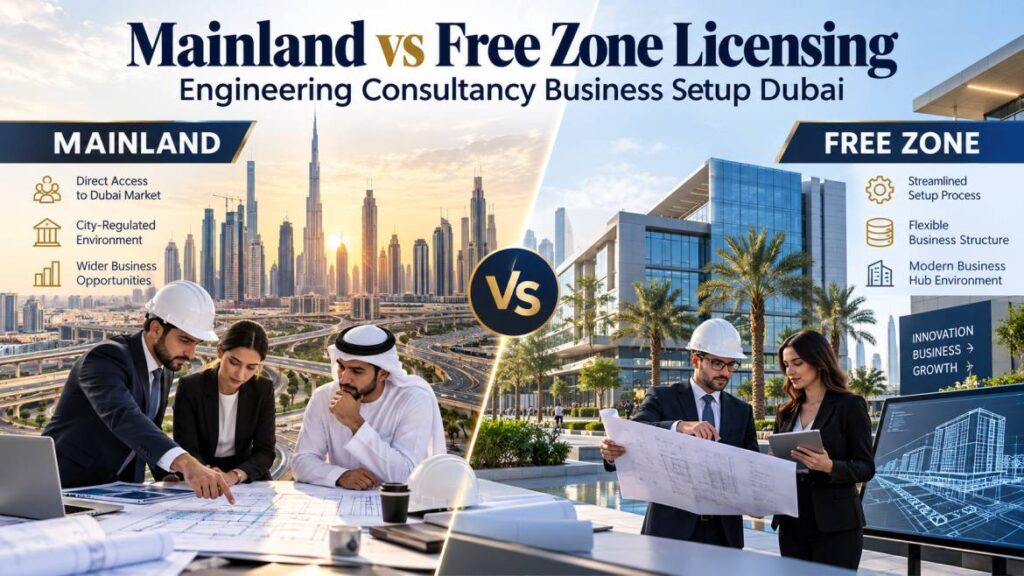
This is the single most consequential decision in an engineering consultancy business setup in Dubai, and it’s where most generic setup guides stop short. Forming a business and being professionally authorised to practise regulated engineering are two different things. Dubai Municipality’s own licensing standards state that consulting engineering offices must hold the relevant economic licence and be authorised and registered under its engineering-consultancy regime, separately from the trade licence itself.
For an investor whose core proposition is designing, signing, submitting or obtaining approvals for regulated engineering work, that generally means a mainland DET licence plus Dubai Municipality engineering-office authorisation and classification, not a free zone licence treated as a substitute. A free zone licence by itself should not be assumed to confer Dubai Municipality engineering-office authority. Free zones remain genuinely compelling, but for a narrower set of activities: advisory, regional consulting, digital and BIM services, ESG and sustainability consulting, or export-oriented work that doesn’t require the entity itself to act as the locally authorised engineer of record.
That’s a meaningful distinction for anyone considering SPARK (formerly SRTIP), Sharjah’s research and innovation free zone. If your engineering consultancy’s core service is stamping drawings and taking design liability on UAE projects, SPARK doesn’t replace the mainland DM route, and that’s covered in more depth in SRTIP for research and innovation projects.
But if the plan includes a genuinely separate R&D, digital-engineering, BIM-consulting or sustainability-advisory arm that doesn’t carry local design authority, SPARK’s R&D infrastructure and innovation-hub positioning is worth evaluating as a second vehicle alongside the mainland entity, not instead of it. The broader mainland business-setup approvals process, which engineering offices layer additional Dubai Municipality requirements on top of, is covered in Dubai Municipality approvals for business setup 2026.
Ownership rules are also frequently stated incorrectly in generic guides. Dubai’s investment regime allows 100% foreign ownership for most activities, and Local Order No. 4 of 1999 specifically exempts branches of foreign engineering firms from the local-service-agent requirement. That does not remove Dubai Municipality’s separate requirements on the licence holder, technical director, registered engineers, experience and staffing classification, engineering stays a regulated profession regardless of the ownership structure.
| Consideration | Mainland Dubai | Free zone |
|---|---|---|
| Primary regulator | DET plus Dubai Municipality | Relevant free zone authority |
| Engineer-of-record, sign/stamp authority | Natural route once classified and registered | Not conferred by the free zone licence alone |
| Advisory, BIM, ESG, regional consulting | Permitted within licensed scope | Often a genuinely strong fit |
| Government/developer prequalification | Usually straightforward if eligible | Client and tender rules need checking |
| Best use for this business | Design consultant, engineer of record, authority-facing work | Non-regulated advisory, digital services, export work |
Engineering Consultancy Business Setup Costs in Dubai
Startup capital scales heavily with team size, and the working-capital reserve, not the licence fee, is what actually determines whether a new firm survives its first 18 months. For a small 5-10 staff practice, total indicative funding need runs roughly AED0.8-1.6 million. A medium 20-50 staff firm needs approximately AED2.9-5.2 million. A large 50+ staff launch needs AED7.3-14.1 million, and is only appropriate where there’s a transferred book of business, an anchor client or an overseas parent feeding Dubai work, not a speculative hire-first strategy.
| Cost category | Small (5-10 staff) | Medium (20-50 staff) |
|---|---|---|
| Formation, licensing, DM/professional, legal | AED35k-70k | AED70k-130k |
| Office deposit, fit-out, furniture | AED80k-180k | AED250k-500k |
| Hardware/network | AED50k-100k | AED150k-300k |
| Initial software (BIM, structural analysis, project controls) | AED80k-180k | AED250k-550k |
| Insurance/legal/compliance | AED30k-70k | AED70k-150k |
| Recruitment, visas, onboarding | AED60k-130k | AED200k-450k |
| Working-capital reserve | AED450k-800k | AED1.8m-3.0m |
| Indicative total funding need | AED0.82m-1.59m | AED2.87m-5.23m |
Don’t assume free-zone status means 0% corporate tax on this income either, the Federal Tax Authority’s own guidance on qualifying free-zone persons makes clear that 0% applies only to qualifying income under specific conditions, and professional services sold into the mainland market generally need transaction-specific tax analysis.
For the medium base case, AED3.5-4.5 million is a prudent financing target for an engineering consultancy business setup, low enough to assume founders are billable and recruitment is staged, high enough to survive genuinely delayed receivables, which are the norm, not the exception, in this industry. A firm can be profitable on paper while remaining cash-constrained, because mobilisation, work-in-progress and receivables all lag accounting revenue. A firm billing AED1 million a month with roughly 90 days of receivables can easily have AED3 million of revenue outstanding at any given time.
Break-Even Reality: When You Actually Turn a Profit
For the recommended medium-scale entry, Year 1 revenue comes in around AED7.2 million with EBITDA of approximately -AED0.3 million, the launch year is expected to run at a loss. Year 2 revenue rises to roughly AED11.5 million with EBITDA around AED1.25 million, and Year 3 reaches approximately AED15.8 million revenue with EBITDA near AED2.6 million, a 16.5% margin. Operational break-even typically lands around 12-18 months in, not immediately after licensing.
At a blended gross margin of roughly 40-45% and fixed central operating costs of around AED3.0-3.3 million annually, theoretical accounting break-even sits near AED7 million in revenue. Allowing for realistic underutilised headcount and project leakage, a safer commercial break-even target is approximately AED7-8 million in annual revenue, or AED600,000-670,000 in average monthly billings, roughly 18-22 productive professional FTEs at ramped utilisation.
The single most dangerous combination for a new Dubai engineering consultancy isn’t low demand, it’s revenue running 15-20% below plan while recruitment happens too early and client payments stretch to 120 days. That combination can eliminate cash before the pipeline has a chance to convert, which is why a minimum unrestricted cash floor of three to six payroll cycles matters more than negotiating a slightly lower licence fee.
Staffing: The Cost That Actually Drives the Model
Payroll is the dominant cost in this business, and technical staff utilisation, not headcount, is what drives profitability. A medium firm’s planning range for a Managing Director/Principal runs AED45k-70k monthly, a Technical Director AED35k-55k, senior design engineers AED18k-28k, and design engineers AED10k-18k, with roughly 15-25% added on top for benefits, visas, insurance and end-of-service accrual. The key modelling assumption is billable utilisation rising to approximately 65-70% for technical staff as the pipeline matures, management utilisation runs lower throughout.
The most common early-stage mistake is building a full multidisciplinary bench before there’s backlog to support it. A leaner launch, using properly permitted temporary and project-based staff for early peaks rather than hiring 20-30 people speculatively, keeps the firm closer to break-even and gives it room to adjust as real pipeline data comes in.
The Risks That Actually Sink These Firms
Dubai’s engineering consulting risk profile is professional and regulatory first, commercial second. Three risks are rated critical rather than merely high: not obtaining the planned Dubai Municipality classification (mitigated by pre-assessing named principals and disciplines before incorporation), slow client payments (mitigated by credit checks, mobilisation payments, milestone billing and a genuine cash reserve), and professional liability from design errors (mitigated by QA/QC processes, independent checks and professional indemnity insurance from day one). Fee undercutting, uncontrolled scope change, and over-dependence on a single developer client, no client should exceed roughly 25-30% of revenue by Year 3, round out the list of risks worth planning around before, not after, incorporation.
Engineering Consultancy Business Setup Checklist
Before committing capital to an engineering consultancy business setup in Dubai, these are the items worth having confirmed in writing, in roughly this order:
- Exact professional activities selected with DET: civil, structural, MEP, infrastructure or project management.
- Licence holder and technical principal eligibility checked against Dubai Municipality standards: attested degree, experience certificates and discipline.
- Requested Dubai Municipality disciplines and classification mapped against the engineers you will actually employ.
- Office and Ejari that meet both the DET and Dubai Municipality requirements for the chosen route.
- Professional indemnity insurance active before the firm takes on any design liability.
- Corporate tax registration from the start, and VAT registration once taxable supplies pass AED375,000 over 12 months.
- Sector enrolments such as DEWA, RTA or developer vendor lists, mapped to the work you plan to pursue.
Allow roughly six to twelve weeks for a straightforward, fully qualified mainland formation, and three to six months where classification, foreign-branch documents or engineer accreditation are more complex. Neither figure is a published government service level, so no hiring or client start date should depend on the fast end of that range.
My Approach: Getting the Licensing Route Right Before Anything Else
For an engineering consultancy specifically, I treat the Dubai Municipality eligibility question, whether the proposed licence holder and technical principals qualify for the classification the business actually needs, as more important than negotiating the lowest formation fee. Getting that wrong after incorporation is expensive to unwind. I work through the mainland versus free zone decision against what the business will actually do, regulated design work, advisory-only, or both through separate vehicles, before any capital is committed, and the fuller case for working this way across any UAE setup is in why founders choose to work with me.
If you’re weighing whether an engineering consultancy business setup in Dubai makes sense for your situation, or need the licensing route worked out before you commit capital, get in touch.
Frequently Asked Questions
Is now a good time to start an engineering consultancy business setup in Dubai?
The demand backdrop is strong, construction grew 11.1% in 2025 and Dubai is running several multi-billion-dirham infrastructure programmes simultaneously, but the opportunity is qualification-intensive rather than open to any generic services entrant. Regulatory eligibility matters more than market timing.
Can I set up an engineering consultancy through a free zone instead of mainland?
Only for the parts of the business that don’t require you to act as the locally authorised engineer of record. A free zone licence alone doesn’t confer Dubai Municipality engineering-office authority, so regulated design work generally needs a mainland DET licence and DM registration.
How much capital do I actually need to launch?
For a medium-scale 20-50 staff launch, plan for AED3.5-4.5 million, weighted heavily toward a working-capital reserve rather than office fit-out, because receivables and mobilisation lag revenue significantly in this industry.
When does a new Dubai engineering consultancy actually break even?
Operational break-even for a medium-scale firm typically lands 12-18 months after launch, around AED7-8 million in annual revenue, assuming technical staff utilisation reaches roughly 65-70%.
Do I need a 51% Emirati shareholder to start an engineering consultancy in Dubai?
No, that requirement is outdated for most activities. Dubai allows 100% foreign ownership for most mainland businesses, and branches of foreign engineering firms are specifically exempt from the local-service-agent requirement. This doesn’t remove Dubai Municipality’s separate professional-qualification requirements.
What’s the biggest risk that actually sinks new engineering consultancies?
Slow client payments combined with premature hiring. A firm can look profitable on paper while running out of cash because receivables, mobilisation and work-in-progress all lag accounting revenue, which is why a genuine cash reserve matters more than an aggressive growth plan.
Should a new firm compete directly with AECOM, WSP or Arup on price?
No. A new consultancy can’t match the balance-sheet strength or reference base of the global tier, and competing on price against them tends to attract structurally loss-making work. The defensible position is senior-led, specialist, faster-turnaround service in the space between boutique local offices and multinational firms.